

Effective Calling Culture for Businesses: Dos and Don’ts


Your competitor just stole another customer. Why? Because nobody answered your phone.
Most businesses think phone calls don’t matter anymore. They’re wrong. When you are perfecting your email templates and social media posts, customers are on the phone waiting, calling, and hanging up in frustration. Then they call your competitor, who happens to pick up.
An efficient calling culture isn’t optional anymore. It’s the difference between customers who stay loyal and customers who leave bad reviews. Poor phone practices cost you more than you think.
This blog covers the basics of building a phone system that actually works. You’ll learn practical strategies, what to avoid, and how modern tools are changing the game.
Learn why responsive calling, active listening, and timely follow-ups are essential for building customer trust and driving long-term business growth.
Discover how to use proper greetings, personalization, and proven call practices while avoiding common mistakes that hurt customer satisfaction and conversions.
See how trained teams set clear standards and use modern calling technology to boost retention, efficiency, and overall revenue.


Your phone system tells customers who you are. Every ring, every hold, every conversation shapes their opinion of your business.
Here’s why an effective calling culture matters.
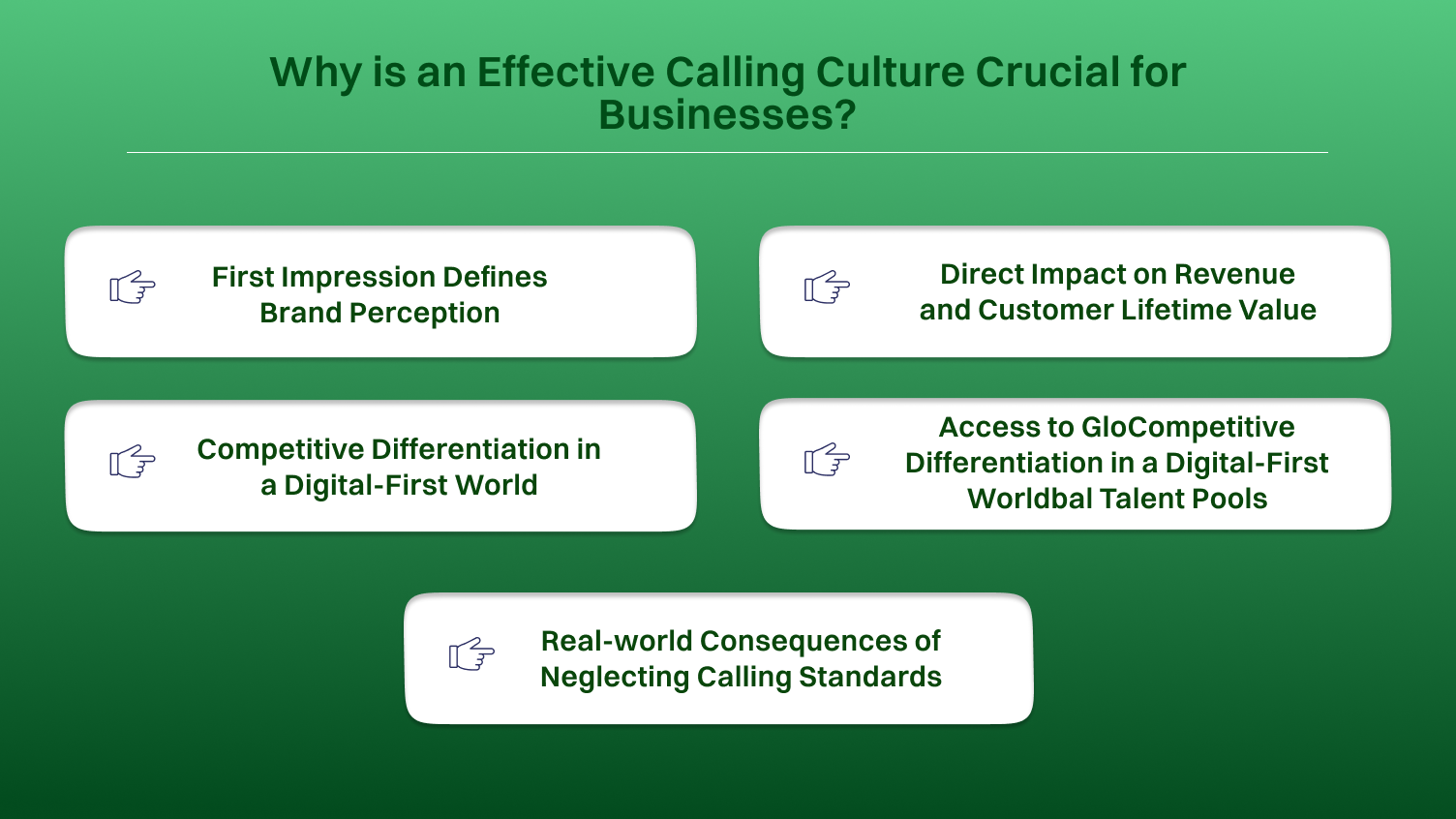 1. First Impression Defines Brand Perception
Someone calls your business and decides within 30 seconds if you’re worth their time. The person who picks up sets the whole tone. A friendly voice and a clear answer make them relax. A rushed response or confusion makes them doubt you.
Your calling culture shows what you care about. When employees sound scattered or bored, customers think your whole operation runs that way. One bad call can undo weeks of good marketing. People share bad phone experiences more than good ones.
Effective call culture changes how much money you make. Train teams close more deals; it’s that simple. A good phone conversation builds trust in five minutes. That same trust takes weeks to build through email.
Customers who get quick callbacks stick around. They don’t shop your competitors when they know you’ll pick up the phone. Every call is a chance to sell something else, too. That doesn’t happen in email threads.
Most businesses hide behind chatbots now. Customers hate it, as they want to talk to real people who can actually help them. This gives you a huge opening.
Your effective calling approach sets you apart. While competitors make people press several buttons to reach a human, you answer on the third ring. Customers notice and switch to businesses that answer the phone like they actually want the business.
Your team needs to know what good looks like. Without clear standards, they stress about every call. A solid calling culture removes the guesswork. People handle tough calls better when they know the plan.
Confidence comes through in their voice. Good interactions make employees feel better about their jobs. Companies with proper phone training keep employees longer. That saves you money and keeps service consistent.
Every minor call issue can pile up faster than you’d expect. Poor call volume management means long holds. Customers hang up and buy somewhere else. Most people won’t wait more than a minute on hold.
Mixed messages from different team members kill trust. When one person says yes and another says no, customers get confused and angry. They post about it online. Legal problems pop up, too, when you don’t document calls properly in regulated industries.
An effective calling culture is a consistent system where every phone interaction reflects your company’s values and meets customer needs. It’s about creating positive experiences through trained employees, clear standards, and genuine care for the people calling you.
Measurable standards separate intentional calling culture from random phone habits. You need clear answers to basic questions like how many rings before answering, what response time for callbacks, and which details get documented. These concrete benchmarks eliminate confusion and give your team confidence. When standards exist, performance improves because everyone knows the target.
Integration with your overall brand identity makes calling culture authentic rather than forced. If your company promises fast service, your phone team must deliver quick responses. If you emphasize personal attention, calls should feel unhurried and customized. Misalignment between brand promises and phone reality creates disappointed customers who notice the gap immediately.
Strong phone practices create advantages for everyone involved. The value flows in both directions. Here, an effective calling culture demonstrates how effective phone practices create meaningful benefits for both businesses and customers.
Sales development professionals report that well-handled calls close faster than email campaigns alone. Phone conversations allow real-time objection handling and relationship building. The personal connection makes decision-making easier for prospects. When customers hear confidence and proficiency in your voice, they feel comfortable moving forward. Your team can also read verbal signals and adjust their approach immediately for better results.
You hear tone, urgency, and unstated concerns that written messages hide. These insights serve as a guide for the product development and marketing strategies. Many times, customers disclose their pain points only through calls and not via surveys. The casual nature of conversation reveals what they truly value. Your business can adapt offerings based on these real-world needs that emerge naturally during phone discussions.
Issues that might escalate through slow email chains get solved in one call. This saves time for your support team and avoids customer frustration. Complex issues with several factors are solved faster with the help of back-and-forth conversations. Your team can ask clarifying questions immediately rather than waiting hours for email responses. The efficiency benefits both your operations and customer satisfaction levels.
Customers who are satisfied leave good reviews, and they also refer other people to you. This organic marketing does not cost any money but rewards. Every good encounter over the phone creates a possible brand ambassador. Customers will not forget those companies that made them feel appreciated and heard. The recommendations that are left by satisfied customers speak louder than the advertisement you buy.
Departments coordinate more effectively when everyone practices good calling habits with each other. Misunderstandings that trouble email threads get cleared up in minutes. The collaborative culture that develops from good phone practices extends beyond customer interactions. Strong remote communication ensures these benefits even for distributed teams. Your entire organization becomes more responsive and connected.
Customers don’t waste time waiting for email responses when they need help now. The fact is that people want to feel heard and understood. Phone conversations deliver it best out of all the digital channels. The human voice is reassuring and comforting when one is facing a stressful moment. The peace of mind that comes with the knowledge of the ability to have a real person is a thing that chatbots cannot imitate.
Your team can adapt recommendations based on what they learn during the call. Generic responses frustrate customers who have unique situations. Verbal communication on the phone enables one to have a subtle view of personal situations. The instant capacity of customizing the solution to the needs of the customer makes the customer feel fully appreciated. This customization transforms the one-time customers into long-term customers.
Customers appreciate not having to explain their problem multiple times. The back-and-forth nature of phone calls allows for complete resolution. No more waiting days for email chains to solve simple problems. Everything gets handled while they’re still on the line. This efficiency respects their time and reduces their effort dramatically.
Hearing a knowledgeable, helpful person creates confidence in your business. Voice inflection and tone convey sincerity, whereas text messages do not. When a customer is uncertain, he/she can pose follow-up questions. The conversational flow builds rapport quickly. This trust foundation leads to stronger relationships and increased customer lifetime value.
You serve a broader audience by maintaining strong phone options. Some customers struggle with digital tools or prefer traditional communication. Older demographics particularly appreciate phone accessibility. People with disabilities may find phones easier than websites. Offering robust phone support ensures you don’t exclude valuable customer segments.
The next step is understanding what elements make this system work.
In order to build effective calling systems, it is necessary to focus on different key areas. Every part of the system supports the others.
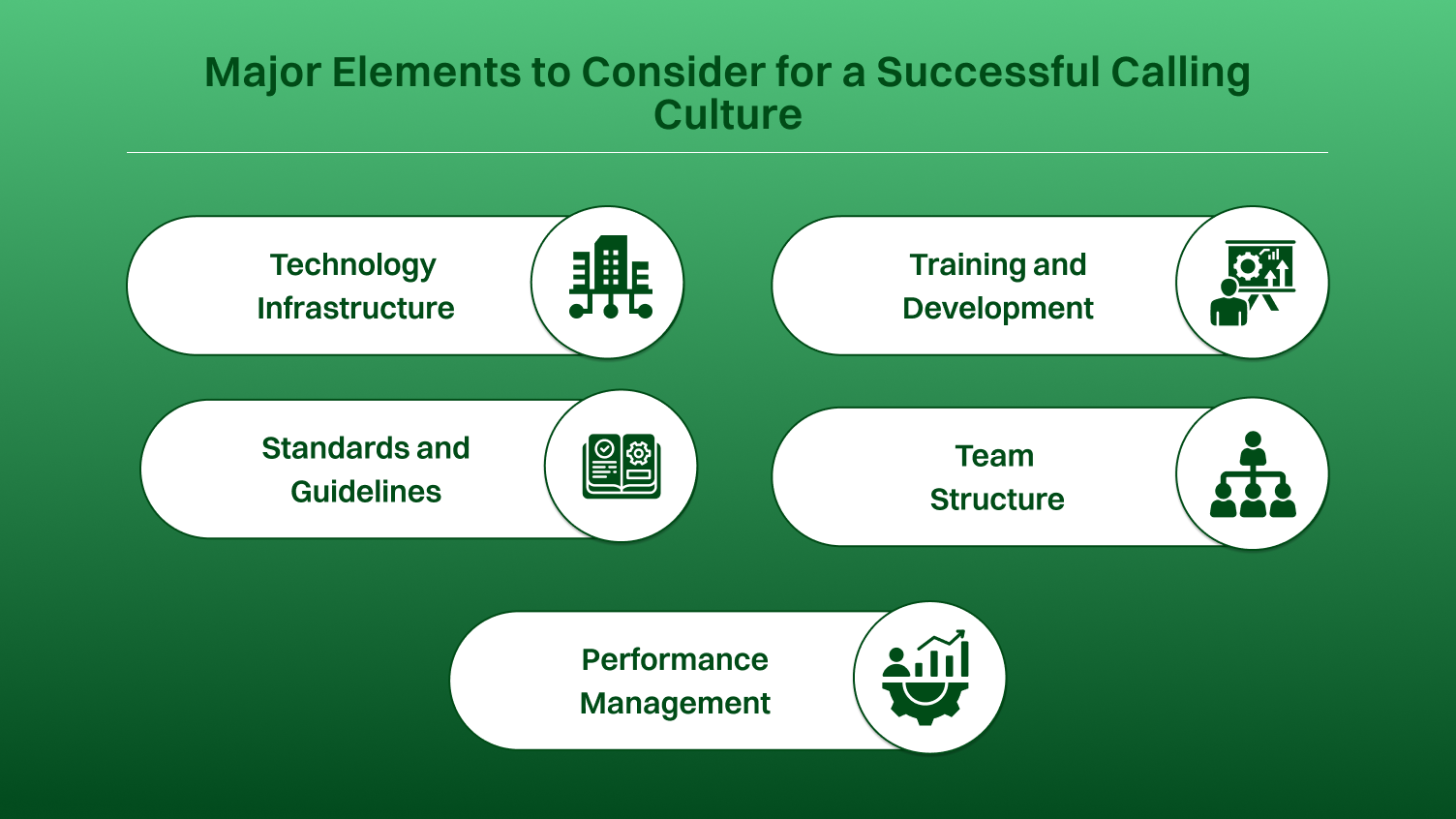
Your phone system forms the foundation of everything else. Modern VoIP solutions are far more flexible and feature-rich as compared to conventional phone lines. They connect with other business tools and offer comprehensive analytics that help you know your calling patterns.
Call routing ensures customers reach the right person quickly without frustrating transfers. Smart routing uses caller information to direct them appropriately based on their needs and history. Queue management keeps callers informed during wait times with position updates. Good systems also offer callbacks instead of forcing people to hold indefinitely.
Total onboarding introduces new hires to your phone standards before they handle real calls. They acquire scripts, systems, and expectations in a supportive environment. This foundation prevents bad habits from forming and builds confidence early.
Continuous skill development keeps teams sharp as customer expectations change. Regular training addresses common challenges and new techniques that improve outcomes. Role-playing activities train individuals on how to handle difficult scenarios they will face. The soft skills training develops empathy, active listening, as well as patience, which cannot be developed through technical knowledge.
Call frameworks provide structure without sounding robotic or impersonal. Good frameworks guide conversations naturally while ensuring key points get covered. They give employees confidence while allowing flexibility for individual situations.
Escalation procedures clarify when and how to involve supervisors in complex situations. Clear paths prevent problems from spiraling out of control or leaving employees uncertain. Documentation requirements specify what information can be documented for future reference. Response time expectations have clear targets, so everyone will know how fast they should pick up calls and reply to voicemails.
Clear roles prevent confusion about who handles what types of calls. Defined responsibilities ensure complete coverage without overlap or gaps. Everyone knows their specific role within the larger system.
Adequate staffing levels match call volume patterns throughout the day and week. Too few people create long waits and frustrated customers. Too many wasteful resources reduce individual engagement. Shift scheduling optimizes coverage during peak times when customers call the most. Backup systems cover absences and unexpected surges without disrupting service quality.
(Key Performance Indicator) KPIs evaluate what actually matters for your business. Further, first-call resolution, customer satisfaction, and average handle time should be monitored. These statistics show trends and places where you can improve on what your gut feeling fails to detect.
Quality assurance processes review calls systematically rather than randomly. A mix of random sampling and targeted review of flagged calls maintains standards. Feedback and coaching transform performance data into actual improvement by having monthly one-on-one sessions. Recognition programs are made public, showcasing great work and encouraging further excellence within the whole team.
Now let’s get specific about what to do and what to avoid.
Effective phone conversations are all about patterns that can be learnt by anyone. The best practices are applicable to both industries and situations. Here are the essential dos that make phone interactions effective.
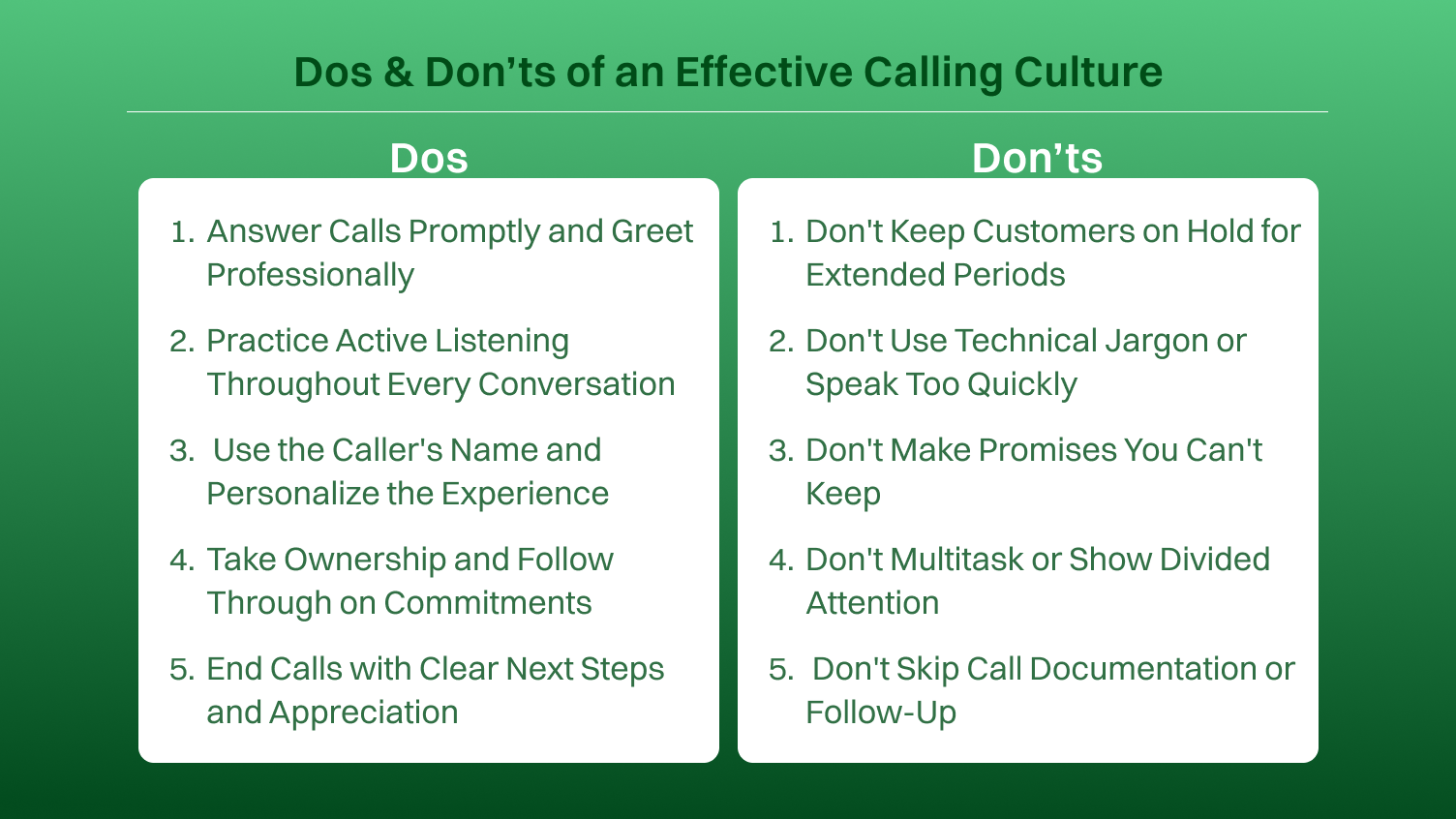
Pick up the phone within three rings. Response time is a sign that you respect the time of your caller and that you do not disregard their business.
Your greeting determines the tone of the conversation. Speak with a strong and warm voice and address your name and company. A professional greeting like “Good morning, thank you for calling ABC Company, this is Sarah speaking” makes callers feel at ease. They are well aware of who they are addressing and are sure they are at the correct location.
Listening to callers without interruption. Allow them to speak out their thoughts to the end, and then you respond. This shows respect and ensures you understand their actual concern and not what you assume they need.
Active listening means more than just staying quiet. Acknowledge what you hear with phrases like “I understand” or “That makes sense.” Take notes during the call so you don’t forget important details. This approach prevents misunderstandings and makes customers feel heard and appreciated.
Human beings will react well when you call them by their names. It builds a personal relationship instead of a trading relationship.
Before or during the conversation, review the customer’s available information. Reference their previous purchases or interactions when relevant. This personalization shows you see them as individuals. Customers appreciate it when you remember their preferences or situations. The extra effort transforms routine calls into a relationship-building process.
Do not fault other departments when things go wrong. The customers focus on solutions and not on whose fault it is. Instead of saying “That is not my department,” say “I will take care of that on your behalf”.
Do what you say you are going to do. Set reminders to complete follow-up activities in time. If you say you will call at 2 PM, then call at 2 PM. No other factor develops trust as quickly as reliability. Document your commitments and check them off systematically. Your follow-through separates effective calling from mediocre service.
Summarize before hanging up the phone, what you discussed and what to do next. Check that the customer has actions to do, and what you will do on your part. This helps to avoid confusion, and both parties walk away with the same understanding.
Express genuine appreciation to callers rather than rushing them off the phone. A warm closing like “Thank you for calling, and please don’t hesitate to reach out if you need anything else” leaves a positive final impression. Strong business communication ensures that what the customers hear last remains in their minds. So, make it count.
Avoiding common mistakes protects your reputation and relationships. These pitfalls undermine even well-intentioned phone interactions. Here are the key don’ts for maintaining an effective calling culture.
Long hold times frustrate customers more than almost any other phone issue. Two minutes represents the absolute maximum before you should offer a callback option. Most people start feeling abandoned after just 60 seconds of silence.
If you must place someone on hold, always ask permission first. Explain why you need to put them on hold and estimate how long it will take, honestly. Check back every minute for updates if the wait extends longer than expected. Better yet, offer to call them back when you have the information ready. Respecting their time shows you value their business and understand their schedule matters.
Industry terminology that seems obvious to you confuses customers. Explain concepts in simple, clear language that anyone can understand.
Speaking too fast makes people feel rushed and often requires repeating information. Slow down and communicate clearly. Match your pace to the customer’s speaking speed when possible. Pause between major points to let information sink in. Remember that the goal is understanding, not checking boxes quickly. Clear communication prevents callbacks and frustration for everyone involved.
Overpromising destroys trust faster than almost any other mistake. When you commit to something and fail to deliver, customers remember. They lose faith in your entire company based on broken promises.
Be realistic about timelines and capabilities. It’s better to under-promise and over-deliver than the reverse. If you’re not sure about something, say so. Tell customers you’ll verify the information and call them back with an accurate answer. Honesty builds credibility even when the news isn’t what they hoped to hear. Your integrity matters more than making the current call easy.
Customers hear everything during calls. Keyboard clicking, side conversations, and distracted responses tell them they’re not your priority. This disrespect damages relationships quickly.
Give each call your complete focus. Close unnecessary browser tabs and silence other notifications. Don’t check email or chat with coworkers while on the phone. Your undivided attention shows respect and allows you to catch important details you’d otherwise miss. The quality of your attention directly impacts the quality of the outcome. Being present matters.
Failing to document calls properly creates problems for everyone. The next person who helps this customer won’t know what happened. Customers hate repeating themselves to multiple team members.
Record key details immediately after each call while everything is fresh in your memory. Note the customer’s concern, what you discussed, and what actions you promised. Update your (Customer Relationship Management) CRM system completely and accurately. This documentation protects you if questions arise later about what was said. It also helps your team provide consistent service.
TechFlow Solutions, a mid-sized B2B software company, struggled with its phone system. Their story shows what’s possible with focused improvement.


AI conversations are changing business phone systems. Understanding these changes helps you prepare for what’s coming.
Smart call routing is now based on customer call history to assume what a customer needs before anyone answers. The system looks at past interactions and makes calls to the team member most likely to help.
Real-time transcription captures every word without taking notes. Managers are able to listen to calls by reading transcripts instead of listening to hours of recording. Sentiment detection flags calls where frustration is rising, allowing supervisors to step in before situations get worse.
Chatbots are effective at initial screening and routing compared to traditional methods. Basic queries are answered instantly, and serious matters are conveyed to humans in a short time. With every interaction, the system becomes better and gets better at making routing decisions.
Automated appointment scheduling removes phone tag frustration. Integrated systems allow customers to book available time without the need to wait to get their call back. The queue callback also eliminates uncomfortable wait times as the customers are called back when agents are available.
Some interactions must stay human-handled for the best results. Emotional situations, complex problem-solving, and high-value sales require human judgment and empathy that technology cannot match. The personal touch matters most when the risks are highest.
Automation is effective in addressing routine tasks, data collection, and after-hours coverage. It expands your skills without replacing the personal connection that builds loyalty. It becomes essential to train employees to use such tools. Your team should be aware of what technology is competent with and when to assume personal control.
The future of calling cultures combines technology with timeless communication principles for the best results.
Your calling culture shapes every customer relationship and business outcome. Start by assessing where you stand today through an honest evaluation of current practices.
Focus on fundamentals like answering promptly, listening actively, and following through on promises. These basics deliver immediate results without requiring major investments. Balance efficiency with genuine connection because speed matters, but rushing customers always backfires.
Embrace helpful technology while maintaining human warmth. Strong phone practices build lasting customer relationships, improve employee satisfaction, and create competitive advantages that drive long-term growth.
General calling is purely transactional without a specific strategy or standards. Effective calling follows a strategic approach designed to build relationships and achieve measurable outcomes through preparation, active listening, and systematic follow-up.
Cold calls still work in specific B2B sectors when combined with thorough research and personalized approaches. Most B2C cold calling struggles due to spam filtering and consumer preferences, so hybrid strategies combining multiple channels perform better than pure cold calling.
Small businesses typically handle lower call volume with generalist team members who manage multiple responsibilities. Call centers operate with specialized call center agents who focus exclusively on phone interactions and follow more structured protocols.
Remote teams need cloud phone systems, clear communication protocols, and regular video check-ins to maintain connection. Time zone considerations require thorough documentation, and virtual training methods help teams develop skills despite physical distance.
Mid-morning (10-11 AM) and mid-afternoon (2-3 PM) typically work best for B2B calls. B2C timing differs, with late morning and early evening showing better results, but testing with your specific audience reveals the optimal times for your situation.
