

VoIP App: Everything You Need to Know in 2026

Choosing a new VoIP app in 2026 can feel overwhelming. The market is crowded with options. Each one promises huge cost savings and advanced features. How do you separate hype from reality?
Making the wrong choice can lead to significant disadvantages of VoIP. These include poor call quality and a frustrated team. The right choice, however, unlocks the powerful benefits of VoIP. It can transform your business communication.
This is not just about finding a cheaper phone system. It is a strategic decision. This guide will give you the essential questions to ask, cover the key trends, and provide a clear framework.
Before you dive into a VoIP comparison, you must start with a self-assessment. Answering a few simple questions brings clarity to your search. It prevents you from getting distracted by features you do not need.
This checklist is your starting point. It will guide your thinking.
Business or Personal?
This is the most fundamental question. Are you looking for VoIP services for home use or a robust VoIP for business solution? Personal apps focus on cheap calls and simplicity. A business phone system requires advanced features like call forwarding and conference calling.
What’s Your Budget?
Your budget determines the tier of service you can consider. Are you looking for a free VoIP solution with basic features? Are you a startup needing a low-cost but professional internet phone?
Or are you an established business ready to invest in a premium phone system with agent assist and analytics? Honesty about your budget saves you time looking at mismatched providers.
How Many Users?
The number of users directly impacts pricing and feature requirements. Are you a solopreneur needing a single virtual phone number? Or are you a growing contact center with 50 agents?
The needs of one person are very different from the needs of a team. This number helps you find a VoIP provider that can scale with your company.
What’s Your Must-Have Feature?
Every business has a non-negotiable feature. For a law firm, it might be a compliant call recording. For a sales team, it could be a power dialer. For a consultant, it might be voicemail-to-email transcription.
Do you need video conferencing or a specific US/UK number? Identifying your one “must-have” feature acts as a powerful filter.
What Device Will You Use Most?
Consider how you and your team work day-to-day. Will you primarily use a desktop and mobile web app? Or are you constantly on the go, relying on an iPhone or Android calling app?
The quality of the mobile VoIP app is crucial for remote and hybrid teams. This ensures you choose a platform that excels on the devices your team actually uses.
After answering the key questions, the next step is a shift in mindset. It is easy to view a VoIP app as a simple replacement for a traditional phone. This is a huge mistake. In 2026, the right VoIP system is not a utility. It is a strategic asset that actively drives business growth.
This section explores how this transformation happens in the real world.
Historically, a phone system was a cost center. You paid for phone lines. You paid for hardware. It was a necessary expense. This is one of the biggest disadvantages of phone systems from the past. A modern VoIP for business solution flips this model on its head.
Imagine a sales rep using a VoIP phone integrated with their CRM software. Before making an outbound call, they see the prospect’s entire history. During the VoIP call, they can take notes that sync automatically. This efficiency means they can make more calls. They can have smarter conversations. This is a direct advantage of using internet-based tools to close more deals.
The cost savings are just the beginning. The real value is in revenue growth.
A poor customer experience is a major disadvantage of using outdated technology. Customers hate waiting on hold. They despise repeating their issue to multiple agents. A modern VoIP system is designed to solve these problems.
Consider a customer calling your contact center. An intelligent VoIP phone system can route its inbound calls to the exact agent they spoke with last week. The agent’s screen instantly shows their entire support history. The customer feels understood. Their problem is solved faster. This is a powerful advantage of VoIP that traditional phones simply cannot offer.
This superior service turns customers into advocates for your brand.
The world of work has changed. The expectation of being tied to a desk with a landline phone is gone. The best VoIP app is built for this new reality. It empowers your team to be productive from anywhere.
A team member can start a voice call on their mobile device while commuting. They can seamlessly switch that call to a video conferencing session on their laptop when they get home. All communication channels are unified. This is a core benefit of VoIP that allows employees to work how and where they are most effective.
This transformation is not magic. It is powered by specific technological shifts. Let’s explore the key trends that make this growth possible.
The difference between a 2024 app and a 2026-ready platform is significant. It is not just about features. It is a fundamental shift in philosophy. Here are the five key trends you must understand.
These trends represent the most important advantages of VoIP technology today.
Intelligent systems are no longer a futuristic concept in VoIP systems. They are practical tools that provide immediate value. The best VoIP service uses this intelligence to assist your team. This is a clear advantage of VoIP over traditional phone systems.
This kind of agent assistance allows employees to improve the customer experience in real time.
Top-tier VoIP apps in 2026 connect to all your critical business tools. This creates a unified hub for all communication and customer data. It avoids the disadvantage of VoIP related to siloed information.
This deep integration turns a simple phone call into a fully documented business action.
Many platforms offer voice, video, and messaging. A 2026-ready platform combines them into one fluid experience. This unified communications approach is a major benefit of VoIP for collaborative teams.
This prevents important information from getting lost when switching between communication channels.
Your team expects business tools to be as intuitive as the apps on their smartphone. A major disadvantage of VoIP in the past was clunky VoIP software. The best modern platforms prioritize a great user experience.
A simple, user-friendly interface is a huge advantage of phone systems built for today. It reduces training costs.
With remote work as the new standard, security is critical. Your VoIP system must protect your conversations and data. It also must provide full functionality on mobile devices.
This combination of security and mobility is a core benefit of VoIP for the modern workforce.
In 2026, the conversation has moved beyond basic features. The leading platforms have already perfected the fundamentals. These are no longer items on a wish list. They are the absolute standard for any professional VoIP phone.
A platform that fails on these points is not ready for modern business.
A 2026-ready app delivers flawless voice quality. Crystal-clear audio is no longer a luxury. It is the expected outcome of every VoIP call. Top-tier providers have engineered their networks to overcome the old disadvantage of VoIP related to a bad internet connection.
The best VoIP software provides complete control over all phone calls. This is not an optional add-on. It includes built-in call monitoring for coaching. It has compliant call recording. It features intelligent call queuing and call forwarding to manage inbound calls without fail.
Note: A voicemail greeting generator lets you create tailored messages for different teams, departments, or scenarios, ensuring consistent and professional communication.
A modern VoIP system delivers actionable data on demand. It provides instant access to detailed call records. You can see who is making the most outbound calls. You can track key metrics for your contact center. Data is no longer hidden. It is a core part of the user experience.
Top platforms have solved the reliability problem. The old disadvantage of VoIP related to internet dependency is a thing of the past for premium providers. They offer geo-redundant systems. They back their service with a strict Service Level Agreement (SLA). This provides superior reliability compared to aging copper wire landline phones.
Effortless scalability is built into the architecture of modern VoIP systems. The platform grows with you instantly. Adding or removing users takes just a few clicks. You will never have to replace your phone system just because your company is successful.
The best VoIP apps are inherently global. They provide affordable international calls as a standard feature. This delivers a massive cost savings advantage of VoIP over traditional phone lines. A modern business phone connects you to the world without exorbitant fees.
A ‘best-of’ list is a starting point, not a destination. This five-step framework will help you analyze the advantages and disadvantages for your specific needs. It will help you make a confident choice.
Follow these steps to switch to VoIP successfully.
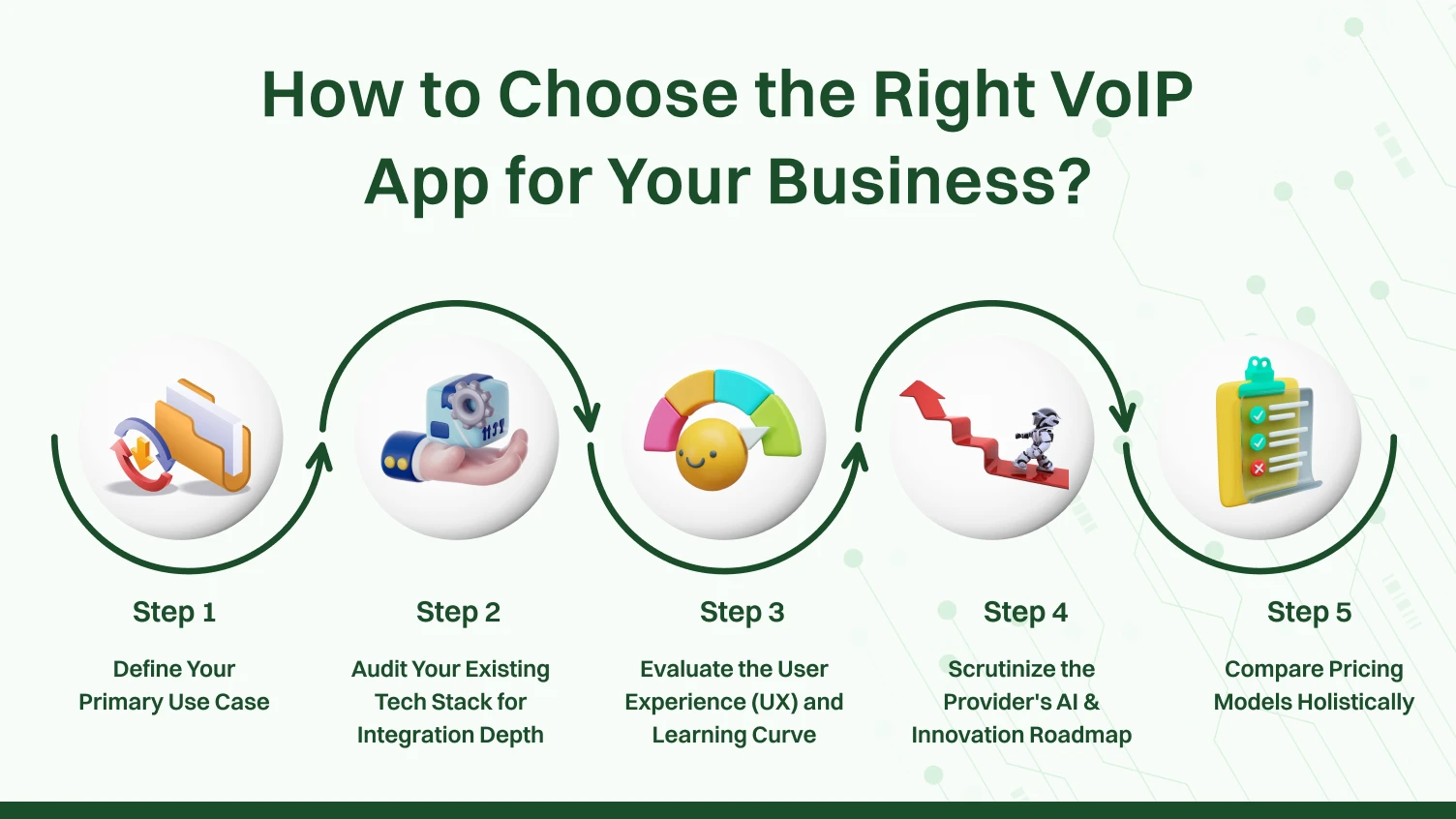
First, ask what job you are hiring the VoIP app to do. A clear purpose is essential.
Defining your primary use case helps you filter out irrelevant options and focus on what truly matters.
Next, look at the tools your business already relies on every day. A VoIP system should enhance your workflow, not disrupt it.
This audit ensures your new phone system will feel like a natural extension of your existing tools.
A powerful system is useless if your team finds it difficult to use. Hands-on testing is non-negotiable.
This hands-on testing phase is the best way to prevent you from making a costly mistake.
You are choosing a technology partner for the long term, not just a piece of VoIP software. Their vision for the future is as important as their features today.
This step helps you avoid the disadvantage of VoIP related to being stuck with outdated technology.
Finally, you must look at the price. The sticker price is only one factor. You must analyze the total cost of ownership.
A full analysis ensures the VoIP benefits of cost savings are real and sustainable for your business.
Using our future-proof framework, we have analyzed the market. This VoIP comparison highlights platforms that excel in specific areas. They are best positioned for the challenges and opportunities of 2026.
| Provider | Best For | Key Features | Pricing* |
|---|---|---|---|
| Dialaxy | Startups and small businesses needing quick and easy setup for US & Canada calling | 2-minute call center setup Agent groups for team management |
$10/user/month |
| RingCentral | Businesses seeking a comprehensive, omnichannel contact center with AI and integrations | AI-powered tools (bots, virtual agents, call summaries) 300+ prebuilt integrations |
$20/user/month |
| Microsoft Teams Phone | Companies integrated with Microsoft 365/Teams ecosystem | Native Teams integration AI-generated call summaries, notes & insights |
$10/user/month |
| Nextiva | Businesses looking for an all-in-one UCaaS & CXM platform | Unified platform for phone, video & messaging Automated attendants & hold music |
$30/user/month |
| OpenPhone | Modern teams & startups needing collaborative phone system with shared numbers | Shared phone numbers for collaboration AI-powered call transcription & summaries |
$15/user/month |
Dialaxy is positioned for startups and small businesses. The primary advantage of VoIP is speed. The platform promises a 2-minute call center setup. This allows new companies to get their business phone running immediately.
It is focused on the core needs of a growing team. Its agent groups feature makes it simple to organize your contact center for efficient inbound calls. With an accessible starting price, it is an excellent choice for businesses focused on the US & Canada markets.
RingCentral offers a comprehensive omnichannel contact center. This is a robust choice for businesses wanting to manage all communication channels in one place. It is more than a VoIP phone system. It is a complete communications hub.
Its biggest strengths are integrations and intelligence. It connects to over 300 other business applications. It also provides a suite of AI-powered tools. These include virtual agents and automated call summaries. This makes it a powerful platform for scaling businesses.
Microsoft Teams Phone is the ideal choice for companies already using the Microsoft 365 ecosystem. The main benefit of VoIP is its native integration. It works directly inside the Teams application that your team already knows, which would significantly reduce the learning curve.
The platform adds full business phone capabilities to Teams. It also leverages AI for productivity. It can generate call summaries, notes, and insights automatically. This makes it an efficient and cost-effective option for Microsoft-centric organizations.
The Nextiva phone system provides an all-in-one platform for communications and customer experience. It is designed for businesses that want a single tool to manage the entire customer journey. It unifies your phone calls, video conferencing, and instant messaging.
It also includes professional calling features. These include automated attendants and custom hold music. This helps small and mid-sized businesses present a polished image. Nextiva VoIP is a strong choice for companies that want to consolidate their tech stack.
OpenPhone is designed for modern teams and startups. Its core focus is collaboration. The standout feature is its shared phone numbers. This allows employees to manage a single business phone line from a shared inbox. It is perfect for a sales or support team.
The platform also embraces modern advanced features. It offers AI-powered call recording transcription and summaries. This makes it a powerful internet phone for new businesses. It provides professional tools without the complexity of traditional phone systems.
Choosing a VoIP app in 2026 is a critical business decision. It is no longer about finding a replacement for your landline phone. It is about selecting an intelligent engine for your business growth. You must carefully weigh the VoIP advantages and disadvantages before you commit.
The greatest benefit of VoIP is its potential to unify your tools. It can empower your team. The biggest disadvantage of VoIP comes from choosing an outdated provider. A bad partner cannot deliver on the promise of modern communication. The future of business communication is integrated, intelligent, and focused on user experience.
Your choice of a VoIP provider is a choice about your company’s future. Do not settle for a simple dial tone. Demand a platform that makes your entire business smarter. If your vision for 2026 includes a more efficient and connected team, you are ready for the next step.
See how Dialaxy app turns communication into your biggest advantage.
Voice over Internet Protocol is a technology that allows you to make voice calls using an internet connection by simply converting your voice into a digital signal that travels over the Internet.
The advantages include:
The disadvantages are:
Yes, in almost all cases. Traditional phone systems require expensive on-site hardware and copper wiring. They also charge high rates for long-distance calls. VoIP systems have much lower overhead. They offer more competitive pricing models.
This is a key drawback of VoIP. However, the best VoIP providers have solutions. Many VoIP apps have call forwarding features. These can automatically redirect inbound calls to a pre-set mobile phone number if your internet connection fails.
Yes, you can make emergency calls (like 911) with most VoIP services. It works differently from a traditional phone, and you must register your physical address with your VoIP provider. This is the location that will be sent to emergency responders. It is your responsibility to keep this address updated.
