

VoIP Advantages and Disadvantages: The Definitive Guide

Your business communication is a critical asset. For decades, the traditional phone system was the only option. It was built on copper wires and physical exchanges. Today, that technology is obsolete. A new system has taken its place. It is called Voice over Internet Protocol or VoIP.
This technology powers modern business communication. It offers incredible flexibility and features. Many businesses still have questions. They wonder about the real advantages and disadvantages of making the switch. Is the voice quality reliable? What are the true cost savings?
This definitive guide will answer those questions. We will explore all the VoIP advantages and disadvantages. We will not just list problems but show how to solve thecoolie m too.
Before our deep dive, here is a simple summary. This table gives you a quick overview of the core points. We will explore each one in detail throughout this guide.
| VoIP Advantages (Pros) | VoIP Disadvantages (Cons) |
|---|---|
| ✅ Significant Cost Savings | ❌ Dependent on Internet Connection Stability |
| ✅ Work From Anywhere Flexibility | ❌ Requires Stable Power Source |
| ✅ Highly Scalable for Growth | ❌ Potential for Poor Call Quality (If Not Set Up Right) |
| ✅ Access to Advanced Calling Features | ❌ Security Needs Careful Management |
| ✅ Unified Communications (Voice, Video, Chat) | ❌ Emergency (E911) Calls Work Differently |
| ✅ Low-Cost International Calls | ❌ May Require New Hardware (IP Phones) |
This table provides a high-level view. Now we must examine the details to understand the full picture.
The advantages of VoIP extend far beyond simple calling. This VoIP technology redefines what a business phone can do. We can group these powerful VoIP benefits into three main categories.
This structure helps clarify how a modern VoIP phone system improves your business.
The most immediate benefit businesses notice is financial. A switch to VoIP can dramatically impact your bottom line.
Your traditional phone bill has many parts. You pay for line rental, each call, and maintenance on an old phone system. VoIP changes this model completely. It uses your existing internet connection.
This eliminates the need for separate phone lines made of copper wiring. Businesses report cost savings of more than 50% after switching. The lower costs are a primary driver for adoption.
Does your business make international calls? You know the high costs associated with traditional providers. A call across the world can be incredibly expensive. VoIP routes these calls over the internet.
The cost is a tiny fraction of the old method. Businesses with global clients or teams see massive savings here. A VoIP call to another country can cost the same as a local call.
This global reach opens up new markets for small businesses.
Modern business is not static; it grows and adapts. Your phone system must do the same. This is where VoIP truly shines compared to old landline phones.
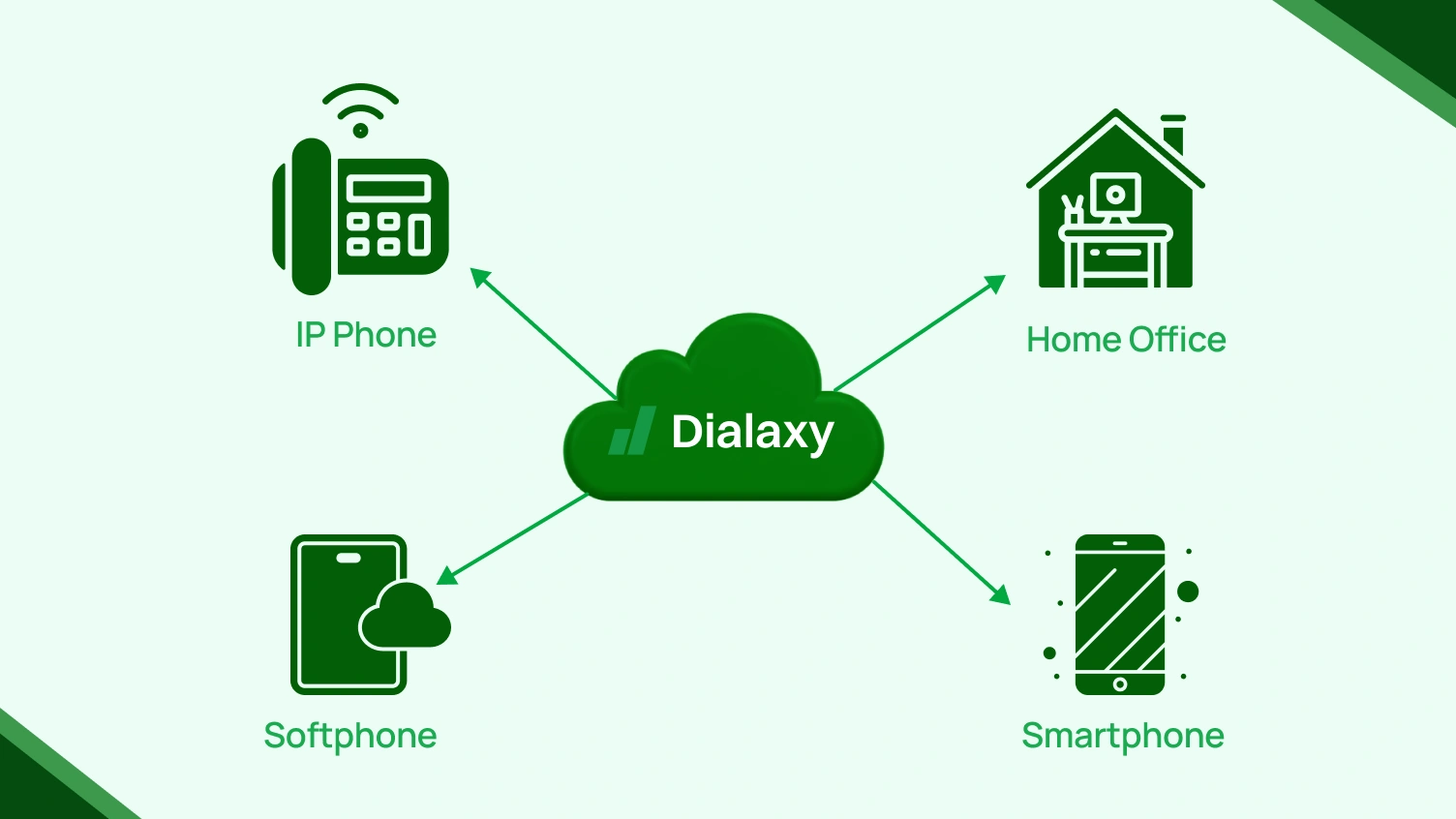
A traditional phone system tethers you to a desk. Your phone number is tied to a physical line in the office. VoIP frees you from this, as your virtual phone number is tied to you, not a location. You can take calls on a desk phone in the office. You can take the same calls on a software application (softphone) on your laptop at home.
You can even use a mobile app on your smartphone while traveling. This system allows employees to stay connected from anywhere. This flexibility is essential for remote teams and hybrid work models.
Imagine your business is growing fast. You hire five new employees. With a traditional phone system, you must call a technician. They need to come on-site. They install new copper wires. This process takes days or weeks.
With a VoIP system, you just log into your admin portal. You can add five new users in five minutes. They can start making calls immediately. The same is true for downsizing. Scaling your phone systems up or down is instant and easy.
VoIP is not just a cheaper phone. It is a smarter phone. It includes a suite of advanced features. These features were once only available to massive corporations. Now, any business can use them.
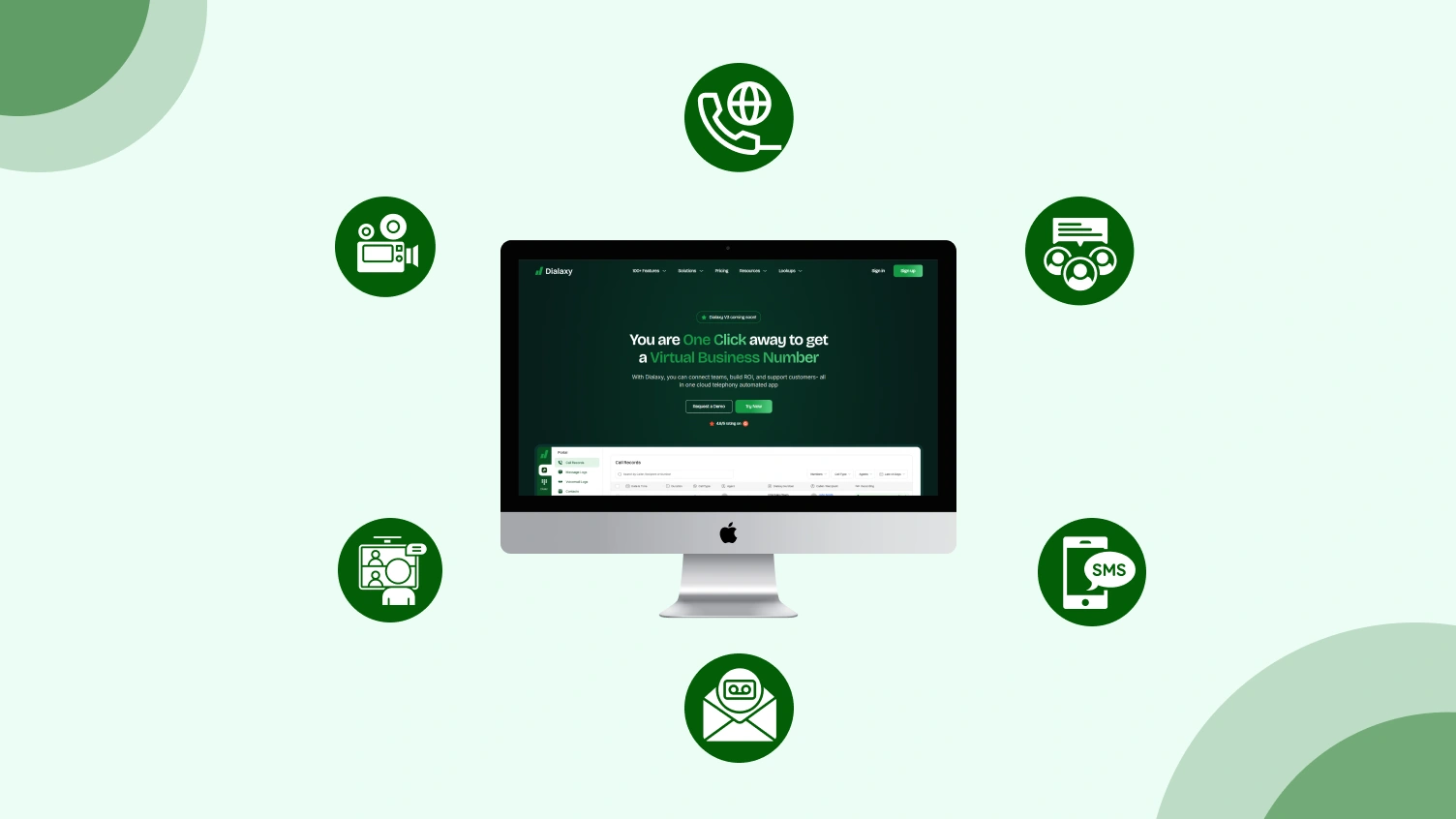
This is a core concept in modern VoIP. Unified Communications means all your communication channels are integrated. It combines essential services into one single application. This includes your main VoIP calling and collaborative team messaging.
It also integrates video meetings, SMS, and even voicemail-to-email. This stops you from jumping between five different apps. Everything is in one place. This integration makes teamwork and collaboration much smoother.
VoIP for businesses comes packed with powerful tools. Here are just a few VoIP examples:
III. Conference Calling: Host multi-person audio meetings with ease. No need for a separate service.
These calling features transform your phone from a simple utility into a powerful business tool.
No technology is perfect. It is important to understand the disadvantages of VoIP. Here we will examine each potential disadvantage of VoIP. Then we will provide a clear step-by-step plan to mitigate it. These are not deal-breakers. They are manageable challenges.
This proactive approach is key to a successful switch to VoIP.
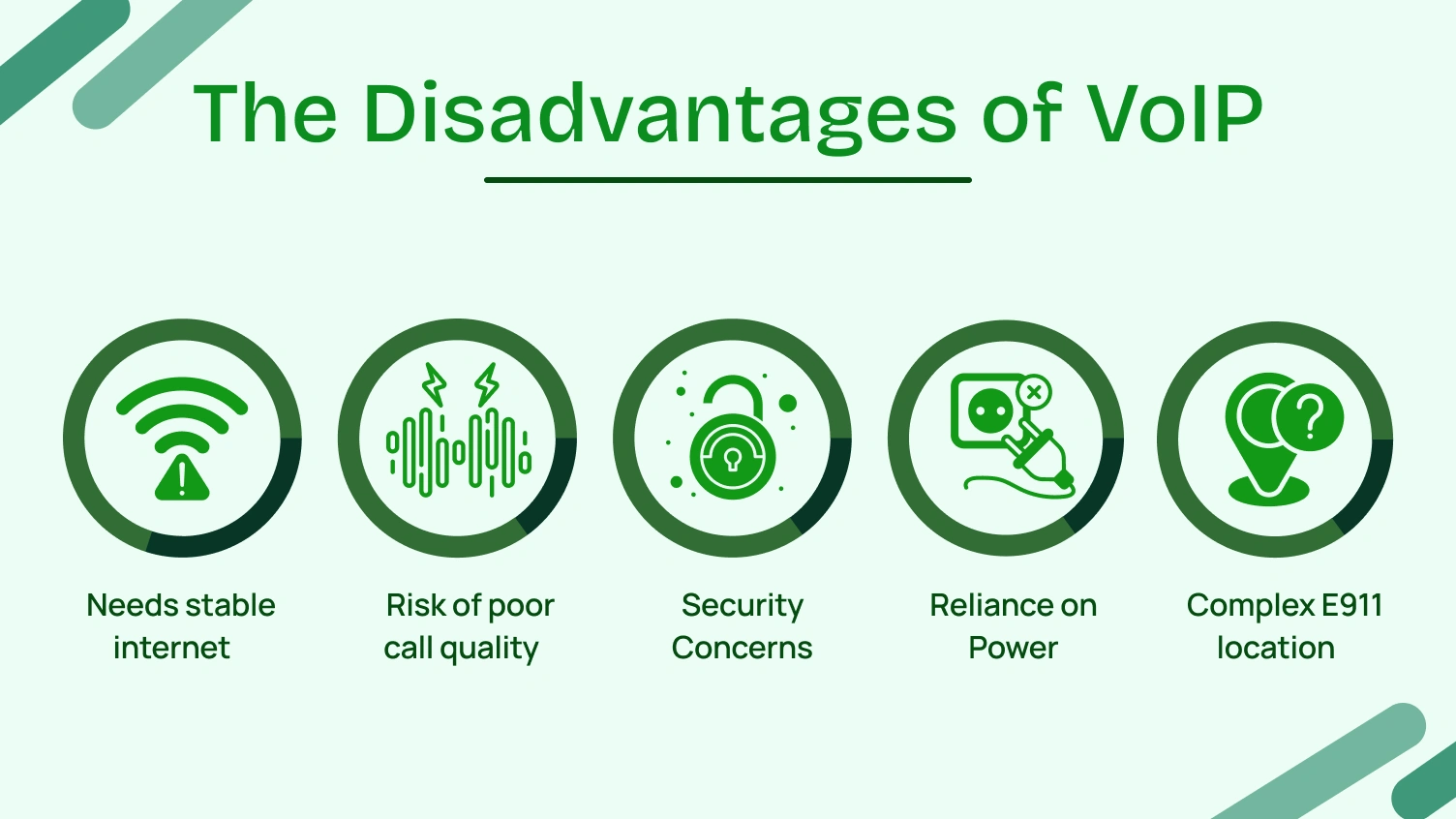
The Problem: Your VoIP phone runs on the internet. If your internet goes down, your phones go down too. This is a valid concern. The advantages and disadvantages of internet use are linked. Great connectivity gives great quality. Poor connectivity creates problems.
How to Mitigate It:
The Problem: People worry about choppy audio or delayed audio. This is often described as bad voice quality. Early VoIP technology sometimes had these issues. Jitter and latency could disrupt a VoIP call. This is one of the oldest drawbacks of VoIP.
How to Mitigate It:
Modern VoIP systems have largely solved the call quality issue. Excellent quality is now the standard, not the exception.
The Problem: Any service that runs over the internet has potential security risks. These can include hacking, eavesdropping, or denial-of-service attacks. Securing your voice over IP communications is essential.
How to Mitigate It:
VoIP is not inherently insecure. It simply needs the same security attention as your email or data services.
The Problem: Your Internet Protocol phones need electricity to work. Your router and modem also need power. If there is a power outage, you could lose your phone service. This is different from old traditional phone systems. The copper wire in a landline phone often carried its own low-voltage power.
How to Mitigate It:
Power reliance is a real issue. Modern VoIP has simple and effective solutions.
The Problem: This is a serious concern. A traditional phone line is tied to a physical address. When you dial 911, the operator knows exactly where you are. A VoIP phone is mobile. You could be making an emergency call from the office, your home, or a coffee shop. How do emergency services find you?
How to Mitigate It:
Emergency calling on VoIP is safe and effective when managed correctly.
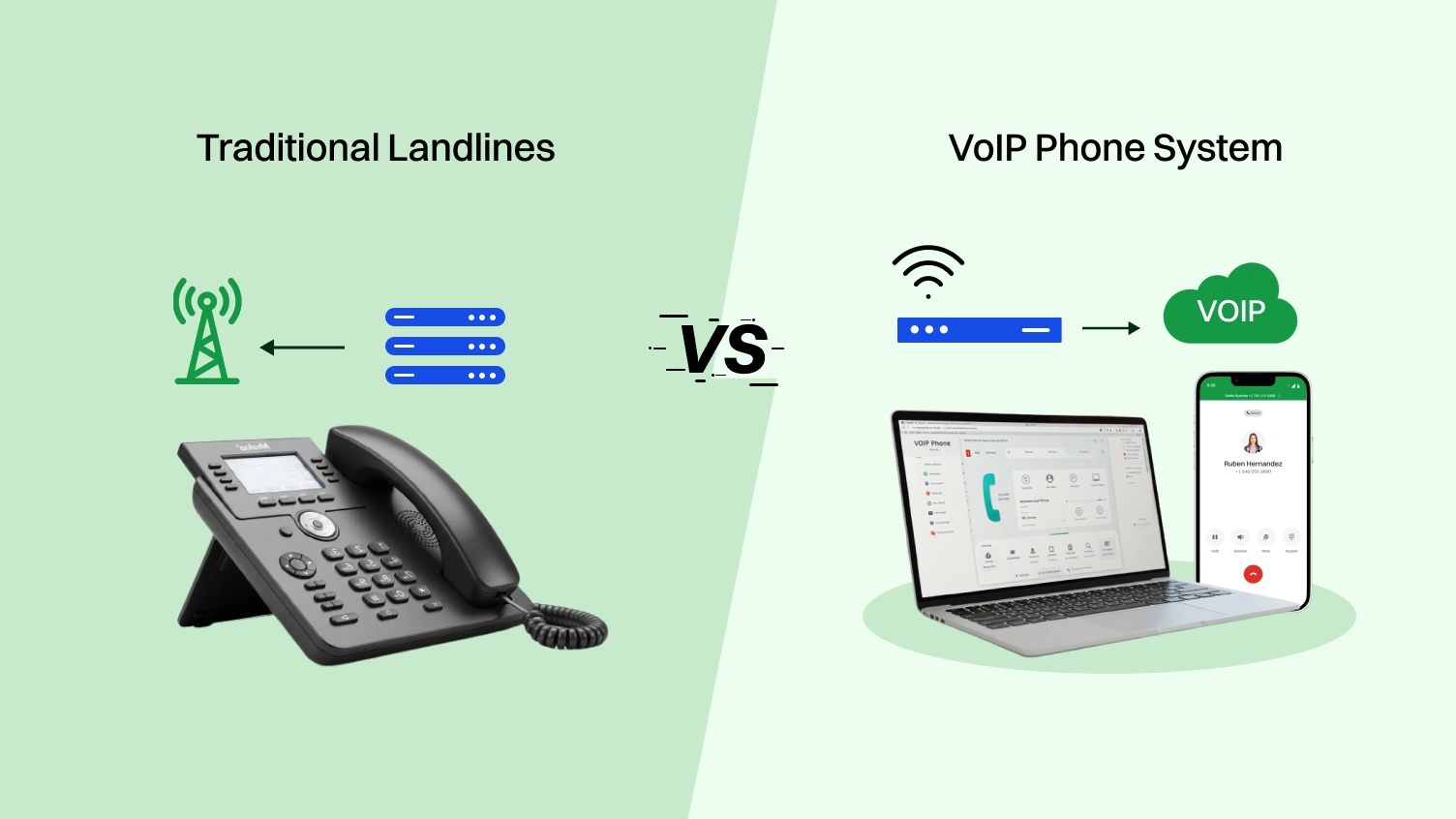
To fully appreciate the VoIP advantages and disadvantages, we need a direct comparison. Let’s place a modern VoIP system against the Public Switched Telephone Network (PSTN), the technology behind traditional phones.
This VoIP comparison makes the choice clear for most businesses.
| Feature | VoIP (Voice over Internet Protocol) | Traditional Landline (PSTN) |
|---|---|---|
| Underlying Technology | Digital signals over the internet (Internet Protocol) | Analog signals over physical copper wiring |
| Cost Structure | Low monthly fee per user. Includes unlimited calling. Very low international calls. | High monthly line rental fees plus per-call charges. Expensive international rates. |
| Scalability | Excellent. Add or remove users instantly online. | Poor. Requires a technician visit and physical wiring changes. |
| Location Dependency | None. Works anywhere with an internet connection. | High. Tied to a specific physical address. |
| Features | Huge suite of advanced features included (unified communications, call forwarding, IVR etc.) | Basic features (call forwarding) often cost extra. Lacks advanced capabilities. |
| Hardware | VoIP phones (IP Phones), softphones (apps), mobile apps. | Traditional phone sets. |
| Reliability | High with a good internet connection and backup plan. | Very high but lacks redundancy. A cut wire can cause total failure. |
| Setup & Maintenance | Simple plug-and-play setup. Managed by the VoIP provider. | Complex installation. Maintained by the telephone company. |
This head-to-head showdown highlights the clear superiority of VoIP technology for modern needs.
The theoretical benefits of VoIP are clear. But how does it work in the real world? Let’s look at some voice over internet protocol examples for different business types.
Seeing how others use it helps you visualize its potential for you.
A property management firm has a central office. It also has agents constantly visiting properties.
An online store has a team of 15 support and sales agents. They handle both inbound questions and outbound call campaigns.
A new law firm with three partners wants to project a professional image without a high budget.
These examples show how flexible VoIP for businesses can be.
We have explored the complete landscape of VoIP advantages and disadvantages. The evidence is overwhelming. While there are drawbacks to VoIP, each one is manageable. Each one has a clear and practical solution. The concerns about call quality and reliability are largely relics of the past.
The advantages, however, are more significant than ever. The incredible cost savings, the powerful flexibility, and the suite of advanced features are transformative. VoIP is not just a replacement for your old phone systems. It is a fundamental upgrade to your entire business communication strategy.
Comparing VoIP to a traditional phone is like comparing a smartphone to a rotary phone. One is a dynamic multi-functional tool for the modern world. The other is a single-purpose utility from a bygone era. For any business looking to grow, adapt, and succeed in today’s environment, the choice is clear.
The question is no longer “Should we switch to VoIP?” The question is “How quickly can we start reaping the benefits?”
Transform your business communication by scheduling a free personalized demo with a Dialaxy expert to maximize VoIP benefits.
The core advantages and disadvantages of VoIP are clear.
Advantages: Lower costs, work-from-anywhere flexibility, and advanced calling features.
Disadvantages: Requires a stable internet connection and a consistent power source to operate.
Yes. VoIP eliminates expensive fees for physical phone lines and copper wiring. It uses your internet to provide phone service at a lower cost with a predictable monthly bill.
The biggest disadvantage is its dependence on the internet. A poor connection can cause bad call quality or outages. This is solved with a good business internet plan and a backup connection or mobile app.
Sometimes. Old traditional phones require a special adapter to work. For the best voice quality and access to all features, it is better to use modern VoIP phones.
Not much. VoIP needs only about 100 kbps per active call. The stability of your internet connection is more important than raw speed for ensuring clear voice quality.
VoIP uses an E911 system. You register a physical address with your VoIP provider. When you make an emergency call, that address is sent to responders. You must keep this address updated.
No, the process is straightforward. A good VoIP provider helps you keep your number, set up features, and simply plug in your new phones. The transition is designed to be fast and smooth.
VoIP is the technology for making phone calls over the internet. Unified Communications is a platform that uses VoIP. It adds video, messaging, and other tools into a single application.
