

What Is PSTN and How Does It Work: A Complete Guide

Ever wondered what happens when you make a regular phone call? The call travels through the Public Switched Telephone Network (PSTN), a worldwide network of telephone systems that connect callers through switching and transmission infrastructure.
PSTN started with traditional landline networks, but today’s network is much more than copper wires. It can use digital switching, fibre-optic networks, and other technologies to connect calls.
In this guide, we’ll explain what PSTN means, how PSTN calls work, how it differs from VoIP and POTS, and why businesses are moving toward IP-based phone systems.
PSTN stands for Public Switched Telephone Network. It is the worldwide network of interconnected public telephone networks that carries voice calls between people and businesses.
In simple terms, PSTN is the traditional telephone network behind regular phone calls. It includes telephone exchanges, switching systems, transmission networks, and other infrastructure used to connect callers.
PSTN is not the same as POTS. POTS (Plain Old Telephone Service) refers to traditional analog telephone service, while PSTN describes the broader public telephone network.
The PSTN has changed over time. Early networks relied heavily on copper lines and manual switching. Modern telephone networks use digital switching and fiber-optic transmission alongside older infrastructure.
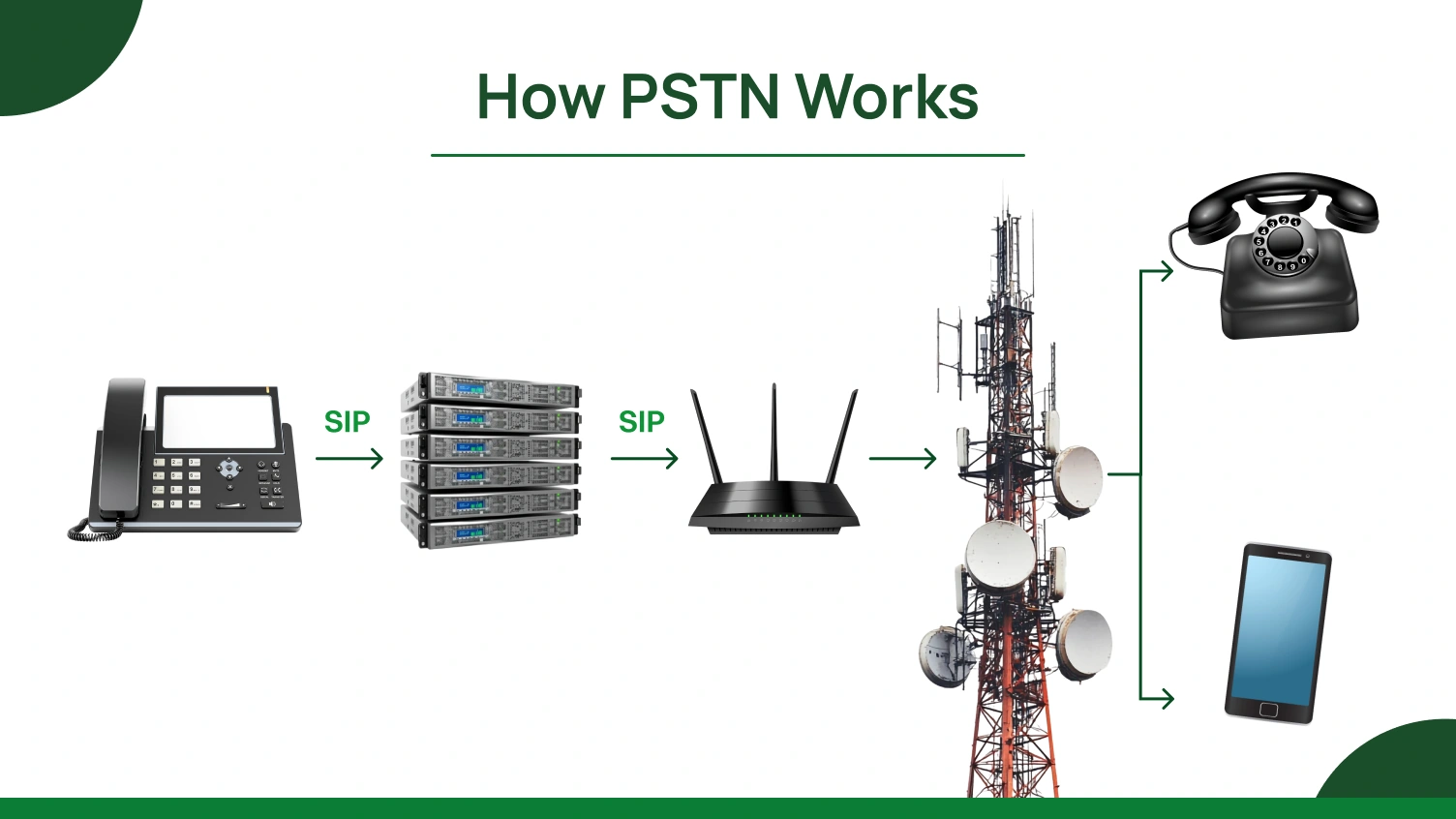
A traditional PSTN call uses switching and signaling systems to connect one telephone number to another. The exact technology varies by network, but the basic process looks like this:
The telephone connects to the local telephone network. In a traditional landline setup, the local exchange detects the connection and provides a dial tone.
The telephone sends the dialed digits to the network. Older phones used pulse dialing, while touch-tone phones use DTMF signals.
The telephone network analyzes the number and determines where the call needs to go. Numbering systems such as E.164 provide a framework for international telephone numbers and routing.
Local exchanges and other switching systems route the call toward the destination. For longer-distance calls, the call may pass through multiple switches or transit networks.
The destination network sends a signal to the receiving telephone. When the person answers, the call is connected.
The network carries the voice between the two endpoints. Traditional PSTN used circuit switching, while modern telephone infrastructure may use digital transmission and other technologies.
When either person hangs up, signaling systems release the connection and make the network resources available for another call.
Plain Old Telephone System (POTS) became the beginning of the Public Switched Telephone Network (PSTN) in the late 1800s. Early call network operators could connect calls manually, but as the call volume increased, automated central offices and tandem offices managed long-distance calls automatically.
PSTN used underground copper wires and circuit switching for many years, and assigned each call one line. Although it was dependable, this restricted the number of simultaneous calls that the network could support.
Digital voice and fiber optic cables enhanced the quality and capacity of calls in the 1970s and 1980s. International calls were also quicker due to the development of communication satellites that span an extended distance across the world.
PSTN is now used with VoIP and unified communications. Most companies implement hybrid systems that have the reliability of PSTN with the contemporary digital capability, including video calls, SIP trunking, and artificial intelligence-based call routing. Although digital networks are on the increase, PSTN still has some significance in emergency services and in places where internet connectivity is minimal.
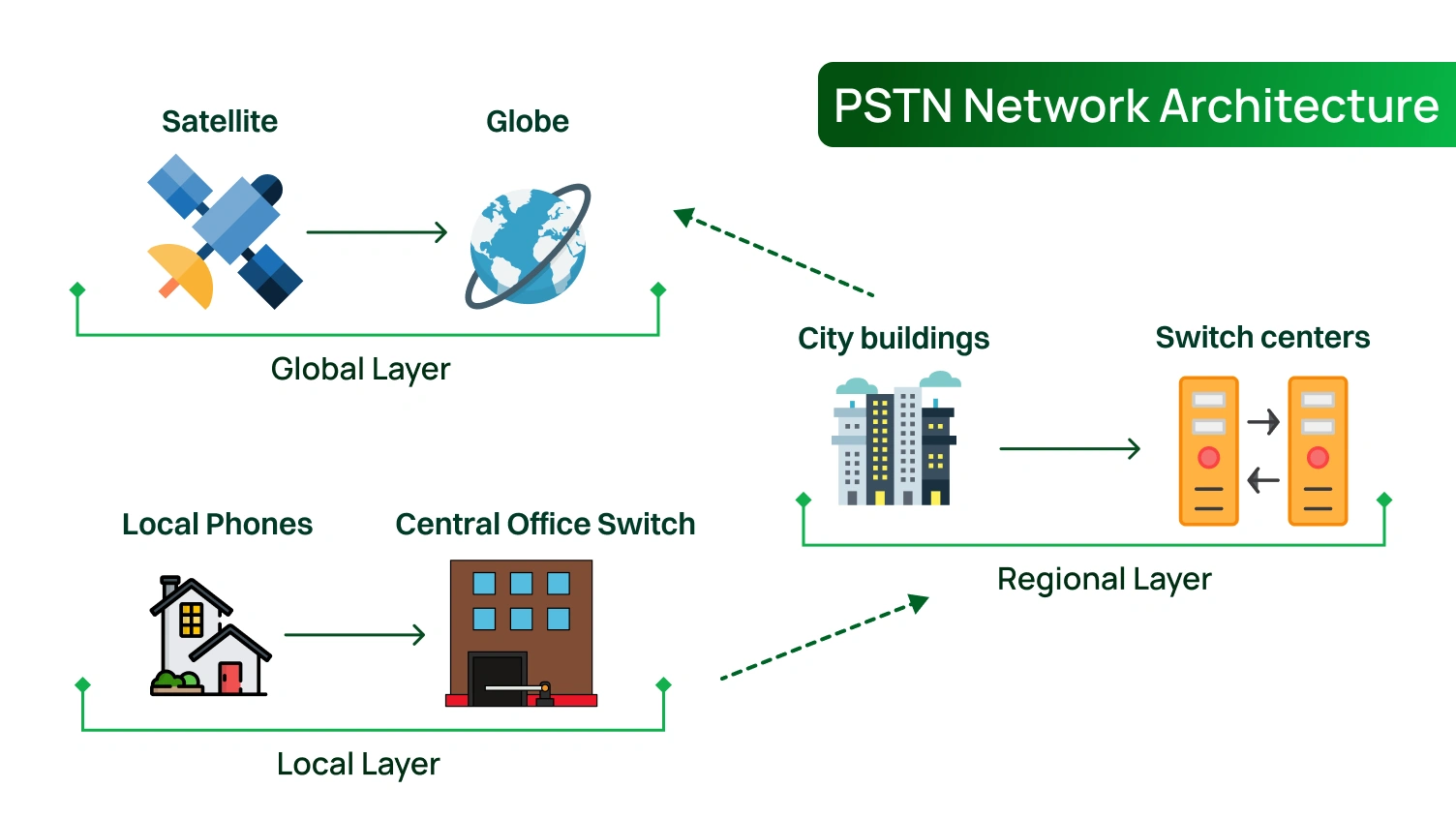
Public Switched Telephone Network (PSTN) is based on a well-organized architecture to provide a trustworthy voice connection between two phones. This process revolves around switches, and the connection is dedicated throughout the process of making a call until it is terminated.
Here are the four key components that form the PSTN network architecture:
The central office is also known as a local exchange or telephone exchange. It links the individual phone lines to the wider PSTN. Central office switches (each) can carry thousands of lines, up to 10,000.
When you call, the central office finds out where you want to go and points the connection in such a way that your voice goes to the appropriate recipient. This is the initial process towards proper and dependable voice communication.
The tandem office manages switching between different central offices. For instance, if you call someone in another town within the same country, the call is routed from your local exchange to a tandem office.
The tandem office then forwards the signals to the recipient’s nearest central office, enabling seamless connection across telephone networks.
The toll office handles long-distance and national calls. It keeps the voice quality high even over long distances, as calls traversing across cities or states are efficiently directed.
Toll offices also liaise with central offices and tandem offices to ensure that loss of signals does not occur and to ensure that there are continuous connections.
In international calls, it is the international PSTN gateway that routes the call to the right country. It connects with foreign PSNs and handles international switchover, thus making sure that the call is delivered effectively to the receiver.
This aspect plays a very important role in global connectivity and is usually combined with communications satellites and digital voice networks.
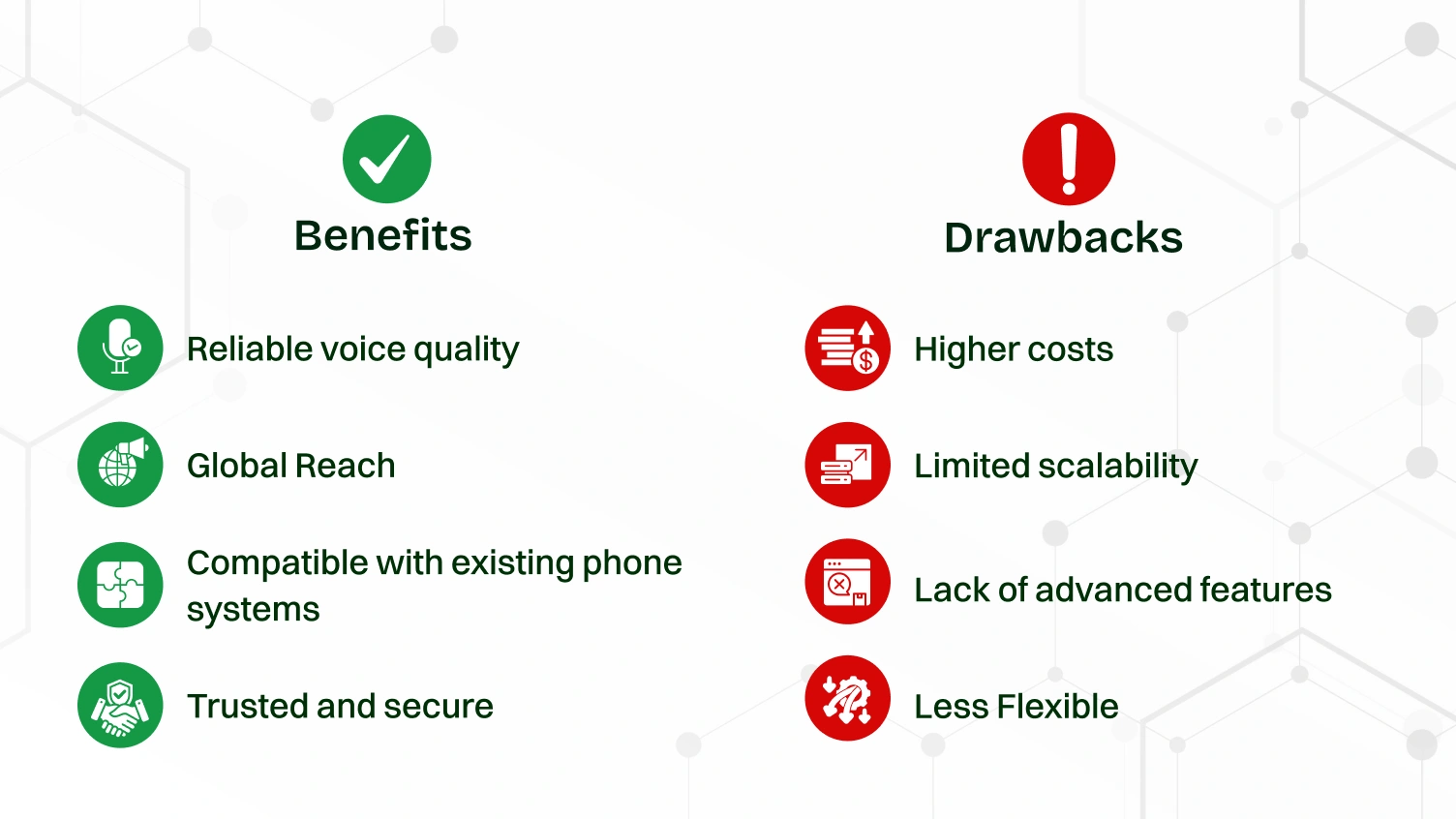
PSTN has been the basis of voice communication throughout the world. VoIP and digital voice technologies have not yet replaced PSTN; nevertheless, they still provide many benefits to individuals and companies.
PSTN offers very high stability and reliability. Through dedicated circuit-switched lines, a path is continuously maintained between the caller and the recipient with each call. This reliability allows for a few dropped calls, and PSTN is good when emergency services, essential business communication, and areas with poor internet connectivity are required.
Calls maintain a clear and consistent voice signal using a circuit and robust PSTN network infrastructure. In contrast to certain internal-based systems, PSTN calls are not burdened with latency, jitter, or distortion, which is very important to contact centers, customer care, and professional contacts.
PSTN is available in both urban and rural locations, which is supported by the central office, tandem office, and toll office. PSTN is a reliable option globally, unlike VoIP phone systems that need internet connectivity to operate and that can only serve almost all places with the use of a standard telephone line.
A lot of organizations are still using the traditional PBX or branch exchange. PSTN can be easily integrated with these configurations and, by doing so, businesses will have the opportunity to retain their current infrastructure and still provide dependable voice transmission between offices.
PSTN provides international connectivity through the use of international gateways, communications satellites, and combined digital networks. This also makes local and long-distance calls possible, and businesses and consumers can communicate all over the world without any kind of doubt.
PSTN itself is a secure system because of dedicated circuits and the absence of reliance on the Internet packet switches. It minimizes vulnerability to cyberattacks by providing business phone systems, government processes, and confidential conversations with privacy and confidentiality.
Although the Public Switched Telephone Network (PSTN) has been the main communication tool of the world over the past decades, it has its limits as well. Companies and personalities are moving to VoIP and digital telephony due to the following disadvantages:
Traditional PSTN lines require physical branch exchanges and telephone infrastructure. Adding new lines or expanding PBX systems for growing teams can be costly and slow. Unlike VoIP, it doesn’t scale easily for modern business phone systems or contact centers.
Maintaining copper wires, central offices, and tandem offices is expensive. PSTN costs for long-distance calls, line rentals, and repairs can quickly add up compared to digital voice solutions.
The PSTN system was built for voice calls only. It cannot natively support video conferencing, AI voice assistants, call routing, or integration with digital platforms and partner portals. Businesses miss out on the efficiencies provided by modern VoIP phones and unified communications.
Traditional telephone networks rely on physical lines, which makes remote work and mobility challenging. Unlike VoIP systems, PSTN does not easily connect remote employees, mobile devices, or multiple office branches seamlessly.
Many telecommunications providers are phasing out PSTN in favor of digital networks. This means reduced maintenance, limited updates, and eventually, less global support for public switched telephone networks.
Businesses today rely on cloud systems, CRM platforms, and collaboration tools. PSTN lines cannot integrate with these digital tools, limiting automation and efficiency in business phone systems.
The PSTN network was designed for voice, not data. It has limited bandwidth, making video calls, file transfers, or high-quality digital voice impossible without supplemental internet protocols like SIP trunking.
Yes. Some businesses still use traditional telephone services, particularly where legacy phone systems, equipment, or local infrastructure remain in place.
PSTN can also appear behind modern business calls. A VoIP call may connect with a traditional telephone number through a carrier or gateway.
For businesses, the bigger change is that IP-based phone systems are replacing many traditional setups because they are easier to scale and connect with cloud tools.
There isn’t one single replacement for PSTN. The technology replacing traditional telephone infrastructure depends on the use case.
VoIP carries voice calls over IP networks. It is widely used for business phone systems because it supports features such as call routing, mobile apps, analytics, and software integrations.
SIP trunking connects a business phone system or PBX to a telephone service through an IP network. It can be useful for businesses moving away from traditional phone lines without replacing their entire phone system.
A hosted PBX moves the business phone system to the cloud. The provider manages much of the underlying infrastructure, while users access their phone system through internet-connected devices.
Telecom providers are also moving toward newer digital and IP-based network infrastructure as legacy telephone systems are retired.
Let’s compare in tabular form:
| Feature / System | PSTN System | VoIP Phone System | Hosted PBX | ISDN |
|---|---|---|---|---|
| Technology | Circuit Switching | Packet Switching (Internet Protocol) | Cloud-based PBX with SIP Trunking | Digital Transmission over Telephone Lines |
| Infrastructure | Copper wires, central & tandem offices | Internet Protocol networks | Cloud servers, SIP trunking | Telephone lines and switching centers |
| Voice Quality | Consistently high | Depends on the internet bandwidth | High with a good internet connection | High-quality digital voice |
| Scalability | Limited, physical expansion required | Easy, highly scalable | Easy, flexible for growing businesses | Limited scalability |
| Advanced Features | Basic voice calls only | Video calls, AI voice, call routing, unified communications | Call routing, AI voice, video conferencing, unified communications | Limited, mostly voice with some data transmission |
| Cost for Long-Distance / International | High | Low | Low | Moderate |
| Integration with Digital Tools | None | Fully integrates with CRMs, cloud platforms | Fully integrates with business software | Minimal |
| Support for Remote / Mobile Work | Low | High | High | Low |
| PSTN Replacement / Future Proof | Aging, being phased out | Modern, recommended for future communications | Modern, suitable for hybrid PSTN transition | Being phased out in favor of VoIP/SIP |
The Public Switched Telephone Network (PSTN) has been a cornerstone of global voice communication for decades, but its future is increasingly limited. Many telecommunications providers are gradually phasing out PSTN in favor of digital voice solutions, SIP trunking, and VoIP phones, which offer more flexibility, lower PSTN costs, and advanced features like AI voice, video conferencing, and unified communications.
For businesses, this shift means that relying solely on traditional landlines is becoming less practical. Organizations are moving toward digital networks that support remote work, branch exchanges, and seamless integration with partner portals and cloud platforms. Even in areas where PSTN remains active, it often serves as a backup rather than the primary phone system.
In short, the future of PSTN is being redefined. While it may still provide voice reliability for a few years, the global trend clearly favors VoIP, hosted PBX, and digital voice technologies as the sustainable and scalable solutions for modern business communications.
The Public Switched Telephone Network (PSTN) has been the backbone of voice communication for over a century. It’s reliable, familiar, and has supported businesses and households alike. But the world is changing. Digital voice, VoIP phones, hosted PBX, and SIP trunking offer more flexibility, advanced features, and lower costs, especially for long-distance calls, remote teams, and modern business phone systems.
For many businesses, sticking with PSTN alone is no longer practical. The smart move is to explore digital alternatives, either as a replacement or as a backup to traditional lines. The transition doesn’t have to be complicated. With the right tools, companies can keep the voice quality and reliability they trust while gaining scalability, AI features, and seamless integration with today’s digital workflows.
If you’re comparing PSTN with VoIP, the right choice depends on your existing setup, budget, team, and communication needs.
FAQs
The Public Switched Telephone Network (PSTN) is the traditional global telephone network that connects calls using circuit switching. When you make a call, your voice signals are converted into electrical signals, travel through copper wires, fiber optics, or satellites, pass through switching centers, and are converted back into sound at the receiver’s end.
The main purpose of PSTN is to provide reliable voice communication between two or more parties over long or short distances. It supports business phone systems, residential calls, and even international voice calls using a network of central offices, tandem offices, and branch exchanges.
When a call is made, the voice is converted into electrical signals, routed through local exchanges and toll offices, and travels via switching centers to the receiver. This circuit-switching method ensures a dedicated path for the duration of the call, delivering consistent voice quality.
Yes, PSTN is still used, especially in areas with limited internet connectivity and in legacy business phone systems. However, its usage is declining as VoIP, hosted PBX, and digital voice solutions become more common due to lower costs and advanced features.
Digital voice solutions like VoIP phones, SIP Trunking, and hosted PBX systems are gradually replacing PSTN. These technologies provide call routing, AI voice, video conferencing, and seamless integration with unified communications platforms, making them ideal for modern businesses.
Traditionally, PSTN was analog, using electrical signals to transmit voice calls over copper wires. Modern PSTN lines increasingly support digital technologies, including ISDN lines and digital voice transmission, before the complete transition to IP-based systems like VoIP.
