

The Role of DNS in VoIP Performance


The Domain Name System (DNS) is a very important part of every VoIP call and video call. When your DNS is slow and inaccurate, you may have a problem where you will see degraded VoIP and other network traffic, and poor voice quality on your phones.
Whether it be mapping of IP addresses or management of data packets, DNS adds value to SIP phones and telephone systems to ensure that they connect well. Knowledge or understanding of DNS in VoIP is first and foremost in helping any network administrator to improve the quality of VoIP, ensure the security of DNS servers, and maintain a quality flow of VoIP traffic.
This guide will show you how you can secure, optimize, monitor, and future-proof your DNS infrastructure to ensure consistently clear VoIP calls.

A domain name system (DNS) is an Internet phone book of sorts. It translates usable names of domains into IP addresses so that your devices know where to send data packets, either through a data center or to your home networks.
DNS plays the most important role in the VoIP system since it directs the VoIP traffic to the right servers within a shorter time. Sometimes the DNS is slow or poorly configured, which affects the quality of your VoIP calls- causing delay in delivery, jitter, and even dropped call connections.
In a practical sense, DNS usually cooperates with the Internet Protocol and the naming system. Both SIP phones and video conferencing, and the VoIP connection are based on the accurate establishment of DNS. Packets that comprise IP traffic may be lost or delayed in case the DNS fails, which will have a direct impact on the VoIP call quality and the overall VoIP traffic flow.
Take an example: You are in a video Call with your team members, and you suddenly experience lagging or freezing of the video. In many cases, the actual source is slow DNS resolution or weak DNS caching and DNS TTL parameters.
Updating/optimizing the DNS servers or dynamic DNS method will bring a significant reduction to such interruptions, achieving seamless voice over IP communication and increased VoIP quality. Knowing about DNS is the initial success in secure VoIP. Until this is in place, even the most excellent telephone systems and network settings cannot deliver reliable performance.
This is the case because appropriate DNS ensures the flow of VoIP traffic without interruption, providing your business with clear communication. Having a problem? You can always get direct support over the contact form on your VoIP provider’s webpage.
Securing DNS is critical for maintaining a reliable VoIP and telephone system. Implementing proper DNS security and DNS security extensions protects your network from attacks and misconfigurations.
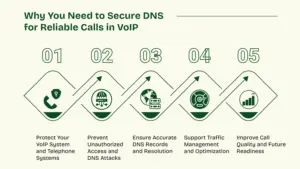
Implementing DNS security and DNS security extensions safeguards your VoIP system and telephone systems from potential threats. A secure DNS setup prevents disruptions in VoIP traffic caused by attacks or misconfigurations. This foundational protection ensures reliable call quality for all users.
Strong security measures block DNS spoofing, hijacking, and other unauthorized access attempts. These threats can degrade VoIP quality or cause dropped calls. Proper DNS protection keeps your SIP phones and data packets flowing safely.
Keeping DNS records correct and DNS servers secure prevents delays in DNS resolution. Misconfigured records can lead to packet loss and choppy VoIP traffic. Accurate DNS ensures smooth connections for VoIP calls and video calls.
Secure DNS allows network admins to implement load balancing, DNS failover, and quality of service (QoS). These strategies keep VoIP traffic flowing efficiently even during high network load. Optimized DNS directly improves overall VoIP quality and system reliability.
Strong DNS security enhances call quality by preventing interruptions and delays in VoIP calls. It ensures your SIP phones and data packets are handled reliably across telephone systems. This proactive approach prepares your VoIP system for future growth and increasing network demands.
Ensuring DNS security is not just about protection. It directly impacts performance. A safe, well-managed DNS enables your business to maintain consistent call quality and prepares your telephone systems for future demands.
Start by auditing your DNS records and DNS servers. Make sure each record points to the correct IP address and TLD server. Proper DNS resolution ensures VoIP calls and video calls connect quickly.
Incorrect configurations can cause packet loss and dropped VoIP traffic. Checking your domain name system DNS regularly lays the foundation for reliable telephone systems.
Spread data packets across multiple DNS servers to prevent overloading any single server. This improves VoIP quality during peak VoIP traffic times. SIP phones and VoIP calls perform better when the load is balanced.
For example, businesses with heavy telephone system usage, multiple calls often see fewer interruptions when using DNS load balancing. This step also prepares your VoIP system for future growth.
Configure automatic DNS failover so that if one DNS server goes offline, traffic is redirected to a backup. This prevents dropped VoIP calls and lost IP packets. Failover ensures that VoIP traffic keeps moving and call quality remains consistent.
Even short DNS outages can cause noticeable lag in video calls, so failover is essential for stable telephone systems.
Use quality of service (QoS) settings to prioritize VoIP traffic over other data. This reduces latency and packet loss for SIP phones and video calls. Proper QoS ensures the VoIP system performance remains high even during network congestion.
Businesses that skip this step often notice jitter and echo, which directly affects VoIP quality.
A VoIP provider once faced frequent call drops on SIP phones. By updating DNS servers, balancing IP packets, and managing DNS records carefully, they improved VoIP traffic flow. The result was more precise VoIP calls, fewer interruptions, and better call quality.
Real-world cases show that optimizing DNS is not just technical—it has a measurable impact on daily communication.
Optimization is continuous. Network admins should regularly review DNS management, update DNS configurations, and monitor DNS resolution. This prevents packet loss, keeps VoIP traffic smooth, and maintains reliable telephone systems.
A well-maintained DNS setup ensures your VoIP system stays ready for high call volumes and evolving internet protocol demands.
Testing DNS resolution ensures that all IP packets reach the correct DNS servers promptly. Fast resolution keeps VoIP calls and video calls smooth without lag. Delays here can disrupt VoIP traffic and lower overall call quality.
Keeping DNS records accurate and DNS configurations updated prevents misrouted VoIP traffic. Correct configurations ensure your telephone systems and VoIP system run reliably. This reduces packet loss and maintains consistent VoIP quality.
Regularly checking DNS servers ensures they respond quickly to SIP phones and VoIP system requests. Slow servers can cause lag, dropped VoIP calls, and jitter in VoIP traffic. Monitoring server health improves call quality and smooths video calls.
Early monitoring helps detect problems that could cause packet loss or interrupted VoIP traffic. Fixing issues promptly keeps VoIP calls stable and prevents disruptions in telephone systems. This proactive approach protects data packets and overall VoIP quality.
Ongoing DNS management prepares your VoIP system for growth and increased traffic. It supports load balancing, DNS failover, and stable quality of service (QoS) for VoIP traffic. Proactive checks ensure long-term reliable call quality and smooth network operations.
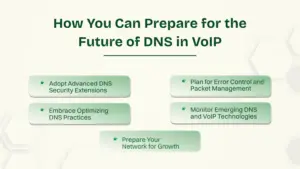
Use DNS security extensions to protect your VoIP system and telephone systems from spoofing or hijacking. Secure domain name systems prevent delays in VoIP traffic and maintain high call quality.
Implementing these measures ensures your SIP phones and video calls stay reliable as networks evolve.
Focus on error control strategies to reduce packet loss in VoIP calls. Proper handling of IP packets and data packets ensures smooth VoIP traffic. This prepares your VoIP provider or business network to handle higher loads and complex Internet Protocol demands.
Continuously review DNS configurations and perform DNS management tasks. Apply load balancing, DNS failover, and quality of service (QoS) to future-proof your VoIP system. Well-optimized DNS ensures consistent VoIP quality as your telephone system scales.
Stay updated on new naming system improvements and Domain Name System DNS standards. Advanced DNS solutions improve DNS resolution speed, security, and reliability for VoIP calls.
Early adoption allows your network admins to prevent issues before they affect VoIP traffic.
Plan your DNS servers and TLD server configurations to handle increasing VoIP traffic. Maintain proactive network administration and DNS management for scalable performance. This ensures your telephone systems and VoIP system continue delivering high call quality as demand grows.
VoIP and DNS go hand in hand in ensuring high quality and consistency on the VoIP call. Any of the steps taken in DNS management can, in itself, impact DNS and the telephony system, including VoIP and telephone communication.
Getting to know how DNS resolution works is the first step to securing your DNS servers and enabling DNS security extensions to secure your network. Optimizing DNS settings, implementing load balancing, and establishing a DNS failover are the surest ways to keep VoIP communications traffic flowing uninterrupted and attain a zero packet loss.
The monitoring of DNS servers and the management of DNS ensure that your SIP phones and data packets flow without difficulties. Lastly, scaling of DNS solutions in anticipation of the future ensures quality calls and dependable VoIP traffic as your network increases.
The Domain Name System (DNS) resolves IP addresses into a readable name that connects SIP phones and telephone systems. Good DNS resolution is important because without it, VoIP traffic may be delayed or lost, thus lowering VoIP quality. The efficiency of VoIP calls and network efficiency requires a basic knowledge of DNS.
The consequence of slow or misconfigured DNS servers is dropped VoIP calls and packet loss. Proper DNS management, DNS settings, and secure DNS entries make the data packets reach their destination. Improved VoIP traffic flow and call quality clearly come from optimizing DNS.
Have DNS security extensions, secure DNS servers, and audit DNS records on a regular basis to avoid spoofing or hijacking. DNS security minimizes interruptions to VoIP traffic and eliminates fluctuations in VoIP quality. Interconnection of security with DNS failover and load balancing arms your VoIP with enhanced performance.
Optimize DNS configurations and DNS management by implementing load balancing, DNS failover, and quality of service (QoS). Regular monitoring of DNS servers ensures smooth VoIP traffic and reduces packet loss. Well-optimized DNS enhances the performance of SIP phones, video calls, and telephone systems.
Monitoring DNS resolution and checking DNS servers proactively prevents packet loss and dropped VoIP calls. Continuous DNS management ensures your VoIP system adapts to network changes and growth. This proactive approach maintains high call quality and prepares your telephone systems for future demands.
