

Understanding VoIP Protocols: SIP, H.323, and More

Adoption of VoIP as the main system of communication is picking up amongst businesses. It has altered how you relate to customers, partners, and even employees. The calls are now faster, cheaper, and flexible than traditional phone lines. So what is the force behind VoIP?
The reason can be found in VoIP protocols. The rules that govern the manner in which VoIP functions are these protocols. It determines the manner in which the setup of calls is arranged and the transmission of voiced data. Its absence can corrupt the entire VoIP system, and calls may fragment or be incompatible.
In this guide, we will examine what VoIP protocols are, why they are essential, and the most commonly used, such as SIP and H.323. We will also discuss problems, emerging trends, and how to choose the most suitable VoIP protocol for your business. Let’s start right through it.
VoIP protocols are rules and standards that allow voice to travel over Internet Protocol (IP) networks. They turn voice signals into small digital data packets. These packets carry the correct information so calls can be sent and received on different devices.
In addition to conversion, VoIP protocols initiate, regulate, and release call sessions and handle the delivery of voice media in real-time. It establishes broadband links (same as phone lines), allowing features such as
All these features are not available over traditional phone lines.
Accordingly, VoIP protocols play a significant role in managing the following processes:
VoIP services convert voice signals into digital data, enabling the signals to traverse over the Internet easily. Digital data is translated into signals when you dial a phone number, and vice versa, to allow seamless interaction between a classical telephone and a VoIP device. Its key components are:
VoIP makes calls possible on computers, specific VoIP phones, or even regular phones using particular adapters. By just being connected to the net, you can make calls wherever you are without having to be in the office or a remote area. Perfect for remote businesses managing multiple phone numbers.
Now that you understand what VoIP protocols are, let’s move forward and explore why they matter so much in today’s communication systems.
VoIP protocols set the rules for sending and formatting data. They define the order of actions for establishing calls. These protocols handle real-time sessions, register users, and determine which media types are shared. They also control sending, receiving, and managing communication effectively.
A single VoIP call uses multiple protocols. Each has a specific role in the process. Some run at the same time to manage audio or video. Others run in sequence to set up the call. Together, they ensure reliable and consistent VoIP communication across devices, networks, and applications that use VoIP.
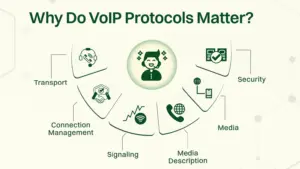
Transport protocols provide secure end-to-end connections for callers. They make sure voice and video packets reach correctly and are ordered. They can demand that the missed data be transmitted to them. UDP has become common in media delivery due to the low latency compared with TCP.
Connection management protocols handle setup, maintenance, and termination of calls. They invite participants, negotiate session details, and close connections when finished. These protocols ensure both ends agree on timing and communication parameters.
Signaling protocols exchange control information needed for communication. They identify IP addresses, manage dialing, and route calls. They negotiate codecs and formats for media. SIP is popular due to its flexibility. Such protocols also accommodate functions like call queuing, transfer, and conferencing.
Media description protocols define which types of media will be transmitted. They specify codecs, bitrates, timing, and transport settings. SDP is commonly paired with SIP to describe these details. Both endpoints agree on these parameters before audio, video, or data streams begin.
Media protocols handle real-time delivery of audio and video. They focus on low latency and proper synchronization for natural conversation. RTP is most common, often paired with RTCP for monitoring quality. They control packet-ordering, time, and place of buffering to drop network fluctuations.
Security protocols are the ones that prevent eavesdropping, fraud, and tampering, securing VoIP. They authenticate users before call participation. They encrypt signaling and media streams for confidentiality. TLS secures signaling, while SRTP protects media.
Having explored their functions, the next step is to understand the key VoIP protocols you should know and how they operate.
VoIP system functionalities depend on various networking protocols. They collaborate and make communication smooth, secure, and in real time. Each protocol has its role in signaling, negotiation, media transmission, monitoring, and encryption. So, let us take a shot at them.
SIP is the signaling protocol that acts as the “traffic controller” for VoIP calls. It encourages smooth two-way communication without requiring users to replace existing hardware. SIP is one of the most commonly used protocols and is responsible for:
When you dial a number, SIP sends messages to set up the connection between your device and the recipient’s. SIP utilizes SIP servers and registrars to facilitate device discovery and verification.
SIP handles all changes that happen during a VoIP call session. These changes are the calls you put on hold, transfer them, or add another participant.
When a conversation ends, SIP coordinates the closing of the session. It sends BYE requests that inform both parties that the connection should end.
SIP works with the Session Description Protocol (SDP) to establish technical details before media flows. It helps endpoints agree on the type of media, such as:
This ensures both devices use compatible settings for a smooth and high-quality call.
SIP employs the textual, request/response pattern, which is typical of the way web browsers interact with websites. Every SIP transaction consists of a request to a device, such as a call initiation (INVITE), and a response sent by another (such as a 200 OK) that the call is successfully accepted.
SIP messages carry information including the caller ID, media types, and codecs.
You want to up your business interaction. Use call features such as call recording features powered by SIP to improve team productivity and compliance.
Once SIP sets up the connection, RTP takes over for the following process. It handles the real-time transmission of audio and video data. RTP focuses on speed instead of guaranteed delivery. This is important because delays can harm the quality of real-time conversations.
RTP splits multimedia data into smaller packets that can be efficiently transmitted over IP. Each packet covers:
Payload: The actual audio-video information.
Header: Includes such information as:
Payload Type: Describes the kind of codec used.
RTP is frequently transported using the User Datagram Protocol (UDP). It is faster (than TCP) but connectionless with no delivery assurance. RTP is used in conjunction with RTCP to provide quality regulation and reports, and can be exercised with secure RTP (SRTP) to provide encryption.
RTCP is the companion protocol to RTP. It provides quality of service (QoS) and statistical feedback about the media streams during a VoIP call. It doesn’t carry the actual media data, but helps monitor and maintain call quality.
This feedback allows applications to adjust their transmission strategies dynamically. It can be like modifying data rates or using different codecs to optimize call quality in real time.
SDP is a format for describing the parameters of multimedia sessions. It enables endpoints to negotiate and agree on compatible media types and formats. These types of protocols are used in conjunction with signaling protocols like SIP.
SDP messages contain details like:
Devices exchange SDP messages as part of a SIP “offer/answer” process. It lets each device understand the other’s capabilities. This ability will help to establish a compatible connection for the media streams.
SRTP implements security for RTP. This aids in the safeguard of voice and video information against replay attacks, eavesdropping, and corruption.
SRTP is very important in ensuring the privacy of sensitive VoIP communication and video conferencing. These protocols accomplish privacy and data integrity.
MGCP is a management protocol that controls media gateways. They are those that translate signals between old-school telephone networks (PSTN) and IP networks.
How it Works: MGCP separates the intelligence of the network into:
With MGCP, communication between devices on the IP networks and traditional telephone lines is seamless. It is necessary in businesses that require connecting between their VoIP systems and PSTN.
H.323 is an older and complete set of protocols that deal with Multimedia communications on IP networks. It controls signaling as well as media transportation and security. Though it was common usage at some point, in contemporary systems, it has been largely superseded by the use of SIP.
History and Limitations:
The following protocols are less common than the ones above. They serve specialized use cases or play supplementary roles in VoIP communication. Some are outdated and have gradually been replaced by more modern protocols. Let’s have a look at them.
XMPP was designed with a primary goal to send instant messages, presence information, and contact lists on the Internet initially. Due to its extreme extensibility, its use has branched into VoIP, video chat, messages, and file transfer, covering real-time communication and much beyond its initial intent.
Jingle is an extension of XMPP designed for managing multimedia sessions like voice calls, video conferences, and even file transfer. It is the signaling protocol used in coordinating and preparing such sessions, but it uses RTP in transporting the media streams themselves after establishment.
IAX is a VoIP telephony protocol, SIP’s replacement, currently widely applied within Asterisk PBX. In contrast to SIP or MGCP, with split signaling and media, IAX combines them within a single data stream and single port, and thus, cloud telephony processes are much more simplified.
H.248, or Megaco, is a second protocol that is utilized alongside MGCP, such that media gateway controllers can communicate via gateways and PSTN-to-IP network conversion. It cannot provide controller-to-controller communication on its own but instead uses MGCP and other protocols.
H.320 is a narrow-band ISDN network videoconferencing standard. H.320 established the modes, terminals, and call configurations of early video landline communications. H.320 is now obsolete since the advent of high-speed IP networks.
H.324 is a low-bit-rate standard of multimedia communication over analog telephone lines. It defines technical specifications for the transmission of voice, audio, and video over the PSTN. Though it used to allow multimedia communications over shared landline infrastructures, it is no longer in common use.
SCCP is a Cisco-proprietary protocol for transport and signaling. It links, lists, and controls Cisco endpoints such as VoIP phones. It also performs analog-to-IP and IP-to-analog media translations. Because SCCP is proprietary and SIP is standards-based, SIP became the global default.
To make things more straightforward, let’s compare the major VoIP protocols side by side and see how they differ in strengths and weaknesses.
The Voice over Internet Protocol (VoIP) is based on various signaling protocols to handle calls. There are four significant types, which include SIP, H.323, MGCP, and SCCP. These are distinct in their design objectives, capabilities, and shortcomings. Here is the comparison table to clear your confusion.
| Feature / Protocol | SIP (Session Initiation Protocol) | H.323 | MGCP | SCCP | RTP | RTCP | SDP | SRTP |
|---|---|---|---|---|---|---|---|---|
| Standardization Body | IETF (RFC 3261) | ITU-T | IETF | Cisco Proprietary | IETF (RFC 3550) | IETF (RFC 3550) | IETF (RFC 4566) | IETF (RFC 3711) |
| Primary Use | Call signaling, multimedia sessions, VoIP, video conferencing | Multimedia communication (voice, video, data) | Controls media gateways from call agents | Controls Cisco IP phones and gateways | Transports real-time audio and video | Provides feedback on RTP streams, QoS | Describes session details, codecs, and media formats | Encrypts and secures RTP streams |
| Architecture | Peer-to-peer, client-server | Complex, uses centralized gatekeepers | Master-slave (controller manages gateways) | Client-server (Cisco CallManager controls endpoints) | Works with UDP/IP transport, end-to-end | Companion protocol to RTP, end-to-end | Works with signaling protocols like SIP | Layered over RTP |
| Complexity | Lightweight, text-based | More complex, binary-based | Moderate, gateway control only | Lightweight, simpler than H.323 | Lightweight, efficient, designed for speed | Lightweight, adds monitoring and control | Lightweight, descriptive format only | Moderate, adds encryption/authentication overhead |
| Scalability | Highly scalable across networks and devices | Less scalable due to complexity | Limited, depends on the call agent | Limited to Cisco ecosystems | Highly scalable for media transport | Scales with RTP sessions | Scales with signaling protocols | Scales with RTP deployments |
| Supported Media | Voice, video, instant messaging, presence | Voice, video, data conferencing | Primarily voice | Primarily voice | Audio, video, real-time data | QoS metrics, not media itself | Audio, video, data session details | Audio and video (encrypted) |
| Compatibility | Widely compatible with most VoIP systems | Mostly legacy enterprise and carrier systems | Works with PSTN interconnect via gateways | Works only with Cisco CallManager | Works with SIP, H.323, and other signaling protocols | Works with RTP sessions universally | Works with SIP, H.323, MGCP, etc. | Works with RTP-based VoIP |
| Deployment Scope | Global adoption, dominant VoIP standard | Declining, replaced by SIP in most deployments | Niche use in hybrid VoIP–PSTN networks | Cisco environments only | Universal for media delivery in VoIP | Widely used with RTP | Essential in SIP/H.323 deployments | Deployed wherever security is required |
| Best Use Case | Modern VoIP, unified communications, SIP trunking | Legacy video conferencing and telecom systems | Centralized control of gateways | Cisco IP telephony solutions | Fast delivery of real-time voice and video | Monitoring and optimizing call quality | Negotiating codecs, session setup | Secure VoIP and video conferencing |
| Future Outlook | Strong adoption and continuous development | Phasing out, legacy support only | Still used in hybrid PSTN-VoIP systems | Limited to Cisco infrastructure | Continued use, critical for VoIP media | Remains essential for QoS monitoring | Continuous importance to interoperability | Increasing adoption with security demands |
With this comparison in mind, the next question is, how do you decide which protocol best fits your business needs? To decide easily, learn the importance of the VoIP Protocol for your business.
The VoIP protocol is the foundation of how the VoIP system works. The standardized sets of protocols allow businesses to utilize cost-effective, scalable, and flexible communication solutions. Here’s what it offers to your VoIP Phone system.

The VoIP protocols establish the same platform of devices and programs. They facilitate easy interconnection between systems. This prevents issues with compatibility and helps provide cohesive business communication, regardless of technology or geographic location.
Voice data is under the control of the VoIP protocols. They give priority to the voice packets in order to avoid delays and maintain clarity of calls. This makes it possible to carry out professional communication with clients or employees, which is the key to successful business activities.
Voice information can be compressed and controlled using protocols. This saves bandwidth and avoids congestion in the network. Your company will be able to support high-quality voice calls along with the rest of the internet-related services without experiencing a lag.
VoIP specifications are based on encryption and authentication. They prevent eavesdropping and fraud on communication. This secures any sensitive business information and maintains confidential communication to and from the network.
The grouping of uniform protocols facilitates the ease of adding or dropping users and devices. This can enhance the development of businesses and enable remote work. Your communication system is alleviated, and it dynamically works as per the transforming organizational requirements.
The employment of the VoIP protocols reduces the dependence on conventional telephone lines. This minimises installation and maintenance costs. Your company will enjoy lower costs on the call and advanced communication functionalities without the high costs.
VoIP protocols place the voice traffic above other data. This maintains the cleanness of calls and is free of interruptions, even when many people are using the network. There is sound voice-based communication to support critical business requirements.
Once you understand the importance, the logical step is figuring out which VoIP protocol is right for your business setup.
Ready to scale? Manage Multiple Phone Numbers under one VoIP system to streamline business communication.
The selection of the VoIP protocol is based on your needs and desired communication features. In case you observe the market, SIP may be the ideal option. It is usually implemented to enable voice, video, and messaging. In contrast, H.323 is an earlier protocol used for voice and video conferencing.
The main aspects to consider when selecting a protocol are:
Finally, let’s summarize everything we’ve covered and see why VoIP protocols are the backbone of modern communication.
VoIP protocols are at the center of modern communication as they allow convenient, secure, and stable digital calls. They enable companies to scale, integrate, and enhance the quality of communication without the use of outdated phone networks.
The choice of the proper protocol relies on compatibility, scalability, and intended features. As the modern adoption of SIP rises to the top, enterprises can establish future readiness towards technology advancements by maintaining the cost-efficiency, flexibility, and security of their communications.
VoIP protocols are sets of rules that allow voice to travel as digital packets over the internet. They are essential because they ensure calls are clear, reliable, and compatible across devices and networks.
SIP is widely adopted because it is flexible, open-standard, and compatible with most devices. It supports voice, video, and messaging, making it ideal for businesses that want a unified communication system.
RTP carries the actual audio and video streams in real time. It ensures low delay, so conversations feel natural. Without RTP, calls would suffer from lag, jitter, or broken audio.
H.323 was once widely used for video conferencing but has been replaced by SIP due to its complexity and limited scalability. However, some legacy systems still rely on H.323 endpoints and an H.323 gateway to connect older devices with modern VoIP networks.
MGCP manages media gateways, which connect VoIP systems with the Public Switched Telephone Network (PSTN). This makes it useful for businesses transitioning from traditional telephony to modern VoIP.
VoIP calls travel over the internet, making them vulnerable to hacking, eavesdropping, or fraud. A border controller plays a key role in securing sessions, while protocols like SRTP and TLS protect calls by encrypting the data and verifying user identities.
Yes, VoIP protocols prioritize voice packets to reduce delay and interference. With features like jitter correction and codec optimization, calls can often sound clearer than those on analog phone lines.
