

What is a PBX Phone System and How Does It Work?

Communication is the pulse of any business. Whether you are a startup in a garage or a multinational corporation, if your customers can’t reach you, you don’t have a business.
Yet, there is a hidden mistake most people make when setting up their office: they confuse a “Phone Service” with a “Phone System.”
In 2026, simply having a dial tone isn’t enough. You need intelligence behind that dial tone. You need call routing, auto-attendants, and the ability to transfer a call from a desk in Dublin, OH, to a remote worker in London. This is where the PBX Phone System comes in.
This guide is your definitive resource. We will strip away the telecom jargon, explain the types of PBX systems, dissect the PBX phone system price, and help you decide between a cloud-based phone system and versus virtual PBX.
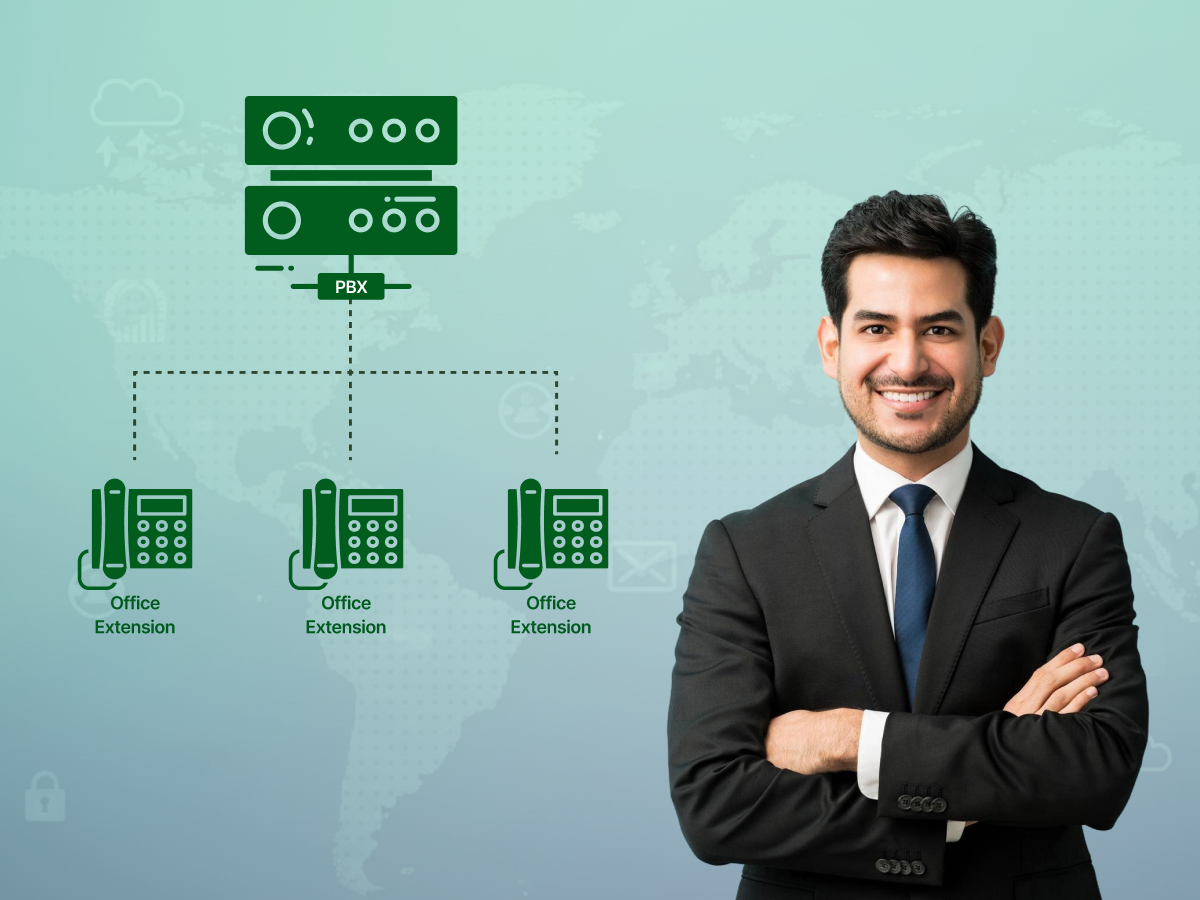
A PBX Phone System (Private Branch Exchange) is a private telephone network used within an organization that manages the switching and routing of calls between internal users and external landlines.
To truly grasp the PBX phone system’s meaning, we have to look at the history of the public phone network.
The Problem: Why “Private” Matters
In the early days of telephony, every phone on a desk needed a direct copper wire running to the local telephone company. If a business had 50 employees, it needed 50 individual subscriptions to the public switched telephone network (PSTN). This was financially ruinous and physically messy.
The PBX system was invented to solve this density problem. It acts as a “traffic concentrator.” It allows those 50 employees to share a much smaller pool of outside lines (perhaps only 8 or 10 trunks).
But it does something even more important: it creates a private branch exchange.
When you dial extension 105 to talk to Bob in accounting, that call never touches the telephone poles outside. It is routed internally by your PBX, completely free of charge.
The Evolution: From Heavy Metal to Code
The conventional small business PBX was a beast. It was a large beige cabinet mounted on a plywood board in a server closet, filled with clicking relays and punch-down blocks. If you wanted to add a new employee, you had to call a technician to physically wire a new cross-connect.
Today, the modern PBX phone system has evolved into software.
You might be thinking, “We use Slack and Zoom; why do we need a business telephone system?”
While text-based chat is great for quick internal questions, voice remains the primary channel for external trust. A centralized phone network offers credibility and control that mobile phones and standalone apps simply cannot match.
The concept of “Trunking” is the financial backbone of the PBX. By pooling resources, you reduce waste. A law firm with 50 lawyers doesn’t need 50 simultaneous external lines because they are rarely all on the phone at the exact same second. A PBX solution allows them to buy just 10 SIP Trunks (virtual lines), saving thousands of dollars a month compared to individual subscriptions.
Perception is reality. A PBX phone system for small businesses levels the playing field. When a customer calls, they should not hear a generic “Please leave a message.” Rather, they ought to be welcomed with a tailored greeting managed by an auto attendant: “Thank you for calling Acme Corp. Press 1 for Sales, Press 2, for Support.” This immediately conveys a sense of professionalism.
If your top sales rep quits today, does he take his client list with him because they all call his personal cell phone? With a PBX private system, the business owns the number. If an employee leaves, you simply reset the password on their extension and forward the incoming calls to a new hire. You retain control over your assets.
The best PBX phone system providers 2026 are not selling simple phone systems; they are selling communication hubs. A modern hosted PBX integrates video conferencing, screen sharing, voicemail to email, and CRM pop-ups. This is often referred to as Unified Communications, where your phone system talks to your email and your customer database.
To understand how a PBX phone system works, we need to step away from the marketing fluff and look at the engineering of switching systems and data networks.
Imagine the PBX as a highly intelligent traffic controller standing at the intersection of two very different roads:
When you pick up the handset on a Cisco IP PBX phone system, the phone sends a signal to the PBX server stating, “I am active.” Upon dialing a phone number, that instruction is sent via a protocol called SIP (Session Initiation Protocol). SIP serves as the communication protocol that VoIP phones use to convey “Hello,” “Ring,” and “Hang up.”
The PBX system references its directory (the Dial Plan).
Internal Call: When you dial 102, the PBX retrieves the IP address of extension 102 and connects the two phones.
External Call: When you place a call to a client, the PBX searches for an external line or SIP Trunk. It secures the line. Connects your internal device to the external network.
After the call links up, the real voice audio is transmitted via a protocol named RTP (Real-Time Transport Protocol). This is the stage where the process truly works its magic. Your voice’s analog sound is sliced into small digital packets compressed through a Codec (such as G.711 or G.729) and sent over the internet.
Upon ending the call, a “BYE” signal is transmitted through SIP. The PBX then frees the line, returning it to the pool, for the user.
The Physical vs. Virtual Diagram
The market is flooded with options. When you search for types of PBX systems, you will generally find four distinct architectures. Choosing the wrong one can lead to PBX phone system fraud vulnerabilities or wasted capital.
This is the legacy architecture, often referred to as “Big Iron.”
This is the modern evolution of the on-site box. It sits in your office but uses Internet Protocol (IP) technology.
Hosted PBX is the dominant model in 2026, often called Virtual PBX.
The bridge between two worlds.
A PBX solution is defined by its feature set. Here are the core additional features you should expect beyond simple dialing.
IVR is the “front door” of your business. An Interactive Voice Response system allows callers to navigate your organization without human intervention.
In the era of hybrid work, you are rarely at your desk 9-to-5.
The line between a phone system and a meeting platform has blurred. Microsoft Cloud PBX phone system solutions or Elevate UC cloud-based PBX phone system platforms allow you to escalate a voice call to a video conferencing session with one click.
Listening to voicemail is slow. Reading it is fast. Modern systems record the message, transcribe it using AI, and email the text to your inbox. This allows for discreet message checking during meetings.
When a customer calls, the system reads their caller ID, matches it against the database, and pops their profile up on your screen. You know who they are and what they bought last week before you even say “Hello.”
Security Features
Selecting the best PBX phone system is not about picking the one with the most flashing lights. It is about matching the technology to your business model.
Nonetheless, to evade charges for each user purchasing a dedicated office PBX phone system device (such as a Yeastar or Grandstream) could be more cost-effective over a 3-year period. These are typically classified as a small business IP PBX phone system offering a mix of affordability and sophisticated capabilities.
How do you actually build this? Whether you are looking at how to build a PBX phone system using open-source tools or deploying a commercial unit, here is the workflow.
Before you buy a single phone, check your data networks. VoIP is sensitive.
Troubleshooting PBX phone system issues is a skill in itself.
The cost of PBX phone system ownership is split into two categories: CAPEX (Capital Expenditure) and OPEX (Operating Expenditure).
| Cost Factor | Hosted / Cloud PBX (OpEx) | On-Premise IP PBX (CapEx) |
|---|---|---|
| Upfront Hardware | Low ($100/phone) | High ($2000+ Server + Phones) |
| Monthly Fees | $20 – $40 per user | $25 for SIP Trunk (Unlimited users) |
| Maintenance | Included ($0) | IT Staff or Contract ($) |
| Scalability | Click to add user | Buy hardware expansion cards |
| 5-Year TCO | Higher for large teams | Lower for large teams |
1. Hosted / Cloud PBX Model
To illustrate the impact, let’s look at a hypothetical medical practice in Columbus, Ohio.
The Before State:
The clinic used an old Panasonic analog PBX phone system. They had 4 copper lines costing $200/month. When the receptionist was on the phone, patients got a busy signal. If the office closed due to a snowstorm, they had no way to answer calls from home.
The Transformation:
They migrated to a Yeastar P-Series VoIP PBX.
The Result: Missed calls dropped by 80%. Patient satisfaction scores soared.
| Feature | On-Premise IP PBX | Hosted / Cloud PBX | Traditional Analog |
|---|---|---|---|
| Initial Cost | High ($) | Low ($) | Medium ($) |
| Monthly Cost | Low ($) | High ($) | High ($) |
| Control | Full (You own it) | Limited (Provider owns it) | Full |
| Maintenance | Your IT Team | The Provider | Specialized Technician |
| Reliability | Dependent on Power/Server | Dependent on the Internet | High (Copper lines) |
| Features | Advanced | Advanced | Basic |
| Best For | Enterprise, Hospitals | SMBs, Startups | Rural, Legacy Hotels |
The business telephone system has graduated. It is no longer a utility device hanging on the wall; it is a software application that drives the pulse of your organization.
Whether you choose a robust Cisco IP PBX phone system for your headquarters or flexible hosted PBX systems for your remote workforce, the goal remains the same: removing friction.
In 2026, the barrier between data networks and phone networks has vanished. Your voice is data. Your office is wherever you have an internet connection.
The Bottom Line: If you are still paying for individual phone lines, you are bleeding money. If your customers cannot reach a human when they need one, you are bleeding loyalty. It is time to upgrade to a PBX solution that works as intelligently as you do.
Ready to stop overpaying? Start by auditing your current bill. Look at your “per line” costs. Then, compare that to the per-user model of the best virtual PBX phone system small business options. The savings and the capabilities might surprise you.
PBX (Private Branch Exchange) is the architecture, the machine, or the software that routes the calls. VoIP (Voice over IP) is the transport mechanism, the way the voice travels (over the internet). You can have a PBX that uses VoIP (IP PBX) or a PBX that uses copper lines (Analog PBX). Most modern systems are VoIP PBX phone systems.
Yes. This process is called “Porting.” By law (in the US and many other regions), you own your phone number. You can move it from a traditional phone carrier to a cloud PBX provider. The process usually takes 1-4 weeks.
Generally, yes. Reputable hosted PBX providers use strong encryption (TLS/SRTP) to protect your calls from eavesdropping. However, the security of your local network is up to you. You must ensure your passwords are strong to prevent hacking of the PBX phone system.
If you have a cloud PBX phone system, your desk phones will stop working. However, most providers have a failover feature that automatically forwards calls to your mobile phone app or an external cell number, ensuring you never miss incoming calls
Yes, but you will need a device called an ATA (Analog Telephone Adapter) or a hybrid PBX phone system. This box converts the analog signal from your old phone into a digital signal that the IP PBX can understand. This is a popular strategy for hotel PBX phone system upgrades.
You can buy PBX phone system hardware from telecom distributors, online retailers (like Amazon for small PBX phone system units), or directly from Managed Service Providers (MSPs). For hosted PBX systems, you sign up directly with the provider online. Be cautious when buying a used PBX phone system, as it may be locked to a specific carrier or missing license keys.
