

Non-Fixed VoIP Explained: How It Compares to Fixed VoIP

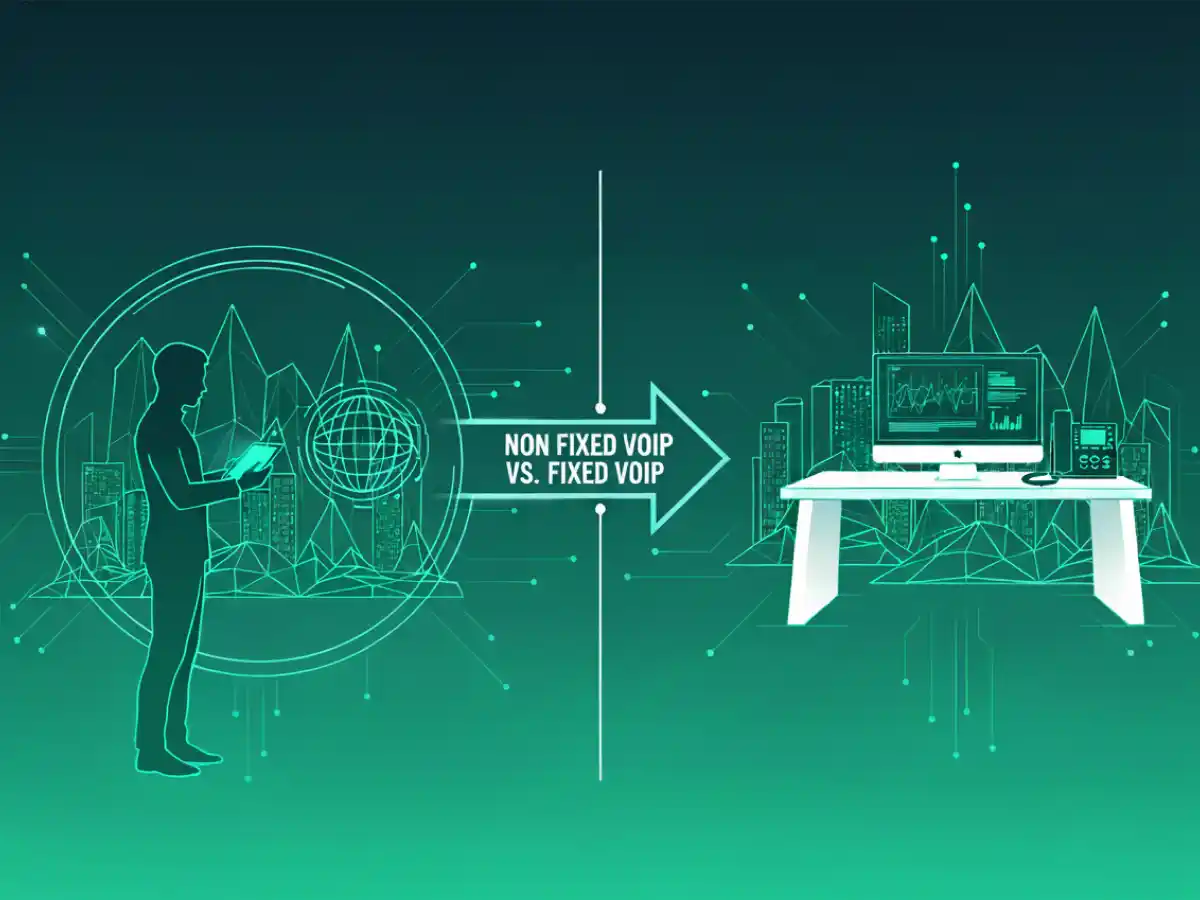
Modern businesses succeed because they are fast and flexible. You need a phone system that goes wherever you go, whether that is your home office or a coffee shop on the other side of the world. VoIP technology changes everything by moving your phones to the cloud, getting rid of expensive equipment and messy wires.
But not all internet phone services are the same. Choosing between Fixed and Non-Fixed VoIP is a big deal for your freedom, your security, and your bank account. This guide makes it easy to understand the differences so you can pick the best way for your team to stay connected while saving as much money as possible.
You and your team need to stay connected, whether you are at home, in a coffee shop, or traveling. Voice over Internet Protocol (VoIP) is the technology that enables this connection. It simply converts your voice into small data packets, which are then sent over the internet.
This adoption of cloud systems is a smart move for your productivity. Instead of paying for expensive hardware, you use a platform that handles voice, video, and text messaging all in one place. It helps you manage high inbound call volumes without needing a massive office or a complicated phone company setup.
Basically, it’s the most flexible way to handle your business communication without breaking the bank.
Non-fixed VoIP is a phone service that lives entirely in the cloud. When you register, the VoIP provider only requires an email address for your account; a physical address is not required to issue you a number. It is called “virtual” numbers. It doesn’t matter where you are; you can still choose your area code.
Let’s say you are a remote worker residing in a little town, but your target market is big cities like New York. With a non-fixed VoIP service, getting a ‘840 area code number’ is not a problem at all. When someone calls you, the caller ID shows a New York business number, even though you are in another state, just relaxing on your porch.
Compared to the other versions of internet calling, fixed VoIP is more “formal”. In order to provision the service, your VoIP carrier will have to know your actual physical location. Because the line is associated with a particular address, the telephone network treats it as more reliable and secure. It is like a combination of an old landline and a contemporary internet phone.
As an illustration, let’s say you own a small neighborhood dental clinic. The most probable option for you would be to go for a fixed VoIP system. Since it is a must for your patients and the ambulance staff to know your exact location, having a number directly connected to your building serves the purpose of allowing someone to dial 911.
While fixed and non-fixed allow you to make calls over the internet, the way they handle your identity and physical location is completely different. Understanding these nuances is key to ensuring your business communication stays professional, safe, and cost-effective.
The main differences between fixed and non-fixed VoIP are given below:
| Feature | Non-Fixed VoIP | Fixed VoIP |
|---|---|---|
| Location | Use it anywhere | Tied to your desk |
| Setup | Fast (Digital Verification) | Slower (Address Verification) |
| Security | Flexible / Nomadic | High Trust / Static |
| Emergency | Nomadic E911 | Automatic Dispatch |
Non-fixed numbers give you total independence. You could be on vacation in Italy and still receive calls on your Los Angeles business phone as if you never left.
Fixed VoIP numbers are anchored to your office; if you move your business, you have to update your records with the service provider.
You can get a non-fixed VoIP phone number almost instantly by clicking a button on a site like Dialaxy. While it’s fast, modern providers will verify your identity to keep the network safe.
Fixed VoIP takes longer because the company has to verify your physical address and business listing before it can turn the service on.
In the past, scammers loved non-fixed numbers because they were anonymous. Today, premium VoIP services use a framework called STIR/SHAKEN.
This is an industry-standard way to “digitally sign” your calls. It proves to the telephone network that you are a real business, so your calls don’t get labeled as “Spam Likely.”
Under the Ray Baum’s Act, businesses must provide a “dispatchable location” for 911 calls. Fixed VoIP does this automatically. For non-fixed VoIP, you use Nomadic E911.
It means your softphone app will ask you to update your address whenever you move to a new location. It ensures public safety personnel can find you.
While non-fixed VoIP is the go-to choice for agility, it comes with a specific set of trade-offs that every business owner should consider. Let’s look into it in detail.
The fixed VoIP also has its pros and cons. Let’s look into it.
Think of your firewall as a filter. For business communication to work, the filter needs to recognize VoIP traffic and let it pass through without delay. Let’s look into the technical requirements of it.
Your firewall blocks most incoming traffic by default. To allow phone calls, you must open specific “ports”.
Almost every router has a feature called Session Initiation Protocol Application Layer Gateway (SIP ALG). It was designed to help data packets find their way, but it often does the opposite. It inspects VoIP data and tries to “fix” the IP address, which usually corrupts the message.
If your users can’t receive calls consistently, SIP ALG is likely the culprit. Always log into your router and switch this to “Disabled.”
This is a crucial step for call quality. You need to tell your router that VoIP QoS is more important than a YouTube video or a large file download. You do this by tagging voice traffic with a “Priority” label (often called DSCP or CoS tagging).
It ensures that even if your broadband is at 99% capacity, the 1% needed for your business phone is always protected.
While both types of VoIP use the internet, they have different security needs based on their physical location.
Since fixed VoIP is tied to a specific office, you can use IP Whitelisting. This tells your firewall to only accept calls from the specific IP address of your VoIP service provider. This creates a “private tunnel” that keeps fraudsters and scammers out of your telephone network entirely.
Because your staff is moving around—using coffee shop WiFi or home internet services—you can’t whitelist a single address.
Getting a non-fixed VoIP system is a digital-first process that bypasses the old-school phone company wait times.
Start by looking at VoIP providers like Dialaxy. Check their pricing and see if they offer features like an AI receptionist or live chat integration. You want a solution that fits your growth plans.
You will be asked to choose a telephone number. You can search for specific area codes to establish a local presence in any city. If you are doing B2B sales in a different state, picking a number that matches their area code can significantly increase your outbound calls answer rate.
You’ll provide an email address and set up your account owner details. Unlike fixed VoIP, you won’t need to wait for a technician to install PBX equipment. You are simply buying access to a cloud PBX.
Download the softphone apps onto your devices. Most providers allow you to use the same number on your computer, cell phone, and tablet simultaneously. This flexibility ensures you can receive calls anywhere.
This is the most important part for businesses. Once your number is active, go into the settings and update your Caller Name (CNAM). If you leave it blank, your business number might show up as “Unknown” or be flagged as spam by carrier databases.
To make your decision easier, let’s look at the specific needs of different businesses. While non-fixed VoIP is famous for flexibility, fixed VoIP is the gold standard for security and reliability.
| If your priority is… | Choose Non-Fixed VoIP | Choose Fixed VoIP |
|---|---|---|
| Work Location | You work from home, cafes, or travel. | You have a permanent, physical office. |
| Growth Speed | You need to add 10 users in 10 minutes. | You have a stable, slow-growing staff. |
| Local Reach | You want numbers in five different cities today. | You only need one local business listing. |
| Budget | You want zero equipment or setup fees. | You can afford IP phones and installation. |
| Compliance | You need basic business communication. | You need advanced E911 and HIPAA or legal compliance. |
This is the best choice for modern, agile businesses that don’t want to be tied down by wires or long contracts.
If your office is wherever your laptop is, you need independence. You can receive calls on your cell phone using a softphone app without giving out your private number.
Example: A freelance graphic designer traveling through Europe who needs to stay reachable on a California business phone line.
When your workforce is spread across different geographical locations, you need a platform that lives in the cloud. You can manage all users from one central dashboard.
Example: A 20-person marketing team where everyone works from their own home but uses the same company phone system.
You can grab phone numbers for various area codes to build trust with local customers.
Example: A real estate investment company that wants a local presence in Phoenix, Dallas, and Miami to increase its outbound calls answer rate.
Non-fixed providers like Dialaxy can connect to CRMs such as HubSpot or Salesforce with a single click.
Example: A sales team that needs every call record and voicemail transcription to automatically sync to their customer database for better productivity.
This is the right option for established organizations where identity and safety are the top priorities.
In these industries, every second counts. Because fixed VoIP is tied to a physical location, emergency services can find the exact room or floor immediately.
Example: A local hospital where public safety personnel need a guaranteed subscriber location during an emergency call.
Fixed lines are harder to spoof and offer a more stable identity on the telephone network. This builds a higher reputation for security.
Example: A law office that frequently handles 2FA (Two-Factor Authentication) for bank verification and needs a number that financial institutions won’t block.
If you have 50 people sitting at desks, you want the stability of desk phones and SIP trunking. These systems are built for massive inbound call volumes.
Example: A customer service hub with 100 staff members who require crystal-clear audio and zero service disruptions.
If you don’t want to worry about Nomadic E911 updates or Ray Baum’s Act compliance, fixed is the “set it and forget it” choice.
Example: A manufacturing plant where safety services must be routed to a specific street address automatically.
With Dialaxy’s $10 per user pricing, the financial advantage is undeniable. A traditional fixed system for 100 agents requires a massive upfront investment that a cloud-based system completely ignores.
| Expense Category | Dialaxy Non-Fixed VoIP | Traditional Fixed VoIP |
|---|---|---|
| Upfront Hardware | $0 (Use existing laptops or phones) | $10,000+ (Physical desk phones) |
| Setup & Wiring | $0 (Digital setup in minutes) | $2,500+ (Office cabling labor) |
| Monthly Service | $1,000 ($10 per user flat rate) | $2,500–$4,000 ($25–$40 per user) |
| Maintenance | Included (No hardware to maintain) | $3,000+ per year (IT site visits) |
| Year 1 Total Cost | $12,000 | $50,000+ |
With Dialaxy’s $10 pricing, your monthly bill for 100 people is only $1,000. Most fixed VoIP providers charge three to four times that amount because they have to maintain physical lines and hardware. By choosing Dialaxy, you save approximately $38,000 in your first year alone.
If your company grows from 100 to 150 employees next month, you don’t need to call a technician or buy more desk phones. With Dialaxy, you simply add 50 more users through your dashboard at the same $10/user rate. They can start calling and texting immediately.
Even at a lower price point, you aren’t sacrificing quality. A 100-person team using Dialaxy gets access to:
For a large team, staying safe is vital. Dialaxy helps you stay compliant with the Ray Baum’s Act by allowing your employees to update their “dispatchable location” directly in the app. This ensures that if a remote worker dials 911, help is sent to the correct place.
At the end of the day, switching to VoIP isn’t just about new tech; it’s about making sure your business is ready for the future. While some old-school companies still need a phone tied to a desk, most modern teams need the total freedom that non-fixed VoIP provides.
Why pay more for a system that keeps you trapped? With a solution like Dialaxy, you can cut your phone bills by nearly 75%, paying just $10 per user. You get high-end features like AI receptionists and instant CRM integration.
Upgrade to a non-fixed VoIP solution of Dialaxy today to keep your team connected, save a fortune, and work from wherever life takes you.
A traditional landline keeps your workers stuck at a desk. This makes it hard for remote teams to work together. A virtual phone system is a better business solution because it lives on the internet. It lets everyone use the same number from anywhere, which makes team collaboration simple and fast.
Channel partners (like IT experts) act as a bridge between you and the phone company. They don’t just sell you a plan; they make sure your internet is ready for clear VoIP calling. They do this by fixing your router settings so your calls don’t drop or sound bad.
Yes! Modern VoIP does more than just make call. Most virtual phone systems let you handle sending and receiving text messages using an app on your phone or computer.
Business Professionalism: You can text customers from your business number instead of your private cell phone.
Team Access: These business solutions let many team members see and answer the same text, so nobody is left waiting.
Cost Efficiency: With a provider like Dialaxy, texting is usually included in your cheap monthly plan. This is much more affordable than a traditional landline.
Making an emergency call (like dialing 911) is a bit different on a virtual system. Since your number isn’t tied to one building, the 911 operator might not know exactly where you are. To fix this, high-quality systems use “Nomadic E911.”
Not at all! You don’t have to lose the number your customers already know. Most virtual phone providers allow you to “port” (transfer) your existing number from a traditional landline or another carrier.
With providers like Dialaxy, moving the business number to VoIP takes only few minutes.
