

Landline vs VoIP: Which Is Better for Small Businesses?

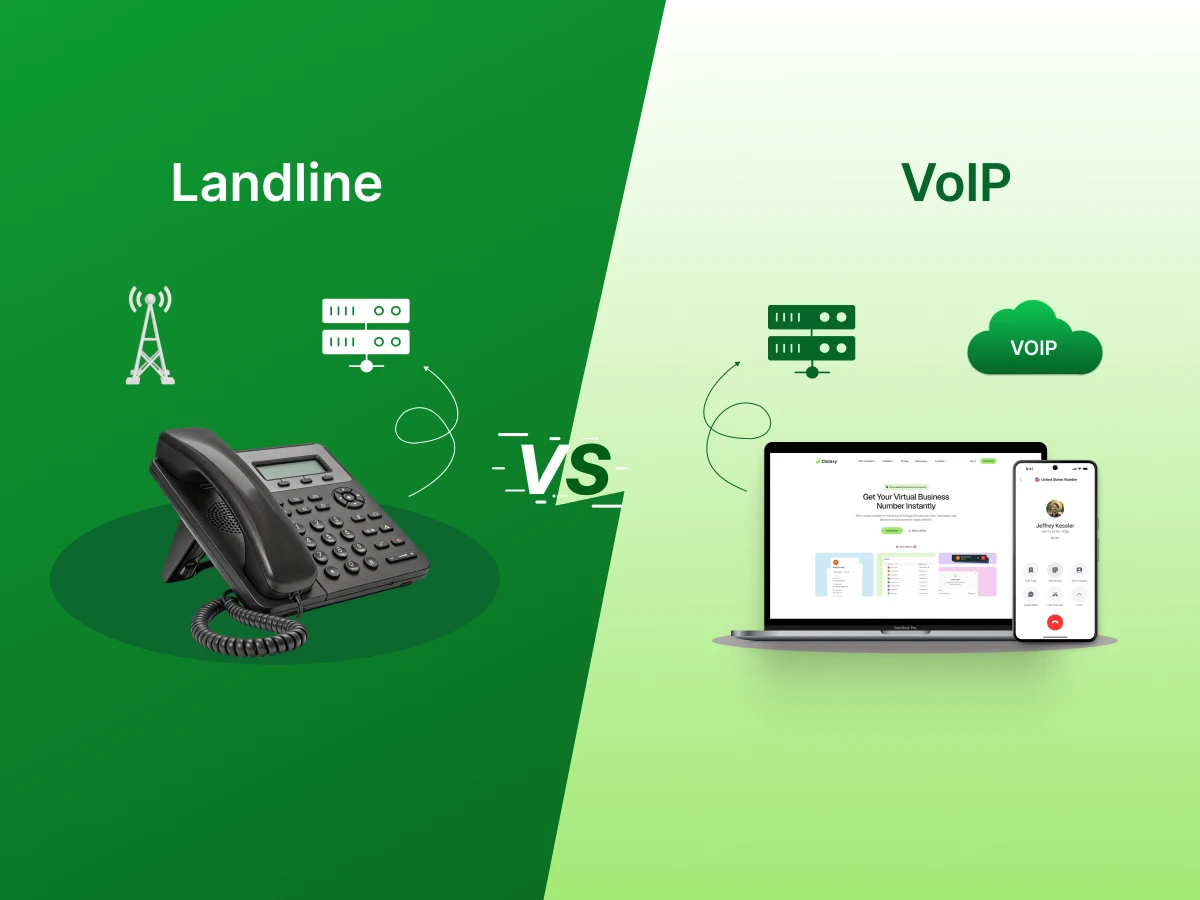
Modern business communications are at a crossroads. For years, traditional landline phones were the standard for every office. However, as company news increasingly focuses on digital transformation, the debate of landline vs VoIP has become central to operational efficiency.
A virtual phone system is no longer just a luxury for tech giants. It is a critical tool for small businesses looking to reduce VoIP costs while improving team collaboration. Understanding the key differences between these two technologies allows you to choose a phone system that supports both remote teams and in-office staff.
In this blog, we will explore the differences between landlines and Voice over Internet Protocol. We will cover VoIP features, the cost of VoIP vs landline, and how to make the switch to VoIP. At the end, you will understand the nitty-gritty of choosing the right business phone system.
When evaluating landline vs VoIP, you shouldn’t just look at the monthly bill. You need to consider the “invisible” factors that keep your business running. Based on my years in the telecom industry, here are the non-negotiables:
Your phone system is your lifeline. If a client calls and gets a busy signal or a dead line, they go to your competitor. Traditional landline phones offer “five-nines” reliability (99.999%), but a high-quality VoIP service provider like Nextiva or Dialaxy matches this through redundant data centers.
Small businesses need to preserve cash. A landline requires a massive upfront “Capex” (Capital Expenditure) for wiring and a physical PBX. VoIP is an “Opex” (Operating Expenditure) model. You pay a small monthly subscription fee, and the provider handles the expensive infrastructure in the cloud.
I once worked with a startup that grew from 3 to 25 employees in four months. If they had stayed on a landline system, they would have spent thousands on technician visits and new copper wire installs. With VoIP, they simply ordered new headsets and added users in their online partner portal.
In 2026, work happens anywhere. Your phone system must support a smartphone app or softphone on a laptop. When your staff can receive calls on their business phone number while at a job site or working from home, your productivity (578) skyrockets.
A modern system should do more than just ring. It should integrate with CRM software like Salesforce or HubSpot. It should offer call recording for training and video meetings for team collaboration. These features turn a simple phone into a powerful business communication tool.
A landline phone system is a telephone service that transmits voice via electrical signals over physical copper wire. This network is known as the public switched telephone network (PSTN), or sometimes POTS (Plain Old Telephone Service).
For over a century, this was the only way for businesses to communicate. It involves a physical connection from your office to a local central office or exchange managed by the phone company.
VoIP stands for Voice over Internet Protocol. It is a technology that converts your voice into digital signals, breaks them into data packets, and sends them over the internet.
Think of it this way: instead of a dedicated physical path (the copper wire), your voice travels the same “digital highway” as your email, your Netflix stream, and your web browsing. Because it uses your existing broadband internet connection, it removes the need for separate telephone lines.
Because VoIP is digital from the start, it is much easier for AI to process. This allows for ai receptionist features that can transcribe voicemails in real-time or analyze the “sentiment” of a customer call to help your staff provide better support.
You speak
Air pressure from your voice moves a thin diaphragm inside the handset.
Motion becomes electricity
That movement creates a matching electrical signal, a continuous analog wave.
A private path is built
The phone network reserves a single, uninterrupted circuit just for your call.
The signal travels
Electric current moves through copper wires and through switching offices, sometimes over long distances.
The call stays stable
Because no one else uses that circuit, sound quality remains steady and delay-free.
Power is supplied externally
Electricity comes from the telephone company, allowing calls even during local power outages.
Infrastructure has a cost
Miles of copper, physical switches, and constant maintenance make landlines expensive to operate.
Most small businesses use analog lines. You can tell by looking at the phone jack. A standard, small rectangular jack (RJ-11) usually indicates an analog phone. If your phone plugs into a larger Ethernet port (RJ-45) or requires an internet connection to work, you are likely using a VoIP or digital system.
VoIP is all about efficiency. It doesn’t need a dedicated circuit; it uses “packet switching.”
This entire process happens in a fraction of a second. If you have a high-quality high-speed internet connection, the sound is often better than a landline. However, if your bandwidth is low, packets can get lost, leading to static or dropped calls.
While VoIP is highly efficient, it is also sensitive. Because it shares the “road” with other internet traffic, two things can ruin your call experience:
The Fix: This is why we recommend QoS settings (Quality of Service) on your router. It tells your network to always give VoIP packets the “siren and lights” treatment, letting them skip to the front of the line ahead of other data.
Summary
The Technology: VoIP operates using packet switching rather than the circuit switching used by landlines.
Actually, no! A standard VoIP call uses about 100 kbps of bandwidth. To put that in perspective, watching one YouTube video in 4K uses as much data as hundreds of simultaneous VoIP calls. Most small businesses find that even a basic broadband plan can handle their entire staff making calls at once.
TIP: VoIP sounds like the perfect solution, but there is one hidden setting in your router that can instantly “break” your new phone system. Find out why “SIP ALG” is every business owner’s worst nightmare in our next guide.
When we discuss the landline vs VoIP debate, it is easy to lump all landlines into one category. However, landline phone systems have evolved significantly over the decades. Understanding these three specific types is crucial because they represent different levels of business communications capability and expense.
Depending on your business needs, you might still be using a system that was installed twenty years ago, or you might be using a “hybrid” that attempts to bridge the gap between copper wire and internet technology.
This is the “grandfather” of the telephone network. It is the standard single-line setup that most of us grew up with in our homes. In the industry, we call this the plain old telephone service.
How it works:
You simply plug a physical analog phone into a wall landline jack. The connection is direct and immediate. This system relies entirely on the PSTN and requires no internet or complex software.
Why small businesses still use it:
It is perfect for a very small shop, like a local bakery or a solo consulting office, that only needs one or two lines. It is famous for its reliability because it stays active during a power outage.
The Drawback:
It is “feature-poor.” With a plain old telephone setup, you lack advanced calling features. You cannot easily set up video meetings, you don’t have access to call analytics, and you certainly cannot integrate it with Microsoft Teams or other modern collaboration tools. For most growing businesses, this system is a bottleneck because it cannot scale. If you want a third line, you have to wait for the phone company to physically install it.
In the 1980s and 90s, the industry realized that analog signals had limits. To improve call quality and data transmission, Digital and ISDN (Integrated Services Digital Network) lines were introduced. This was a “mid-point” technology that offered much clearer voice signals than the plain old telephone.
The Technical Advantage:
ISDN allowed a single copper wire to carry both voice and data at the same time. It provided a faster “handshake” for calls and was the first step toward modern internet technology in the office.
Why is it fading?
While ISDN was a revolution at the time, it is mostly obsolete today. As VoIP solutions became more stable and high-speed broadband became the standard, the need for expensive digital landlines evaporated. VoIP provides better international calling rates and more advanced features for a fraction of the cost. Most carriers are now actively “sunsetting” ISDN, pushing businesses to migrate to a VoIP telephone system.
If you have ever worked in a larger office where you had to “dial 9 to get an outside line,” you were likely using an on-premise PBX system. A Private Branch Exchange is essentially a physical computer or “brain” installed in your office closet or server room.
The Complexity of PBX:
This PBX system acts as a local telephone network for your building. It allows you to have hundreds of extensions and enables internal calls between employees without using the public network. It manages call routing, auto-attendants, and voicemail for the entire company.
The High Cost of Ownership:
While powerful, an on-premise PBX system is a massive “Capex” (Capital Expenditure) burden.
The Modern Shift:
Today, most businesses are replacing these clunky boxes with VoIP solutions. A modern VoIP telephone system provides all the same extensions and call routing, but it lives in the cloud. It integrates seamlessly with Microsoft Teams for video meetings and provides deep call analytics that a physical PBX box simply cannot track.
When we look at these three types, it is clear that landlines are the “heavy metal” of the phone world. They are physical, durable, and reliable. However, they lack the intelligence of a VoIP telephone system.
In my experience, many businesses (289) get stuck in a “sunk cost fallacy.” They spent $5,000 on an on-premise PBX ten years ago, so they feel they have to keep using it. But when you factor in the high international calling costs and the lack of video meetings, the “savings” of an old system quickly disappear.
Summary
| Feature | Traditional Landline | VoIP (Voice over IP) |
|---|---|---|
| Connection | Physical copper wire | Broadband internet |
| Initial Set-up | High (Wiring & Technicians) | Low (Plug-and-play) |
| Monthly Cost | $60 per line | $25 per user |
| International Calls | Very Expensive | Low-cost or Included |
| Mobility | None (Tied to desk) | High (Anywhere via app) |
| Advanced Features | Minimal | AI Receptionist, Video, CRM |
| Reliability | Works in a power outage | Needs power & internet |
| Scalability | Hard (Needs new wires) | Instant (Add users online) |
When we analyze the pricing differences, the gap is massive.
A small business with five staff members will typically need five physical telephone lines.
That same business on a hosted VoIP plan:
The Conclusion: VoIP saves the average small business about $3,400 in just the first year. Over five years, those cost savings can fund an entire new marketing campaign or a new hire.
While most company news focuses on the low VoIP cost, the traditional landline telephone is still a strong choice for some. When you look at the key differences between landlines and a virtual phone system, there are five areas where old-school copper still wins.
Here is why you might keep those physical desk phones:
A landline telephone draws its power from the phone line itself. If your office loses electricity, your desk phones will still have a dial tone. This makes it a vital tool for emergency rooms or any business that cannot afford to be offline during a storm.
Your VoIP voice over internet service is only as good as your Wi-Fi. If your internet slows down or crashes, your calls will drop. A landline is a separate physical path. This means your calls stay clear even if your broadband is failing.
You don’t have to “log in” to a landline. There are no software updates or passwords to remember. It’s a “plug and play” system that is perfect for staff members who aren’t tech-savvy. You pick it up, and it works every single time.
A virtual phone system lives on the web, making it a target for digital hacks. A landline telephone is a closed physical loop. It is much harder for someone to “listen in” or hack your system from the other side of the world.
In many VoIP vs landline FAQs, people ask about 911 safety. Because a landline is tied to a fixed physical jack, emergency services know your exact floor and room number instantly. It is the most reliable choice for critical outbound dialing in a crisis.
The pros of VoIP are what drive businesses to make the switch:
As shown above, the VoIP costs are a fraction of traditional systems. You eliminate long-distance charges and expensive hardware upgrades.
With a virtual phone system, your office phone number lives in the cloud. Your employees can receive calls on their cell phone while sitting in a car, or on their laptop while at a coffee shop.
Small businesses can finally sound like big corporations. You get auto-attendants, call recording, call routing, and AI receptionist tools that make your customer service look world-class.
When your phone system talks to your CRM, which is a key benefit of VoIP vs UCaaS, your team becomes more efficient. When a client calls, their history pops up on the screen. This increases productivity and makes your account management much more personal.
As we move into 2026, landlines are being phased out. VoIP is constantly being updated with new features like video conferencing and real-time translation. By switching to VoIP now, you are future-proofing your business communications.
How do you make the final choice? Use this simple decision matrix:
If you’ve decided to move from landlines to VoIP, don’t just “plug and play.” Follow these steps to ensure a smooth transition (658):
Each VoIP call (185) requires about 100 kbps of bandwidth. However, you also need to check for VoIP speed test, i.e., “Jitter” and “Ping.” If your internet connection has high latency, your calls will sound laggy.
This is a setting on your router that tells your network to prioritize voice packets over other traffic. This ensures that even if someone is downloading a large file, your phone call remains clear.
Phone number porting is the process of moving your current number to your new VoIP provider. It can take 5 to 14 days. Do not cancel your old landline service until the port is complete, or you may lose your number forever.
Check reviews for uptime, customer service, and security. Look for a VoIP provider that offers a partner portal where you can easily manage your settings.
A virtual phone system has more functionality than an old phone. Make sure your staff knows how to use the mobile apps, how to access voicemails in their email, and how to start a video meeting.
The battle of landline vs VoIP is effectively over. For 95% of small businesses, VoIP is the absolute winner. It is more flexible, it is much cheaper, and it integrates with the digital tools you use every day. It allows your team members to be more productive and gives your business a professional image that landlines simply cannot provide.
You should only choose a landline if you are in a location where the high-speed internet connection is completely nonexistent or if you have a legal safety requirement for a physical wire.
Don’t let an outdated phone system hold your business back. Find out which VoIP provider has the highest-rated customer support in our next comprehensive comparison guide.
In All the post should be change FAQ (v3)
Yes, as long as you use encryption. Look for a VoIP system (215) that supports SRTP (Secure Real-time Transport Protocol) and TLS. This ensures that even if someone intercepts your data packets, they cannot listen to your conversations.
Yes, but you will need an analog telephone adapter (ATA). This device acts as a bridge between your old analog phone and your internet connection. However, for the best call experience, we recommend investing in modern ip phones.
Burying the answer! The most common mistake is not checking the upload speed. Most internet plans are fast for downloading but slow for uploading. Since a VoIP call (186) requires sending data out, a slow upload speed will ruin your voice quality.
Not on its own. However, a VoIP system is smarter than a landline. You can set an “Automatic Failover” rule. If the system detects that your office power is out, it instantly sends all calls to your cell phones (340). Your customers will never even know there was an issue.
