

Local Caller ID: Definition, Benefits, and Use Cases

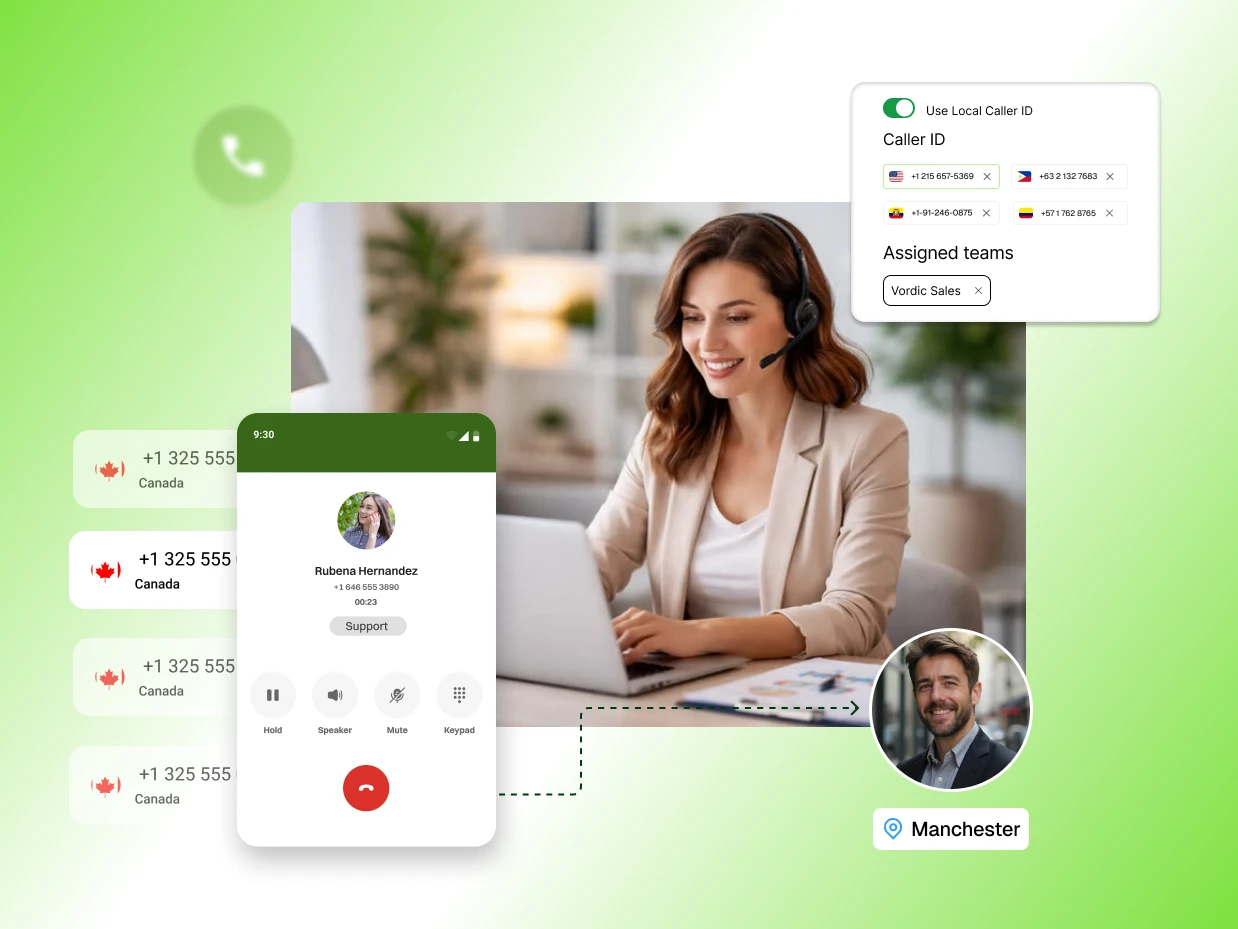
Making successful outbound calls is harder than it used to be. Most people do not pick up the phone when they see a random or blocked number. This happens because spam calls have made everyone suspicious. If your sales teams use a generic business phone, your answer rates will likely stay low.
To fix this, companies use local caller ID to show a familiar local area code on the recipient’s screen.
When a sales rep calls a lead, the caller ID display shows a number that looks like it belongs in the lead’s neighborhood. This simple change can increase answer rates significantly.
Whether you run a small contact center or a large outbound sales team, your communications platform needs this feature. It helps your business calls stand out from the noise. This article covers everything from the Caller ID Act to setting up local numbers for your team.
Local caller ID is a technology that allows your business to display a local area code when making outbound calls, regardless of your actual physical location or office.
This feature allows a phone system to provide localized identification to the person receiving the call. When you use a local phone number, you establish immediate trust. It is not just about the digits on the screen. It is about appearing relevant to the person you are trying to reach. Most outbound caller IDs show a company name or a headquarters number. However, a local caller identity uses a local area code that matches the prospect’s location.
Modern communications platforms integrate this directly into their sales dialer. It ensures that your outgoing caller ID matches the region of the person you call. This is not about hiding who you are. It is about making your business calls look professional and approachable. By using local caller ID, you bridge the gap between a cold call and a local conversation.
The technology uses intelligent call routing to detect the destination of your call and then automatically selects a matching local number from your available pool of resources.
Behind the scenes, the communications platform manages a large database of caller IDs. The platform overview usually shows how these numbers are assigned to different regions.
Once the call is placed, the caller ID display shows the local number to the recipient. This system ensures increasing connection rates without manual work from your team. You can also view the system status to ensure your numbers are active and not flagged as spam.
Standard caller ID shows one fixed number for all calls, while local caller ID changes based on the location of the person you are currently trying to reach.
| Feature | Standard Caller ID | Local Caller ID |
|---|---|---|
| Area Code | Remains the same (e.g., your HQ). | Matches the recipient’s local area. |
| Trust Factor | Low; often ignored as spam. | High, looks like a local neighbor. |
| Answer Rates | Usually lower for cold calls. | Proven to boost answer rates. |
| Setup | Simple, one-time configuration. | Requires setting up local number pools. |
| Cost | Included in basic plans. | Often part of local presence add-ons. |
| Return Calls | Go back to your main office line. | Can return calls to specific reps. |
Standard ID uses a single business phone number. If your office is in New York and you call California, the Californian sees a New York number. With local caller ID, that same call shows a California area code. This difference is the key to increasing connection success in modern sales.
Using local numbers provides several strategic advantages, from better trust to improved data insights that help your sales teams perform better and reach goals faster.
Different businesses have different needs, so providers offer various options like static local numbers, dynamic local presence, and specialized two-way voice features for teams.
From real estate to healthcare, localized calling helps professionals reach their clients more effectively by breaking down the barrier of the unknown long-distance number.
Agents use local caller ID to call homeowners in specific neighborhoods. A local number makes the agent seem like a neighbor rather than a national corporation. This helps when making cold calls about property listings.
Agencies find that answer rates go up when they use a local phone number. People are more willing to discuss private matters when the call feels local and personal.
Sales teams use a sales dialer to reach leads across the country. By automatically matching the area code, they ensure their outbound calls are not ignored. This helps them hit their targets and start free trial signups.
Clinics use local caller ID for appointment reminders. Patients are more likely to answer calls from a local area code they recognize as belonging to their doctor’s city.
Local numbers are essential for inbound communication, enabling customers to reach you without incurring long-distance charges or feeling disconnected.
Local caller numbers on the missed call list tend to attract a customer’s attention and will likely cause a customer to call back. These return calls must be dealt with flawlessly by your phone system. Call forwarding will allow you to direct these calls to any mobile or desk phone. That way, you won’t miss any leads.
Many businesses use local presence numbers as their primary contact points. In your platform overview, you can see which local numbers get the most inbound traffic. You can also use call transcription to keep records of these conversations. This turns a simple outbound sales tool into a full-service communications platform.
Regulations such as the Truth in Caller ID Act are important for staying legal with localized calling, as they dictate the proper and safe ways in which businesses can identify their phone.
Federal regulations require local caller ID to be ethical and clear between caller and receiver to prevent fraud or deceptive communication practices.
Monitoring your system status ensures your numbers remain in good standing with carriers. Providers like United World Telecom help you register your numbers to maintain high connection rates and avoid spam protection filters.
Setting up a localized presence is a straightforward process that involves choosing a provider, selecting your numbers, and integrating them into your existing workflow.
Step 1: Choose a VoIP or virtual phone number provider
Find a solid communications platform that offers local presence packages. Look for a phone system with broad country coverage and good spam protection to keep your outbound sales running.
Step 2: Select area codes aligned to your target regions
Pick a local area code for each city you target. This ensures every sales rep makes calls that look familiar. Focus on regions where you have the most prospects.
Step 3: Assign numbers to your team or campaigns
Link your new numbers to your sales dialer or power dialer. This allows your team to use different caller IDs depending on which specific marketing campaign they are running.
Step 4: Configure outbound caller ID settings
Access your system settings to ensure your outgoing caller ID shows the right name. Proper configuration helps you provide localized service and improves the overall caller ID display experience.
Step 5: Test and verify what recipients see
Call a test device to check the area code. Verifying your settings helps you boost answer rates and ensures your phone system is correctly automatically matching the right numbers.
While similar, local caller ID is the identity shown, whereas local presence dialing is the automated process of selecting that identity during a high-volume campaign.
| Feature | Local Caller ID | Local Presence Dialing |
|---|---|---|
| Core Concept | This is the actual local phone number shown on the caller ID display. | This is the technology that manages and automatically selects numbers for your team. |
| Functional Goal | It serves as the physical identity for any of your business calls. | It is a smart feature inside a sales dialer or a power dialer. |
| User Action | A sales rep usually assigns these specific numbers to their outgoing calls. | The system automatically matches the area code of the person being called. |
| Sales Impact | It provides a familiar local feel to help you reach regional leads. | It helps sales teams boost answer rates across thousands of outbound calls. |
| Best Use Case | Small campaigns focusing on specific cities or a single local area code. | Large contact center operations that need to scale outbound sales efforts quickly. |
The right provider offers more than just numbers; they provide reliability, compliance tools, and advanced features like AI call insights and full platform support.
Look for a provider like United World Telecom that has experience in the industry. You need a phone system that offers high connection rates and low latency. The platform overview should be easy to use. It should give you access to call recording, call transcription, and AI call insights.
Check if they offer local 2-way voice and toll-free flexdial. These features give you more flexibility. Also, ensure they have strong spam protection to keep your numbers from being blocked. A good provider helps you set up local caller IDs quickly so you can focus on making sales calls.
Understanding local caller ID is the first step toward better sales. We have looked at how it works and why it is so effective for outbound calls. By matching the area code of your prospects, you build instant trust. Using a professional communications platform makes the process easy. This leads to increasing connection success and better conversations for your sales rep.
If you want to boost answer rates today, start by setting up local numbers for your most important markets. Most providers let you start free trial periods to see the results yourself. Stop letting your business calls go to voicemail.
Switch to Dialaxy and see how your answer rates climb!
No, it is not the same. Caller ID spoofing is often used to hide an identity or commit fraud. Local caller ID is a legitimate business practice used to provide a localized calling experience. As long as you comply with the Caller ID Act, it is a standard professional communication method.
Local caller ID increases trust by displaying a familiar area code. People are generally more likely to answer calls from local numbers than unknown long-distance numbers, helping businesses improve connection and response rates.
Yes. With two-way calling capabilities, customers can return calls to your local number. The system can then use call forwarding or routing rules to connect callers with the appropriate sales representative or support team.
Yes, most local caller ID solutions are provided through VoIP-based communication platforms. These systems can automatically display different local caller IDs depending on the destination of the call.
Yes, local caller ID is legal in the United States and many other countries. However, businesses must follow truth-in-caller-ID regulations and cannot use the technology to mislead, harm, or defraud people.
You can typically choose from a wide range of local area codes offered by your provider. Most providers offer extensive coverage across multiple cities, regions, and states.
You can configure local caller IDs through your communications platform dashboard. After assigning local numbers to your team, the system or power dialer automatically selects the most relevant caller ID for outbound calls.
Local caller ID uses a geographic area code associated with a specific city or region, while toll-free caller ID uses numbers such as 800, 888, or 877. Local numbers often achieve higher answer rates because they appear more familiar and personal.
Yes. Most modern sales dialers and VoIP platforms integrate with CRM systems, allowing you to track calls, access customer information, and review call analytics directly within your CRM.
You need a provider that offers international coverage and local numbers in multiple countries. The system can display a local number in the recipient’s country, helping improve trust and answer rates for international outbound calls.
