You just hung up with customer service, and a new question pops up: “What did they mean by FCR? And what’s an IVR?” Many customers face the same confusion after calls.
Call centers also have their own abbreviated language to accelerate the process, yet the local language may confuse customers and new employees. Knowing the terms is better so that everyone can communicate more properly.
Understanding these abbreviations isn’t just helpful, but it also leads to faster solutions and smoother interactions. For call centers, it also supports better performance tracking while keeping customers informed and empowered.
This blog will explain the most common call center abbreviations. We’ll cover smart ways to use these terms clearly.
🔑Key Highlights
Knowing the abbreviations of call centers reduces miscommunication and results in quicker resolution of issues.
With knowledge of the common call center terms, customers have greater control and understanding.
Metrics such as FCR, CSAT, and AHT can be measured using abbreviations in call centers.
Consistent use of shorthand improves training, quality assurance, and operational clarity.
Proper use of abbreviations strengthens customer experience and internal productivity.
Why are Call Center Abbreviations Crucial for Consumers and Call Centers Alike?
We should know why these call center abbreviations exist before we get to the specific terms. They play key roles for both people seeking help and the companies giving it. This dual benefit makes them essential for smooth center operations, especially for faster call answering.
To better understand the importance, let’s see how call center abbreviations benefit both customers and the centers themselves.
For Consumers
Knowing call center abbreviations can really change your experience. It helps you deal with customer service more effectively. This knowledge lets you take a more active role.
Improved Communication & Efficiency:
Understanding an agent’s terminology helps you grasp the situation more quickly.
It reduces the need for repeated explanations, saving time for both sides.
This makes the conversation smoother and more efficient.
Example: Knowing that “FCR” means resolving your issue in the first interaction helps align expectations and improves the overall experience.
Empowerment:
Having knowledge puts you in a stronger position during interactions.
Speeds up writing, discussion, and understanding in busy environments, essential for meeting SLA standards.
It helps you see how call center systems work to meet service goals.
This leads to more informed, productive conversations and better overall experiences during inbound calls.
Faster Resolution:
Understanding troubleshooting terms helps you follow the agent’s steps more easily.
You can provide accurate information without delays.
This directly speeds up problem resolution and improves overall customer satisfaction.
Example: When an agent says they’ll “create an SR (Service Request)”, it means your issue is officially recorded, making follow-ups easier.
Avoiding Misunderstandings:
Technical language can often lead to confusion or mixed messages.
Understanding call center abbreviations helps reduce the risk of misinterpreting instructions.
This is especially important when dealing with complex or technical issues.
Clear communication prevents frustration and ensures smoother interactions for everyone.
Building Connection:
Although not the primary goal, understanding a bit of an agent’s internal language can help build a stronger connection.
It shows that you’re interested and willing to meet halfway, making the interaction more positive and cooperative.
It also encourages smoother communication with the customer service representative.
Example: Saying “I understand you’re aiming for FCR here” shows that you’re on the same page.
For Call Centers
Call center abbreviations aren’t just handy; they are important for any call center operation to run well. They make internal processes smoother. They also ensure consistency across all departments.
Internal Efficiency & Speed:
Call center abbreviations help supervisors, agents, and support staff communicate quickly without long explanations.
Speeds up writing, discussion, and understanding in busy environments, essential for meeting SLA standards.
Example: Instead of saying “The average amount of time an agent spends talking on the phone and doing after-call work,” they simply say “AHT.”
Consistency & Standard Service:
Standard call center acronyms ensure everyone speaks a common language across agents and shifts.
Supports training, quality checks, and consistent service in overall center operations.
Tip: Regular training refreshers on abbreviations prevent misunderstandings from creeping in.
Performance Tracking:
Most call center metrics are tracked using abbreviations, making reporting and monitoring easier.
Abbreviations help track KPIs like agent performance efficiently.
Example: A team leader can quickly check an “agent’s AHT and FCR” without reading long sentences.
Lists of Common Call Center Abbreviations
Now that we understand why these call center abbreviations are used, let’s look at the main part of this blog: a full list of the most common terms.
We have classified them into definite groups so that you can understand. On each, you will see the brief description.
I. Performance & Operational Metrics
These call center abbreviations show how well a call center is doing. They measure how fast and how happy customers are. They are critical KPIs.
AHT (Average Handle Time): AHT (Average Handle Time) is the total time an agent spends with a customer. It starts when they first say hello, includes all your talking, and ends when they’re done with any tasks tied to your call.
ACW (After Call Work): ACW (After Call Work) is the update a customer service person handles right after a conversation finishes. Things like updating notes, sending follow-up emails, or scheduling something for later.
FCR (First Call Resolution):FCR (First Call Resolution) is when your issue is fully solved during your very first call. It means no need for follow-up calls or transfers.
SLA (Service Level Agreement): SLA (Service Level Agreement) is a promise about the expected level of service. It often includes how fast they should respond, how quickly problems should be solved, or how available service should be.
ASA (Average Speed of Answer): ASA (Average Speed of Answer) is the average time it takes for an agent to answer an incoming call after it has been routed.
CSAT (Customer Satisfaction Score):CSAT (Customer Satisfaction Score) is a direct measure of how happy a customer is with a specific interaction or service. It’s usually asked in a survey, like “How satisfied were you with your experience?”
NPS (Net Promoter Score): NPS (Net Promoter Score) is a way to measure customer loyalty. It shows how likely a customer is to tell their friends about a company’s product or service, usually on a scale of 0 to 10. This is also called net promoter.
CES (Customer Effort Score): CES (Customer Effort Score) measures how much effort a customer had to put in to get their issue solved or question answered. Often asked, “How easy was it to handle your request?”
KPI (Key Performance Indicator): A KPI (Key Performance Indicator) is a measurable value used to see how well an organization, employee, or activity is meeting its goals. These are the “targets.”
QA (Quality Assurance): QA (Quality Assurance) is the process of checking and reviewing how customer service representatives interact with customers (on calls, chats, and emails) to ensure they meet standards and follow rules.
OCC (Occupancy Rate): OCC (Occupancy Rate) is the percentage of time agents spend actively helping customers. This includes inbound calls, chats, and ACW. It’s compared to their total available time.
QoS (Quality of Service): QoS (Quality of Service) is a measure of how a system, network, or service performs. It ensures reliability, speed, and efficiency for users by prioritizing critical tasks or traffic.
ROI (Return on Investment): ROI (Return on Investment) is a measure of the profit or benefit gained from an investment relative to its cost.
TCO (Total Cost of Ownership): TCO (Total Cost of Ownership) is the complete cost of acquiring, operating, and maintaining an asset or system over its entire lifecycle. It includes all expenses such as purchase, operation, maintenance, and disposal.
II. Interaction, Routing & System Components
These call center abbreviations describe the technology and processes that link you to the right agent. They ensure a smooth trip through the phone system. This often relies on call center software.
IVR (Interactive Voice Response):IVR (Interactive Voice Response) is an automated phone system that talks to callers, collects information (like when you press a number), and then sends your call to the right person or department.
ACD (Automatic Call Distributor): ACD (Automatic Call Distributor) is a system that automatically sends incoming calls to available agents or specific departments. It uses rules like skillbased routing.
CRM (Customer Relationship Management): CRM (Customer Relationship Management) is a system or call center software used to manage and analyze customer interactions and data. It follows the customer through their journey, aiming to build better business relationships.
CMS (Call Management System): CMS (Call Management System) is call center software that manages and monitors call center operations. This often includes call routing, reporting, and agent performance tracking.
CCaaS (Contact Center as a Service):CCaaS (Customer Center as a Service) is a cloud-based software that provides all the tools a contact center needs (like call routing, IVR, and customer info integration). Another company hosts and manages it online.
DMS (Document Management System): DMS (Document Management System) is a system used to store, manage, and track electronic documents and files.
PBX (Private Branch Exchange): PBX (Private Branch Exchange) is a private phone system used within a company, allowing internal calls between users and shares outside phone lines.
PSTN (Public Switched Telephone Network): PSTN (Public Switched Telephone Network) is the global network of traditional phone lines that carries regular voice calls.
API (Application Programming Interface): API (Application Programming Interface) is like a set of rules that let different software programs chat with each other and swap information, helping systems like customer information and automated phone menus work together.
VoIP (Voice Over Internet Protocol):VoIP (Voice Over Internet Protocol) is a technology that lets you make voice calls using an internet protocol connection instead of a traditional phone line.
SIP (Session Initiation Protocol): SIP (Session Initiation Protocol) is a communication protocol used to initiate, manage, and end real-time sessions over IP networks. It can include VoIP, video calls, or SMS.
Text-to-speech (TTS): TTS (Text-to-speech) is a technology that lets computers or devices “talk” by turning written text into spoken words.
Virtual Private Network (VPN): A Virtual Private Network (VPN) is a technology that establishes a safe, encrypted connection for your data to travel over the internet.
Omnichannel contact center: An omnichannel contact center lets customers communicate across multiple channels, such as phone, chat, email, or social media, and get a smooth experience.
III. Issue, Support & Resolution Related Terms
These call center abbreviations describe the actual process of solving problems. They help explain your request. They also track its journey until it’s fixed. This is vital for call resolution.
IR (Issue Resolution): IR (Issue Resolution) is the entire process of addressing and resolving a customer’s problem or concern.
SR (Service Request or Service Record): SR (Service Request or Service Record) is a formal request from a customer for help, support, or information, which usually gets its own unique tracking number.
CRN (Customer Reference Number / Case Reference Number): CRN (Customer Reference Number) is a unique ID number assigned to a specific customer interaction or issue, which is crucial for follow-up.
Customer Lifetime Value (CLV):CLV (Customer Lifetime Value) is an estimate of how much money a customer is expected to spend with a business over their entire time as a customer.
TSR (Technical Support Representative): TSR (Technical Support Representative) is an agent specifically trained to handle technical issues.
Abandonment Rate: Abandonment Rate is the percentage of callers who hang up before an agent answers their call, or before their inbound call is successfully connected.
Predictive Dialer: Predictive Dialer is a software that automatically dials a list of numbers and only connects the answered calls to available agents. This is key for outbound call centers and is part of the automated calling process.
Power Dialer: A power dialer is similar to a predictive dialer, but it dials one number at a time. It only moves to the next number when an agent is ready. It is often used for outbound calls.
Sentiment Analysis: Sentiment analysis is a software that checks recorded calls to find keywords, emotions, and trends. It helps figure out the overall feeling (positive, negative, neutral) of customer interactions.
Customer Experience (CX): CX (Customer Experience) is how customers feel about every interaction they have with a company, from browsing to buying to getting help.
Call & Contact Center
Inbound Call Center: What It Is, Benefits & How It Works
These call center abbreviations describe internal ways of working. They involve staffing decisions. They also include management roles that keep the call center running smoothly. They are vital for workforce management.
WFM (Workforce Management): WFM (Workforce Management) is the process of making a workforce as productive as possible, which includes forecasting future needs, scheduling, and watching agents in real-time.
QC (Quality Control): QC (Quality Control) refers to the checks and processes in place to maintain high service quality. It is similar to QA.
BPO (Business Process Outsourcing):BPO (Business Process Outsourcing) is when a company hires an outside firm to handle a specific business process. It often involves non-core functions like call center operations.
SA (Speech Analytics): SA (Speech Analytics) is a software that looks at recorded calls to find keywords, emotions, and trends. It is used for quality monitoring, agent training, and understanding customer interactions.
Hold Time: Hold Time is how long a customer waits on hold for an agent.
Idle Time: Idle Time is the time an agent is logged in but not actively on a call (talk time) or doing ACW (After Call Work).
Business Continuity/Disaster Recovery (BC/DR): Business Continuity and Disaster Recovery (BC/DR) refers to the company’s ability to keep important functions operational during and after a disaster.
Although abbreviations in a call center are essential to internal efficiency, the actual value of the abbreviation is in its proper use. To customer-oriented companies, this is a measure approach.
Here’s how to use call center abbreviations the right way.
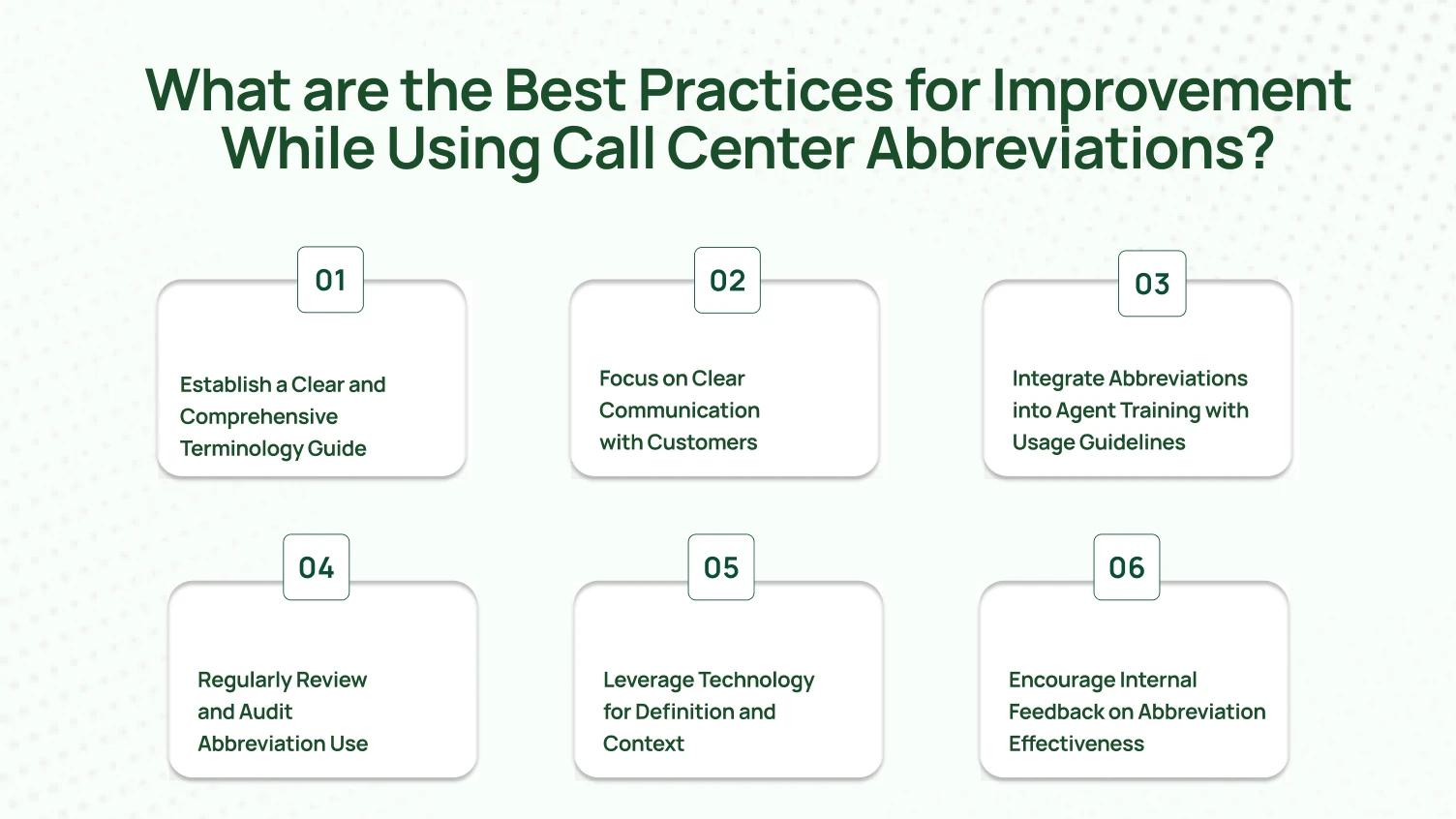
What are the Best Practices for Improvement While Using Call Center Abbreviations?
1. Establish a Clear and Comprehensive Terminology Guide
Make a single, official document for all approved call center abbreviations. Include their full terms and simple, clear definitions. The terminology should be easy for all employees to find. This helps with workforce management and consistent training.
Include examples of how to use them correctly. Note any differences by region or department. Update this document regularly as call center operations change.
2. Focus on Clear Communication with Customers
Don’t use technical terms with customers. If an abbreviation has to be used, explain it right away. The goal is to inform, not confuse. This is important for improving customer understanding.
Train agents to spot when they’re using internal technical terms. Prompt them to rephrase or explain. Do anonymous calls to check this.
3. Integrate Abbreviations into Agent Training with Usage Guidelines
New agents need thorough training on call center abbreviations. This isn’t just about memorizing. It’s about understanding when and how to use them correctly, especially when talking to customers. This is key for new center operators.
Use role-playing where agents practice explaining call center abbreviations to customers. Give them a “cheat sheet” during initial training.
4. Regularly Review and Audit Abbreviation Use
Call center abbreviations can change or become overused. Periodically check which terms are truly needed. See which ones might be confusing. This ensures clarity in center operations.
Survey agents. Listen to recorded calls to find areas where abbreviation use is unclear or excessive. This is part of quality monitoring.
5. Leverage Technology for Definition and Context
Implement internal tools. These include CRM integrations and internal knowledge bases. Agents can quickly look up definitions if they’re unsure. Or call center abbreviations can be automatically expanded for documentation. This is helped by call center software.
To maximize efficiency and maintain clarity, it’s important to follow structured best practices when using call center abbreviations.
6. Encourage Internal Feedback on Abbreviation Effectiveness
Create ways for agents and team leaders to give feedback. They can comment on how clear and useful existing call center abbreviations are. Are new ones needed? Are some old or confusing? This helps improve call center operations continuously.
Hold regular “lingo review” sessions. Or set up a suggestion box for feedback on abbreviations.
Conclusion
We’ve explored the world of call center abbreviations. We’ve seen their important role in both efficient operations and positive customer engagement. From performance indicators like AHT and FCR to system components like IVR and CRM, these terms are fundamental to modern customer service.
By understanding the special language, customers gain more clarity and feel more in control of their support interactions. At the same time, call center operators can communicate more effectively. The main point is that while call center abbreviations are Important, their strength comes from being thoughtful. This leads to a better customer experience.
FAQs
Which abbreviations relate to routing, telephony, or system components?
Key call center abbreviations here include:
IVR (Interactive Voice Response) for automated menu systems
ACD (Automatic Call Distributor) routes calls
CRM (Customer Relationship Management) handles customer data
VOIP (Voice Over Internet Protocol) deals with Internet protocol-based calling technology
How can I keep track of and remember so many abbreviations?
Here are some practical strategies to help you remember them effectively.
Keep track of abbreviations through practice.
Start with the most common ones you hear or see.
Link abbreviations to a mental image or simple phrase.
Use flashcards or internal glossaries, especially as a new agent.
Focus on abbreviations that directly affect your interactions (e.g., FCR, CRN).
Consistency and regular exposure are key to mastering call center terminology.
Can the same abbreviation have different meanings in different call centers?
Yes, that can happen. While many main call center abbreviations (like AHT, FCR, CRM) are generally understood across the industry, some less common or internally made call center acronyms might have company-specific meanings. That is why official terminologies are so important for call centers.
What does FCR stand for, and why is it valued in call centers?
FCR stands for First Call Resolution. It’s highly valued because it means both efficiency and customer satisfaction. When an issue is solved on the first contact, customers save time and effort. This leads to higher CSAT and lower CES.
Do call center abbreviations have universal meanings?
More core operational and performance indicators (call-centric metric) abbreviations have widely accepted meanings across the call center industry. Examples include AHT, FCR, CSAT, and NPS.
What is the 80/20 rule in a call center?
The 80/20 rule means roughly 80% of calls, issues, or results come from 20% of causes. In call centers, it helps identify top problems, key customers, or high-performing agents to focus on for efficiency.
Ready to transform your business telephony?
Dialaxy gives your team local numbers in 100+ countries, smart call
routing, and a centralized dashboard — all set up in under 90 seconds.
George Whitmore is an experienced SEO specialist known for driving organic growth through data-driven strategies and technical optimization. With a strong background in keyword research, on-page SEO, and link building, he helps businesses improve their search rankings and online visibility. George is passionate about staying updated with the latest SEO trends to deliver effective, measurable results.