

The Ultimate Guide to Call Center Metrics and KPIs for 2026

Your call center is important to your business. To make it great, you must know your call center metrics and KPIs. These important numbers show how well your team is working. They are not just for managers.
Good metrics save your company money and help you find problems quickly. They also make your customers much happier.
This guide will show you every key call center metric for your business. Learn how to use this data to boost service quality, improve team focus, and ensure long-term business success.
It’s easy to think these numbers are just for the managers. But call center metrics are very important for the business’s success. We track these numbers for three main reasons:
When you focus on treating customers well (good Customer Experience or CX), they are more likely to stay with us and buy more. Fixing a problem on the first call means the customer doesn’t call back. This saves us money because we don’t have to handle the same call twice.
Metrics are like a map. They quickly show us problems in our work. If one product makes people wait a long time or makes them angry, the numbers point us right to that problem. We can then fix it fast.
KPIs give every agent a clear goal. We don’t just say, “Be helpful.” We say, “Get a CSAT score above 90%.” This helps everyone work together to give great service every time.
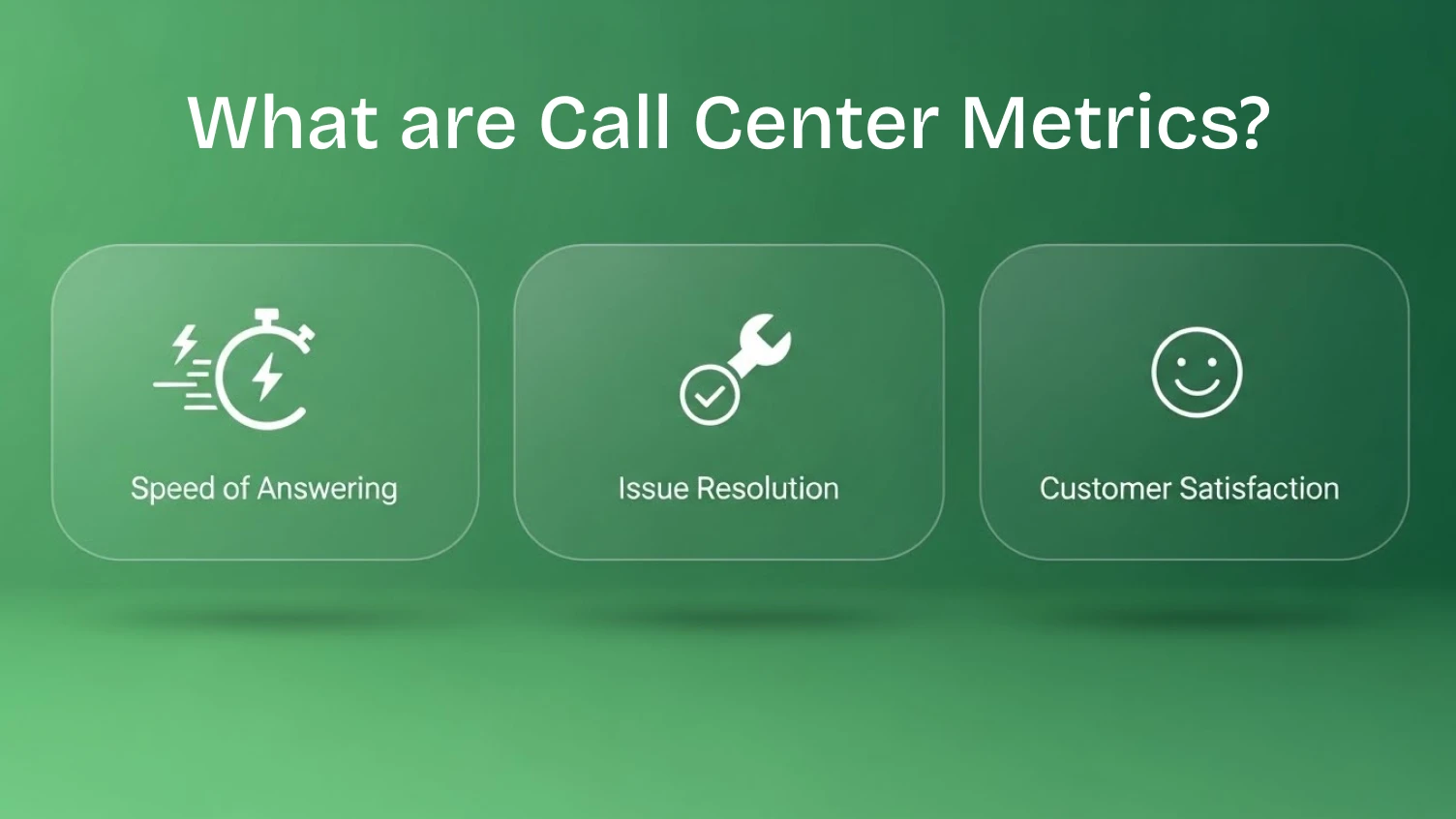
Every good business needs its customers. The contact center is where we work with those customers every day. That’s why we use Call Center Metrics and KPIs (Key Performance Indicators).
Simply put, Metrics are the important numbers that show how your team is doing. They are like a report card for the whole job. These numbers help us understand:
In the past, call centers only cared about being fast. They wanted a low Average Handle Time (AHT).
But quick service that doesn’t fix the customer’s issue is bad service. The customer will just call back later. This makes the customer angry and costs the company more money.
So, we stopped focusing only on speed. Now, we focus on the quality of the service. We want to know how the customer feels about the whole process. This focus is called Customer Experience (CX).
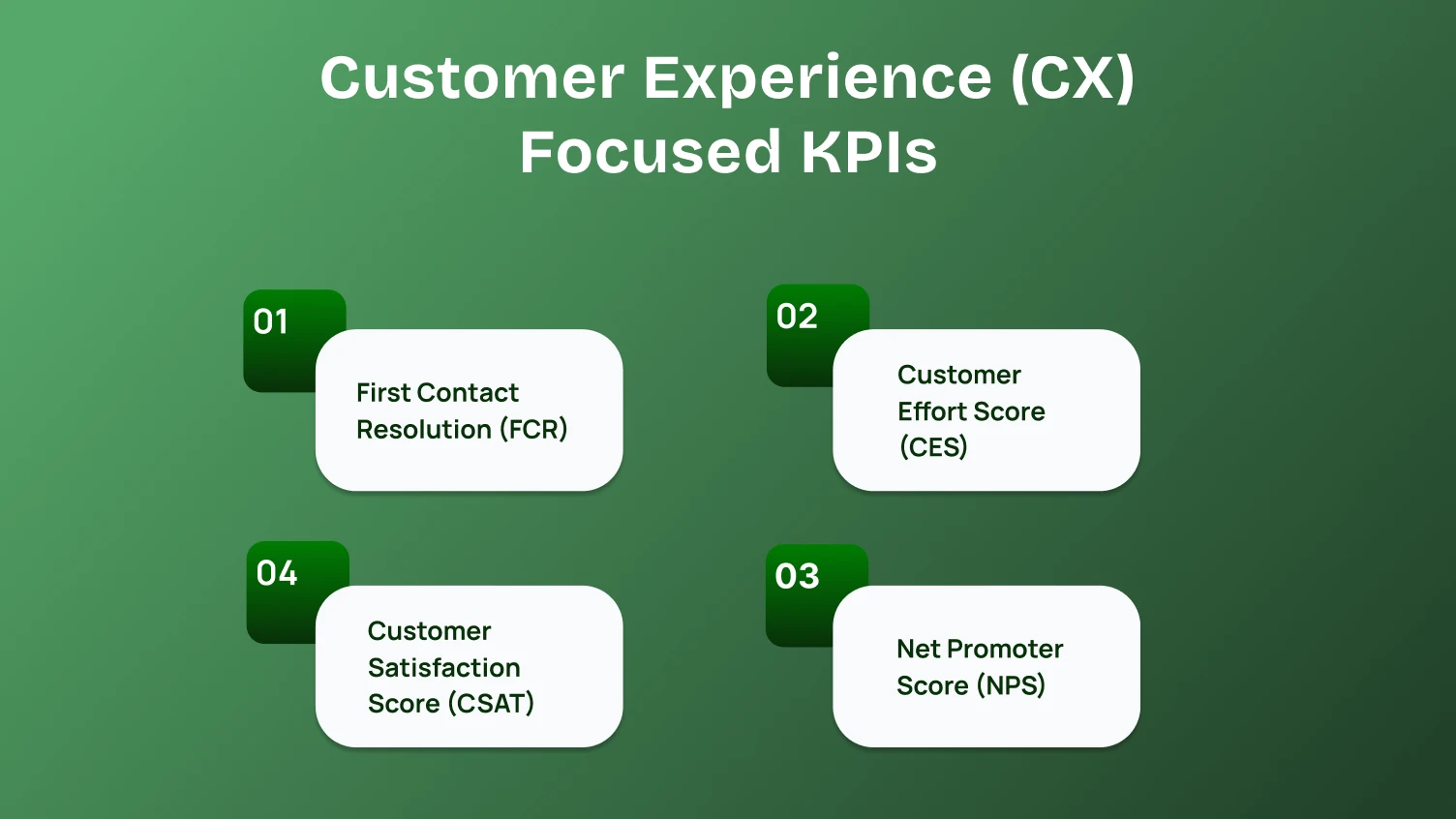
The goal of tracking customer experience metrics is to measure how the individual customer feels about their journey. These key call center metrics go beyond just checking speed and focus on the true effect of the service.
A positive contact center experience builds customer loyalty and brings repeat business. This focus is needed to enhance customer trust and relationships.
First Contact Resolution (FCR) is a key number for checking how fast and good we are. It counts how often we fix the customer’s problem on their first call. They don’t have to call back. When contact resolution rates are high, customers are much happier with our service.
Call resolution metrics make both customers happier and the business run better. When issues are fixed right away, we don’t need many agents or long message chains. This greatly cuts down on business costs while saving valuable customer time.
The formula for FCR is calculated: successful first interactions divided by total handled calls.
FCR = (First Call Solved/ Total Handled) * 100%
Experts suggest aiming for a result over 75 percent in 2065. This shows a real effort to solve problems quickly.
A high resolution rate means agents have the right training, tools, and power to help immediately. Low scores point to bigger problems with staff knowledge or how processes are set up. These results tell us what training needs to change.
The customer effort score (CES) measures how simple it is for a customer to get a problem solved. It tracks how much effort the customer feels they had to put in. A low-effort experience is the necessary base for strong customer loyalty.
The main idea behind customer effort score is to make things easy for the customer. Companies want customers to feel the issue was fixed without extra steps or repeating information. Customers really like a smooth, easy process.
Studies show that experiences that require high effort greatly lower the chance of future business. If the effort score is low, customers are much more likely to tell others about the company. This score is directly linked to positive word-of-mouth.
To calculate CES, post-call surveys ask customers to rate how easy it was to fix the issue.
CES = Sum of scores / Total respondents
Answers use a scale of one to seven, from very difficult to very easy. The final score helps make quick changes to the process.
Customer satisfaction score (CSAT) is the usual way to measure immediate happiness after a specific interaction. It captures feelings about the service quality given by the center agent. CSAT scores are key for checking success right after the service happens.
The metric uses customer answers from short surveys after the call.
CSAT = (Satisfied Customers / Total Responses) * 100%
Customers often use a simple scale or give a score from one to five stars. These answers give quick, useful feedback on the quality of a specific handled call.
High CSAT scores show that the agent or digital system met or beat the customer’s expectations. Low scores mean the agent lacks soft skills, product knowledge, or the system has technical issues. Tracking this score is needed for good agent coaching.
Surveys must be short, about the right topic, and simple for the customer to fill out. Asking too many questions greatly lowers the number of people who answer. Being quick is also important; sending the survey right after the call means customers remember the details clearly.
The Net Promoter Score (NPS) measures long-term loyalty and how likely the customer is to tell friends about the brand. Unlike CSAT, which is just about one time, NPS measures the whole relationship. It finds the true fans who speak well of the brand.
The calculation uses one question: “How likely are you to recommend this company to a friend or colleague?”. Customers use a zero-to-ten scale, putting them into three groups. These groups are used to find the final company score.
The final net promoter score uses the difference between the customer groups.
NPS = (%Promoter) – (%Detractors)
The number, from -100 to +100, shows how much the brand can grow. Improving this promoter score needs constant work by the whole company.
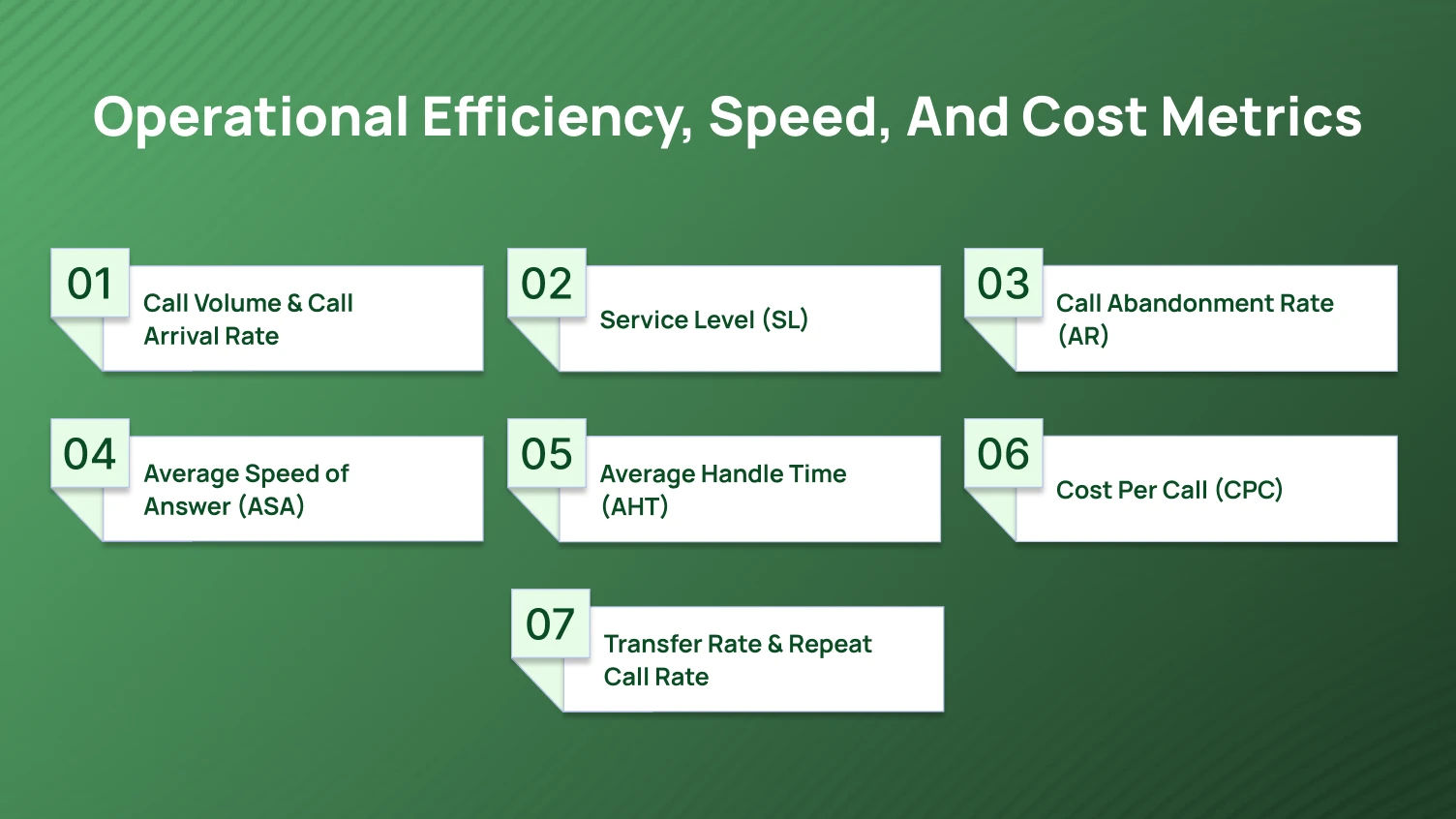
This group of call center metrics shows how well the service setup is working for the company. These numbers look at how we use service resources and how much they cost. Checking these metrics helps center managers make contact center operations better every day.
This check shows how well agents are spending their time, money, and system resources. Tracking these numbers gives us key facts for improving call center performance. These metrics are the base for good operational efficiency planning.
Call volumes track the total number of incoming calls we get in a set time, like an hour, a day, or a week. Watching volume trends is key to planning resources and guessing staffing needs correctly. This basic number is the first step for planning.
The call arrival rate looks closer by tracking exactly when calls come in. This metric finds the busiest hours, which helps managers set agent schedules correctly to meet customer demand. Good analysis stops long waiting times during busy hours.
Forecasting tools use past volume and arrival rate numbers to guess future demand correctly. Without exact planning, the center’s operations become wasteful and may not have enough staff. Getting the numbers right is critical for keeping service levels steady.
Big, unexpected jumps in call volumes need quick action to stop service problems. Checking these trends often points to outside causes, like ads or system outages, that cause more calls. Knowing the cause is key to stopping it next time.
Service Level is a promise to answer a specific percentage of calls within a set amount of time. A common goal is 80/20, meaning eighty percent of calls are answered by an agent in twenty seconds. This metric sets the standard for how fast the company must be.
Service Level measures how many calls are answered quickly compared to all calls answered.
SL = (Calls answered in x seconds / Total call received) * 100%
Reaching a high Service Level is a direct sign of smart staffing and good call routing. Smart routing makes sure customers reach the best available agent right away. This system design prevents unnecessary waits and transfers.
Failing to meet the Service Level goal often means customers get angry, and more of them hang up (call abandonment). The goal is to always have enough agents to match the expected number of calls. Bad scheduling directly hurts this key number.
The call abandonment rate counts the percentage of calls that hang up before they talk to an agent or get sent to the right team. This number is directly tied to customer impatience and very long waiting times. A high percentage shows big problems in the service process.
The abandon rate is a key sign of customer anger and a bad experience with the company. Customers hang up when they feel the wait is too long or unacceptable. This often leads them to choose a competitor for service.
The call abandonment rate formula divides abandoned calls by the total service volume.
AR = (Abandoned calls / Total incoming calls) * 100%
This final number is a hard reminder of lost chances with customers. Companies should try to keep this number below three to five percent.
To fix the call abandonment problem, we must make the first waiting times very short and offer other self-service options. Better queue management, plus telling customers the expected wait time, lowers this frustrating result.
No post selected.
Average speed of answer (ASA) measures the total average time it takes for a customer’s call to be picked up by a human agent.
ASA = Total waiting time/ total calls answered
The clock starts when the call enters the wait line and stops when an agent accepts it. This is a critical speed measure.
ASA is the main number that shows how fast the company responds to customer needs. A low average speed means resources are used well, and staff are scheduled correctly for all shifts. It suggests that high center productivity is maintained.
High ASA numbers lead to bad customer satisfaction score results and more abandoned calls. Quick response time is now a basic rule for good service. Customers today expect to connect with a person almost instantly.
Making the average speed of answer better means improving planning and using smart routing tools. The main goal is to cut out unneeded wait time for the customer as much as possible. This immediate availability makes the customer experience better.
Average handle time (AHT) is the full length of one interaction, including several necessary steps.
AHT = Talk time + hold time + ACW
It includes the talk time with the customer, the hold time during the call, and the required after-call work (ACW) done by the agent. AHT is a complete check of how long the call lasts.
AHT is still a main number for checking call center productivity and agent speed today. The perfect average handling time is a balance between speed and fixing the problem well for the customer. A very low AHT might mean service was rushed or not finished.
The total handle time is the total of all parts: talking, waiting, and wrap-up work. Cutting down on things like long hold time is key to making this metric better. Agents need better resources to keep up the speed.
Today’s call handle checks look at AHT along with FCR and CSAT for a balanced view. A long average handle time AHT is fine if it means the problem is fixed on the first call and customer happiness is high. The quality of the handled call is now more important than just speed.
The Cost Per Call (CPC) is a key financial metric that shows the real expense of every customer contact for the company.
CPC = Total center costs / Total calls handled
It is the total cost to run the center divided by the number of successful calls handled. Keeping the cost per call low is key to increasing revenue.
This metric covers agent pay, technology costs, office costs, and support costs for the system. A high CPC suggests the system is wasteful, has too many staff, or has unneeded extra work for agents. Making this cost lower is a main goal.
Ways to lower cost per call often include using digital workflow automation to stop human help for simple tasks. Self-service options handle basic questions, letting human agents deal with complex, high-value issues. This smart change uses staff time better.
Reducing CPC needs smart spending on the right technology, not just cutting agent pay. The goal is to make agents work as well as possible and improve center performance across the whole service process. This ensures profit while keeping quality high.
Transfer rate tracks the percentage of handled call interactions that require moving the customer to a new agent or department.
TR = (transferred calls/ total handled calls) * 100%
High rates mean a process failure, bad initial routing, or not enough training for the first-level agent. This is a clear sign of poor efficiency.
The repeat calls metric counts how often one customer calls back about the exact same problem very soon after the first call.
RCR = (Repeat calls / Total unique issues) * 100%
This rate clearly shows that the first service call did not fully fix the problem.
Both the call transfer rate and the number of repeat calls signal a failure to get to the root of the customer’s problem. Checking these trends helps center managers find big errors in rules or gaps in staff knowledge. This review of the main cause is vital.
A high center performance needs low transfer and repeat call numbers, since both greatly bother the customer. Agents must have the right knowledge and power to solve the issue on their own to make both these numbers better. This makes sure service delivery is good.
The growth of digital self-service and AI needs new numbers to measure success today. These new call center metrics are necessary to measure how well automated customer interactions work. They track system correctness, customer acceptance, and the effect of digital channels.
These advanced numbers measure the value of AI-driven insights and automation across the whole service system. They check how well bots and self-service tools handle regular customer needs. These numbers help guide future spending on technology correctly.
The Self-Service Success Rate measures how many customer problems are fixed entirely without a human center agent. This number shows how well IVR, apps, or chatbot systems work for the company.
The Deflection Rate is the percentage of customer calls that are successfully stopped from going to human-staffed channels.
DR = (Deflected interactions/ Total interactions) * 100%
A high Self-Service Success Rate greatly improves center productivity and lowers the total Cost Per Call for the company. Customers benefit from instant fixes, and agents can focus on hard, high-value problems.
Tracking this number points out where the automated help is confusing, lacking details, or doesn’t meet the customer’s needs. Checking success rate data often helps us fix content and maintain the system as needed.
Intent Recognition Accuracy is a key metric for checking how well AI routing systems and chatbots perform.
IRA = (Correct intents recognized / Total intents) * 100%
It measures how often the system correctly finds out why the customer is contacting the business.
A high accuracy score means the customer is always sent to the right information or the best-suited agent for their question. This exact routing stops frustration and removes unneeded transfers quickly.
Low accuracy leads to bad customer satisfaction score outcomes because the customer is sent to the wrong place often. The AI model needs more training and fine-tuning to better understand customer needs.
This metric directly measures how smart and mature the automated system’s language understanding is. Making accuracy better is ongoing work that needs focused center analytics and data input.
Conversational analytics systems use speech and text checks to track the customer’s feelings from the start of a call to the end. The sentiment shift during interaction metric measures how this feeling changes, for the better or worse.
A positive shift in feeling shows the agent or bot successfully calmed an angry customer and gave a helpful, caring fix. This positive result is a strong sign of good emotional skills.
On the other hand, a negative shift in feeling shows the call started well but quickly went wrong because of the agent or a system problem. This metric points out exactly when customers get frustrated.
Center analytics uses this data to quickly find coaching chances for agents who often fail to improve the customer’s mood. It makes sure agents handle every call with the necessary care and skill.
The Escalation Quality Index (EQI) is a new metric that checks how well the handoff works from an automated system or a first-level agent to a human expert. A smooth transfer is critical for a good customer experience.
EQI checks if the agent who takes over has instant access to the full story and context of the previous chat. This preparation stops the customer from having to tell their story again and again, which is annoying.
A high EQI score means the first agent or bot correctly summarized the problem and added all important customer data to the file. This easy process makes the final expert agent more likely to achieve call resolution.
Low EQI scores point to a failure in internal knowledge sharing or system connection problems. Improving this number needs better links between automation platforms and the main Customer Relationship Management (CRM) system.
The Automation Utilization Rate measures the percentage of total interactions successfully handled by automated tools without any human involvement.
AUR = (Automated interactions / Total interactions) * 100%
A high utilization rate shows the company has successfully put self-service and bot technologies to work across all channels. This success means big savings in operating costs for the company.
Good workflow automation lets the company handle many more service requests quickly without needing to hire more human staff. This number shows the profit from the effort spent on digital changes over time.
Checking the agent utilization rate along with this metric ensures that the automated systems are not too complex. The main goal is to use automation as much as possible without making the customer experience worse.
These key call center metrics link the success of the individual call center agent directly to the overall customer experience metrics for the business. A happy, well-supported agent always gives great service.
These numbers check agent productivity, focusing on the quality, rule-following, and dedication of the staff. They look beyond simple numbers like occupancy rate to understand deeper staff involvement. This is critical for good performance management.
The final goal of checking agent performance metrics is to build a staff that is highly involved and motivated. High workforce engagement leads to fewer people quitting and consistently better service for customers.
The Quality Assurance (QA) Score measures how well the center agent follows rules, soft-skill guides, and necessary compliance during a customer call. This check focuses on the quality of the service provided.
Old QA often used simple checklists, but modern quality management focuses on key actions like showing care, taking ownership of the problem, and speaking clearly. This makes the customer service experience better and more personal.
The score is usually set by experts who listen to recorded calls or read chat logs based on a fair set of rules. Getting regular feedback based on this score is the key to good agent coaching and helping them grow.
A high QA Score proves that the call center agent has both the needed technical knowledge and the right emotional skills. This ensures every call meets the high standards of the brand.
The Agent Attrition Rate is the percentage of agents who leave the company within a certain time, which costs the company a lot.
AAR = (Departing agents / Average agents) * 100%
High turnover quickly hurts the contact center experience because there are more new agents on the phones.
The Agent Engagement Score (AES) is a measure of how connected the agent feels to the company’s goals and how happy they are at their job. High AES is a strong way to stop high agent turnover and the cost of training new staff.
High turnover is expensive because the company must constantly hire, train, and replace staff often. A good Employee Experience (EX) stops this cycle, creating a stable, smart, and experienced team.
Measuring AES often involves regular, private staff surveys about workload, tools, manager support, and job growth chances. Spending money on staff well-being directly leads to better customer results for the whole business.
The Agent Empowerment Index (AEI) is a key metric that measures how powerful and sure the agent feels in their job. It checks if the agent feels they have the right tools, knowledge, and power to solve problems without help.
Agents with a high AEI are less likely to transfer calls and more likely to have a high FCR, improving center performance. They feel trusted and valued, which directly increases their dedication to the customer.
Low AEI scores show company barriers, like complex approval steps or old systems that slow the agent down. Managers must find and remove these internal blocks to make work faster.
Surveys for AEI often ask about access to real-time knowledge bases, clear rules, and how much trust supervisors give them. Empowered agents naturally provide faster, better service.
Making the whole service operation better needs a smart plan for technology, staff, and processes. Every step must be measurable against the key call center performance numbers chosen for the business.
Investing in smart technology and automation is the quickest way to make your call center faster and save money. These tools handle easy tasks, saving human agents for hard issues.
Agent training must focus on more than just product facts; it needs to build soft skills and emotional smarts so agents can fix difficult issues well.
Your performance data must lead to fixing the root cause of problems, not just treating the symptoms. By checking system failures and internal mistakes, you can make the entire service process faster and simpler.
Modern call center metrics give us the necessary plan for making service better in today’s digital world. Changing the focus from simple speed to complex results like FCR and CES is needed for long-term customer loyalty.
Operational data, like AHT and CPC, show the financial health and work speed of the whole service system constantly. These core speed numbers must be checked along with quality scores for balanced call center performance metrics.
In the end, the goal is to link agent happiness and power to excellent customer results for the company. Spending money on agent performance through training and tools is a direct investment in the entire brand’s future success.
Checking and acting on these key metrics ensures that the service center remains a powerful competitive edge for the business. This careful approach guarantees a future of fast, high-quality customer service delivery.
Stop guessing and start driving real CX improvement. See how Dialaxy uses the latest technology to optimize all your call center metrics today.
The most important number is First Contact Resolution (FCR). It tracks how often we solve the customer’s problem the very first time they call, so they don’t have to contact us again.
CSAT (Customer Satisfaction Score) measures how happy a customer is right after one specific call. NPS (Net Promoter Score) measures how likely they are to tell a friend about the company (long-term loyalty).
AHT stands for Average Handle Time. This is the total time for one call (talking, holding, and after-call work). It should not be too low. A good AHT means the agent took enough time to fix the problem completely (high FCR).
Use the Quality Assurance (QA) Score to find out if agents need training on skills or product facts. Also, check the Agent Engagement Score to make sure agents are happy and don’t want to leave their jobs.
