

How to Improve Customer Satisfaction: In Depth Review


96% of customers say customer service is a key factor in their choice of loyalty to a brand, yet most contact centers are still operating reactive, volume-driven models that leave customers frustrated. (Source: Microsoft State of Global Customer Service Report)
Today’s customers don’t separate the product from the support experience. A single long wait time, a transferred call that drops, or an agent who can’t access their history can undo months of positive brand-building. For contact centers and call center teams, knowing how to improve customer satisfaction is no longer a soft goal. It’s a measurable operational priority.
This guide covers exactly how to do that: the metrics that matter, eight proven strategies built for contact center environments, the common mistakes that quietly drag scores down, and how the right communication tools make every tactic easier to execute.
Whether you run a small support team or a multi-seat contact center, the framework in this guide will give you a clear path from your current CSAT score to a consistently better one. You can also explore how Dialaxy’s virtual phone system supports each of these strategies at scale.
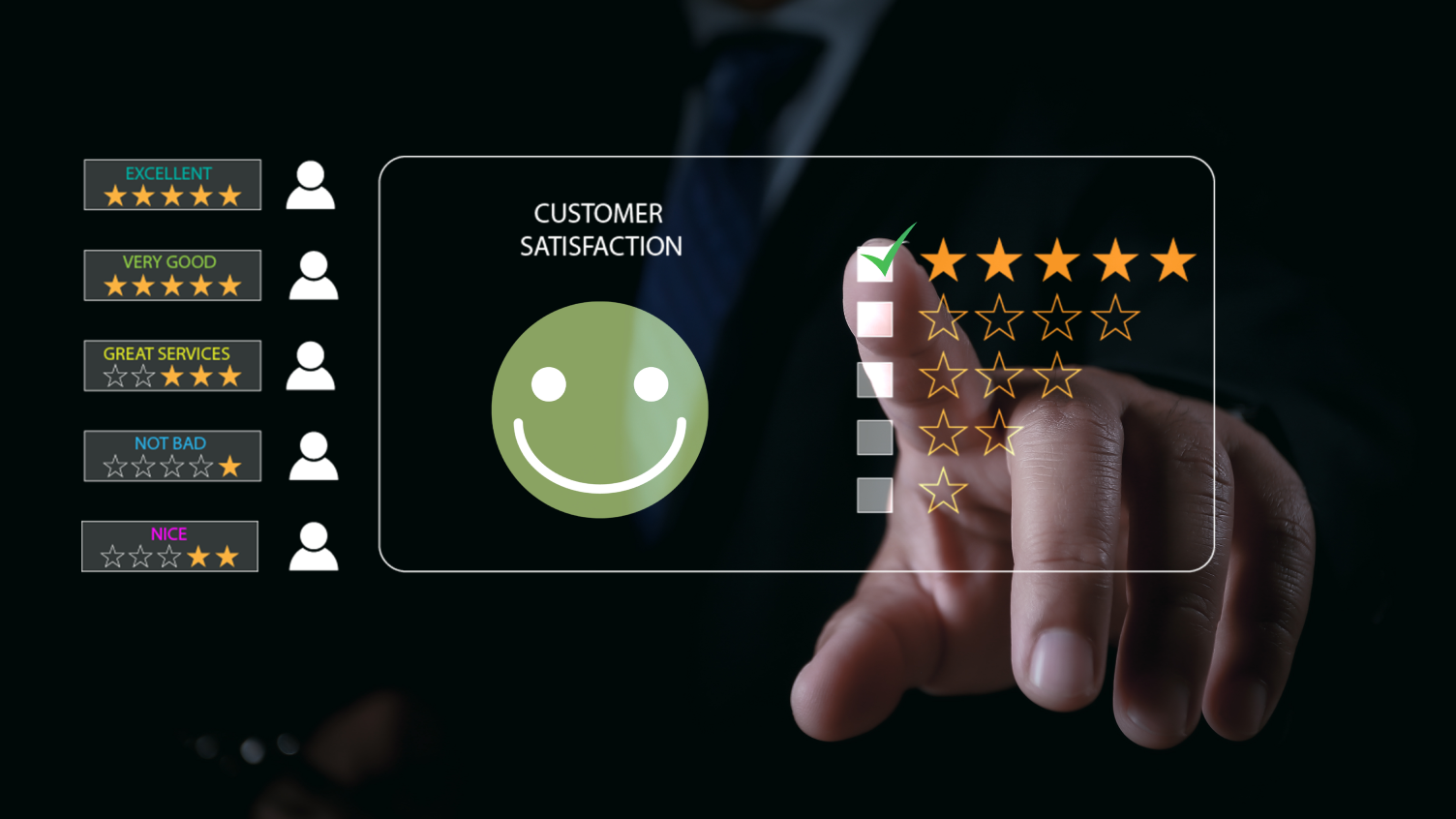
Customer satisfaction (CSAT) measures how well a company’s products, services, and support interactions meet or exceed customer expectations. In a contact center context, it is primarily shaped by the quality, speed, and consistency of every customer-agent interaction across all channels.
Contact centers sit at the front line of the customer relationship. Research by Bain & Company found that a 5% increase in customer retention can increase profits by 25% to 95%. Since the contact center is where most retention decisions are made or broken, CSAT scores here directly predict revenue outcomes, not just service quality.
For call center teams specifically, the stakes are even higher. Customers who reach out by phone are often already dealing with a problem. How that call is handled, speed of answer, first call resolution, tone, follow-through, becomes the defining memory of your brand for that customer.
Before you can improve customer satisfaction, you need to know exactly where you stand. Three metrics give contact center managers the clearest signal: CSAT, NPS, and CES. Each measures a different dimension of the customer experience.
CSAT measures how satisfied a customer is with a specific interaction, typically a call, chat, or support ticket. It is collected immediately after the interaction while the experience is fresh.
Formula: CSAT = (Number of satisfied responses / Total responses) x 100
Benchmark: A CSAT score of 80% or above is considered strong across most industries. Contact centers in telecom and SaaS typically target 75–85%.
Best deployment: Immediately after a call ends or a ticket is closed. Keep it to one question: “How satisfied were you with the support you received today?”
NPS measures long-term customer loyalty by asking a single question: “How likely are you to recommend us to a friend or colleague?” Responses are scored 0–10 and grouped into three categories:
Formula: NPS = % Promoters minus % Detractors
Best deployment: Every 90 days to track trends, and after significant product or service changes.
Contact center use: Link NPS drops to specific call queues or agent groups to identify systemic issues before they compound.
CES measures how much effort a customer had to put in to get their issue resolved. Research from Gartner found that 96% of customers who experience a high-effort interaction become more disloyal, making CES one of the strongest predictors of churn.
Key question: “How easy was it to get your issue resolved today?” (Scale: 1 = Very Difficult, 7 = Very Easy)
Best deployment: Immediately after issue resolution. Combine with First Call Resolution (FCR) data for the clearest picture of effort drivers.
Good customer satisfaction keeps a business strong. It helps people trust your brand and stay loyal. In today’s busy market, every company must care about its customer experiences to grow and improve customer satisfaction.
Knowing how to improve customer satisfaction is, therefore, not just a goal but a vital strategy for survival and growth.
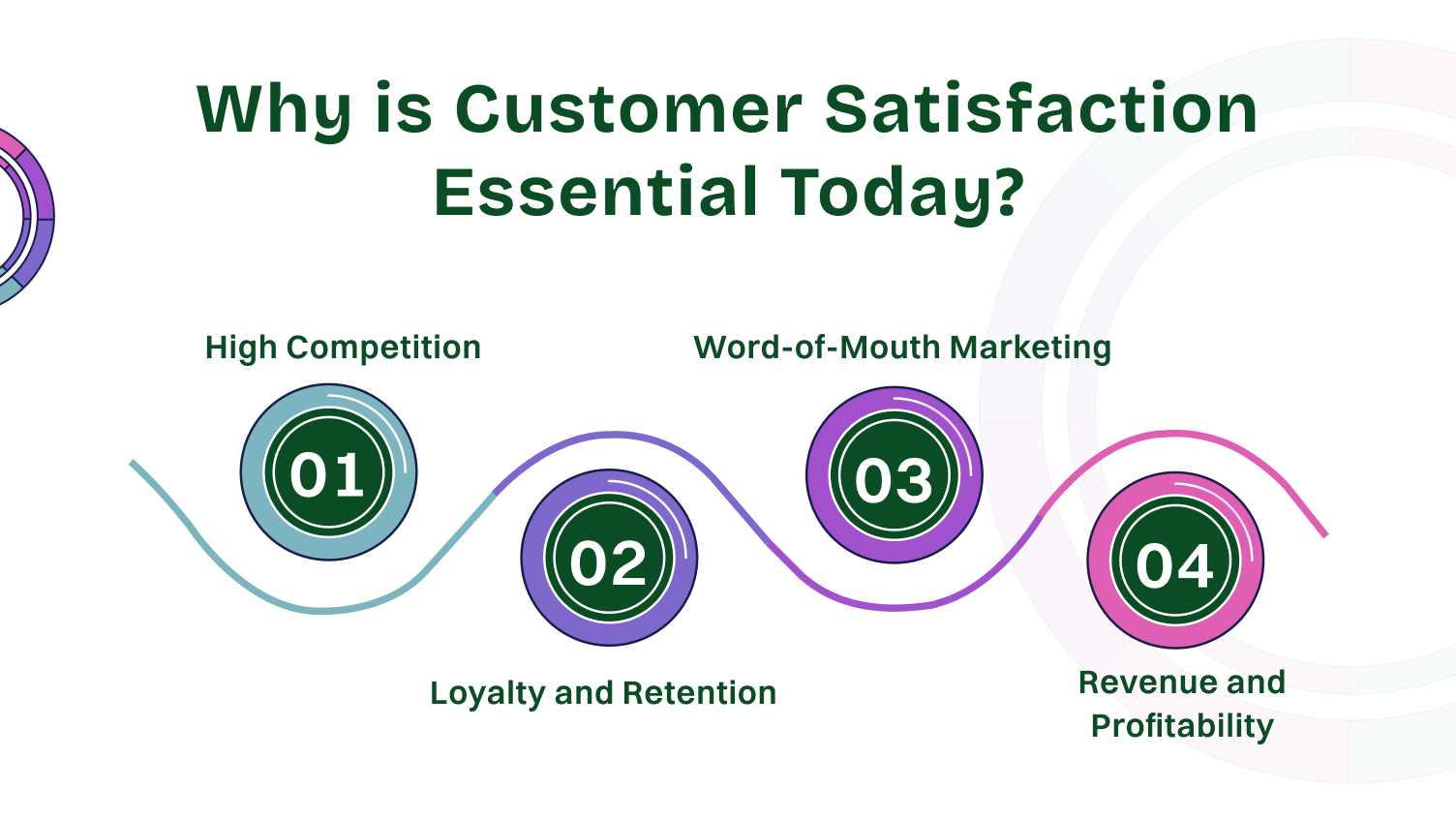
Many companies offer the same things. What makes one business better is how it treats its customers. People choose brands that care, reply fast, and give help when needed. This is how to increase customer numbers.
For example, two food delivery apps may look alike. But the one that gives quick replies on social media and fixes problems fast will get more users. Small customer interactions like this can turn new users into loyal customers.
It costs less to keep a customer than to find a new one. Customer retention helps a business grow. This is because loyal customers spend more and trust the brand. This boosts lifetime value.
A company that focuses on the customer journey can guess what users want. If a website has a clear knowledge base and easy support, people will come back. These small efforts raise the lifetime value of every customer. They also build customer loyalty over time.
Satisfied customers discuss their positive experiences. They will tell their friends, write reviews, and share their stories online. This is known as word-of-mouth advertising, and it is very strong.
For example, one person who really enjoys the experience of using your product might post on social media. One honest post can result in hundreds of people seeing that post. When you listen to your customers, they will advertise your brand for free.
Satisfied people buy more and stay longer. They do not switch brands easily or ask for sales. High customer satisfaction levels bring more money and trust. This helps to increase customer income.
For instance, a streaming app that gives quick help and short wait times will see more people renew. The strong trust center between the company and its users improves sales. Over time, these small actions raise income and success for a long time.
| Metric | What It Measures | Best Timing | Primary Use | Limitation |
|---|---|---|---|---|
| CSAT | Satisfaction with one interaction | Immediately after the interaction | Spot performance issues fast | Doesn’t predict long-term loyalty |
| NPS | Long-term loyalty and advocacy | Quarterly or post-milestone | Measure overall customer loyalty | Doesn’t reveal why; needs follow-up |
| CES | Ease of issue resolution | Immediately post-resolution | Identify friction in support processes | Narrow scope; interaction-level only |
Speed is the single most cited driver of contact center CSAT. According to HubSpot, 90% of customers rate an “immediate” response as important when they have a service question with immediate defined as 10 minutes or less for phone interactions.
In a call center environment, every second of unnecessary hold time erodes the customer’s confidence. Practical ways to reduce response and resolution times include:
The most common mistake in call center agent training is focusing entirely on scripts and procedures while neglecting the skill that customers actually value most: being genuinely heard.
Active listening in a contact center context means acknowledging the customer’s frustration before moving to the solution, paraphrasing to confirm understanding, and avoiding interruptions. Customers who feel heard are significantly more likely to rate an interaction positively, even when the outcome isn’t what they wanted.
Customers today move between channels. They might start a query via SMS, follow up by phone, and expect the agent to have full context from both. A contact center that forces customers to repeat themselves every time they switch channels is creating unnecessary effort and tanking CES scores.
True omnichannel support means a unified customer context across every channel. With Dialaxy’s virtual phone number system, teams can manage voice, SMS, and messaging from a single platform, ensuring agents always have the full conversation history before they say hello.
Collecting CSAT surveys without a structured process to act on them is one of the most common and costly mistakes in contact center management. Customers notice when nothing changes, and survey fatigue sets in fast.
The feedback loop that actually moves scores looks like this:
Personalization in a contact center doesn’t require complex AI. It starts with something basic: the agent knowing who they’re talking to before the call begins.
When a customer calls, and the agent can see their name, account history, previous tickets, and product usage before picking up, the interaction starts from a position of context not confusion. That alone increases CSAT significantly.
One of the biggest hidden drivers of low CSAT and high CES is the escalation bottleneck, where agents identify the right solution but lack the authority or tools to execute it without approval.
Contact centers with high FCR rates typically share one common trait: agents have clear, defined resolution authority within specific parameters. They can issue refunds up to a threshold, apply credits, offer upgrades, or escalate immediately without a queue.
Every inbound complaint is a signal of a missed proactive communication opportunity. If a customer calls to ask about a delayed delivery, an outage, or a billing error, you already had the chance to reach them first.
Proactive outreach dramatically reduces complaint volume and increases customer satisfaction simultaneously. Customers who are informed before they have a reason to complain are far more forgiving and far less likely to churn.
Dialaxy’s virtual phone number platform supports outbound SMS and voice campaigns from a single dashboard, making proactive communication scalable without additional infrastructure.
You cannot improve what you cannot see. Contact centers that rely solely on end-of-month CSAT reports are always solving yesterday’s problems. Real-time visibility into key metrics gives supervisors the ability to intervene before a bad day becomes a bad month.
Key metrics to monitor live and historically:
Sales & Marketing
Jun 9, 2026
Read More
These two terms are often used interchangeably, but they measure very different things. Understanding the distinction helps contact center managers avoid the common trap of optimizing for a single score while the broader customer relationship deteriorates.
| Aspect | CSAT | Customer Experience (CX) |
|---|---|---|
| Scope | Single interaction or transaction | Full customer lifecycle |
| Measurement | Post-interaction survey score | NPS, CES, journey analytics, churn rate |
| Timeframe | Immediate right after the event | Ongoing; tracks patterns over months or years |
| Primary Use | Spot-fix agent or process issues fast | Guide long-term strategic improvement |
| Contact Center Role | Agent-level performance signal | Cross-functional alignment signal |
| Risk if Over-Indexed | High CSAT on individual calls, high churn overall | Strategy without tactical execution |
The practical takeaway: use CSAT to manage performance week-to-week. Use CX metrics to set direction quarter-to-quarter. Both matter, but confusing them leads to tactical wins that don’t move the needle on retention.
Many contact centers invest in the right strategies but undermine them with avoidable process mistakes. These are the most common:
Survey fatigue: Sending a satisfaction survey after every single interaction trains customers to ignore them. Focus surveys on high-stakes interactions, complex issues, escalations, and first-time contacts.
Measuring without acting: If CSAT data sits in a dashboard that nobody reviews or acts on, it creates cynicism. Customers who give feedback and see nothing change stop responding — and then stop calling.
Prioritizing AHT over resolution quality: Pushing agents to close calls quickly at the expense of actually solving the problem is the fastest way to collapse FCR and CSAT simultaneously. Speed matters, but not at the cost of resolution.
Ignoring agent satisfaction: Gallup research consistently shows a direct correlation between employee engagement and customer satisfaction. Burned-out, disengaged agents produce poor customer experiences regardless of training. CSAT improvement strategies that don’t include agent wellbeing rarely sustain.
Inconsistent omnichannel experience: A customer who receives excellent service on the phone but a slow, impersonal response via email doesn’t experience your brand as consistent. Channel inconsistency is one of the most common drivers of low NPS in otherwise high-CSAT contact centers.
Today, smart tools and tech are key to happy customers. They help gather data, talk to users, and make things better fast. Using the right tech helps companies drive customer loyalty and truly improve their customer service.
These are special apps for asking questions. They help you send out customer satisfaction surveys easily. These platforms collect CSAT scores, Net Promoter Scores (NPS), and CES. They help you collect customer feedback quickly after any customer interaction.
These tools take all your customer data and make sense of it. They show trends and patterns. They help you find key insights hidden in the numbers. This lets you measure customer satisfaction better and find areas to improve customer experience.
Fast and easy talk is important. Communication channels like live chat let customers get instant help. Artificial intelligence (AI) chatbots can answer common questions. This reduces wait times and improves the user experience. It makes every customer interaction smoother.
These advanced tools help you see the whole customer journey. Experience analytics platforms use session replays and click maps. They show exactly where users struggle or get confused. This helps you improve the customer journey and fix specific pain points.
A good CRM (Customer Relationship Management) system brings all customer data together. It helps you track every customer relationship and past interaction. This allows for personalization and helps in understanding your customers on a deeper level.
These tools send the right messages at the right time. They can follow up after a purchase or send special offers. Automated marketing helps keep customer engagement high. It uses customer data to tailor messages. This helps to increase customer satisfaction over time.
The strategies above require the right infrastructure to execute consistently. Dialaxy’s cloud communication platform gives contact center teams the tools to deliver faster, more personalized, and more reliable customer experiences without enterprise-level complexity.
Customer happiness makes businesses grow. Checking it with CSAT, NPS, and CES gives clear key insights. These tools are fundamental to understanding how to improve customer satisfaction in big ways. This is a core part of customer satisfaction strategies.
Happy customers stick around longer and trust the brand. This greatly helps to boost customer retention. Thinking about the whole customer journey makes customer relationships stronger. It also increases lifetime value for the company.
Doing things based on customer feedback shows you care. Using these insights for product updates and better service builds customer loyalty. It also leads to better customer interactions. This is key to understanding your customers.
Making customer satisfaction (CSAT) better is a never-ending job. Clear hopes, trained staff, and personal help keep users happy. Watching customer satisfaction levels creates happier users. It also builds stronger brand trust, proving you listen to your customers.
Transform your customer service today. Dialaxy connects you to better customer experiences.
A CSAT score of 80% or above is generally considered strong in a contact center environment. Scores between 75–85% are the typical target range for telecom, SaaS, and B2B service teams. Scores consistently below 70% indicate systemic issues with resolution quality, wait times, or agent training that need structured intervention.
The most effective approach is an automated post-call survey sent via SMS or IVR immediately after the call ends. Ask a single CSAT question, “How satisfied were you with the support you received today?” followed by an optional open-text field. Timing matters: surveys sent within 5 minutes of call completion have significantly higher response rates than delayed surveys.
CSAT measures satisfaction with a single interaction and is collected immediately after a call or ticket. NPS measures overall loyalty and likelihood to recommend, and is collected periodically, typically every quarter. Contact centers use CSAT to manage day-to-day agent performance and NPS to track long-term brand health. Both are needed; neither replaces the other.
First Call Resolution (FCR) is one of the strongest predictors of CSAT in contact center research. When a customer’s issue is resolved in a single interaction without a callback or transfer, CSAT scores are typically 15–20% higher than for multi-contact resolutions. Improving FCR through agent empowerment, better knowledge bases, and smarter routing is usually the fastest lever for lifting CSAT scores.
The most common root causes are: long wait and hold times, unnecessary call transfers, agents lacking authority to resolve issues, inconsistent experiences across channels, and poor follow-through on commitments made during a call. In most contact centers, two or three of these account for the majority of negative scores. Identifying which ones through call analytics and customer verbatims is the essential first step.
Virtual phone numbers improve customer satisfaction by enabling faster, more flexible, and more reliable support coverage. They allow contact centers to route calls intelligently by region, team, or issue type, reducing hold times and transfers. They also support proactive outbound campaigns (reminders, alerts, follow-ups) that prevent complaints before they occur. Explore Dialaxy’s virtual phone number options here.
