

What Is VoIP Number Porting & Why Businesses Need It

Your business phone number is not just a number; it is a part of yourself, and it is one that is trusted by your customers, particularly in business models such as the real estate sector. It would be difficult to leave it behind and lose credibility.
Moving out of a traditional landline system to a new system with video conferencing, text messaging, live chat, and a desktop application should not imply losing your number.
Under number porting of VoIP, the VoIP operation company manages the port processing, Letter of Authorization (LOA), new bill, and contact details, and in many cases, they are free of porting fees. It guarantees you business continuity, the ability to improve customer experience, and maintain your trusted number.
Imagine you have had the same business phone number for years. It is on your website, business cards, and everyone knows it. Then you decide to switch to a VoIP system for its benefits.
Do you really want to change that number? No! VoIP number porting is the act of transferring your old phone number to your current carrier, like a traditional phone line provider, to a new VoIP provider. It means you get to keep your beloved number, just with a much better phone system.
This process is a big deal for businesses. It ensures continuity. You get to upgrade your technology without confusing your customers or losing valuable connections.
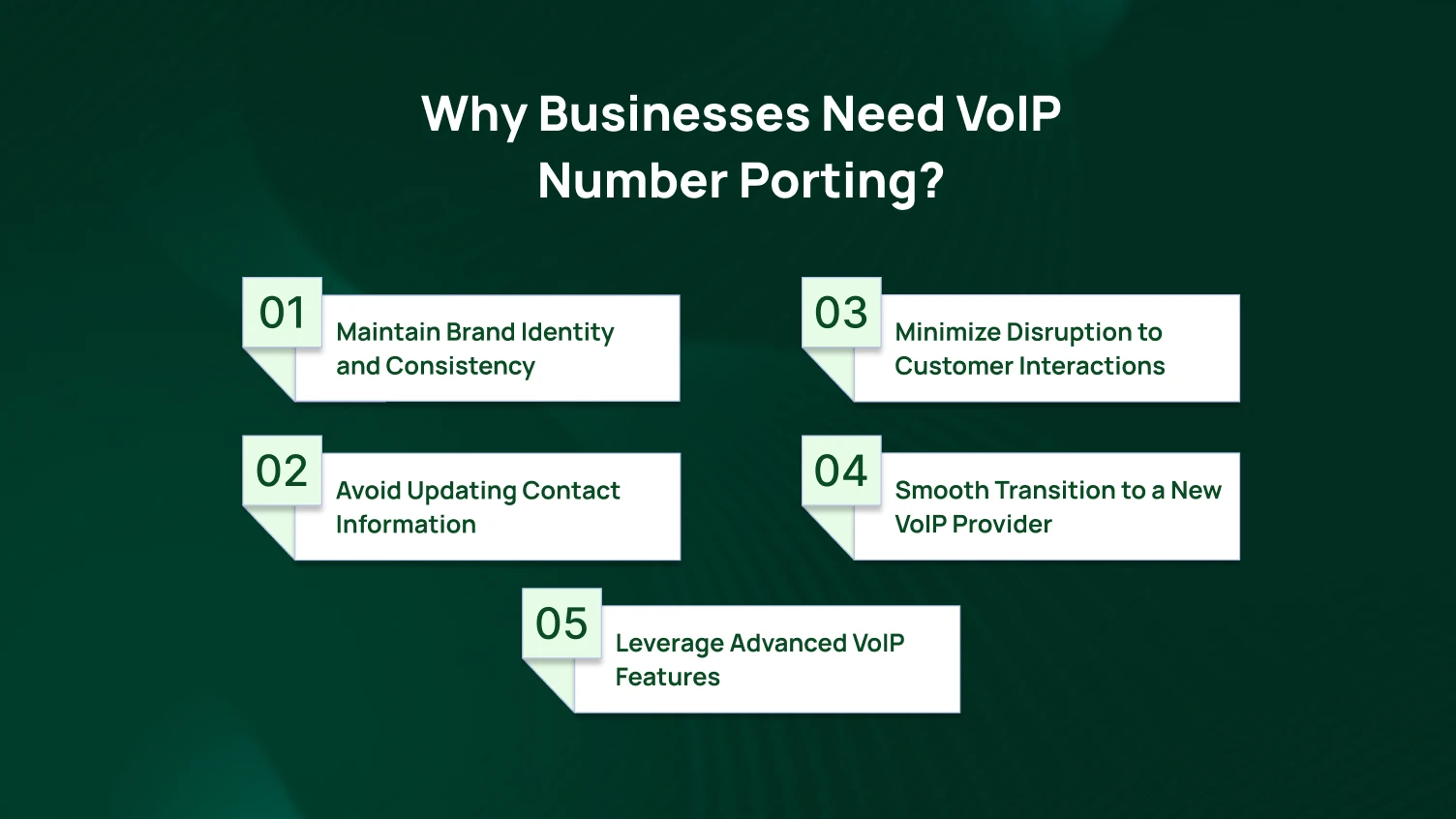
It is due to the fact that businesses are based on consistency and efficiency. VoIP number porting is not only convenient, but it is a strategic decision. Here are the core reasons why your business needs it:
Your phone number is part of your brand. It is how customers recognize you. Changing it is like rebranding your logo every other week. A successful port keeps your brand solid. Your customers will always find you at the same familiar number. It strengthens your business communication and image.
No business wants missed calls. Changing your number means customers might call your old number. They might get a disconnected message. This frustrates them. It can even make them go to a competitor. VoIP number porting ensures continuous customer interactions. Your inbound calls keep flowing without a hitch. This maintains excellent customer service.
Consider all those areas that display your business phone number: website, social media, marketing materials, directories, and email signatures. Changing it means updating everything. It is a monumental task. It is costly and time-consuming. Porting means that you can escape this headache of a giant. You save time, money, and sanity.
The process of changing VoIP service providers should not be stressful, but rather an exciting one. Porting helps in a successful transition. Your business phone operates as usual. There is no downtime for your essential communication channels. This keeps your team productive and your customers happy.
When you port your number, you have the complete capabilities of your new VoIP system. With features such as call forwarding to more than one device, voicemail-to-email, virtual receptionist, and unified communications, you can enjoy it. Your existing phone number simply gets a massive upgrade. It makes your business communication more powerful and efficient.
In the opinion of following the steps, porting sounds complicated, but it is quite a simple process. Imagine it is actually the process of shifting your house, but it is just the address that is changed and not the home itself. VoIP number porting is normally achieved in the following way:
First things first: pick your new VoIP service provider like Dialaxy. Research different VoIP services. Compare their features, pricing, and customer support. Make sure they offer number porting services. Most reputable VoIP providers do. This is the foundation of your new VoIP system.
After selecting your provider, inform them you intend to port your current cell phone number. Your new VoIP company will assist you in filing a porting request. They will usually provide you with the necessary forms. This gets the ball rolling.
This is crucial. Accuracy is king here. You will need to provide:
Any discrepancy in this information can cause significant delays in the port processing. You do not want that.
The port processing timeline may take days or weeks, depending on how quickly your old carrier cooperates. Your current carrier verifies the information. They then release the number. Once your new VoIP provider submits the request, your current phone provider verifies the details before releasing the numbers.
How Long Does It Take to Port a VoIP Number?
This is the burning question, isn’t it? The truth is, it varies. The time that is required to port a VoIP number does not have a single answer.
Remember, your new VoIP provider depends on your previous provider to release the number. Some current carriers are faster than others.
Once your current carrier approves the port, your new VoIP provider will notify you of the “firm order commitment” (FOC) date. This is the big day! On this date, your number will officially switch. Your new VoIP provider will activate your number on their system. You can then start making and receiving calls through your new VoIP system.
After activation, thoroughly test your business phone. Test inbound and outbound calls across all devices, including desk phones, softphones, and the VoIP phone system, to ensure a seamless experience.
The VoIP number porting process is very smooth most of the time, but you can have some hitches in between. When one is prepared for these challenges, it will ensure that the port is successful.
Take a small law firm with five employees. They’ve used the same business phone number for 15 years. Moving to a VoIP provider saves them money and adds features like voicemail-to-email and call forwarding.
But imagine telling every client, vendor, and court office: “Sorry, we changed numbers.” Disaster. They’d lose credibility instantly. Instead, they submitted their letter of authorization, cleared their outstanding balances, and provided the right account details.
Within 10 days, their number was live on the new VoIP system. Clients never noticed the switch. Business communication stayed smooth.
Lesson: Porting is annoying, but it’s worth it.
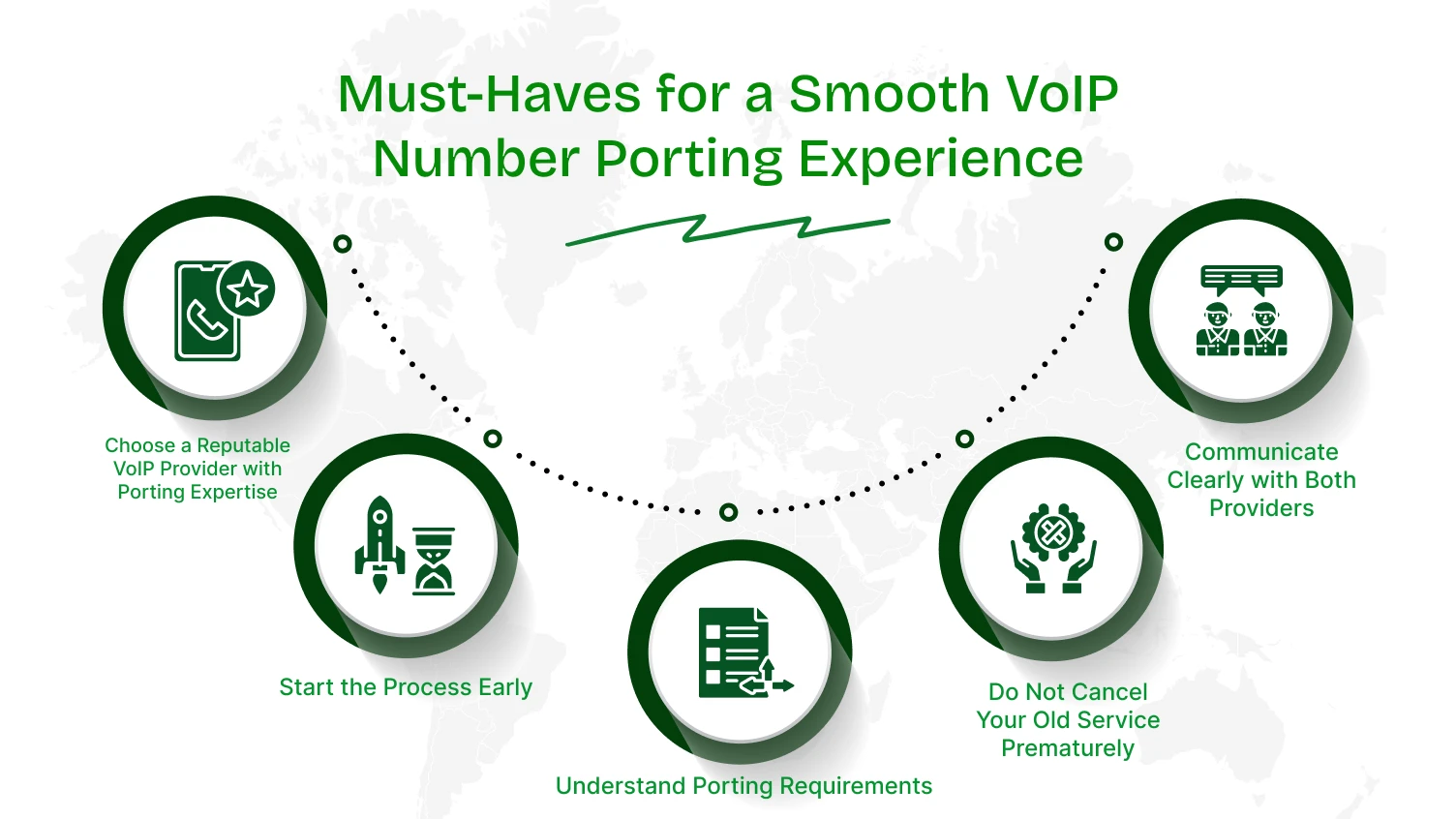
To make your porting experience as painless as possible, keep these tips in mind.
Do not skimp on this. Pick a VoIP provider with a proven track record of successful ports. Ask about their porting process. What kind of support do they offer? Their expertise can make all the difference. They should have a dedicated porting team.
VoIP number porting takes time. Do not wait until the last minute. Begin the port request process weeks before your desired switch date. This buffers against unexpected delays. It helps minimize disruption.
Your current port will only be successful when you have your current phone number running on your current carrier. You may lose your number forever if you abort your service before the port is finished. Wait for your new VoIP provider to confirm the successful port before canceling. This sounds obvious, but you would be surprised.
Maintain a free flow of communication with your existing carrier and your new VoIP service provider. Ask questions. Check on the progress of your port processing. Take the initiative of giving further evidence where necessary. Effective communication eliminates misunderstandings.
Familiarize yourself with the specific porting requirements. These include the LOA and accurate account details. Different carriers might have slightly different nuances. Knowledge is power here.
Beyond the immediate relief of keeping your number, VoIP number porting brings long-term benefits to your business communication.
VoIP services tend to be less expensive than conventional telephone lines. Immediately, you save on monthly phone payments by transferring your current phone number. This incorporates both local, long-distance, and international calls. Who does not love saving money?
When your name is on a VoIP system, you are able to take your business phone everywhere you go. Make and receive calls on any device that has internet connectivity: desk phone, smartphone, laptop. Call forwarding makes sure that you do not miss a beat. This is perfect for remote teams and mobile employees.
VoIP systems provide a package of features that traditional lines can never even dream of having. Think about auto attendants, call queues, voicemail transcription, video conferencing, and CRM integrations. Customer relations are made better by these technologies.
Growing your business? Adding new employees or locations? Scaling your VoIP system is easy. Simply add more lines or extensions to your existing phone number. No need to install new hardware or run new phone lines. It is incredibly efficient.
VoIP systems are resilient. Your calls will be automatically redirected to other places or cell phones in the event of a local power outage or the closing of the office. This ensures continuous business communication. You will experience fewer missed calls, even in emergencies.
While we are talking about your new VoIP system, let’s briefly touch on security. Your business communication needs protection. This is where a VoIP firewall comes in.
A VoIP firewall is a dedicated network security tool. It protects your VoIP communications from unauthorized access and cyber threats. Unlike regular firewalls, it understands voice protocols like SIP and RTP.
Why You Need a VoIP Firewall:
Imagine your VoIP firewall as your VoIP system bouncer. It keeps the scrupulous people on the street and makes your calls run freely.
VoIP number Porting allows the business to upgrade to VoIP telephony without losing its number or logo. Use, among others, video conferencing, live chat, text messaging, and a desktop app to enhance customer experience.
In the presence of the right VoIP provider, Letter of Authorization, recent bill, and correct contact information, the port processing becomes easy, even in cases where there is a charge for porting.
Porting means continuity, flexibility, and reliability, whether working with VoIP phones, good internet connectivity, or even cooperating with the channel partners and real estate customers. Protect your system with a VoIP firewall and centralize your business communication.
Keep your business number while upgrading to smarter communication. Switch to Dialaxy’s VoIP system with seamless number porting.
Yes! VoIP numbers in a traditional landline (or when using a different phone company) can be ported to a new VoIP service company. It makes sure that your business phone remains the same and yet is upgraded to a new modern VoIP phone system.
A Letter of Authorization (LOA), your last bill with the current phone company, and correct contact details (name, billing address, account number) are usually required. Such information should be in accordance with the records of the carrier, so as not to keep them waiting.
The typical process of standard port processing consumes 14 weeks to 4 weeks. More complicated cases, such as multiple lines or carriers, can be more time-consuming, particularly when your VoIP supplier is required to fix problems with your old phone or real estate-based service contracts.
Yes, there are carriers who charge to port your number. But with most of the VoIP providers today, the fees are waived or lowered once you switch to their VoIP phone system. Always check the expenses in advance to avoid unpleasant surprises.
VoIP requires good internet connectivity. It guarantees a clear voice call, video conferencing, and proper utilization of a desktop application. And your refined VoIP phones and teamwork devices, such as live chat, cannot work well without a stable internet.
Porting your number will make sure that your customers still call you on the same number of your business, and brand trust is maintained. A fluid migration does not have abandoned calls, and it maintains your customer experience across various channels such as calls, live chat, and video conferencing.
Sometimes, the phone provider can postpone or oppose a transfer. In the majority of areas, number portability is also a regulated item, and as such, they can not decline without reason. You can further escalate the issue with your new VoIP service provider with your contact information and last bill being correct, and you do not have an outstanding balance on the account.
