

SIP Trunking vs VoIP: Which One Is Better for Your Business?

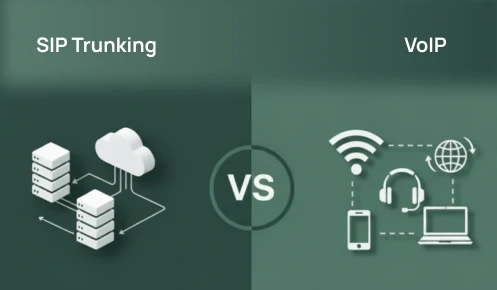
Modern enterprises are heavily dependent on new communication solutions. Phone systems are critical to the work with the other departments, contact with customers, and professional representation.
The two dominating technologies in the current business communication are Voice over Internet Protocol (VoIP) and SIP Trunking. The two are intertwined yet not the same, so choosing the right solution could save a significant amount of money, scalability, quality of the calls, and business processes.
This article will discuss SIP Trunking vs VoIP, their advantages and disadvantages, implementation factors, costs involved, and finally, which one is likely to best fit your business.
At the end, you will be well informed on how to invest in the right communication.
VoIP is a sort of technology that allows one to make use of the internet in order to make a call, as opposed to the use of traditional telephone lines. It is, simply, a replacement of the old copper-based PSTN system with a new system that is internet-based. It is a curious instance of the substitution of a horse-drawn carriage by a smooth Tesla that will make your voice faster, smarter, and more productive.
VoIP also has the advantage of digitizing your analog voice, sending it to the IP network in small data packets and reassembling it on the other side. Now you can have voice and video calls in essence you can talk in almost any place, regardless of the laptop, smartphone or expensive IP phone.
A convenient way to get acquainted with VoIP is to monitor the process of the call. Your voice is converted into digital data and sent across the internet, where it is reassembled at the other end. This is the reason voice and video communication can occur fast and anywhere with virtual presence.
VoIP enables communication flexibility. No standard PSTN line is needed, whether it is a business VoIP or personal calls, or even voice and video conferencing.
VoIP has more than just calling benefits. It can save costs, flexibility, and more, and modern VoIP systems will suit any business and remote staff because they make use of the internet rather than traditional lines.
1. Cost Savings: Internet calls tend to be a lot more affordable than a classic telephone line, particularly when it comes to international calling. This is one of the key benefits of companies seeking cheaper VoIP solutions.
2. Flexibility: Employees will be able to place or receive calls anywhere in the world. VoIP keeps them out of touch when they are at home office, Starbucks or a beach.
3. Scalability: Adding new users is easy. Even with a VoIP system, you do not need to run new cables and install new hardware like old PBX systems.
4. Advanced Features: The VoIP solutions currently available in the market provide such features as call forwarding, voicemail-to-email and video calls, and call analytics. Others are even integrated with CRM systems to increase productivity.
The technology that enables voice/video and other communications over the internet, but not the telephone lines, is VoIP (Voice over Internet Protocol). The SIP, or the Session Initiation Protocol, is a signaling protocol that is used in the establishment, managing, and ending of VoIP communication sessions. In essence, SIP is one of the main protocols that enable the VoIP calls to occur, but VoIP is the broader technology that carries the actual voice or video.
SIP trunking is a technique that interconnects your current business telephone system (say, a PBX) to the internet through SIP. This enables your business to make calls via the internet without having to change your current system. There is a fundamental difference between SIP vs VoIP that many people fail to recognize; SIP is a protocol that is used to transport VoIP traffic, and VoIP is the technology that makes voice and video transmission over the internet possible. These differences in SIP trunking and VoIP make a difference in understanding the solution that businesses prefer in terms of cost efficiency, scaling and availability of features required.
Simply, every SIP communication is VoIP, although not every VoIP communication involves the use of SIP. VoIP may also be carried atop other protocols such as H.323, IAX, or proprietary systems. The wide use of SIP is due to the fact that it is standardized, flexible, and supports voice and video sessions, which makes it perfect to use in the context of modern business communications.
Knowing the way SIP and VoIP interact allows businesses to make the right choice of VoIP solutions. It is important to have this background and also think about the practical limitations and obstacles to using VoIP in a business setting.
Despite the many advantages that VoIP has, it is not perfect. Since it makes use of the internet and other digital networks, other causes, like connection issues, power outages, and security attacks, can affect the quality and reliability of calls. Such drawbacks can help companies to strategize and implement VoIP in a more desirable way.
Business VoIP has emerged as the favorite tool of those companies that seek to upgrade communication. It is affordable, versatile, and full of functionalities. With SIP trunking integrated, companies will have additional opportunities to simplify their operations, save money, and have excellent voice and video options without having to install a lot of hardware.
In remote and hybrid workplace settings, a VoIP system is no longer a luxury but a necessity. Calling via the internet, integrating video conferencing, and scaling capabilities in a short span of time will provide a competitive advantage to businesses.
SIP Trunking will provide a method to bridge the gap between your current business phones or PBX to the internet and allow your business to make internet-based calls, without the need to upgrade your current system. It is an upgraded phone system that allows digital voice and video connectivity to enhance unified communication and improve team productivity. This enables companies to reap the advantages of VoIP with SIP without changing their existing hardware.
SIP Trunking is used to get your PBX onto the internet and convert voice into data packets. This allows VoIP using SIP, voice and video, and unifies with the latest unified communications.
All in all, SIP Trunking can modernize your phone system, at the same time keeping your team productive and ready to embrace complete adoption of unified communications.
As much as SIP Trunking has a lot of advantages, it has challenges. To maintain a steady quality of calls and stable functioning, businesses should take into account such aspects as technical installation, internet connectivity, and the continuous maintenance of the PBX.
Complex Setup: SIP Trunking is not a plug-and-play cloud VoIP, unlike plug-and-play cloud VoIP, which does not need IT professionalism to install, set up, and integrate with PBX.
Bandwidth Requirements: Internet speed is crucial to the quality of calls. The lack of bandwidth might cause delays, jitter, or call drops.
Maintenance: With SIP Trunking, it is important to note that your PBX hardware will need maintenance. Contrary to the fully cloud-based VoIP systems, you still maintain servers, upgrades, and extensions.
When comparing SIP Trunking vs VoIP, it’s important to understand that both enable voice communication over the internet but in different ways. VoIP refers to the overall technology that transmits voice calls online, while SIP Trunking is a specific method that connects traditional phone systems to the internet for broader communication capabilities.
| Feature | VoIP | SIP Trunking |
|---|---|---|
| Infrastructure | Cloud or on-premise | Existing PBX systems |
| Call Routing | Internet-based | Internet-based, PBX-managed |
| Scalability | Easy to add users | Add SIP channels as needed |
| Cost | Lower upfront, subscription-based | Reduced line cost, PBX maintenance remains |
| Setup Complexity | Moderate to low | Moderate to high |
| Best Use Case | Businesses going fully digital | PBX owners reducing traditional lines |
The decision comes down to whether you’re building a new system or upgrading an old one.
Choosing between VoIP and SIP Trunking doesn’t have to be stressful. Let’s break it down step by step.
Step 1: Evaluate Existing Infrastructure
Step 2: Assess Call Volume
Step 3: Consider Remote Work Needs
Step 4: Budget Analysis
Step 5: Security Requirements
If you want mobility and ease, VoIP wins. If you want to leverage existing infrastructure and reduce PSTN costs, SIP Trunking might be your friend.
When choosing SIP Trunking vs VoIP, half is not enough. How you deploy them may greatly affect the quality of calls and reliability, as well as the overall end-user experience. Both technologies have requirements, and ignoring either one will soon make an upgrade a nightmare. Let’s discuss what you should be paying attention to with both options.
Internet Speed: VoIP isn’t forgiving. Slow bandwidth equals robotic voices and frozen calls. Check your network before switching.
Device Compatibility: Not all phones and apps play nicely with every VoIP provider. Test before you buy.
Security Measures: Use firewalls, VPNs, and encryption. Remember, cybercriminals have nothing better to do than hack your phone system.
Quality of Service (QoS): Prioritize VoIP traffic. Otherwise, your Zoom call and your boss’s VoIP call might fight for the same lane.
PBX Capacity: Make sure your PBX can handle additional SIP channels. Don’t buy a Ferrari and put it in a bicycle lane.
Network Readiness: Proper routing, firewall rules, and bandwidth allocation are essential.
Redundancy and Failover: Configure backup SIP providers. Because yes, even digital calls can fail.
Compliance: Ensure call recording, retention, and other regulations are met. This isn’t optional if you want to avoid fines.
Understanding the costs of VoIP vs SIP Trunking can help you avoid surprises and pick the option that actually makes sense for your budget.
Here’s the simple rule: VoIP is predictable and low-hassle. SIP Trunking can save money long-term, but requires a bit more effort.
Let’s explain and understand the difference between SIP Trunking and VoIP.
These examples show that neither solution is universally better. It depends on your starting point and goals.
Not all businesses are required to take sides. In some cases, a hybrid solution, which involves taking the best of the two systems and integrating them, is the best alternative.
Your IP PBX can be connected to the internet through SIP Trunking allows your office to place calls via the internet. Meanwhile, VoIP clients can access remote communication via laptops, smartphones, or tablet computers. This method is based on the reliability of the SIP protocol and allows employees freedom to connect at any location.
This architecture enables scalability – your business can add additional lines, users, or offices without tearing out your traditional phone system. You can have the flexibility of VoIP without having to leave behind the infrastructure that is still functioning well.
Place SIP Trunking on office lines to provide crystal-clear voice and video calls and VoIP to mobile employees. Then, nobody needs to be subjected to the sound of a robot boss when talking to clients, and you can communicate fluently and professionally.
A combination of SIP Trunking and VoIP can bring about the best of both worlds: affordability, flexibility, and state-of-the-art features, without the compromise of the stability of an IP PBX system.
Voice communications are more than the installation of a system and walking off. It can be SIP Trunking or VoIP or both, but adhering to the best practices will not only provide your clients and employees with clear calls but also with reliability and the professional experience they deserve.
The internet is the road of internet calls. Low speed leads to jitter, call drops, and robot voices. Periodically check your connection to ensure that it can support voice and video at the same time, particularly when you have SIP phones in your office.
Security is no joke. Protect your IP PBX and voice over IP systems with firewalls, VPNs, and encryption. Unsecured networks are welcome by hackers. SIP Trunking is a secure and reliable form of connection, except when your infrastructure is not secure.
Latency, jitter, and packet loss are capable of destroying communication. Periodically check the voice quality on VoIP applications and SIP phones. Bad calls are not only annoying but can be detrimental to your reputation and client relations.
Your crew should be familiar with voice communications equipment. Educate workers on the variations of SIP Trunking and VoIP capabilities, voice and video communications, and the use of traditional telephones and online systems. An incremental system is of no use when there is no one who knows how to utilize it.
Select a scalable solution. You may only have ten users initially in your company, but after a year, you can have fifty. SIP Trunking also offers the flexibility to add lines whenever necessary, whereas VoIP gives the flexibility to have employees make calls wherever they are. Preplanning saves cash and eliminates agonizing system upgrades.
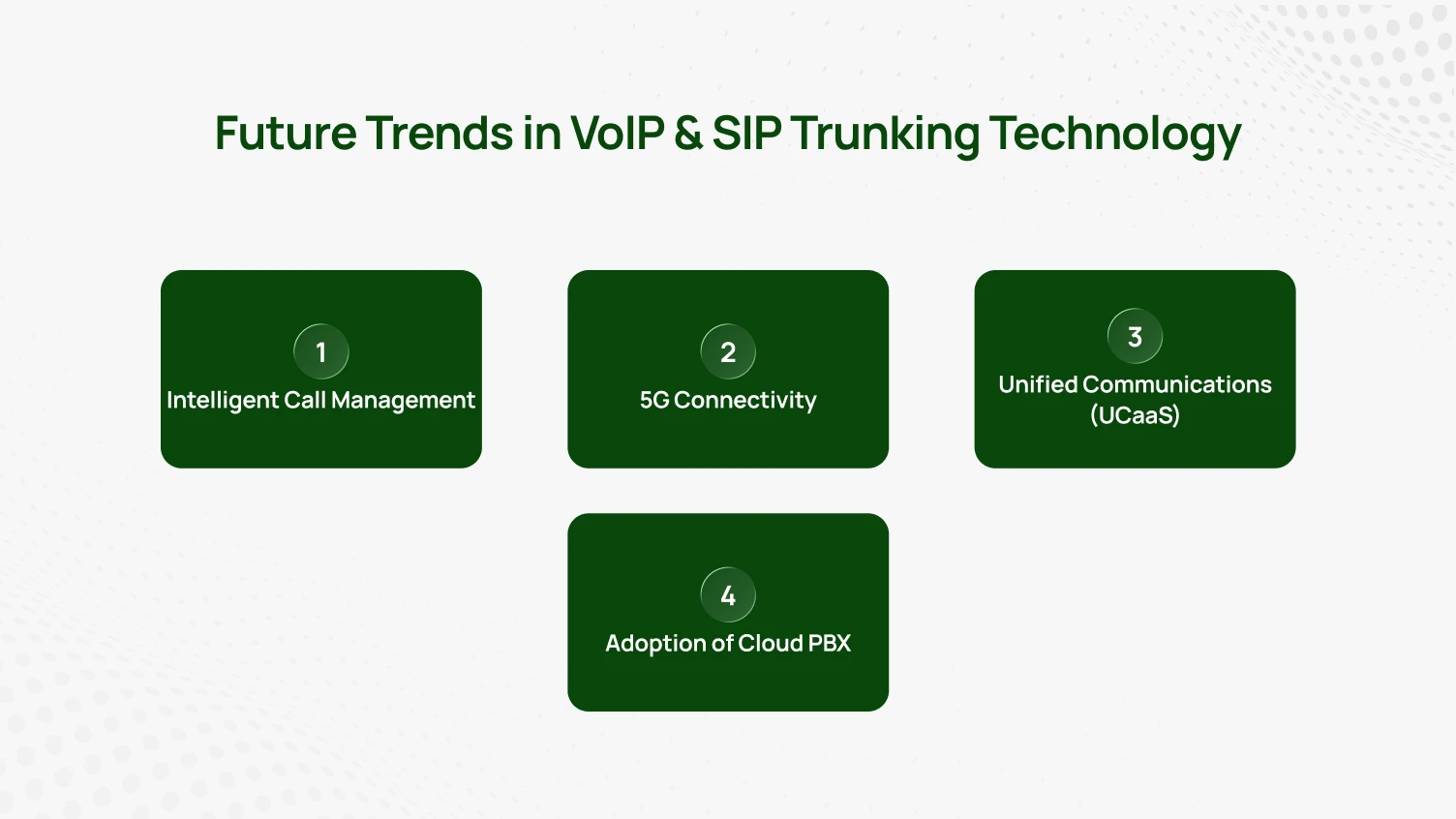
Business communications are changing rapidly. Keeping up with the times means you will not remain with the traditional systems of the past, and competitors are enjoying the benefits of advanced technology.
Intelligent Call Management: AI is changing voice communications. Voice analytics, automated transcription, and predictive routing are useful in managing calls. You could have an AI assistant sifting through incoming calls to help your team prioritize what counts.
5G Connectivity: VOI and video calls are now better and faster over mobile internet. Internet calls enable workers who are not present in the office to participate in calls without experiencing frozen connections or a robotic voice.
Unified Communications (UCaaS): Voice, video, and chat made to be part of the same platform, minimize application-switching, and enhance productivity. Voice communications can be easily managed by your team regardless of location.
Adoption of Cloud PBX: Upgrading to cloud-based IP PBX systems eliminates the dependence on hardware and the maintenance nightmare. Fewer wires and fewer boxes mean that IT teams get more time to do the strategic work, or, to be frank, take coffee breaks.
Choosing between VoIP and SIP Trunking is not a big deal, but it requires knowledge of what you have, and it does require thought. VoIP is ideal for new businesses, remote teams, or anyone seeking minimal hardware requirements. Easy to scale, mobile-friendly, cost-effective. And SIP Trunking is Ideal for businesses with existing PBX systems. Reduces traditional line costs, keeps infrastructure, and allows a gradual transition to digital.
Your decision depends on infrastructure, call volume, budget, and mobility needs. The best approach might even be a hybrid one, using SIP Trunking for office lines and VoIP for remote workers. That way, you don’t have to replace everything at once.
At the end of the day, your business communication should save money, boost productivity, and prevent endless frustration. Both SIP Trunking and VoIP can do that, but only if you choose wisely.
Switch to Dialaxy for reliable, cost-effective VoIP that delivers the flexibility and savings your business deserves.
In contrast to a traditional phone system, SIP relies on the SIP protocol to facilitate voice and video service via VoIP phones or softphones.
Not necessarily. SIP Trunking is compatible with your current PBX and traditional telephones, though VoIP phones or IP telephony devices may improve call quality, enable voice video conferencing, and make it easier to call on the internet.
The simultaneous calls are limited to the number of SIP channels that your trunk supports. The channels can support one call apiece, thus allowing you to expand your private branch exchange in response to increased business requirements without the need to upgrade to standard phone lines.
Yes! With SIP Trunking, high voice video communication is offered in addition to the option of phone calling. You can use the internet to call just as you can make voice and video calls using your PBX and compatible VoIP phones.
SIP Trunking is the protocol that allows transmitting voice and video calls via the internet and is based on the SIP protocol. The conventional phone lines use a circuit-switched network, which does not scale and requires additional hardware. SIP Trunking is also easier to integrate with the VoIP telephones and IP telephony systems.
