

What is IVR Containment? & Why It Matters

Quick Overview:
IVR Containment is a solution that addresses the entire customer request in the automated IVR system and does not involve a live agent. It is a vital measure to improve operational efficiency.
Today, call centers are keen on saving time by improving customer satisfaction. Most of the time, this subtle move depends on how well the automated system that welcomes each caller works —the Interactive Voice Response (IVR). Its success is mainly measured by a key metric called containment.
IVR Containment is far beyond just an account figure. It is a targeted business goal with a direct impact on the company’s operational costs and customer experience (CX). A call that is very much contained is a short, efficient, automated interaction that benefits both the customer and the company’s bottom line.
We will delve into IVR containment in this detailed manual. We will discuss its definition, how it works, the essential features, and the correct methods for using it. You will know how to convert your IVR into a customer service tool that solves problems on its own once you have read this text.

IVR containment means fully handling a customer request autonomously within the automated system, without a live agent. The goal is for the IVR to successfully address the caller’s complete intent, from the initial prompt through to the final resolution.
A contained interaction involves validating identity, accessing necessary back-end data in real-time, executing the specific transaction, and providing a final confirmation message to the caller. No human input is needed for fulfillment or completion.
When containment fails, the customer usually “zeros out” or is automatically routed to an agent for assistance. Tracking these uncontained events is essential for identifying process gaps and ultimately improving the self-service success rate.
The IVR Containment Rate (IVR CR) is a key performance indicator (KPI) calculated by dividing the number of successfully contained calls by the total incoming calls processed by the IVR. This crucial metric is always expressed as a standard percentage.
This rate directly measures the effectiveness, overall efficiency, and self-service proficiency of your IVR investment within the contact center. A consistently higher percentage indicates a greater technological and design maturity in your self-service automation platform.
Businesses must work to maximize this rate to leverage automation fully and reduce costs efficiently. Tracking IVR CR provides the data to justify investments in advanced AI and system integration projects needed to handle high volumes of self-service.
Knowing what IVR containment means is just the start. Next, let’s look at the key features an IVR system needs to achieve strong containment rates.
Achieving a superior IVR containment rate relies heavily on the capabilities and core design of the response IVR platform itself. Certain advanced features are non-negotiable for enabling seamless, satisfactory self-service, which directly impacts call resolution.
The IVR systems must be able to integrate in real-time with backend systems like CRM securely. This capability allows the system to pull real-time, personalized information, such as account balances, for the caller’s self-service needs. Without data integration, the IVR cannot perform complex or personalized transactions effectively.
NLU allows IVR systems to decode and understand a caller’s purpose in a natural, human-like conversation; thus, they are no longer bound to strict menu options. This is very important for enhancing the customer experience and increasing the use of the IVR channel.
For building and modifying call flows, the platform needs to provide a flexible, intuitive tool, such as a drag-and-drop designer. It makes IVR logic optimization straightforward and facilitates classification of the highest-volume call types.
With these features in place, it’s essential to understand how they function during a real call. Here’s how IVR containment works step by step.
The mechanics of IVR containment involve a structured process that guides callers to a resolution through automated means. Here is the structured process of how it works:
The customer dials a company number, and the IVR system responds with a prerecorded or dynamically generated message. This first move not only defines the atmosphere of the help but also, through automation, solves the problem within the platform.
The system offers the caller various options, and they are expected to choose one by pressing keys on the phone (DTMF) or by speaking if speech recognition is used. For instance, it could inquire about account balances or their nature. Such a collection is needed for correct routing & a successful IVR response.
Based on the customer’s input, the IVR takes a path. For common, routine inquiries (such as checking order status or paying a bill), the system moves toward self-service resolution to achieve call containment.
Completion:
A call is considered “contained” if the customer’s issue is fully resolved during the automated interaction and the customer hangs up successfully. They exit the system without ever speaking with a call center agent or needing any assistance. This is the ultimate goal of improving IVR design.
Now that we know how it operates, let’s explore why IVR containment matters so much for businesses today.
The importance of high IVR containment extends far beyond simple automation; it is a critical measure of business health. Containment directly impacts the bottom line and overall operational effectiveness for any contact center. Let’s see the reasons why it matters.
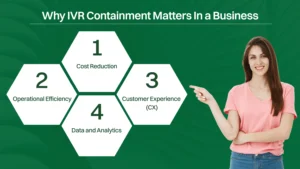
IVR containment rates directly correlate with reduced operational expenses for the business. Every call successfully handled by the automated response IVR avoids the high labor cost of transferring the customer to a call center agent for agent assistance.
Example:
A customer checks their account balances via IVR instead of speaking to an agent. This saves the business the typical per-call cost of a human interaction.
A high containment rate greatly improves operational efficiency, enabling live agents to handle more complex and sensitive call types. This results in the ability to process higher volumes of call-ins without increasing the staffing level for the call center.
Example:
By handling 80% of standard balance inquiries in IVR systems, agents can use their time to handle calls in critical sales and retention roles.
Successful self-service leads to call resolution faster and significantly reduces the customer effort score. When IVR systems are well designed, immediate resolution of simple issues enhances customer satisfaction and builds trust.
Example:
A customer immediately receives an order status update via the IVR, resolving their issue in 45 seconds. They hang up satisfied, avoiding a 5-minute wait time.
Tracking the success and failure of IVR containment provides vital industry insights and data for optimizing processes. Analytics solution reports highlight where the interactive voice response system is failing, guiding targeted improvements.
Example:
Tracking IVR performance shows high abandonment during the authentication process. This suggests that the verification steps need to be streamlined to improve call containment and enhance the overall customer experience immediately.
To track its real impact, businesses must measure IVR performance using the right metrics. Here are the key ones to focus on.
One of the ways to measure the success of your self-service strategy is through tracking the right data points. Monitoring the effectiveness of the IVR system ensures it meets its objectives by resolving issues quickly and efficiently across all call types.
The following are the essential metrics that you should be concerned with:
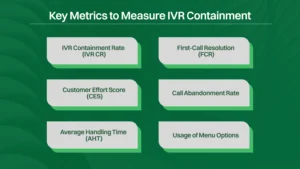
This primary metric calculates the percentage of inbound calls fully resolved by the response IVR without needing agent assistance. Improving the IVR containment rates begins with a strategic IVR menu design that prioritizes self-service and efficiency.
The percentage of calls where the caller’s issue is fully resolved during the first interaction is known as call resolution FCR. High FCR, especially in IVR, indicates better service and a lower customer effort score. In conclusion, it showcases that the issues are resolved effectively by the IVR systems.
CES is a measure of how simple it was for a customer to have their request handled by an IVR. A lower score is frequently associated with a more efficient way of handling the call and quicker navigation through menu options. This measure is vital for enhancing customer satisfaction.
The percentage of callers who disconnect their calls prior to getting a solution or talking to a live agent is what this metric is all about. In most cases, a high call abandonment rate indicates that callers are irritated by the automated phone system (IVR) or by difficult, inefficiently structured call flows that require quick optimization.
While often applied to agents, tracking the system’s AHT is key for contained calls. A shorter average handling time for self-service transactions confirms the efficiency of your technology and call flow structure. Efficient processing boosts operational efficiency.
Modern IVR systems provide analytics solution tools that break down how often each menu option is selected. This data offers crucial industry insights into customer intent and helps administrators optimize the IVR design to boost self-service success.
These metrics reveal performance trends, but what do they mean in practice? Let’s look at the benefits of achieving higher IVR containment.
Achieving a high IVR containment rate is not just a technical goal. It delivers significant strategic benefits across the entire business. Improving IVR performance leads directly to better financial and service outcomes. See this table of benefits to see what a higher IVR containment gives:
| Benefit | Description |
|---|---|
| Reduced Operating Costs | Every successful call containment avoids the cost of a human call center agent. This reduction in labor expense minimizes the need for agent assistance. This action significantly boosts profitability. |
| Increased Agent Productivity | The system handles routine call types and simple issue resolution autonomously. Live agents focus exclusively on complex, sensitive customer issues. This sharp improvement in operational efficiency lowers average handling time. |
| Faster Service & Resolution | The interactive voice response system can resolve issues instantly. It provides data like account balances quickly. This efficiency boosts call resolution FCR. It also significantly lowers the customer effort score. |
| Better Customer Experience | Quick, effective self-service enhances customer satisfaction. It eliminates unnecessary transfers and waits. A well-designed response IVR reduces the call abandonment rate. It builds trust in the IVR systems. |
| Scalability and Resilience | High IVR containment rates allow the center to handle massive spikes in inbound calls. This happens during peak times without being overwhelmed. This capability ensures continuous service delivery. |
Despite these advantages, maintaining high containment can be difficult. Here are the main challenges businesses often face.
High IVR containment rates are challenging to attain due to various standard design and technical flaws. The recognition of these shortcomings marks the beginning of optimizing IVR success and improving customer satisfaction. Let’s see what challenges you will face:
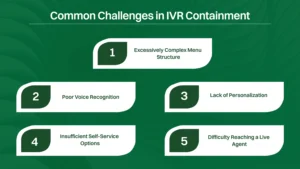
Confusing, complex IVR menu choices frustrate consumers and lead to caller fatigue. Furthermore, if options are counterintuitive, it tends to impact the call attempt negatively, causing the consumer to hang up on the call and then dial the call center hotline instead.
Inefficient voice recognition causes the interactive voice response system to misinterpret instructions. Misrouted calls due to these misunderstandings result in frustrated customers who then require agent assistance, leading to poor call containment.
Many IVR solutions offer generic, one-size-fits-all interactive experiences that fail to account for the caller’s history and activities. The complete failure to leverage data, such as account balances and prior attempts to resolve an issue, results in repeated customer calls.
A significant issue arises if the IVR fails to process popular calls, such as money transfers and order tracking. As such, customers must escalate to a live agent to connect to the concerned party. In effect, customers are denied call FCR because of automation.
Ironically, implementing the option to bury communication with the human agent may result in failed calls. Eventually, the caller becomes frustrated by the inability to locate the transfer option and might hang up rather than successfully implement the non-containment transfer.
Thankfully, these issues can be solved with the right approach. Let’s explore the best practices that help boost containment rates.
Best Practices for IVR Containment Rate Optimization
In optimizing IVR containment rates, there must be an emphasis on simplicity and on investing in technology and data analysis. These are best practices that ensure an IVR system is more effective.
How to Implement:
In IVR flow design, set the first choices to be the most frequent call types. Reduce the audio announcement waiting time to no more than 5 seconds to enable the customer to act without waiting.
How to Implement:
Assess the capabilities of new phone solutions for NLU and compare them based on the availability of “drag-and-drop” functionality. The new solution should securely interact with your backend CRM to retrieve personalized information, such as account balances.
How to Implement:
Analyze reports about transfer queues and call abandon rates. Examine call transcript data to identify calls that transferred to a live agent and find out what was said that caused the failed transfer.
How to Do This:
Enable NLU in your IVR. Develop conversational flow scripts to answer frequently asked questions. Employ AI to extract real-time customer data and enable the IVR to proactively present self-service opportunities.
How to Implement:
Embed a link on your website or within a text message that leads to a visual flow. Using this method, customers can enter data and view menu options on-screen, resulting in exponentially higher completion rates.
Modern technology now plays a massive role in this improvement. AI and speech analytics are leading the next wave of IVR containment success.
AI and conversational AI systems are transforming IVR containment by moving beyond simple menus. NLU enables interactive voice response systems to understand natural language and intent, significantly increasing the likelihood of successful call containment without rigid menu options.
Speech analytics improves services by real-time correction of errors and sentiment analysis services. If the system detects frustration or confusion in the caller, it can automatically direct the call to a live agent so the caller receives help immediately. This will eliminate a high rate of call abandonment.
Finally, AI provides crucial data by tracking every interaction and identifying containment gaps for all call types. This use of analytics and context, such as account balances, increases personalized self-service, leading to higher call resolution FCR.
IVR Containment is a critical business goal. It fundamentally impacts operational costs and customer satisfaction. Success requires three pillars, which are a simple IVR menu design, advanced technologies such as conversational AI, and continuous analysis using analytics solution data.
High containment rates translate directly into financial benefits. They boost operational efficiency and call resolution FCR. Businesses must mitigate challenges such as complex workflows and a lack of personalization. This effectively transforms their IVR systems into a powerful self-service channel.
The flow designer helps administrators strategically place the most frequent call types and issue resolution paths at the start of the customer journey. This quick optimization ensures IVR systems can rapidly adapt to new trends, maintaining the agility needed for continuous containment success.
For contained calls, a short average handling time validates the efficiency of the IVR’s technology and call flow structure. By ensuring fast self-service transactions, the IVR proves its value in boosting overall operational efficiency compared to slower human interaction.
When the interactive voice response system uses generic flows, it fails to leverage available caller data. This forces customers to repeat information or navigate irrelevant steps, leading to frustration and a high failure rate because the system cannot perform personalized transactions.
Visual IVR offers a convenient, multi-channel alternative to traditional voice interaction. By allowing customers to use digital channels (like apps or web chat) to complete their tasks, it alleviates pressure on inbound calls. It offers an effective, low-frustration path to issue resolution.
Speech analytics helps identify the specific friction points that are often related to poor voice recognition, which cause customers to hang up. By detecting frustration in the caller’s voice, the system can trigger immediate intervention or adjustment to reduce the call abandonment rate.
