

How Call Center IVR Improves Customer Experience?

Do you struggle calling customer service? Confusing menus and repeating problems can turn a simple task into a marathon. In an age where everything is instant, why does getting help still feel so slow and complicated? This struggle is a major challenge to businesses: delivering fast, personalized services without overwhelming teams.
The answer lies in a smarter approach to a familiar technology: the Call Center IVR. Forget the outdated voice prompts of the past; today’s advanced systems are actually designed to improve your experience.
This blog will explore how IVR truly enhances your experience, combining speed, personalization, and seamless service like never before.
In today’s dynamic world, customer expectations have never been higher. Consumers demand quick answers. They expect personalized service. Handling massive call volumes with only human agents is inefficient. It leads to long wait times and missed voicemail follow-ups.
Let’s explore the core reasons why IVR has become essential.
Today’s consumers live in an on-demand society. They expect immediate access to information. They want prompt resolutions to their problems. This demand for speed affects all aspects of service. It applies particularly to call centers.
Traditional call center models struggle to meet these high expectations. Relying solely on human agents for every inquiry creates bottlenecks. IVR steps in a critical situation. It addresses these modern demands directly. This means customers can get answers quickly.
Call centers handle immense volumes of inquiries daily. Without efficient systems, this volume can overwhelm operations. Some calls might be handled perfectly. Others might suffer from rushed interactions or errors.
IVR introduces a layer of efficiency and consistency. It ensures every customer receives a standardized initial interaction. The system collects necessary information uniformly. It routes calls accurately every time. This reduces no burdens on agents.
Customers want more personalized interaction. They desire to be recognized and appreciated. This kind of personalized attention to thousands of callers is a big challenge. Human agents might struggle to access complete customer histories quickly.
IVR systems, when integrated with CRM databases, enable personalization. They achieve this on a massive scale. The IVR can identify a caller by their phone number. It can instantly pull up their account details and recent purchase history. This allows individualized greetings and provides choices that are applicable to their specific scenario.
IVR (Interactive Voice Response) is a technology that allows computers to interact with humans via voice and keypad inputs. Callers respond by voice or keypad, guided by prerecorded messages or text-to-speech prompts.
In a call center, IVR systems respond to incoming calls and offer pre-recorded voice prompts. They guide customers through a menu, offering options like billing, technical support, or account updates. This helps resolve simple queries immediately and ensures callers reach the right agent when needed.
IVR systems follow a step-by-step process to direct customers and lead them to the right solution:
An effective IVR system is based on several key elements. Each element works together with modern call center software to provide a seamless customer experience and workforce engagement.
Here are the major elements that make it work.
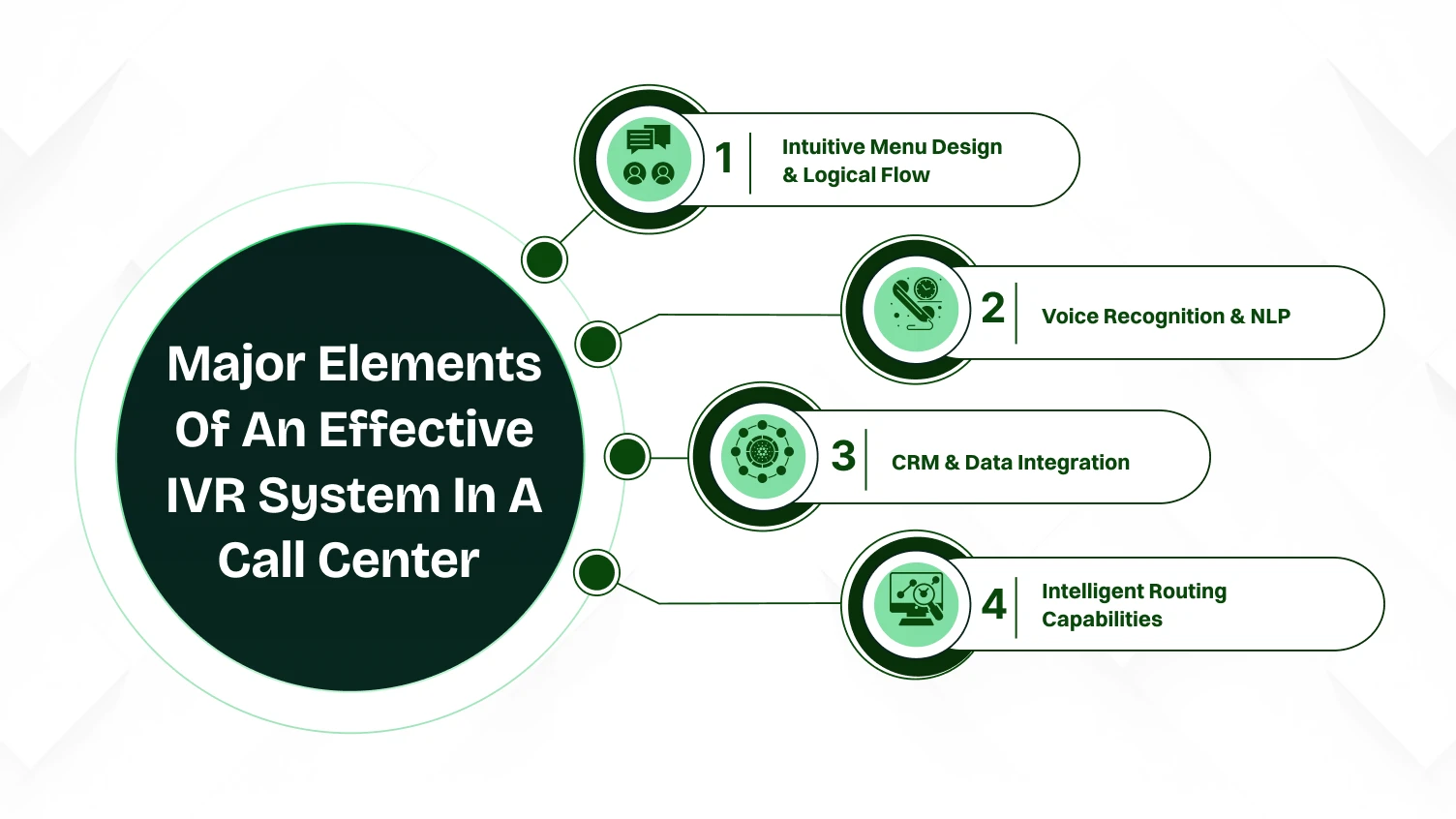
A well-designed IVR must be clear and concise. It presents easy-to-understand options and has a straightforward structure. Good design allows for “barge-in”. This means you can speak over the prompts. You do not have to wait until the system is complete.
Imagine calling for technical support. A poorly designed menu might list 15 options. Then, it might ask you to select from multiple submenus. This becomes frustrating. An intuitive system, however, offers direct choices. For example, “For billing, press 1. For technical support, press 2.” This guides callers to their desired destination quickly.
These technologies allow IVR to understand your spoken words. It interprets full phrases. You don’t have to use specific keywords. You can express your issue naturally. This makes the interaction more human-like.
For example, instead of “Press 2 for support,” you might hear, “What can I help you with today?” You could then respond, “I forgot my password; can you help me reset it?” The system processes this and directs you to the correct function. This eliminates the need for endless button pressing.
CRM connects the IVR system to a company’s customer databases. When you call, the IVR identifies you. It uses your caller ID or account number. It then pulls up your information instantly. This includes your name, past interactions, and account details.
Therefore, the system might greet you by name. It could even reference a recent service request. This means agents receive your call with full context. It streamlines the handoff process.
Intelligent routing directs your call precisely. It routes calls to the most appropriate agent or department. The decision is based on your input. It considers your identified issue. It could consider your customer segment when routing the call.
For example, a technical query will go to an IT specialist. A billing question will go to the finance department. This is called skill-based call routing. It ensures you find someone who can genuinely help. It results in faster and accurate call resolution.
For businesses, it is crucial to implement IVR effectively. It has a direct influence on customer satisfaction and must be approached thoughtfully. Businesses need to concentrate on the client experience. They need to ensure the system that genuinely helps. IVR is not that simple to install.
So how do you actually make it work? Let’s break it down step-by-step.
Businesses must start by understanding their customers’ typical paths. They should identify why customer calls happen. What are their most frequent questions? Are there recurring problems? Mapping these journeys reveals patterns. It highlights opportunities for IVR automation.
For example, if “order status” is a top query, that becomes a priority IVR menu option. The initial analysis ensures the IVR addresses actual customer needs. It prevents building a system that falls short.
Once queries are mapped, categorize them. Which tasks can the IVR handle independently? These are typically simple, transactional requests.
For example, checking balances or changing addresses. Which tasks absolutely require a human agent? These are often complex or emotionally charged issues. Clearly defining these roles prevents frustration. It ensures customers are called appropriately. This distinction improves both efficiency and satisfaction.
Theoretical designs are rarely perfect. Businesses must test their IVR scripts and call flows. This involves real users providing feedback. Are the prerecorded messages clear? Is the navigation intuitive? Does the system understand familiar accents? User testing uncovers unexpected issues. It identifies points of confusion.
For example, a call flow might seem logical internally. Users might find it confusing. This iterative testing is necessary for refinement. It ensures a truly user-friendly system.
Even the best IVR system will have escalations. Customers will still need human help. Agents must be well-prepared for these transfers. They need to understand how the IVR works.
Training should focus on empathetic listening. It should emphasize problem-solving. Agents should not ask customers to repeat information. This practical training ensures a smooth transition. It makes the customer feel supported.
Key Performance Indicators (KPIs) are essential for continuous optimization. Businesses should constantly observe the appropriate metrics. These are First Call Resolution (FCR) rates, call containment rates within IVR, and Customer Satisfaction (CSAT) scores. Monitoring these KPIs helps to identify areas where improvement is required.
For example, if FCR is low after IVR transfers, something needs adjustment. This data-driven approach ensures the IVR continually evolves. It provides the best possible customer experience.
The strategic adoption of IVR by call centers brings multiple advantages. These benefits of IVR directly enhance your customer experience. They transform a potentially frustrating call into a productive one.
Let’s explore these positive impacts.
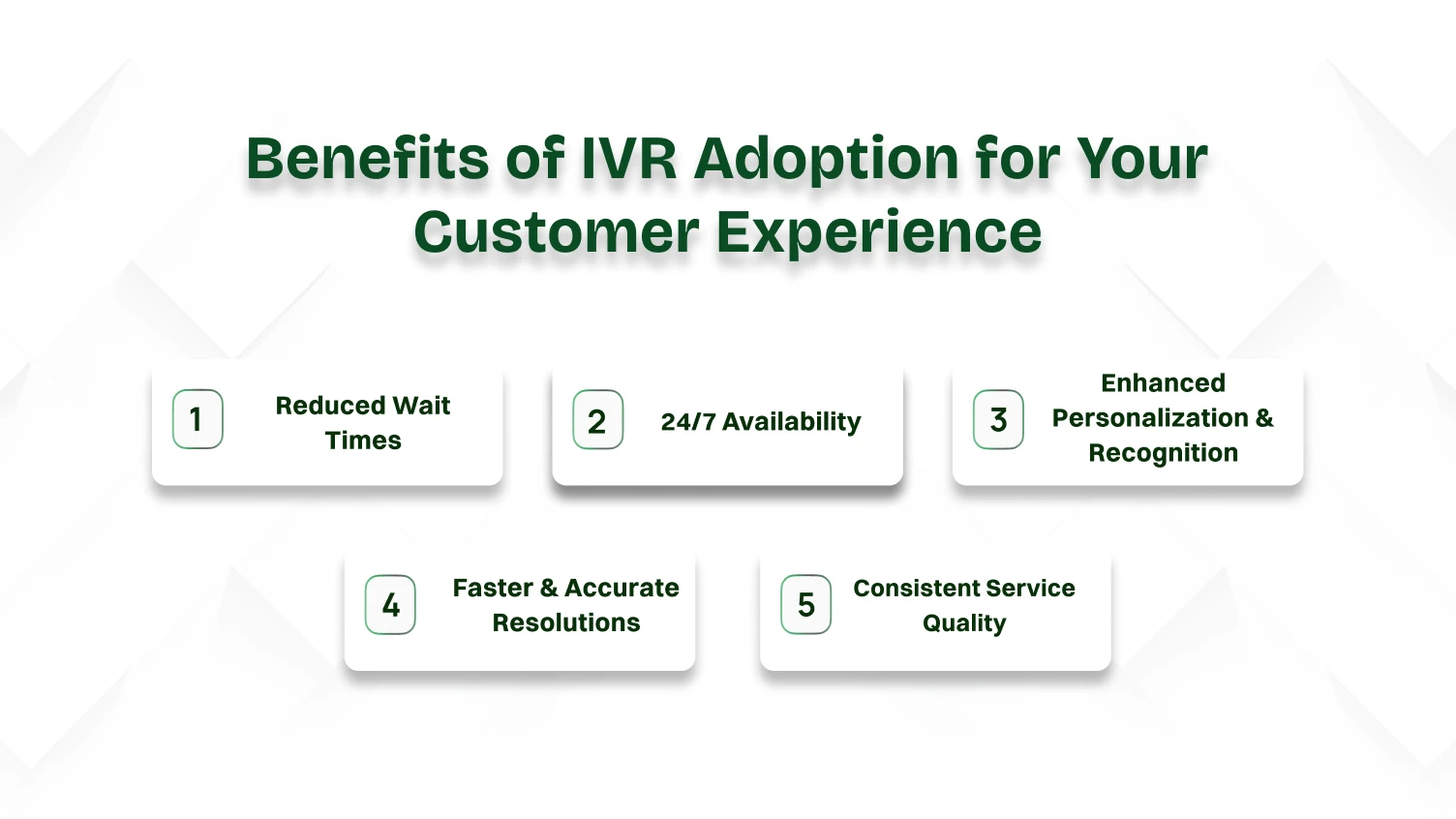
This is a major win for customers. By intelligently routing calls, IVR sends you to the correct department quickly. It also handles many routine queries through self-service options.
Imagine calling your utility company. Instead of a 10-minute hold, the IVR quickly authenticates you. It routes calls to a specialist in under two minutes. This significant time saving directly benefits you. It frees up your day. It reduces your stress.
Life does not adhere to business hours. Neither your questions nor your urgent needs. IVR systems operate continuously. Such availability implies that you can get fundamental services anytime.
You can check an account balance late at night, track an urgent package delivery on a holiday. You can also make a payment outside of typical working hours. This offers incomparable convenience. It gives you the power to organize your own affairs at your own time.
Modern IVR systems use your caller ID. They integrate with CRM integrations. This allows them to greet by name. They can reference your past IVR interactions. They can even offer menu options relevant to your history.
For example, if you recently opened a new account, the IVR might ask, “Are you calling about your new savings account?” This makes you feel valued. It shows the company knows you. This personalized touch transforms a generic interaction.
By gathering information upfront, IVR prepares the agent. It ensures they have your context. Skill-based call routing then directs you to the most qualified person. This means less back-and-forth. It results in quicker and more effective call resolution to your problem.
Consider calling about a complex software issue. The IVR routes you directly to a Level 2 technician. This call center agent already knows your product and issue. This improves the likelihood of a first-contact resolution. Your problem gets solved correctly the first time.
Every customer receives a standardized initial IVR interaction. This creates a reliable experience. Regardless of call volume, the IVR’s performance remains consistent. You can expect a certain level of efficiency every time you call.
For example, an automated order status update is always clear and accurate. It does not depend on an agent’s mood or training. This consistency builds trust. It makes the customer journey smoother.
IVR systems are powerful, but they can create an obstacle to the customer experience if poorly implemented. It is necessary to avoid pitfalls.
The following are the most common IVR mistakes that frustrate customers.
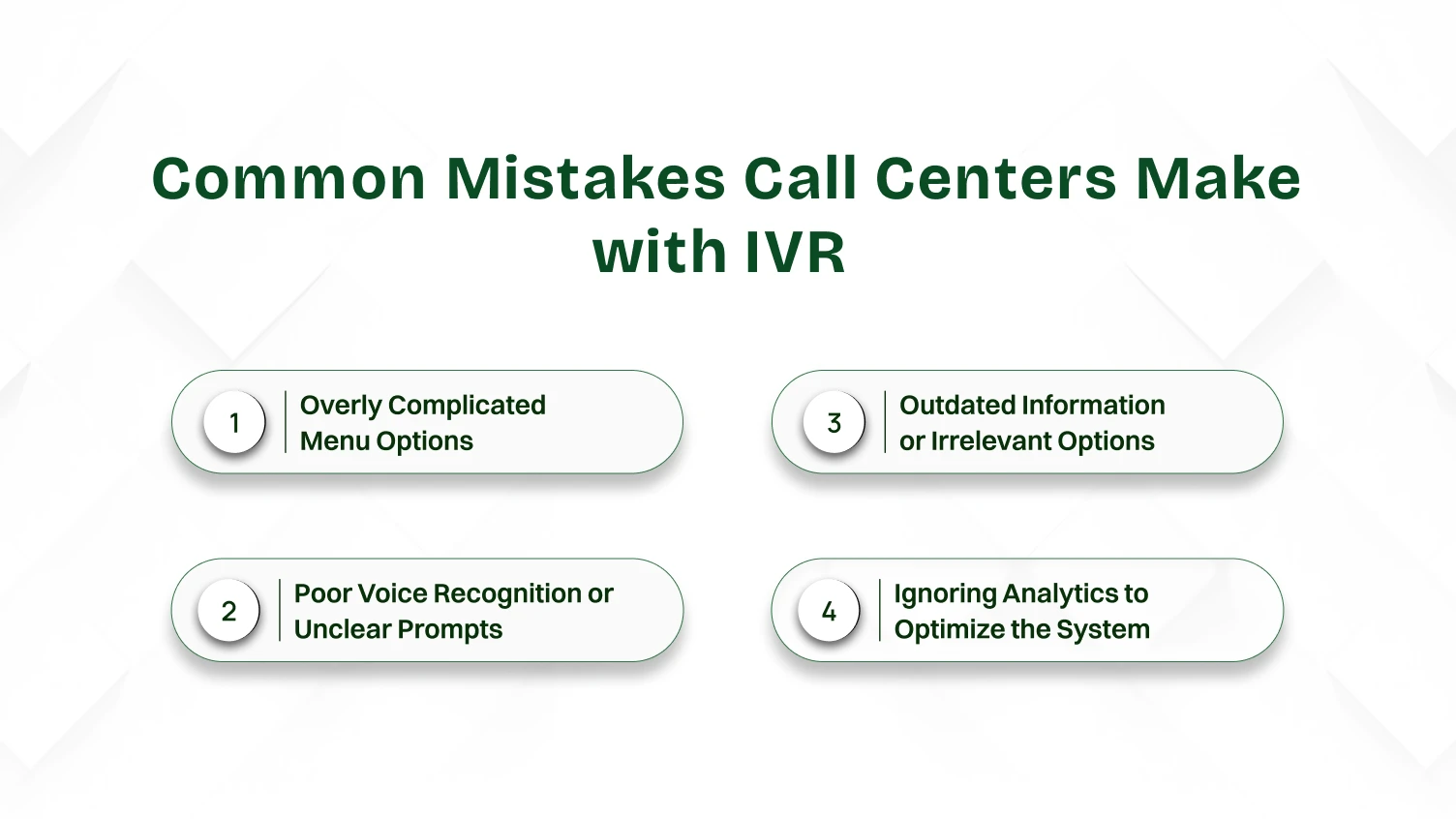
One major mistake is making IVR menus too complex. Too many options overwhelm callers. Overly layered menus frustrate them. Customers want simple, clear choices. They need to find their option quickly.
If a caller has to navigate through five different sub-menus, they will get annoyed. They will likely choose the option to speak to a live agent. This defeats the purpose of self-service. Keep IVR menus simple.
Ineffective voice recognition is highly frustrating. If the system constantly misunderstands callers, it fails. Unclear prerecorded messages also cause issues. Muted audio or confusing language harms the experience.
A system that asks a caller to repeat themselves multiple times creates anger. It makes the IVR system seem incompetent.
An IVR system with old information is useless. If promotions or services are no longer valid, update them. Irrelevant options confuse customers. They waste time navigating through options that don’t apply to them.
For example, offering a seasonal promotion option in the middle of summer is poor design. Regularly review and update IVR menu content. Ensure it reflects current business offerings.
Many companies implement IVR and then forget it. They fail to monitor its performance. Ignoring IVR data means missing improvement opportunities. Analytics provide insights into call flows and common drop-off points.
Without analyzing metrics like call resolution rates or common menu choices, the system cannot improve. Regularly reviewing IVR interactions is crucial for optimization. It helps identify areas where the IVR application can be refined.
To truly leverage IVR for a superior customer experience, businesses must adopt specific best pratices. These approaches focus on making the system user-friendly and practical. They ensure the IVR serves the customer, not just the company.
Follow these approaches that make IVR work for both customers and businesses.
Always design IVR menus with the user in mind. Simplicity and clarity are paramount. Make it easy for callers to achieve their goal. Offer an option to speak to a live agent early. A well-designed IVR menu reduces effort for the customer.
Think about the customer’s perspective. What do they want to achieve? How can the IVR system help them do it most easily? This user-centric approach ensures a high increase in customer satisfaction.
Invest in superior voice recognition technology. Ensure all prerecorded messages are clear. The audio quality should be excellent. A clear, responsive system reduces frustration. It makes the self-service options more effective.
Customers should not struggle to be understood. They also should not strain to hear prompts. This technical quality is foundational for a good IVR solution. It makes directed dialogue a pleasant experience.
When a call transfers from IVR to an agent, ensure relevant data is passed along. Agents should be aware of what the customer has attempted to do and the options they selected. This context helps the agent resolve the issue faster. Additionally, call recording integration adds another layer, allowing supervisors to analyze real interactions.
CRM integrations are key here. The call center agent should see the IVR interaction history. This improves efficiency. It also enhances customer satisfaction by avoiding repetition.
Continuously analyze IVR data and metrics. Look at call volumes for each option. Identify options with high abandonment rates. Track call resolution rates through self-service. Use these insights to refine call flows and IVR menus.
This ongoing analysis is critical for optimization. It ensures the IVR system adapts to changing customer needs. It helps in identifying areas for cost savings and efficiency.
Regularly review and update IVR options. Remove outdated information. Add new services or FAQs. Keep the menu options brief and easy to understand. Concise language reduces confusion and helps callers quickly make choices.
A streamlined and current IVR menu reflects a well-managed system. It ensures the system remains relevant and useful. This commitment to accuracy makes the IVR system a valuable asset.
New technologies will continue to transform the customer service experience. These trends promise even richer, more personalized interactions.
Here’s what’s next in IVR innovation and smarter service solutions.
AI will drive hyper-personalization. AI agents will learn from every interaction. They will predict customer needs. This allows for even more tailored IVR interactions. The system will anticipate queries before they are fully expressed.
Imagine an IVR system that knows you frequently call about your internet bill. When you call, it might proactively offer “Check your current bill.” This proactive service enhances the customer journey greatly. It pushes the boundaries of personalized service.
Visual IVR combines traditional voice menus with visual interfaces. Customers can see options on their phone screen. This enhances the traditional phone system experience. It makes navigation easier. Omnichannel integration means IVR will work seamlessly with chat, email, and social media.
By leveraging an engagement platform, businesses allow customers to start an interaction on one channel and continue on another. For example, a customer could start a query via visual IVR. Then they could seamlessly transition to a chat with an AI agent. This provides a consistent experience.
Future IVR systems will understand emotions. They will use sentiment analysis to detect frustration or anger. This allows the system to respond appropriately. It might offer to transfer a frustrated customer to a live agent faster.
Such a system could identify a stressed customer’s tone. It could prioritize their call for a human touch. This sensitive approach significantly improves customer relations.
Advanced IVR will become more proactive. It will reach out to customers with relevant information. This could be appointment reminders or service updates. Instead of waiting for a call, the system initiates contact.
For example, an IVR system might send a notification about a scheduled service outage. This reduces incoming call volume for confused customers. It demonstrates a commitment to exceptional service and actively enhances customer satisfaction.
Call Center IVR is a powerful tool. It transforms customer experience and meets modern demands for speed and personalization. A well-designed IVR reduces wait times. It delivers consistent, efficient service. By avoiding common mistakes and adopting best practices, businesses can excel. These strategies ensure a robust and customer-centric IVR solution.
The evolution of IVR systems continues to impress. Future trends promise even more advanced, intuitive interactions. These include hyper-personalization with AI. Visual IVR and omnichannel integration are also emerging. Investing in IVR best pratices today prepares businesses for tomorrow’s challenges. It ensures reducing wait times and increasing customer satisfaction in the long run.
An IVR system serves multiple key purposes:
Companies use IVR to reduce operating costs. They ensure call centers operate effectively while offering 24/7 availability. IVR systems are key for efficient contact center solutions.
The average talk time in a call center varies widely. It depends on the industry and complexity of queries. IVR systems can help reduce operating costs by decreasing the average talk time. They resolve simple queries upfront.
IVR systems are best for routine and simple queries. For complex issues, they can pre-qualify calls. They route them to a specialized call center agent. This ensures efficient handling. Advanced IVR with AI can handle more complex tasks.
Businesses ensure their IVR system meets expectations through careful design. They must prioritize user experience (UX). They need high-quality voice recognition. Regular testing with real users is vital. Keeping IVR menus updated and concise helps to ensure the IVR solution remains effective and customer-centric.
