

AI Voice Bot: Definition, Benefits, and Use Cases

We’ve all been there. You call customer support, sit through a long menu, press “0” three times hoping it speeds things up, and still end up waiting 20 minutes for something you could’ve sorted in 30 seconds. It’s a bad experience for the caller. For the business, it’s money and time going straight out the window.
And honestly? Most companies are still struggling with this exact problem.
And here’s AI voice bots as a rescue.
According to Speechmatics, 47% of companies used voice-led technologies in 2024 to start automating customer conversations and internal workflows. The global voice market jumped from $9.25 billion to over $10 billion in a single year.
This article explains what an AI voice bot is, how it works under the hood, and why it’s a whole new game from the phone systems most of us now have to contend with.
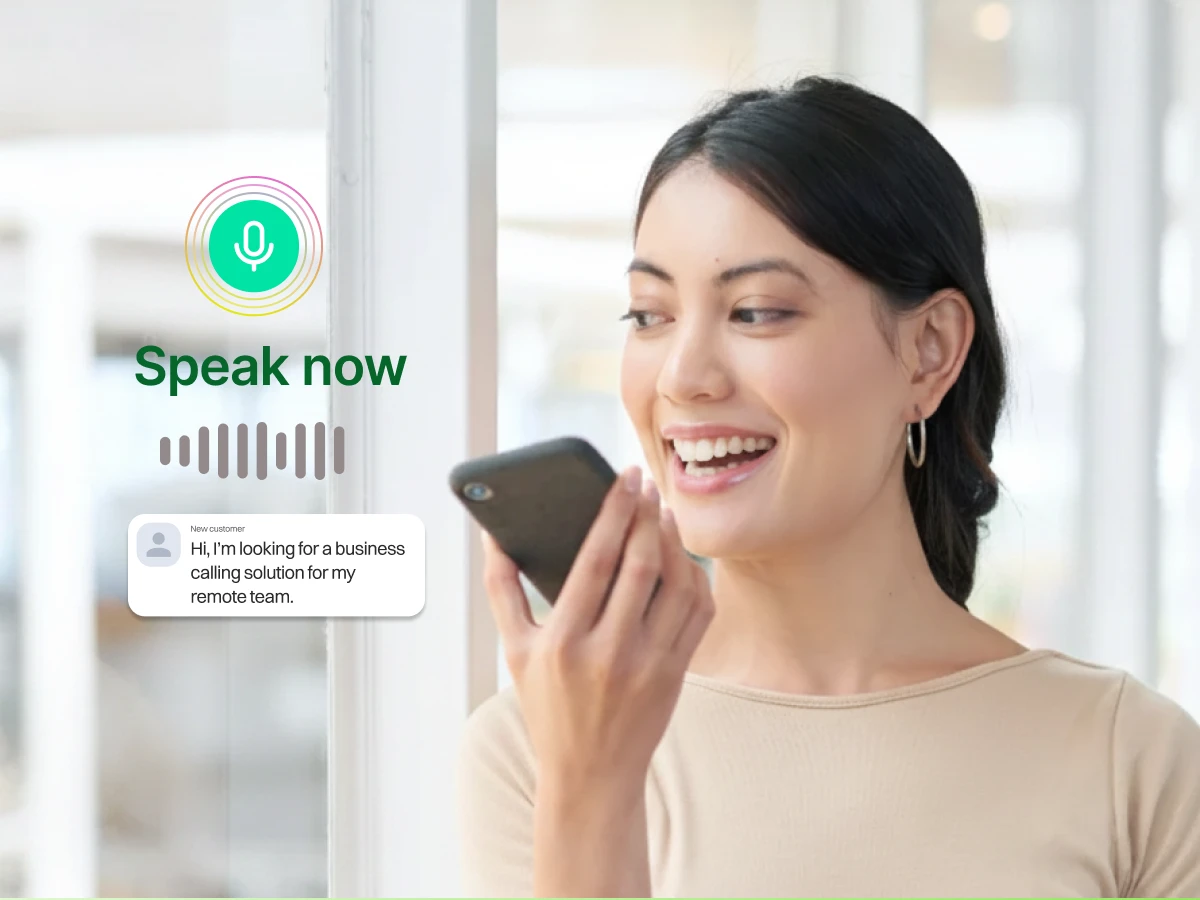
At its core, an AI voice bot is the layer sitting between a customer and your business systems. It’s a conversational tool that runs on voice AI and natural language understanding, so it doesn’t just catch words; it figures out what the person is actually after.
It is a conversational tool based on voice AI and natural language understanding, not only picking up words, but also understanding what the person wants.
A caller rings up and says, “I am looking for my package.” The bot doesn’t require a trigger word or a keyword. It reads the sentence and understands the requirement, and fetches the relevant information.
Where a consumer AI companion like Siri handles general questions, business-grade voice bots are wired differently. They plug into your tech stack, your CRM, helpdesk, and databases, and give callers real, account-specific answers. One system can juggle thousands of voice conversations simultaneously. No hold music. No dropped calls during a rush.
The whole thing happens faster than you’d think. From the second a caller speaks to the moment they hear a response, several technologies are firing at once. Here’s the sequence:
Voice bots are often confused with IVR systems, the “Press 1 for sales, Press 2 for support” that we’ve all used for years. They’re not the same. Not even close.
IVR is a dead end for most callers. It works within tight constraints. If you don’t say the right thing or press the right button, you’re stuck. Anyone with a slightly unusual problem just bounces around the menu until they give up or hit zero.
An AI call bot lets you talk the way you actually talk. No scripts. No specific phrases.
| Feature | Traditional IVR | AI Voice Bot |
|---|---|---|
| Input Method | Keypad / preset commands | Natural speech |
| Understanding | Menu-based, rigid | Context-aware, dynamic |
| Personalization | None (one size fits all) | CRM-integrated (knows who you are) |
| Scalability | Limited by hardware ports | High (cloud-based) |
| Customer Experience | Often frustrating | Natural and conversational |
Both the chatbot and AI Voice bot live under the AI automation umbrella, but they serve different purposes on your agent platform.
| Feature | Chatbot (Chat AI) | AI Voice Bot (Voice Agent) |
|---|---|---|
| Primary Channel | Websites, mobile apps, and social messaging platforms. | Phone lines, call centers, and traditional IVR systems. |
| Communication Mode | Visual and text-based. | Auditory and spoken conversation. |
| Input Method | Users type their questions manually. | Users speak naturally through voice chat. |
| Processing Speed | Limited by how fast a person can type (~40 wpm). | Powered by the speed of human speech (~150 wpm). |
| Accessibility | Best for quiet public spaces or office environments. | Perfect for hands-free use, drivers, or senior citizens. |
| User Experience | Great for reading lists or viewing links. | Offers human-like conversations and immediate empathy. |
| Core AI Power | Focuses on text-based AI solution flows. | Combines real-time AI with speech recognition. |
Voice bots are also more human, which is important for elderly callers, as well as those unable to read a screen while behind the wheel. Having an AI chatbot as well as a voice bot covers both channels, and customers can contact you in their preferred manner.
Depending on what you need, there are a few different directions you can go.
This is not about riding a trend in technology. The reasons are very real and measurable, why business is moving to switch.
Most small businesses go dark after 5 PM. An AI assist bot keeps the lines open. Appointments scheduled overnight. Leads captured on Sundays. You’re not losing business just because nobody was at their desk.
Round-the-clock phone coverage from a human team is expensive. Salaries, training, benefits, turnover. The cost savings with AI show up fast. You’re handling far more calls at a fraction of the staffing cost.
Nobody likes waiting on hold. A voice agent picks up immediately. A hospital in New York deployed an AI call bot to manage flu season call volume. Their average wait time dropped from 20 minutes to under two. For patients, that difference is huge.
Holiday retail traffic. Open enrollment season. Tax deadlines. Whatever causes your call volume to spike, an AI platform absorbs it. A hundred simultaneous calls handled with no degradation in quality, no temp hires required.
When you automate routine tasks, your human team stops drowning in repetitive questions. They get to focus on work that’s actually challenging. That’s better for morale and better for the business.
A voice AI agent can switch between multiple languages without adding headcount in every market. If your customer base is spread across regions, this matters more than most people expect.
Here’s where call bots are making the biggest impact right now.
The most obvious fit. A voice AI agent handles call routing, standard questions, and self-service requests. Someone calls about an internet outage? The bot checks the system, finds the relevant area, and gives them an update on the spot. It’s the kind of thing that makes your agent platform actually work at scale.
Between appointment reminders, prescription refill requests, and symptom triage, a doctor’s office phone line can be relentless. Call bots take a serious chunk of that volume. Appointments scheduled automatically. Staff are freed up for patients who are physically in the building.
Balance checks, lost card reports, fraud alerts, these are high-frequency, low-complexity calls that don’t need a human. A voice agent handles them well. And if the system flags a suspicious charge, it can reach out to the customer and verify it through a natural humanlike conversation.
“Where’s my order?” That’s probably half your inbound call volume. An AI chatbot or voice bot pulls the tracking data and reads it out in seconds. Returns and simple exchanges can be handled the same way.
Employees have questions, too. An internal chat AI answers questions on vacation balances, benefits enrollment, policy explanations, etc., saving HR teams substantial hours this week and providing employees with quicker responses.
A bot can follow up with outbound calls on web inquiries, follow a brief qualifying question set, and mark leads as good ones for sales team members. The reps only spend time on people who actually want to talk.
It’s a good idea to be honest about the things that don’t always go smoothly.
A few directions the industry is clearly heading toward.
Before you sign anything, work through these questions.
Dialaxy is more than a phone service. It’s a full AI platform built around getting your calls handled efficiently, virtual numbers paired with a proper voice AI agent that’s ready to work from day one.
Whether you’re building out a contact center or just trying to stop missing leads after hours, our AI call bot takes the load off your team. It handles automate routine tasks while giving you custom insights into every conversation, so you actually understand what your customers are calling about.
The whole thing is designed to empower human agents, not sideline them. Less time on repetitive calls means more time on the work that moves the needle.
Ready to automate your calls?
Phone-based customer service has been broken for a long time. Long menus, long waits, and agents stuck answering the same five questions all day.
AI call bots are changing that, not by replacing people, but by handling the volume that was overwhelming them in the first place.
Think about where your tech stack is headed this year. Think about how many calls you’re probably missing or mishandling. Then think about what fixing that would actually be worth. The future of human-like conversations over the phone isn’t some far-off idea; it’s already being used by businesses that got tired of putting customers on hold.
See how Dialaxy handles your contact center calls.
It’s an AI-powered voice assistant that can have natural conversations with callers without a human agent on the line. It answers questions, schedules appointments, and resolves common customer inquiries automatically.
Traditional IVR systems rely on button presses and fixed menus, while an AI voice bot uses speech recognition and natural language processing (NLP) to understand spoken requests and respond conversationally.
A chatbot communicates through text on websites or messaging apps, whereas an AI voice bot interacts with customers over phone calls using voice. Speaking is often faster and more convenient than typing.
AI voice bots reduce operational costs, provide 24/7 customer support, and automate repetitive tasks at scale, allowing employees to focus on more complex and valuable work.
Healthcare, finance, retail, travel, and customer support centers are among the biggest adopters. Any business that handles a high volume of phone calls can benefit from AI voice automation.
No. AI voice bots are designed to support human agents by handling routine inquiries and repetitive tasks. Complex, sensitive, or emotionally driven conversations still require human assistance.
The cost depends on your business size, required features, and deployment complexity. However, many businesses achieve a strong return on investment through lower staffing costs and improved efficiency.
AI voice bots combine Automatic Speech Recognition (ASR), Natural Language Understanding (NLU), real-time artificial intelligence, and text-to-speech (TTS) technology to deliver accurate, human-like voice conversations.
