

Features of an IVR System: How They Simplify Call Management


Have you ever called a company and immediately felt annoyed by waiting or confusing options? That feeling is a huge problem for how customers feel about a business. Companies cannot afford to keep people waiting or send them to the wrong person again and again.
The great news is that old-fashioned phone menus are getting much smarter. The Interactive Voice Response (IVR) system is what makes this change possible. It works as your company’s smart receptionist all day and night. It can handle a massive number of calls and complete difficult tasks.
We will look closely at the main features of an IVR system. You will learn how things like smart call routing and self-service options make managing calls simple. These features also help cut down on costs and make customers much happier right away.
The IVR system is much more than just a menu for incoming calls. It’s a strategic component that directly helps a modern call center succeed. Businesses rely on these systems to manage high call volume efficiently every single day.
Here are the reasons why the Interactive Voice Response system is so crucial:

The IVR helps companies save money immediately. It handles simple tasks automatically, like checking a balance or giving out business hours. This means your human agents don’t have to deal with those basic questions. When an automated voice manages these simple requests, your staff can focus on solving harder problems. This improved efficiency naturally helps to reduce operational costs.
No one enjoys being stuck on hold. The IVR, which stands for interactive voice response, is the one that delivers to customers a self-service way in a very short time. In case a customer obtains a quick and correct answer, they will be very satisfied with the service. It eliminates the long waiting times, for which people are so frustrated that they decide to terminate their calls.
One of the key features is intelligent call routing. The system acts like a professional traffic cop for your calls. It listens to the caller’s request, then works to route calls to the most qualified live agent or department. This ensures the customer connects with the right person on the first try. It saves the customer time and makes the entire customer journey smoother.
The IVR works around the clock, all year long. This means your business can support customers even outside of standard business hours. This constant access is vital for today’s global clients. Offering service 24/7 improves overall customer engagement and builds a stronger brand image for the company.
During busy times, like a product launch or a crisis, inbound calls can spike unexpectedly. The IVR prevents the system from being overwhelmed by these massive surges in call volume. It efficiently queues the calls, plays helpful messages, and even tells the customer their estimated wait time. This manages expectations and prevents many angry customers.
A modern IVR is a great source of information. Every choice a customer makes from the menu options is recorded and analyzed. This customer data shows what services people are asking for most often. Businesses can use this insight for strategic planning and digital transformation projects. It turns every single customer call into a valuable piece of business intelligence.
An IVR system (Interactive Voice Response) is an automated telephony technology that allows callers to interact with a company’s phone system using voice commands or keypad inputs. It guides callers through a pre-recorded menu to route calls to the right department or provide self-service options like checking account balances, booking appointments, or tracking orders.
IVR systems truly enhance the customer experience. They immediately cut down on frustrating wait times for everyone. This precious efficiency also frees up your skilled agents. Those agents can then dedicate their full attention to the really complex customer issues. Businesses wisely connect their IVR technology with their existing CRM and VoIP systems. This integration creates wonderfully personalized interactions. It boosts overall efficiency, too.
Today, modern cloud IVR solutions are even smarter. They feature excellent speech recognition abilities. They use AI to provide quick, smart responses. This makes communicating with the company faster and much more convenient. It is a win-win situation for both the customer and the organization.
A modern interactive voice response system uses several key features to revolutionize the customer experience. These capabilities turn a simple phone system into a powerful automated assistant.
Here are some of the most important features of an IVR System that every contact center should look for.
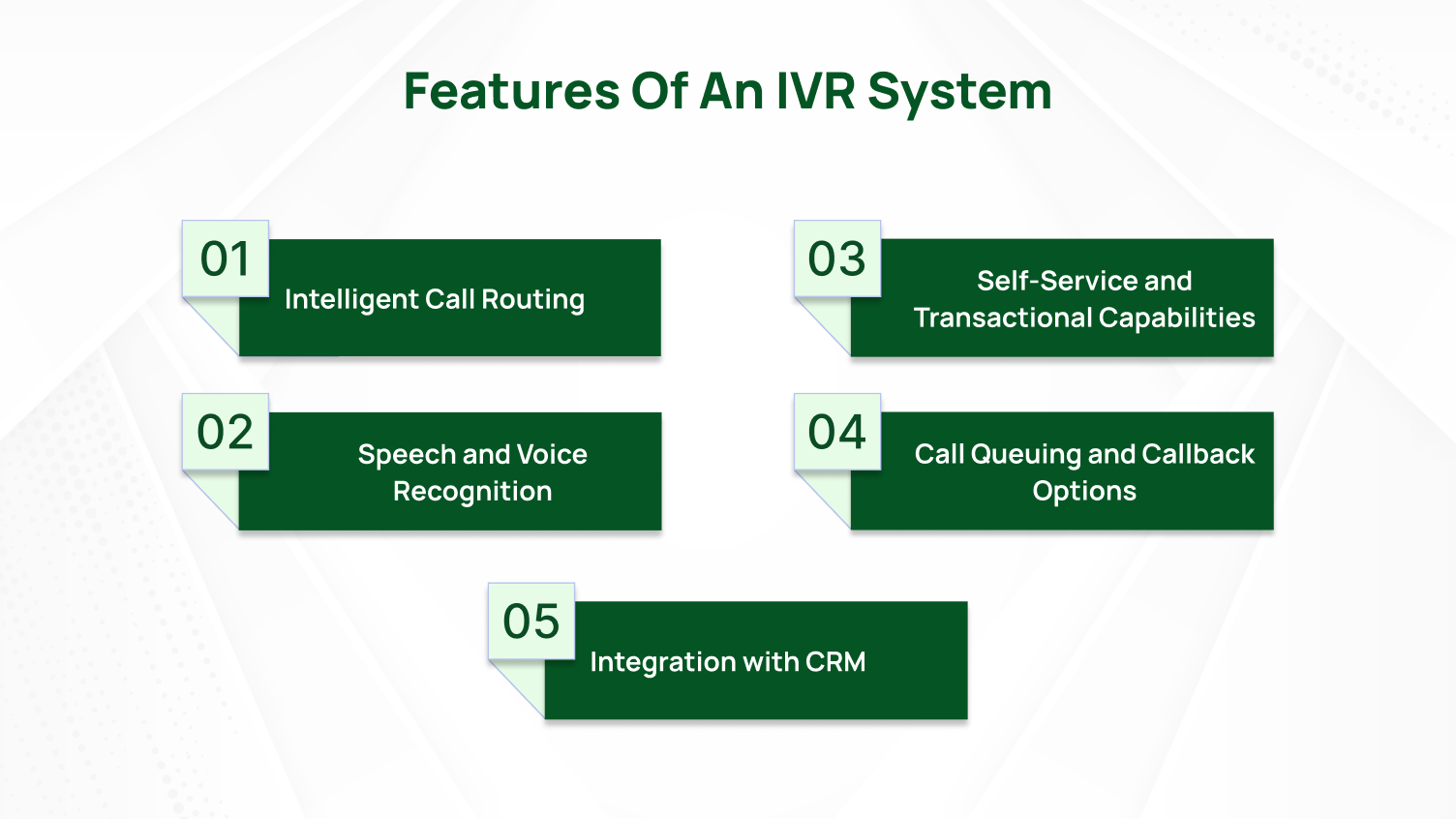
This is one of the most crucial elements of any modern phone system. The IVR uses the caller’s input to automatically route calls to the correct agent or department. It relies on the customer’s selection from the menu options or details provided in their customer data. Efficient routing minimizes the frustration of unnecessary transfers. This greatly improves the overall customer experience.
Modern IVR systems move beyond simple keypad presses. They use advanced speech recognition to understand what the caller says naturally. This makes the conversation feel more human and less robotic. For security, voice recognition can verify the caller’s identity. This robust security feature is often used for multifactor authentication.
The IVR acts as a digital service agent. It allows customers to complete simple tasks without needing a live agent. This includes checking order status, updating an address, or paying a bill. This effective self-service helps businesses reduce operational costs. It also provides customers with instant, 24/7 access to information.
When call volume is high, the system manages the queue professionally. It can inform the caller of their expected wait time. Some systems offer a virtual callback feature. This allows the customer to hang up without losing their place in line. This small courtesy significantly boosts customer satisfaction.
The best IVR software connects seamlessly with other tools. This ivr crm integration provides agents with the caller’s history before they answer the phone. Having this customer data ready helps the live agent deliver faster, more personalized service. This connection is essential for a smooth call flow.
The best thing about modern IVR systems is that they create a winning situation for both the company and the customer. The same key features that save a business money also lead to a better customer experience. It’s a true win-win scenario built on smart automation.
The core goal of using interactive voice response is efficiency and growth. These systems are strategic assets for any contact center.
For the person making the phone call, the IVR should make life easier, not harder.
Choosing the right system is a big decision for your contact center. Even with good intentions, companies often make basic errors. These mistakes happen when picking ivr solution provider. These common errors can seriously damage your customer experience. A poorly chosen system quickly harms customer satisfaction.
Here are the most important errors to avoid during your selection process.
A frequent mistake is creating an overly complex call flow. The IVR greets the caller with a huge list of menu options. Callers get lost in this confusing structure before they can even state their problem.
A successful interactive voice response system keeps the main menu simple. It is best to offer no more than four or five clear choices right at the start.
Some businesses choose basic systems that only accept button presses. This forces the customer to constantly press numbers on their phone system. This interaction feels frustratingly robotic and slow.
Investing in reliable speech recognition is essential for modern IVR systems. It allows the caller to speak naturally. This leads to a much smoother customer journey for everyone.
A crucial error is failing to connect the IVR with your existing tools. The link to your ivr crm system is absolutely vital. Without this connection, the system cannot access important customer data.
The caller is forced to repeat their name or account number to the live agent. This repetition is a top cause of customer annoyance. Always choose IVR vendors who promise deep, seamless integration.
Organizations often buy a system that cannot handle their busiest times. A system that crashes under heavy load is terrible for your brand image and reliability. Businesses should look for cloud IVR solutions for their flexible scalability.
A good hosted IVR provider ensures your system can manage unexpected surges in call volume without failing.
Do not rely only on internal staff to test your system. You must test the IVR application with real customers, making actual phone calls. Gather honest feedback on the clarity of the automated voice and the simplicity of the options.
Continually optimize the system based on actual user experience to ensure a flawless experience for everyone.
Note: Keep your main IVR menu to a maximum of 4 options. After that, use sub-menus or transfer to an agent. Every extra option increases caller frustration and drop-off rate.
The evolution of the interactive voice response IVR is moving quickly. It is now deeply integrated with artificial intelligence. This represents a major pillar of digital transformation for the whole contact center industry.
Next-generation modern IVR systems rely heavily on Natural Language Processing, or NLP. This technology allows the system to comprehend the user’s intent. It moves the interaction past simple button presses into a true, natural conversation. These intelligent programs often take the form of sophisticated AI agents.
Crucially, machine learning enables the AI agent to improve itself constantly. The system learns new phrases and requests from every caller interaction. This continuous refinement leads to more accurate service and higher customer satisfaction. These intelligent AI agents will manage complex tasks. They will soon handle personalized troubleshooting entirely on their own. This revolutionizes the way we experience customer service.
The features of an IVR system are fundamental to modern business success. They are necessary for managing today’s high call volume and customer expectations. Capabilities like intelligent call routing and advanced speech recognition create value. They reduce operational costs and improve overall efficiency.
Selecting the right IVR solution providers ensures you build a robust and scalable platform. This is a critical investment. The IVR serves as the essential digital gateway. It connects your customers to your business efficiently. Mastering this technology is vital for a positive customer experience.
IVR can route calls, collect caller information, provide self-service options, play pre-recorded messages, and integrate with databases or CRMs.
The main components of IVR are telephony equipment, IVR software, databases, and voice prompts.
There are two main types: inbound IVR (handles incoming calls) and outbound IVR (initiates automated calls for alerts or surveys).
VoIP enables voice communication over the internet, while IVR automates call interactions through voice menus and keypad inputs.
