

VoIP Numbers: From Basics to Business Advantage


A VoIP number is fundamentally changing how businesses approach communication. It offers a dynamic and cost-effective alternative to traditional telephone systems.
For any forward-thinking organization, understanding the VoIP number is paramount in today’s digital age.
This guide will explore their core components, significant advantages, and future trajectory.
Let’s break down what truly matters for effective communication in VoIP numbers.
A reliable VoIP number forms the backbone of modern business communication. Several features are absolutely crucial for any organization, ensuring basic functionality and professional operation.
Once the essentials are covered, a range of “nice-to-have” features can significantly enhance your business communications, offering advanced capabilities and streamlining workflows.
A VoIP number is a telephone number. It operates through a VoIP phone system, not a traditional landline. Unlike numbers tied to fixed telephone networks and a physical location, it works over an internet connection. This makes it incredibly flexible.
Imagine using your business phone number on your desk phone, your mobile device, or even a mobile app. Well, VoIP is your gateway to it. Businesses often adopt it as part of a complete business communication system, allowing them to handle more than just incoming calls.
These systems support conference calls, call recording, call forwarding, video conferencing, and other advanced features. It can appear as a local phone number, a toll-free number, or an international number. This depends on the pricing plan from the VoIP service provider.
In essence, a VoIP number is not just a digital alternative to traditional phone lines. It forms the base of modern business VoIP systems. These systems improve call quality, enhance customer experience, and allow companies to grow without the limits of traditional landline systems.
Understanding the core components of a VoIP number reveals the technology’s effectiveness.
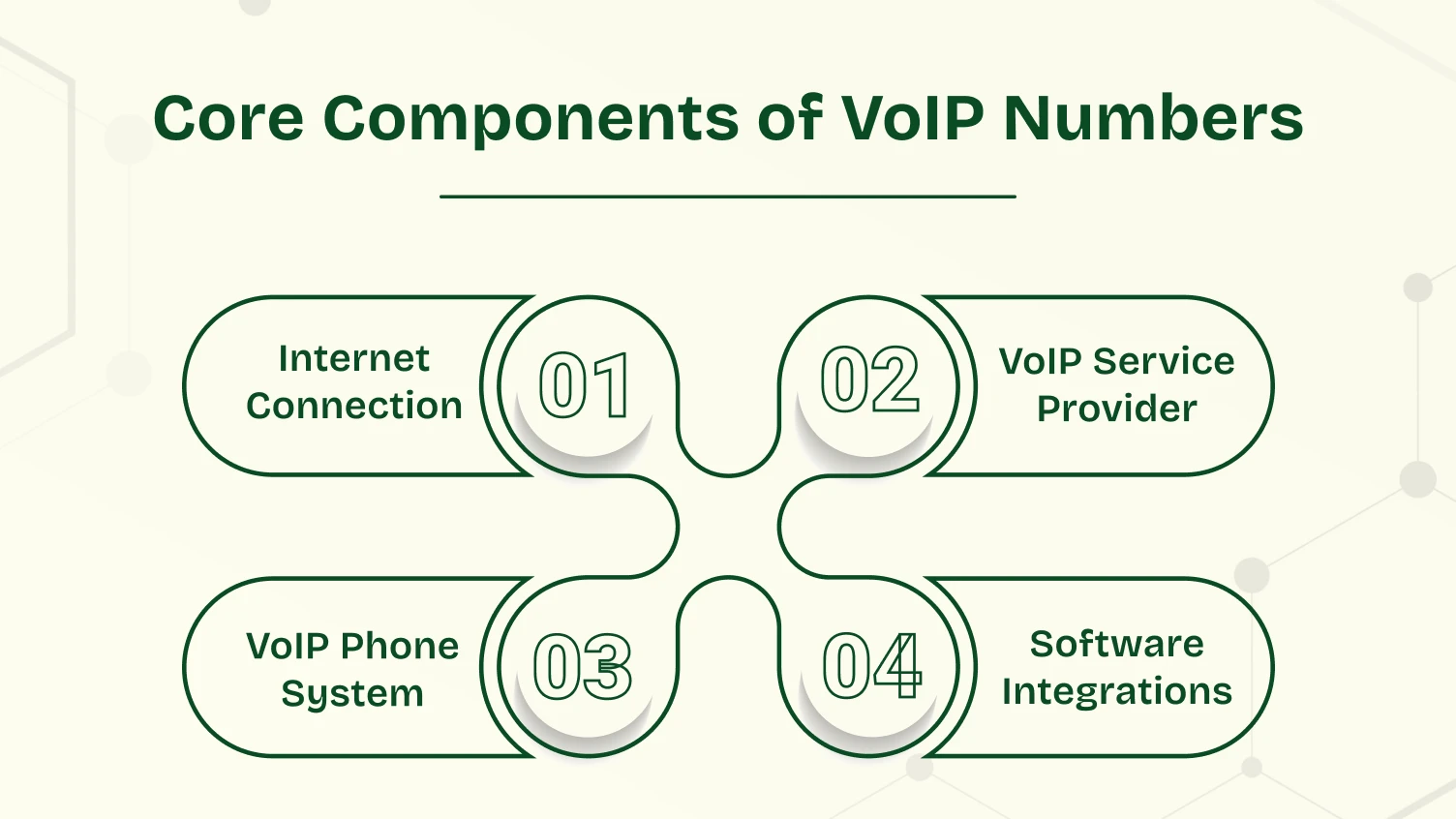
Every number has a strong internet connection as its starting point. It does not utilize copper wires like a regular telephone landline. The quality of your voice is based on your internet speed and reliability. A poor connection will diminish the quality of the calls. Good bandwidth guarantees clear and reliable conversations.
Every number is supported by a service provider who acts as the link between your company and the global telephone system.
They assign you your number, the pricing plans, and provide optional features such as caller ID, call forwarding, or VoIP call recording. The difference between providers is important since it determines your cost as well as the experience of your customers.
Here is the configuration that you and your team are really using. It could be an office desk phone, a cell phone app, both, or either. The good thing about it is that a single number is universal. Calls come to you whether you are on the move or at your desk.
VoIP numbers are not isolated anymore. They are combined with CRM systems, call centers, and even video conferencing. This means you can log calls, view customer stories, or switch to a quick conference call from the same system.
Your number becomes more than just a line; it becomes an integrated part of your wider business ecosystem.
Ever wondered what happens when you make a VoIP call? It’s a fascinating process. It all happens in milliseconds.
Every phone call starts as a voice signal. With VoIP, that sound quickly converts into digital data. This process is called analog-to-digital conversion. Instead of traveling through old copper wires, your words become tiny data packets.
These packets then move across the internet. The result is faster, clearer, and often cheaper than using a traditional landline.
The numbers use a set of rules called the Session Initiation Protocol, or SIP. Think of SIP as the language that tells the system when to start a call, how to connect it, and when to end it.
Without SIP, your VoIP phone system wouldn’t know where to send your incoming calls. It also wouldn’t know how to route them to the right device.
SIP servers are traffic controllers behind the scenes. The server determines the route that the call should take through the network when you dial a number.
Be it a call to a different number, a regular phone line, or a call to an overseas number, the server makes sure that it gets there without any issues.
VoIP uses codecs to support shorter calls using less bandwidth. These tools compress and decompress your audio. Popular examples include G.711 and G.729. Codecs balance quality with efficiency. This means your business communications stay clear without using too much bandwidth.
Together, these steps explain what happens each time you place or receive a call with a VoIP number. Your voice becomes data. SIP handles the instructions. Servers route the call. Codecs make the transmission efficient.
When companies have to decide on whether to use a VoIP number or a virtual phone number, it is important to know the difference between the two.
The two types of numbers are utilized to place and receive incoming calls, to retain local presence, and to conduct business communications, but in different ways. Selection of the optimal option affects the quality of calls, the call routing, and the customer experience.
A VoIP number is fully integrated with a VoIP phone system. It allows calls via an internet connection. These calls can be handled on desk phones, mobile devices, or a mobile app. Businesses can access advanced features. These include conference calls, call recording, auto attendant, and video meetings.
A virtual telephone number normally serves as a forwarding service. It diverts incoming calls to a landline, cell phone, or a VoIP number. It can be helpful in establishing a local presence, but it is not as well-controlled or as comprehensive in its capabilities.
To illustrate, consider this table:
| Feature | VoIP Number | Virtual Phone Number |
|---|---|---|
| Connection Type | Internet-based, using voice over Internet Protocol | Forwards calls to landlines, cell phones, or VoIP lines |
| Call Handling | Can make and receive calls directly | Primarily forwards incoming calls |
| Advanced Features | Supports call forwarding, caller ID, conference calls, call recording, and video meetings | Limited features, mainly call routing |
| Device Flexibility | Works on desk phones, mobile apps, and multiple devices | Dependent on the destination number, usually tied to another line |
| International Reach | Can handle international calls at lower call rates | Provides local presence in different countries but relies on forwarding |
| Business Usage | Ideal for complete business phone systems, contact centers, and unified communications | Useful for local presence or simple call forwarding without extra features |
Practically, a VoIP number will be more appropriate in businesses requiring a full business phone system. It facilitates inbound calls, conference calls, and contact center or CRM integration. It also allows companies to control voice data packets, ensure call quality, and deliver a professional customer experience in many regions.
A virtual phone number, on the other hand, is most suitable where a company wishes to gain a local VoIP presence without having to invest in a full VoIP technology. It enables calling through forwarding to another number, and this feature makes business look local, and operations are centralized.
A VoIP number is not only a means to make or receive a call. It provides businesses with the means to deal with incoming calls, enhance the quality of calls, and efficiently manage business communications. All these characteristics allow one to remain connected, professional, and responsive across devices and locations.
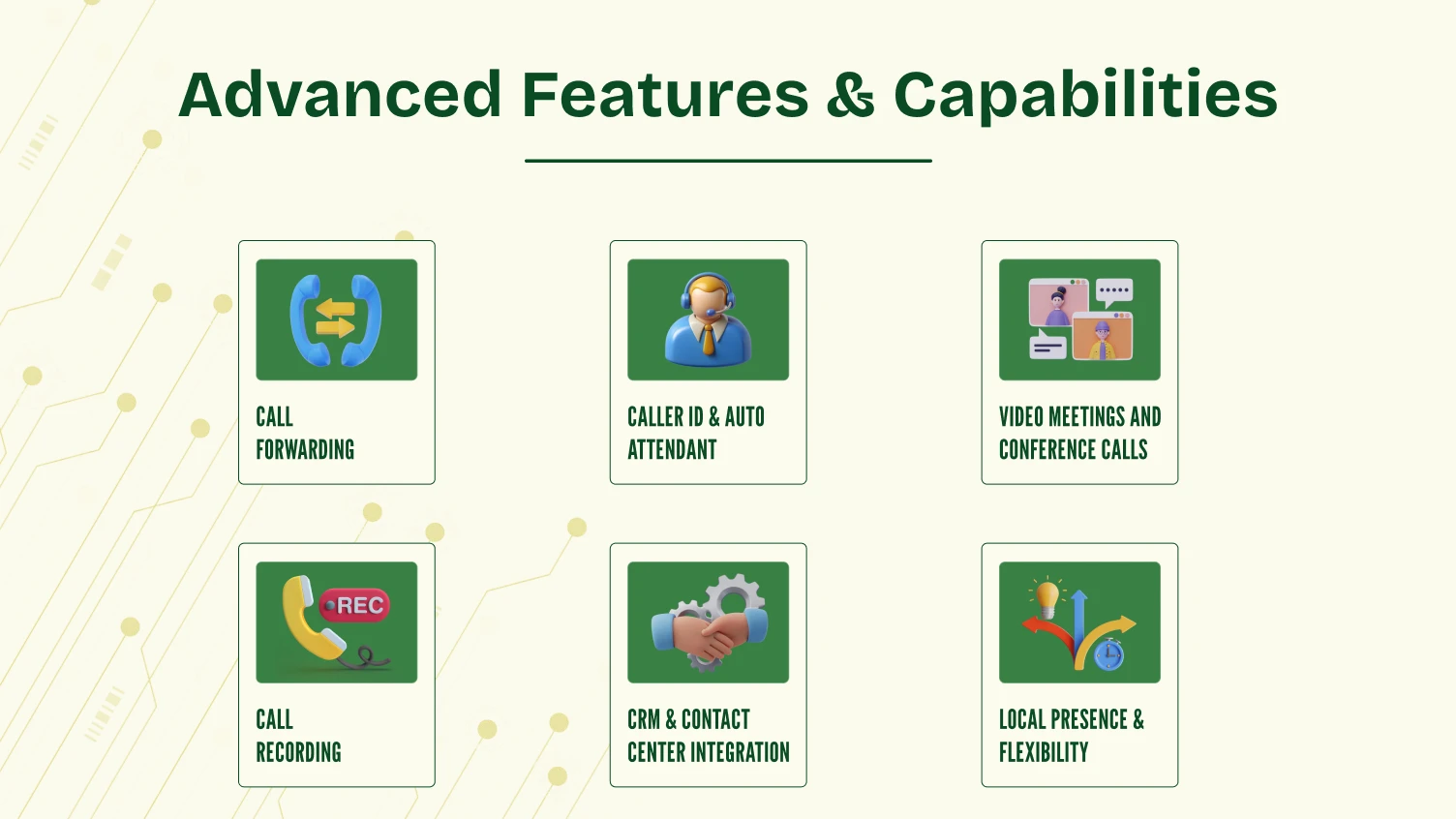
This will be an important feature, as all incoming calls will get to the right person. The calls may be sent to desk telephones, cell phones, or call centers. Working remotely, teams can still be in touch, so the process of customer experience can be better, and missed calls are minimized.
Also, with caller ID, customers will always see a familiar business number, and this builds trust. Auto attendant menus are used to send a call to the right department and save time for both staff and customers.
Video meetings and conference calls can be carried out with the help of VoIP on various devices. This facilitates collaboration in the team and client calls, whether the meeting is local or international.
Voice over Internet Protocol calls can be recorded so that the business can train or ensure quality, or comply. Customer stories and sentiment can also be tracked via recordings to enhance the overall service.
New VoIP telephones integrate with call centers and CRM. This allows tracking incoming calls better, call rates, and teams to handle business communications in one platform.
Companies can select local numbers in the VoIP dashboard. This creates a local presence without physical offices. International calls become more affordable. Pricing plans can be adjusted based on usage.
In short, a VoIP number is more than a phone line. It’s a complete business phone system. It supports text messages, video conferencing, call forwarding, and all the tools needed to manage modern business communications efficiently.
A VoIP number provides more than a way to make or receive phone calls. It drives efficiency, reduces costs, and supports professional business communications. Companies of all sizes can gain a competitive edge. They do this by leveraging the capabilities of a modern VoIP phone system.
These numbers reduce expenses on international calls and long-distance phone lines. Lower call rates make it easier for businesses to manage budgets. They maintain high-quality voice over Internet Protocol communications.
A VoIP phone will expand as your company expands. It is easy to add new numbers, mobile phones, or desk phones. Organisations have the option of increasing their operations or establishing new contact centers. This is done without the burden of installing the traditional phones.
Functionalities such as caller ID, auto attendant, and call forwarding enable businesses to present as a professional. The number is a constant that creates trust. Advanced business VoIP services provide a better customer experience.
The companies are able to obtain local numbers within other countries. This helps in cutting down international calls. It also has a local presence. The clients feel they belong to the team, regardless of whether they work remotely or across borders.
VoIP numbers are compatible with mobile applications, desk phones, and devices. Incoming calls can be received in teams. They are able to participate in a video meeting or attend a conference anywhere. This is the objective of remote or hybrid workforces.
Contemporary VoIP telephony platforms are linked to CRM systems, call centers, and integrated communication systems. This can be used to track customer stories. It allows call rates to be analyzed. It also improves the general communications of the business.
In short, a VoIP number offers more than just voice calls of strategic value. It lowers costs. It enhances call quality. It supports remote teams. It is also used to ensure that businesses have a professional, reliable, and global presence.
A VoIP number can only be useful when offering secure and reliable communication. Companies depend on the quality of the calls. They must be shielded against VoIP fraud. They must also have systems that reduce downtime.
VoIP phone systems that are being developed today are meant to respond to such critical requirements. They facilitate business communications on more than one device.
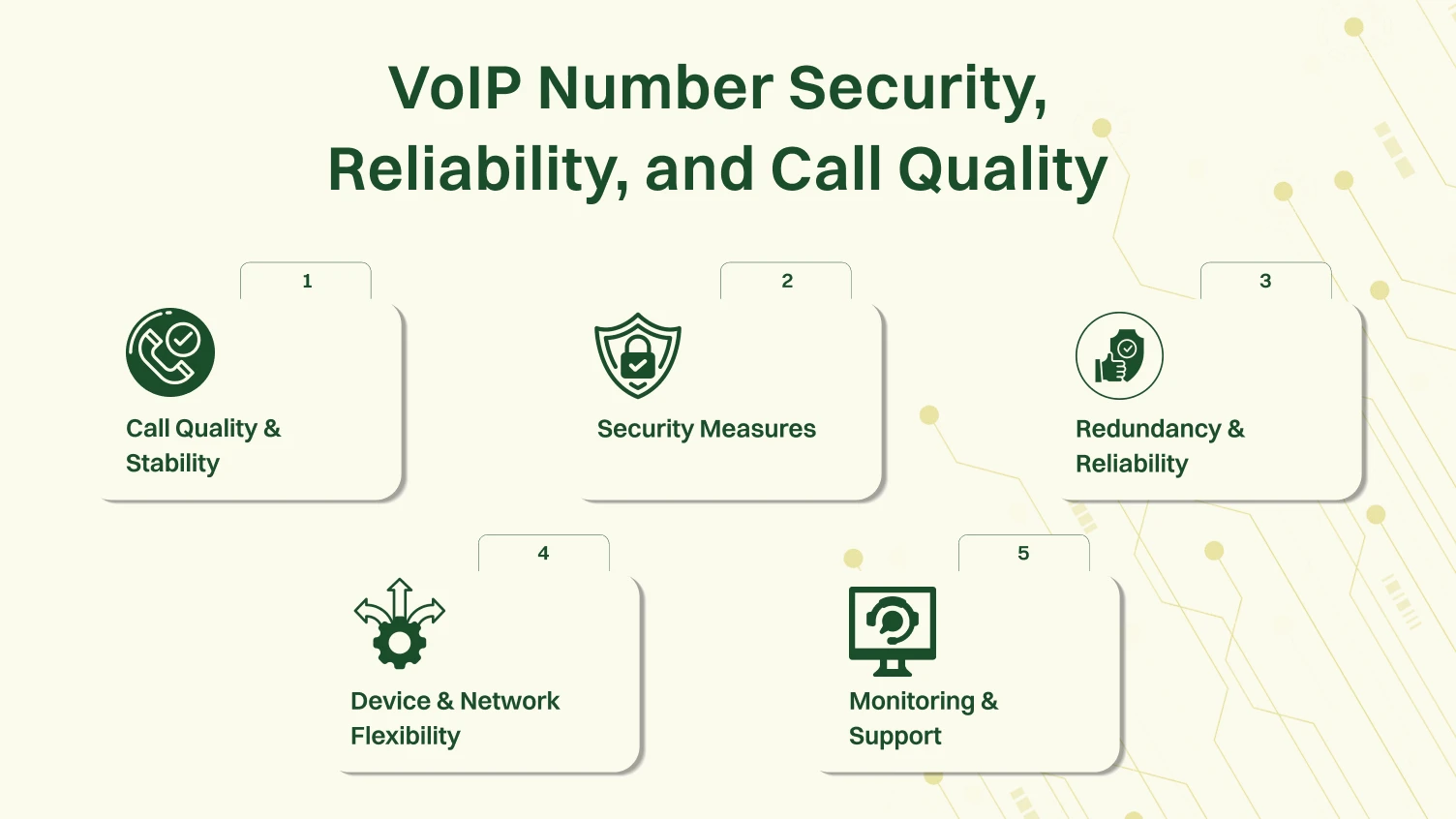
Effective VoIP communication requires a stable internet connection. Strong bandwidth and low latency ensure voice data packets reach their destination clearly. This reduces echoes, delays, and dropped calls. It makes business VoIP as reliable as traditional phones.
Security plays an important role in facilitating sensitive business discussions. The VoIP providers nowadays have encryption, SIP safeguards, and anti-VoIP phishing in place. These will block unauthorized access, minimise the possibility of VoIP fraud, and keep customer and company information secure.
Many VoIP service providers use redundant servers and backup telephone networks. This means if one server goes down, another can handle incoming calls. This keeps business communications uninterrupted. Companies can maintain continuity in call forwarding and conference calls even during technical issues.
VoIP numbers work with desk phones, mobile phones, and virtual phones. Intelligent systems are able to adjust to the dynamic internet connection to maintain the quality of the calls. This is workable and enables teams to communicate instantly, both within the office and off-site.
Numerous operators provide real-time monitoring and support service to ensure a high call quality. Issues like packet loss, jitter, or latency are identified quickly. Solutions are applied to prevent future disruptions.
In short, a VoIP number provides high-quality, secure, and reliable communication. It can be used by businesses to make conference calls, video meetings, call forwarding, and global business communications. They are not forced to think about poor audio and security concerns.
A VoIP number is versatile and fits all businesses within any field. Small startups and global corporations would find it useful due to its features, such as call forwarding, caller ID, conference calls, and CRM integration.
The number provides small businesses with high professionalism. Incoming calls can be managed in teams through desk phones, mobile applications, or more than two devices without being overwhelming to the infrastructure.
The ability to select these numbers offers presence on a local level and builds trust among clients. Price flexibility plans enable companies to expand according to the requirements.
It can be combined with other features such as call forwarding and conference calls, allowing startups to keep business moving.
VoIP numbers are distributed among teams. They bring together workers in different places. It is easy to collaborate through calls made through an internet connection, video calls, and conference calls.
Companies have one business phone system. This guarantees the consistency of caller ID, call forwarding, and VoIP calling. Teams can work remotely.
They offer a business level of customer service. They track call rates. They can easily handle voice data packets without the use of conventional phones.
E-commerce firms also use VoIP numbers to support and integrate CRM. Teams can track customer stories. They manage incoming calls. They are fast in answering questions.
Services such as call forwarding, recording calls, and conferences enhance service. International calls are less expensive, and therefore, international customer support is possible.
Businesses can have a professional image when using mobile devices or virtual phone systems. They also enhance business communications and customer satisfaction.
Healthcare providers can use VoIP numbers to speak with patients safely. Call recording and appointment reminders that are HIPAA-compliant through calls via VoIP or text messaging help facilitate scheduling.
The desk phones, mobile phones, or virtual phone systems are used to handle communications by staff. Functionalities such as caller ID, call forwarding, and conference calls enable effective coordination of the team.
VoIP is patient-confidential, offers great call quality, and is reliable. It does so without the use of conventional landlines.
Real estate agents use VoIP numbers. They have a local presence in the target markets. VoIP calls are made to mobile gadgets in real-time. Caller ID, call forwarding, and conference calls enhance communication with the clients.
Agents are able to make appointments. They provide updates. They are also able to work with fellow team members in different locations. Virtual phone systems and desk phones will enable flexibility.
It results in improved customer experience and business communications, which are efficient. This is even when the company is operating remotely or in a foreign country.
VoIP numbers are advantageous to global companies. They are cheaper for international calls. They have a local VoIP presence all over the world.
Desk phones, mobile phones, or virtual phone systems can be used by teams. They handle the incoming calls efficiently. The connection with the contact centers and CRM applications helps to track customer stories and call rates.
This leads to quality communication and calls and the presence of a reliable business phone system. It assists companies in their cross-border operation.
Getting a VoIP number is not as difficult as some businesses may believe. By following just a few easy steps, you are able to install a professional business phone system. It allows incoming calls, call forwarding, and support for multiple mobile devices.
In just a few steps, businesses can have a fully functional VoIP phone system. It supports voice over Internet Protocol, call routing, and all tools needed for modern business communications.
The future of VoIP numbers looks promising. Technology continues to evolve. Businesses increasingly seek systems that combine advanced features, call forwarding, and unified communications. Emerging trends show how VoIP will integrate with other tools. This will make business communications smarter, more efficient, and globally connected.
UCaaS systems are increasingly handling larger numbers. Businesses can integrate video conferencing, VoIP calls, text messages, and conference calls into a single system. This enhances workflow, back-office, and centralized contact center management.
VoIP will be improved with artificial intelligence. Incoming calls are quicker and more personalised due to features such as improved IVR, sentiment analysis, and automated call routing. AI assists companies in enhancing customer experience and maximizing call rates.
The next generation of VoIP numbers will be unified within CRM solutions, call centers, and other business applications. Following customer stories, voice data packets, and handling call quality will become more automated, enabling teams to quickly and professionally respond.
VoIP technology will keep moving towards intelligent communication systems. Companies are going to get more robust call forwarding. They would expect improved international call rates. They will also witness more support for mobile devices and virtual phone systems. This will ease operations around the world.
In short, the future of VoIP numbers concerns smarter, more integrated business communications. VoIP will keep improving the quality, efficiency, and customer satisfaction of calls with AI, UCaaS integration, and enhanced call features. It will favor both big and small businesses around the world.
A VoIP number is not just a phone line. It changes business communications. It provides options such as call forwarding, caller ID, conference calls, call recording, and video meetings. Better quality of calls, the presence of the locality, and the flexibility of solutions help businesses of all sizes. These solutions can operate on desk phones, mobiles, and virtual phone systems.
The investment in the VoIP phone system improves customer experience. It lowers the charges for international calls. It helps distributed teams in the present day. VoIP is a secure, reliable, and professional way of communication regardless of the size of your business, be it a small start-up company or a large enterprise.
For businesses looking to get started quickly and efficiently, Dialaxy provides a reliable VoIP service provider. They offer competitive pricing plans, robust advanced features, and easy setup. You can manage incoming calls, track call rates, and connect across multiple devices effortlessly.
Stop paying for outdated landlines. Scale your team instantly and go global with Dialaxy’s robust VoIP solutions.
A VoIP number is a phone number that works over the internet using voice over internet protocol, allowing calls via desk phones, mobile devices, or virtual phone systems.
VoIP uses internet connectivity to make and receive calls, unlike traditional phones that rely on physical telephone networks. It supports call forwarding, conference calls, and video meetings.
Yes. You can receive incoming calls on mobile devices, desk phones, or through a mobile app, making it flexible for remote and hybrid workforces.
Yes. VoIP technology reduces international call rates while allowing businesses to maintain a local presence in different regions.
Modern VoIP providers use encryption and secure SIP protocols to protect calls. Features like caller ID and call recording enhance security and reliability.
Absolutely. VoIP phone systems can connect with CRM platforms, contact centers, and other tools, helping track customer stories, manage voice data packets, and improve call quality.
Choose a reliable VoIP service provider like Dialaxy, select a local or international number, set up desk phones or mobile devices, and enable call forwarding and other advanced features.
