

Top Call Queue Issues and How to Fix Them Fast


Effective management of a call queue is essential to businesses that rely on incoming calls to interact with customers. The wait time in the line, high call abandonment rate, and ineffective call routing are, however, challenging issues affecting many businesses. Such problems not only frustrate customers but also overwhelm agents.
The best part is that most of these issues have practical and fast solutions. From ensuring agent availability and using skills-based routing to implement features like offering callback options, businesses can significantly reduce wait times and improve the caller experience.
In this blog, we’ll explore the most common call queue issues businesses encounter and provide practical, fast-acting solutions.
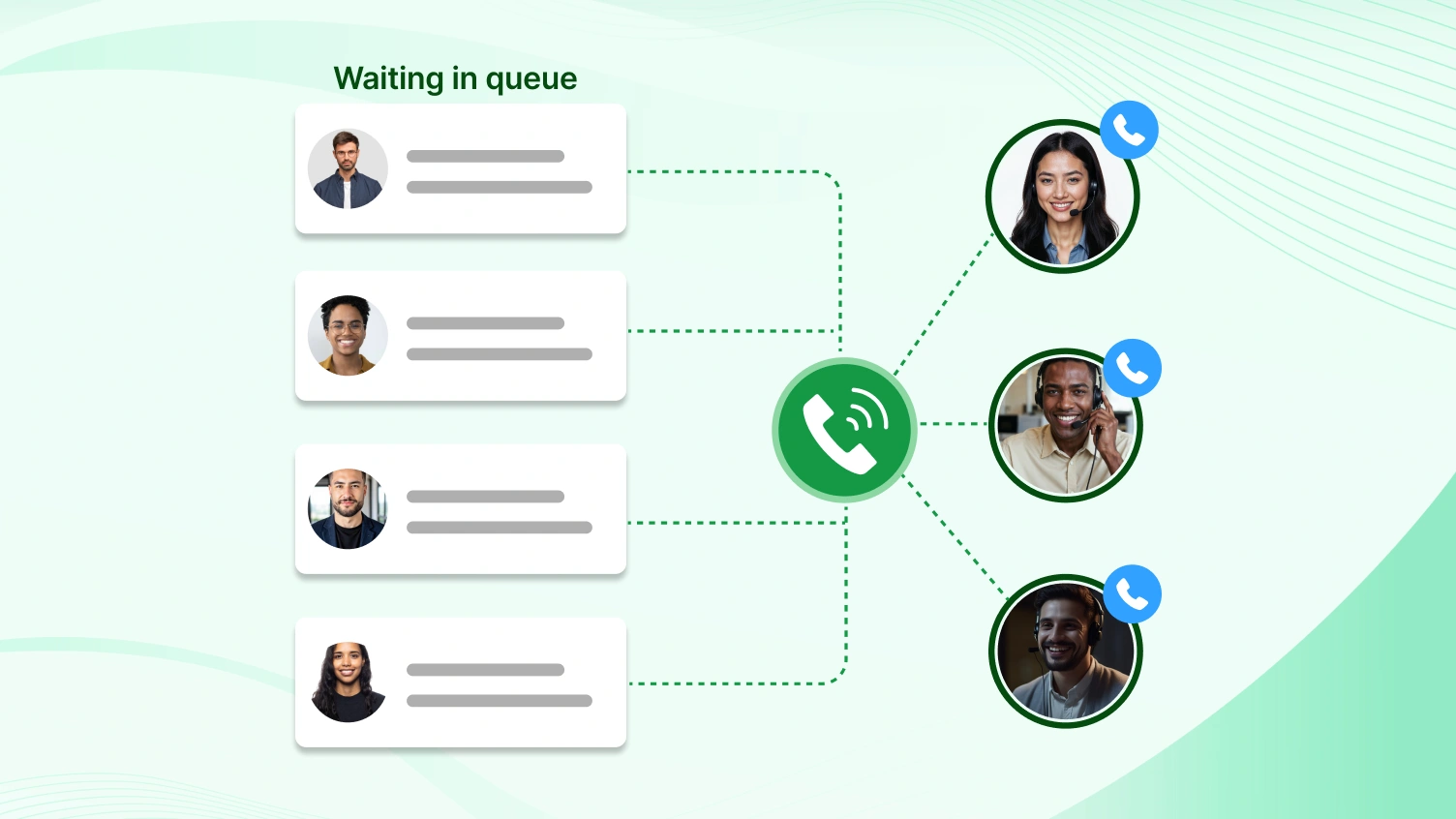
A call queue is a system or feature used in call centers and other service centers to handle incoming calls when all the agents or representatives are busy. Instead of hearing a busy signal, callers are held in the queue until an agent becomes available to take their call.
The system works by placing the incoming calls on a line, virtually speaking, when all the available agents are busy on the other active calls. Callers are put on hold with a welcome message or a custom hold music until the next agent is available. This system helps in dealing with many calls, ensuring no calls are missed.
In small to mid-sized businesses, the call queue maintains the call flow in order. For example, a retail store could encounter dozens of calls simultaneously during peak hours. The call queue holds the calls rather than discarding them. Callers will hear a welcome message or custom hold music to keep them informed.
What happens in a call queue:
📞 Incoming calls are placed in line when all agents are busy.
🎵 Callers hear hold music, messages, or estimated wait time.
🎯Calls are assigned to agents as soon as one becomes available.
Managing a call queue can be challenging, especially when an unexpected problem comes along. Here are the most common issues with detailed explanations of the problems and solutions you can implement today.
A call queue is not about answering calls, but it is about the efficiency of your system, your tools, and your agents to manage this call queue.
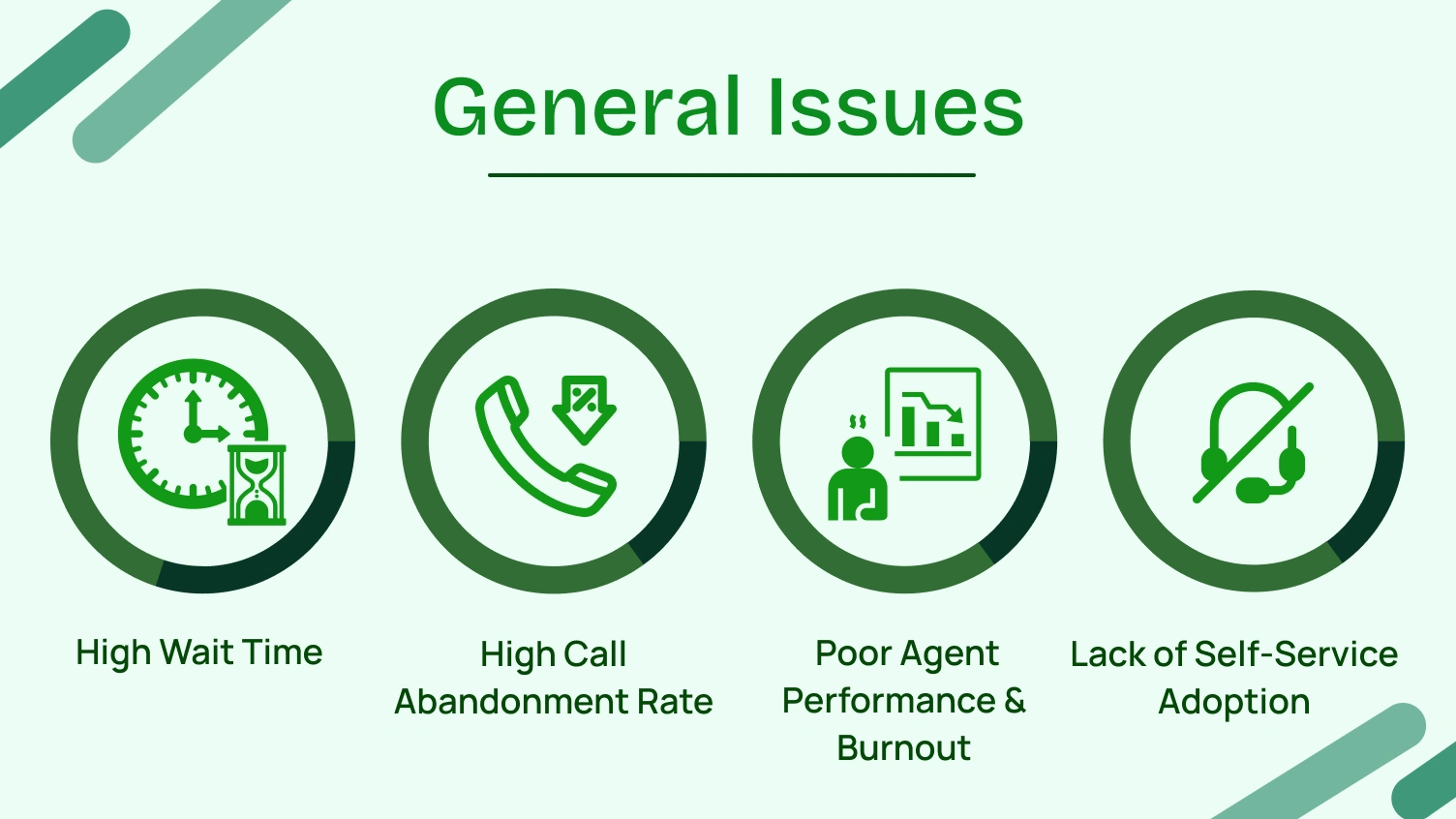
High wait time in a call center queue is the most frequent problem. This happens when there is a limited number of agents available to handle incoming calls.
The most common cause is a lack of sufficient agents to handle the number of incoming calls, leading to the creation of a backlog.
Agents may lack the training or the tools to resolve issues in a short time, and this makes the calls take longer.
III. Unexpected Call Spikes:
Unplanned marketing campaigns, or seasonal slowdowns, can force an abrupt rise in calls that your team cannot handle.
Customers must re-call to address an issue when agents cannot do it the first time, artificially boosting the number of calls and hold times.
⌛Customers are frustrated with excessive hold times; 57% say it is among the most frustrating aspects of customer support.
When callers are kept waiting too long or receive unclear messages, they often hang up before reaching an agent, resulting in missed opportunities and poor customer experience.
The long waits give a call the highest probability of being hung up on when they are given no information about their estimated wait time or place in the queue.
The same short, generic message or loop of music every 30 seconds is not only annoying but can drive callers crazy enough to hang up.
III. Unresponsive Queue Messaging:
When the queue message never changes, or the estimated wait time isn’t updated, callers may feel the waiting time is without purpose and hang up.
Forcing callers through complex and confusing Interactive Voice Response (IVR) menus before they even enter the queue can cause them to give up.
Even the most skilled agents may not succeed without proper support. Agents whose workload is too high, undertrained, or forced into updating repetitive tasks begin to perform worse, and burnout rises.
Agents facing a never-ending queue of back-to-back calls with no downtime are at high risk for burnout.
Lack of authority or the needed tools to resolve issues among the customers makes the agents frustrated, leading them to reflect on their own performance.
III. Repetitive, Low-Value Inquiries:
Having to answer the same simple questions to new clients may seem tedious, and may deny the agents a chance to demonstrate their skills on more technical problems.
Insufficient Training on de-escalation, product knowledge, and system usage will make the agents incompetent and lower their performance and morale.
Several businesses are not aware of the extent to which self-service tools can reduce their reliance on the telephone line. The call line becomes unnecessary once automated options to assist customers are not provided or not encouraged.
An IVR menu is confusing, contains too many options, or lacks choices that customers would expect.
The knowledge base or FAQ area of your site is not mobile-friendly, is not easily found, or has a weak lookup facility.
III. Lack of trust:
Customers might have a historical problem with automated systems, and they automatically assume that they have to talk to a human being in order to have their problem solved.
There is no promotion of self-service steps on hold message, email signatures, or on the web by the company.
Technical issues can usually affect call queuing and delay consumers as they wait on hold, increasing frustration for both customers and agents.
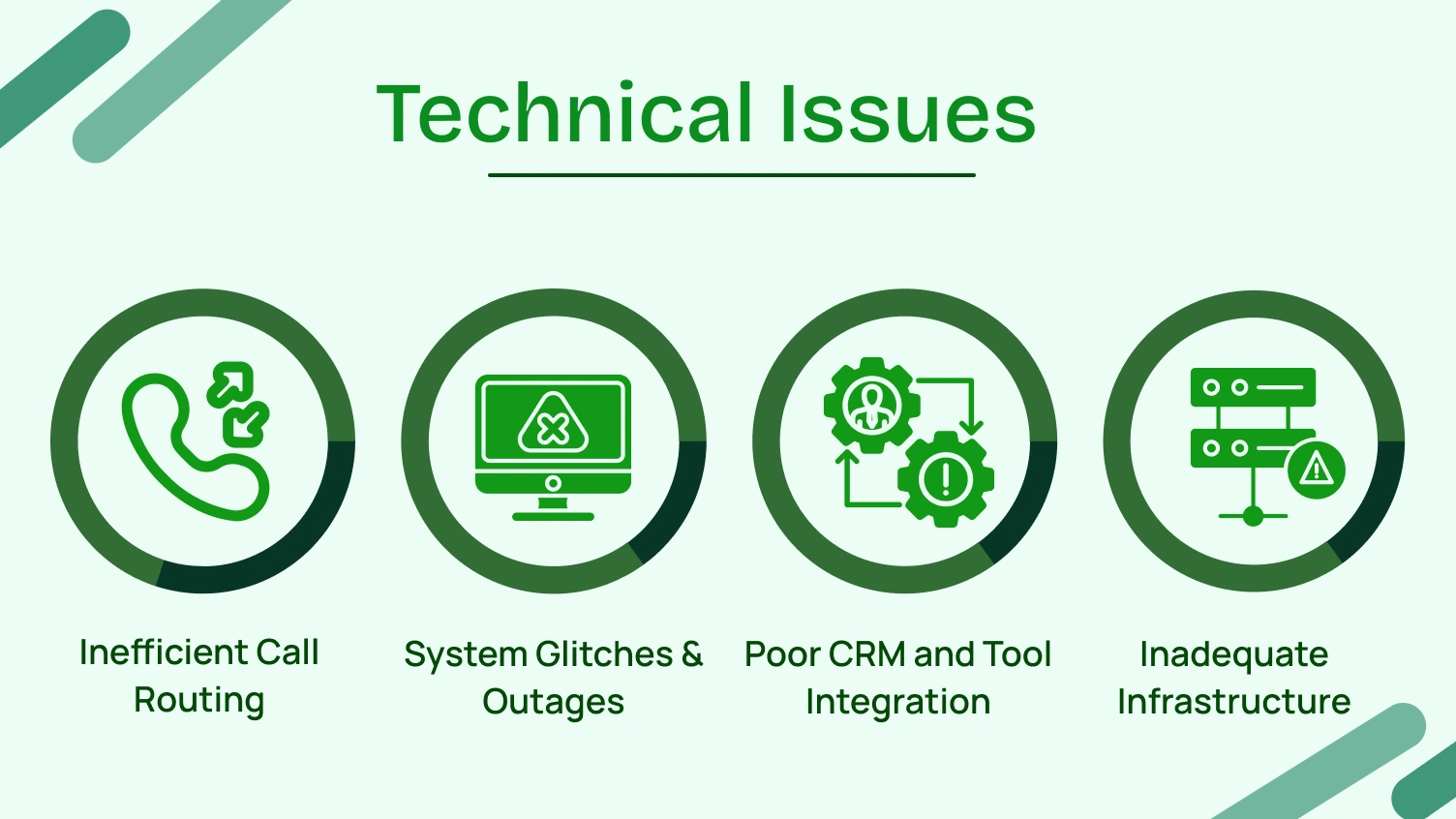
Call routing is not flexible and tends to create an excessive wait time, frustrated callers, and overloaded agents.
Using a basic round-robin tool, which transfers a call to the next agent in the queue, brings a customer to an agent, causing frustrated transfers.
In the system, the specialties of the agents are not taken into consideration (e.g., billing, technical support, sales). A tech problem customer is referred to a billing agent, wasting everyone’s time.
III. Ignoring Customer Data:
The system does not use the available customer data in a CRM to make intelligent routing decisions.
The most trained agents would fail to perform well if the technology fails. Reliability is a vital issue, and the slightest imbalances are expected to affect customer satisfaction and efficiency.
Jitter, latency, or echoing of the calls takes place. This is usually due to a lack of internet bandwidth.
The calls get disconnected during the chat, and the customer has to redial.
III. Complete System Failure:
The PBX on-site fails, or your VoIP Service Provider is down, and there is no backup.
A recent system update of your call center software has caused some glitches that may interrupt handling calls, call transfers, or the call log.
When your call queue system doesn’t sync well with your CRM or other essential tools, it creates unnecessary friction. Efficient call handling and an efficient customer experience rely on seamless integration.
The agents have to progress among different screens (the phone system, the CRM, the knowledge base) in order to find customer data, which increases call handling time.
When a call is received, agents must manually search through customer records, which brings delays and low efficiency.
III. Incomplete Customer History:
The agent lacks the big picture needed to put everything related to a customer in context, which is critical.
Agents have to manually enter call history on the CRM, and this results in an incomplete or inaccurate record that damages future interactions.
An outdated system can limit performance, flexibility, and scalability, which directly impacts both customer experience and operational efficiency.
An outdated, on-premise PBX system has limited features such as skills-based routing, real-time analytics, and remote access.
The current system has reached the point where an increase in call volumes, as well as new agents, will require significant and costly hardware modifications.
III. Insufficient Bandwidth:
If the internet connection is not good enough to make high-quality VoIP calls, then your connection constantly presents jitter and lost calls.
Maintaining and repairing old hardware is expensive and must be done by specialized technicians at the cost of other reserves that might be utilized differently.
Solving problems is a good thing, but the future success lies in consistency and a well-chosen strategy.
Here are some of the best practices that allow you to be efficient and customer-friendly, whether you are handling a few calls waiting or managing every call in the queue in a call center.
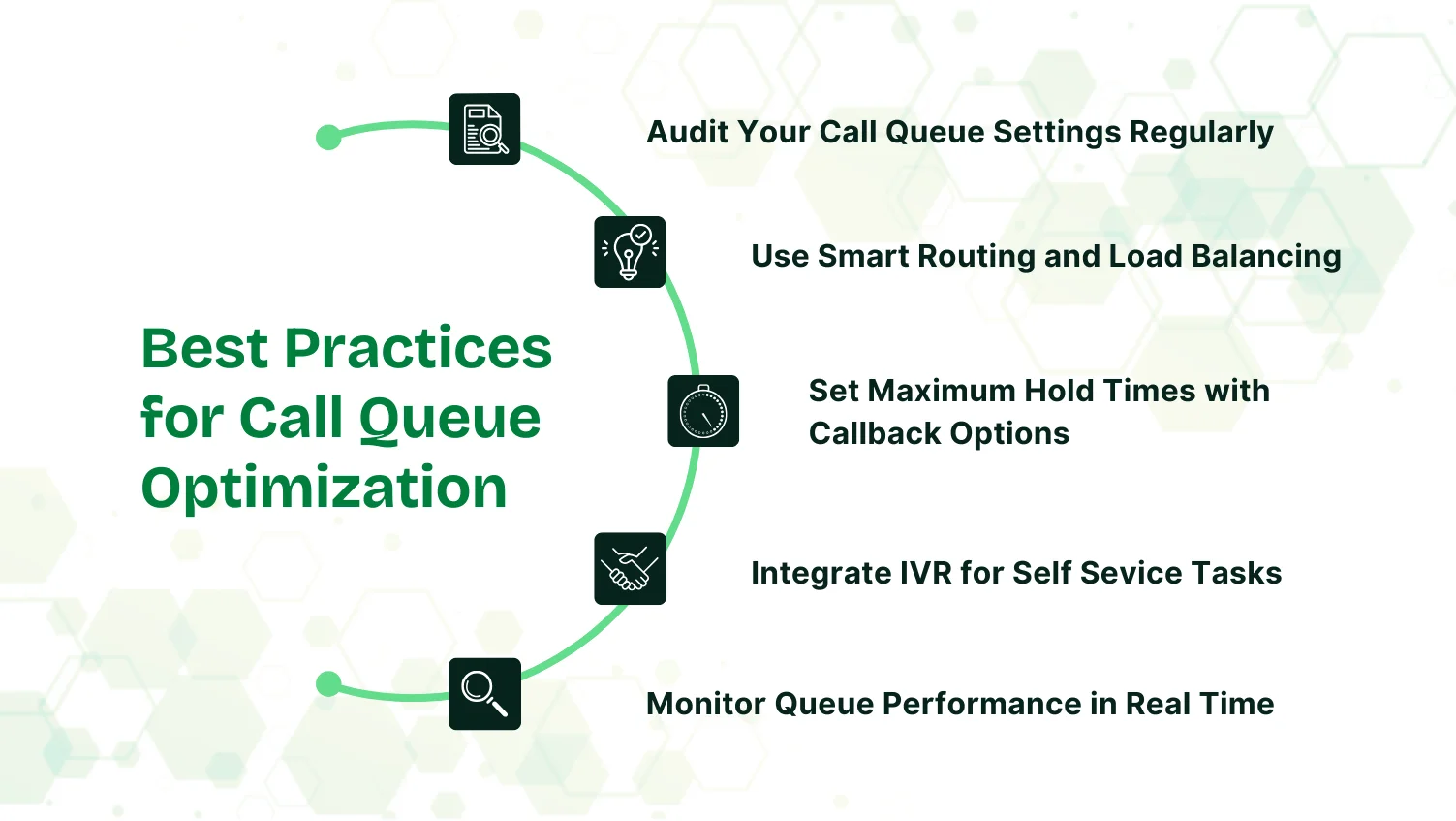
If you are not auditing your call queue settings regularly, they can become outdated. This causes misrouted calls, excessive hold times, and dissatisfied customers.
The most essential tool is the admin dashboard of your phone system. Start by checking on your admin dashboard and reviewing current settings by looking at analytics reports to determine whether it is causing bottlenecks. Check your routing rules, agent assignments, on-hold messages, and queue priorities.
Regular reviews ensure your queue system keeps pace with changing business needs.
You need smart call distribution to prevent overloading individual agents. As you grow, a flat, first-come-first-served model won’t work. Instead, a set of rules is made grounded on skills, call type, or availability.
Consider a dental office using skills-based routing. The front desk agents address calls seeking an appointment, whereas the billing center’s experts address queries about insurance. This minimizes handle time, optimizes service quality, and ensures each is assigned to the call focused on their expertise.
Smart routing will make sure that callers are put through to a working agent who can respond to their call right away.
Nobody likes to wait in the queue. One of the biggest reasons why customers abandon calls is long hold times. To prevent this, ensure that your system can set the maximum duration that a phone call will be held in the queue before triggering an action.
Most modern call queuing systems allow for automatic call forwarding, voicemail, or callback requests. By limiting hold time and providing options, customer satisfaction is ensured, and drop-offs are avoided.
For personalized solutions, contact sales to explore your options.
A well-designed IVR system can handle a significant portion of your inbound calls. Numerous customers demand easy things that do not need human support. They will be able to go through things without putting them on hold when they have a well-designed IVR.
Use tools like Twilio Studio, Zendesk, or the Microsoft Teams app to develop well-designed, easy-to-navigate menus. Let callers inquire about the status of their orders, listen to account balances, or set a new appointment via the keypad.
Self-service releases agents and enhances the performance of the call queues, especially at peak business hours.
You must be aware of this in order to enhance your call queueing. Static reports are beneficial, but too late. Real-time monitoring enables you to know what is currently taking place in order to take instant actions whenever something goes wrong.
Set up dashboards that monitor active calls, calls routed, and total calls in queue. Implement alerts on the increase in call queue time, abandoned calls, or sudden drops in available agents.
When the queues are actively live, you can make faster decisions and avoid major disruptions in the long run.
Take a look at some of the top platforms designed to streamline call queue management, helping to reduce hold times, route calls smarter, and improve agent performance.
| Platform | Features | Best For |
|---|---|---|
| Dialaxy | Affordable VoIP & Virtual Numbers Smart call routing & IVR Call recording & analytics CRM integrations |
Startups and very small businesses need a budget-friendly cloud phone system. Great for companies focused on core calling features and affordability. |
| Aircall | One-click CRM Integration Real-time analytics IVR & skills-based call distribution Power Dialer & Click-to-Dial |
Small to mid-sized businesses, especially sales and support teams, rely on CRM integration and easy-to-use phone systems without complexity. |
| Talkdesk | AI-powered workforce management Agent Assist & AI virtual agent Advanced analytics & reporting Enterprise-grade security and scalability |
Mid-sized to enterprise companies need advanced AI and automation to optimize large-scale call center queues and improve agent performance. |
| RingCentral | All-in-one unified platform: VoIP, video conferencing, messaging, and contact center Advanced call handling Omnichannel: Voice, email, chat, social media in a single queue |
Businesses of all sizes want unified communications to replace multiple tools. Ideal for streamlining internal and external communication with integrated call queues. |
Call queue management is not only related to answering more calls, but rather improving the experience of your customers and agents. Whether you’re using a basic VoIP phone system or a complex cloud contact center, your success is directly based on how fast and efficiently your system can handle each incoming call.
The important point is the capacity to deal with outside phone numbers and incoming calls that are outside your network. Tools that support the wide availability of device use and scalable call forwarding will assist your scaling process. A modern business need is to ensure that the agent assigned to receive the call is available to receive it on any device.
From reviewing call queue settings to integrating CRM, each enhancement reduces customer frustration and increases the performance of your team.
To manage call queues effectively, begin by making sure you have the right number of agents and are logged in at the right time so agents answer calls promptly.. Use skills-based routing to connect callers with the team members best equipped to help them. Monitor real-time metrics like wait time that can help you identify issues before they grow.
Call queuing helps your business stay organized, even when call volumes spike. Instead of overwhelming your agents, incoming queue calls are placed in a virtual line and answered in order. This means no issue is missed, which enhances customer satisfaction.
An IVR (Interactive Voice Response) system is used to collect input from callers and direct them to the right department or action through a menu system. In comparison, the call queue is the waiting room where they’ll stay until the right agent is free to answer the call.
The common causes of long call queues include:
When a call is waiting in a queue, the system plays hold music, estimates wait time announcements, or promotional messages until an agent becomes available.
For small businesses, the ideal call queue length is typically 3–5 callers or less than 2 minutes of wait time. Any longer and the risk of call abandonment increases significantly.
Yes, most modern phone systems allow you to automate multiple tasks:
