

How to Fix Long After-Call Work Time for Better Productivity


High After-Call Work (ACW) time is a universal challenge in any modern contact center. When your ACW Time is high, it directly hurts agent productivity and your team’s ability to handle high call volumes. After Call Work (ACW), also known as post-call processing or call wrap-up time, is the time agents spend on tasks after their talk time with a customer ends.
This post-call work is necessary for accurate customer records, but excessive after-call work drains your productivity and efficiency. It increases customer wait times, a critical issue every call center manager must address. The goal of reducing ACW time is to reduce customer frustration.
This comprehensive troubleshooting system contains data-rich, actionable, semi-structured instructions to identify, analyze, and ultimately remediate extended ACW Time.
Before you can solve the problem, you must see the clear signs of high ACW Time. This starts with understanding the key performance metrics and their impact on your call centre.
A clear problem exists when your team’s ACW Time is consistently too high. This means it exceeds industry benchmarks. For example, if it takes longer than 2 minutes per call. It might also make up more than 20% of the average handling time. The ACW metric is a crucial part of measuring agent performance.
You will see several symptoms and indicators of high ACW.
Reduced Agent Performance & Productivity: Your center’s agents handle fewer calls. This lowers your overall call handling capacity for inbound call volume.
Increased Customer Wait Times: Longer ACW activities make agents unavailable. This creates a longer call queue for customers. Customers get frustrated and may hang up.
Higher Agent Burnout and Stress: Your agents feel constant pressure from long ACW tasks and a building call queue. This directly impacts morale, which eventually can lead to higher staff turnover.
Inconsistent Data Quality: When agents rush their data entry, they make more mistakes. This leads to poor customer records and inaccurate call summaries.
Lower Customer Satisfaction: Long waits and incorrect customer data create a poor experience. This can directly reduce customer satisfaction scores.
The impact on your business operations is significant.
High ACW leads to increased operational costs because you may need to consider agent addition to handle the same call volume more efficiently. It can cause you to miss your Service Level Agreements (SLAs). Ultimately, it has a negative impact on your entire call centre operations and your company’s brand reputation.
With a clear view of the problem, you can now investigate the root causes.
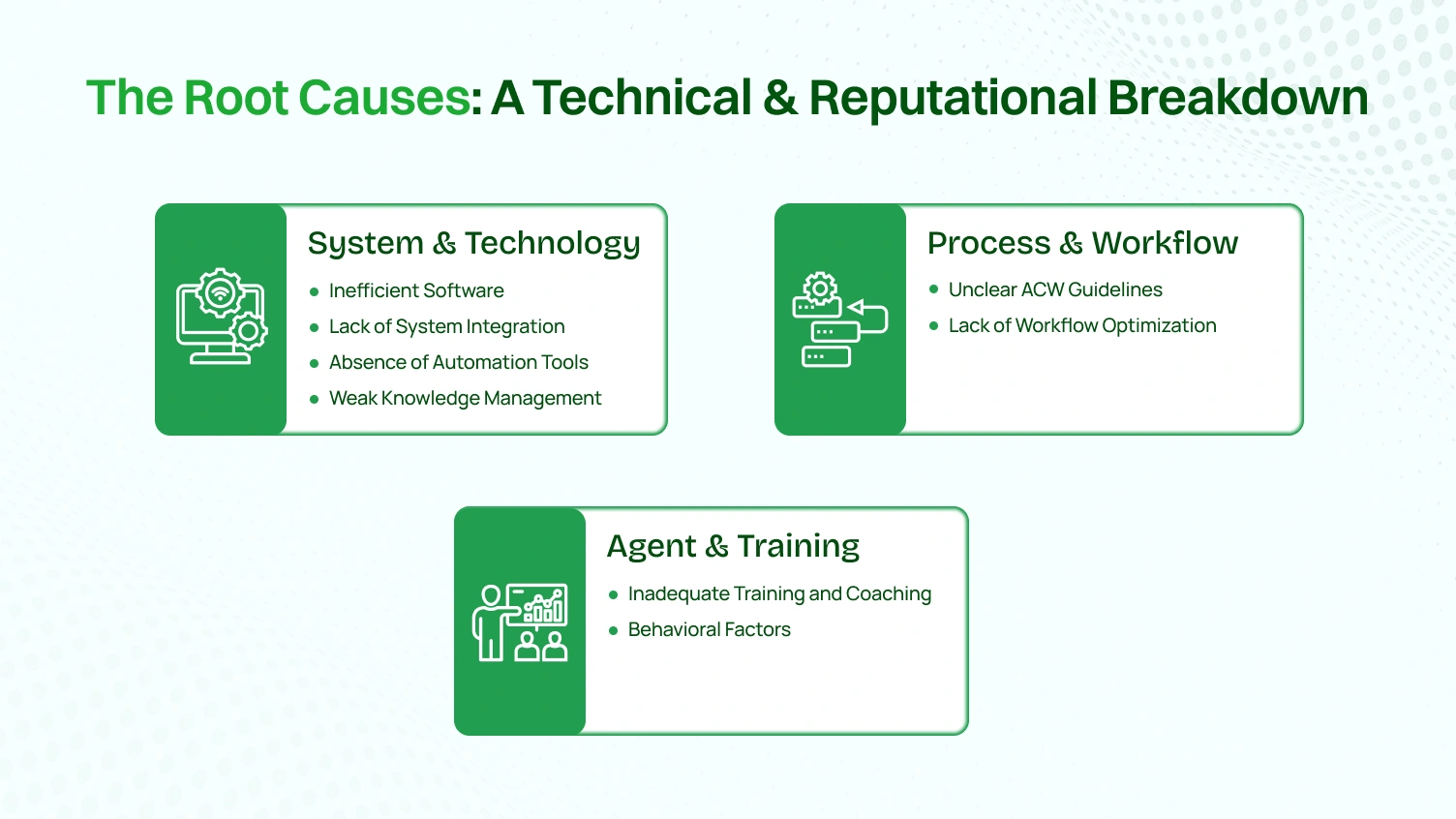
A single issue rarely causes long ACW Time. It is often a mix of problems related to your technology, your processes, and your agent training. You need to investigate all three areas.
After you have established your specific root cause, you can look to leverage solutions.
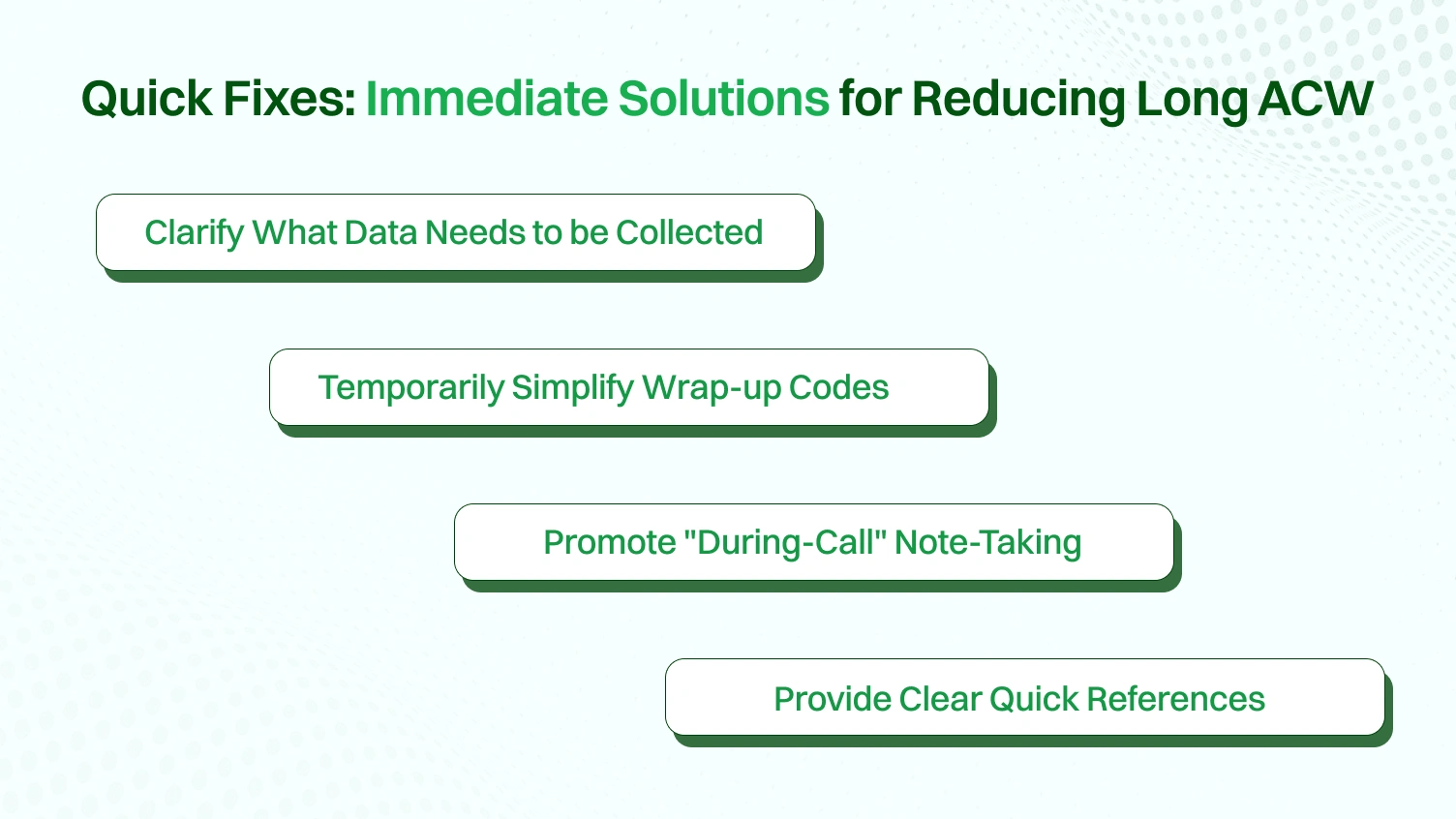
You can start taking steps to reduce your ACW Time today. Here are some easy things that call center managers can do for immediate effect while contemplating larger changes.
As you work through things, you can take these immediate troubleshooting steps.
A significant contributor to your excessive wrap-up time is a lack of real-time support, which detracts from agents’ performance and efforts to improve agent productivity. Once you have established your specific root causes, you can begin to take action now.
If the quick fixes do not work, then it is likely you have a larger system issue. If your CRM is slow or crashing often, you must take further action. You should call the IT department or your software vendor and make sure to have examples.
These immediate steps can provide temporary relief. Now you can focus on building detailed, long-term solutions freely.
To achieve sustainable reductions in ACW Time, you will need a holistic approach. The plan must consider your technology, processes, and people.
This is the most powerful way to reduce acw. AI solutions can automatically transcribe calls and create an accurate Call Summary. This technology, including an AI voice agent, can identify follow-up actions and auto-populate customer information directly into your CRM System.
Benefit:
This drastically reduces manual data entry and the time spent on call details. Research shows this has the potential to automate up to 80% of everyday note-taking. This allows agents to focus on the customer conversations instead, which drives up Productivity and Efficiency.
Action Steps:
Work with your IT team or vendors to improve your current systems. You need to streamline forms, reduce navigation steps, and implement keyboard shortcuts. Customize the view to put essential customer data front and center. A smooth System Integration between your call center software, CRM, and ticketing system is crucial.
Benefit:
A more intuitive workspace minimizes clicks and navigation time. This makes all post-call processing faster and less frustrating for your agents.
Your KMS must be fast, up-to-date, and easy to search. Agents should be able to quickly find answers to customer inquiries or access internal notes needed for their call summary.
Benefit:
A better KMS reduces the time agents spend searching for information during or after a call. This directly shortens the call wrap-up period.
Conduct a full audit of your current codes. Work with agents and supervisors to consolidate redundant codes and add any that are missing. Create clear definitions for each code to improve your call disposition and call tagging.
Benefit:
This improves Data Entry accuracy. It also reduces agent decision fatigue, which speeds up the call wrap-up time.
Create tiered templates for the Call Summary. A simple customer inquiry should have a very brief template. A complex service request can have a more detailed one. Focus only on “need-to-know” information to maintain quality customer records without unnecessary work.
Benefit:
This allows agents to relieve pressure to write detailed notes in every call. It provides them the flexibility to write shorter notes while still capturing the most important information so they can properly execute their ACW tasks.
Integrate your call center software with your ticketing system. This can auto-create tickets or trigger automated emails based on the call disposition.
Benefit:
This allows for a seamless transition from the call to follow-up action. It reduces the amount of manual follow-ups the agents need to do, which is important for proper post-call processing.
Provide specific training sessions on efficient CRM system navigation and keyboard shortcuts. Teach effective call summary techniques and personal time management strategies designed for the ACW Time period.
Benefit:
It gives your centers’ agents practical skills that allow them to be most effective. It is a direct way to improve agent skills, improve agent performance, and establish realistic goals.
Start regularly monitoring ACW Time using your performance metrics. Use your Quality Assurance process to review call summaries and other ACW activities. Provide constructive feedback to help agents identify areas for improvement.
Benefit:
This creates a cycle of continuous improvement. It helps you boost agents’ skills and reinforces the importance of efficient ACW.
With these detailed solutions in place, you can shift your focus to preventing the problem from returning.
Fixing long ACW Time is the first step. The next step is to be proactive to ensure it stays low. This requires shifting from reactive fixes to ongoing management.
Establish Clear ACW Guidelines and Policies:
You must formalize your expectations. Define acceptable ACW Time ranges for different call details and call types. Make these ACW Guidelines and ACW Policies a core part of your new hire training.
Regularly Monitor the ACW Metric:
Use your call center software dashboard to track ACW Time per agent and per team. By regularly monitoring this ACW metric, you can spot outliers and address issues before they grow. An acw timer can also alert supervisors if an agent is stuck in wrap-up for too long.
Conduct Routine Workflow Optimization Audits:
At least twice a year, review your entire post-call processing workflow. Look for new bottlenecks and find more opportunities for automation and AI Integration.
Implement Proactive Training Programs:
Introduce ACW efficiency training for all new hires. Offer refresher courses for existing agents that focus on time management and new software features. This helps reduce the time agents need for wrap-up.
Leverage AI for Predictive Insights:
Use your AI solutions to analyze call data. These tools can often predict which types of customer interactions will lead to higher ACW activities. This allows agents and managers to prepare, perhaps by using real-time assistance.
Sometimes, you will face more challenging ACW issues. These complex scenarios require a deeper level of analysis and more advanced solutions.
ACW Spikes with New Product Launches
When you launch a new product, expect ACW tasks to increase. Agents are dealing with unfamiliar customer inquiries and need to write more complex call summaries.
Solution: Proactively create new documentation templates and update your KMS before the launch. Temporarily adjust ACW time targets for these specific call types.
Compliance-Heavy Environments:
Some industries require very detailed customer records and call details for regulatory compliance.
Solution: This is a perfect use case for AI Integration. Use custom AI templates to automatically extract and format all required compliance information from the call transcript. This ensures accuracy without adding to the agent’s manual workload.
System Latency Issues:
Your agents report that the call center software or CRM system is slow, directly causing long ACW Time.
Solution: Use screen recording software to capture evidence of the lag. Present this data to your IT department to help them diagnose the issue.
Speech Analytics:
Use AI integration to analyze call content. You can search for keywords that correlate with high ACW. For example, you may find that customer inquiries about “billing disputes” always lead to complex follow-up tasks. This allows you to address the root cause directly.
Time-and-Motion Studies:
For persistent problems, observe your agents’ ACW activities in detail. Watch every click and step in their post-call processing to pinpoint exactly where seconds are being lost.
Cross-Functional Workshops:
Hold deep-dive sessions with your IT, Operations, and Training teams. Work together to find and fix complex System Integration failures that affect your operational efficiency.
You need clear triggers for escalation. If a problem is beyond your internal team’s ability to fix, you must contact the vendor for your call center software, CRM system, or AI solutions. Create a formal escalation path for major systemic issues that impact your entire call centre operations.
Fixing long After-Call Work Time is one of the most effective ways to improve your call centre. This is not about pressuring agents to work faster. It is about removing the obstacles that make their job harder. When you give your team better automation tools, clearer processes, and targeted training and coaching, you empower them to succeed.
To achieve lasting results, you must take a complete approach. By embracing AI Integration for repetitive tasks and regularly monitoring your ACW metric, you can transform ACW from a problem into a streamlined part of your operation. This will lead to lower costs, higher customer satisfaction, and a more positive environment for your agents. You will be building a more resilient and efficient call center solution for the future.
Implement Dialaxy’s call center tools today and get your agents back to what matters most – the customer.
ACW After Call Work is the amount of time agents spend doing work (like updating notes), when calls are completed. After a call, work is important to keep records accurate, but also to make sure we support our agents in running an efficient center.
ACW is calculated by dividing the total time spent on post-call tasks by the total number of calls handled. This key metric helps you track agent productivity.
A good average ACW time is around 30 to 120 seconds. However, setting realistic goals is as complex as calls will naturally take longer.
Effective agent training can reduce ACW time. Key skills include:
These are three distinct but related call center metrics:
An AIS agent can and will automatically transcribe calls and write up summaries. This automates most of the manual note-taking and substantially unglues agents faster, reducing customer wait times.
The best agent training for ACW is practical and skills-based. Focus on:
