

How to Use Call Barging to Solve Customer Escalation Issues

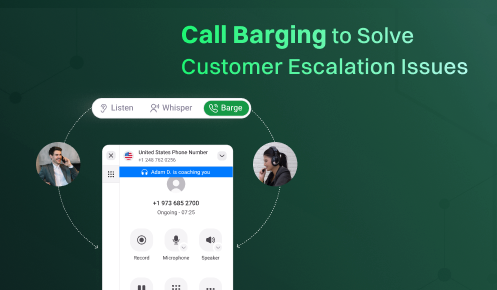
Ever listened to an agent’s call and wished you could jump in like a superhero to save the day? Maybe someone is getting frustrated, and an agent is stuck on a basic query. You’re thinking, “If only I could just jump out of my own… You know, if I could just take over for a second.”
Well, yes, you can. It’s called call barging, and it’s a powerful feature in modern contact center software.
The following guide will explain call barging in simple terms, explain when to use it (and when not to), and most importantly, explain how to do it.
Since you now see ‘why you’re here’, let’s clear up the confusion.
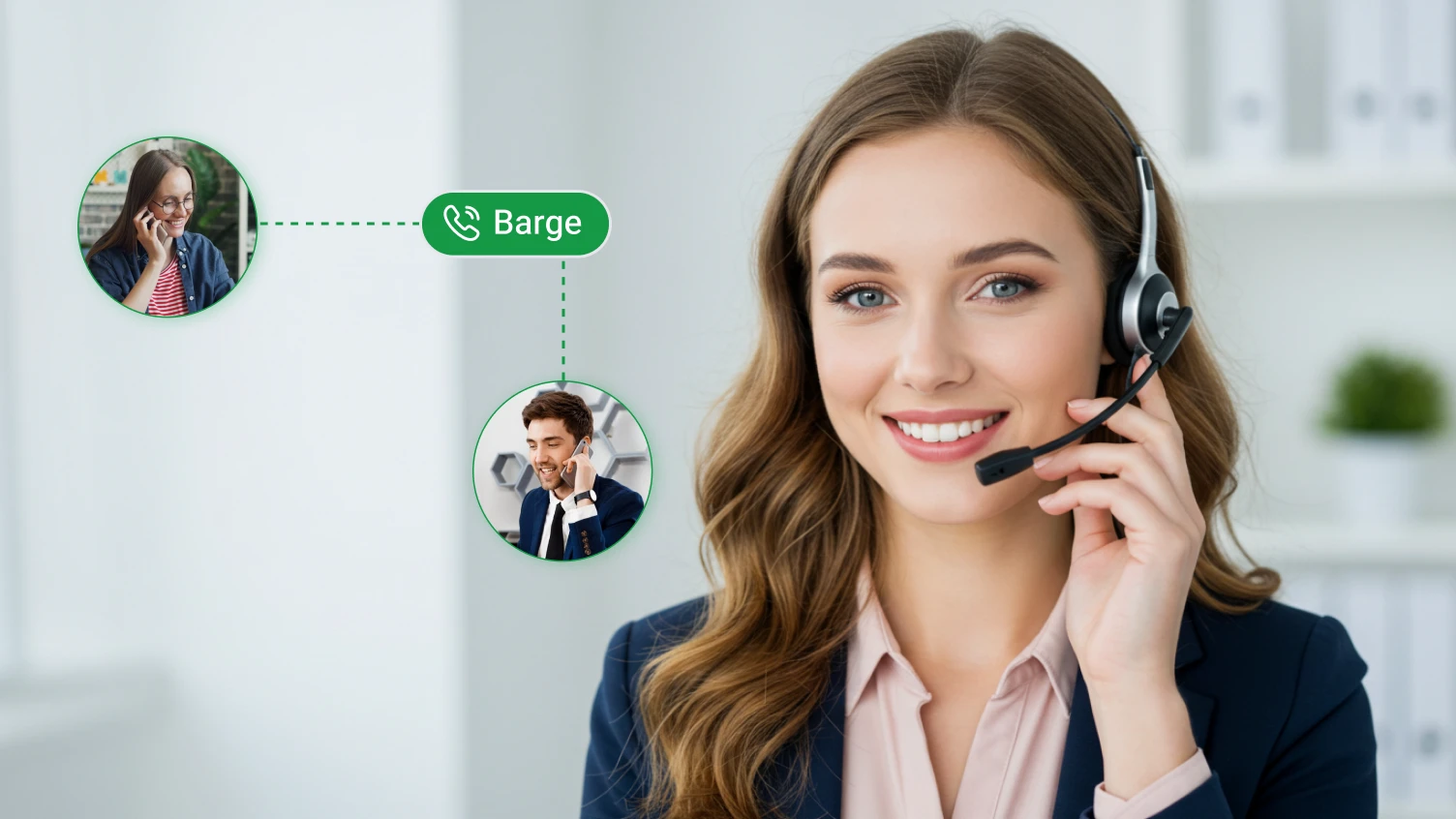
Call Barging is when a supervisor or manager joins an ongoing call between an agent and a customer. Unlike call monitoring, where the supervisor just listens silently, or call whispering, where the supervisor speaks only to the agent, call barging means the supervisor is part of the conversation. Everyone in the call can hear them.
Think of it as barging into a party you didn’t RSVP for, but in this case, it’s totally okay and even encouraged.
The whole point of the call barging feature is to solve problems right now. It’s not about micromanaging; it’s about providing instant backup. This is a lifesaver for a virtual phone number or when you’re managing remote agents and can’t just run over to their desk.
Modern contact center software and VoIP systems make call barging a seamless process. Here’s the usual flow:
It necessitates a VoIP system that has call monitoring, recording, and analytics facilities. Only authorized supervisors or managers have access to barge calls. Because if your intern could barge in anytime, chaos would ensue.
The software logs when barging happens, so there’s accountability. Your team can track performance and improve with real data.
Using the call barging feature too often is a fast track to making your agents feel incompetent and disempowered. Using it too late means you’ve likely already lost the customer and are just performing brand damage control.
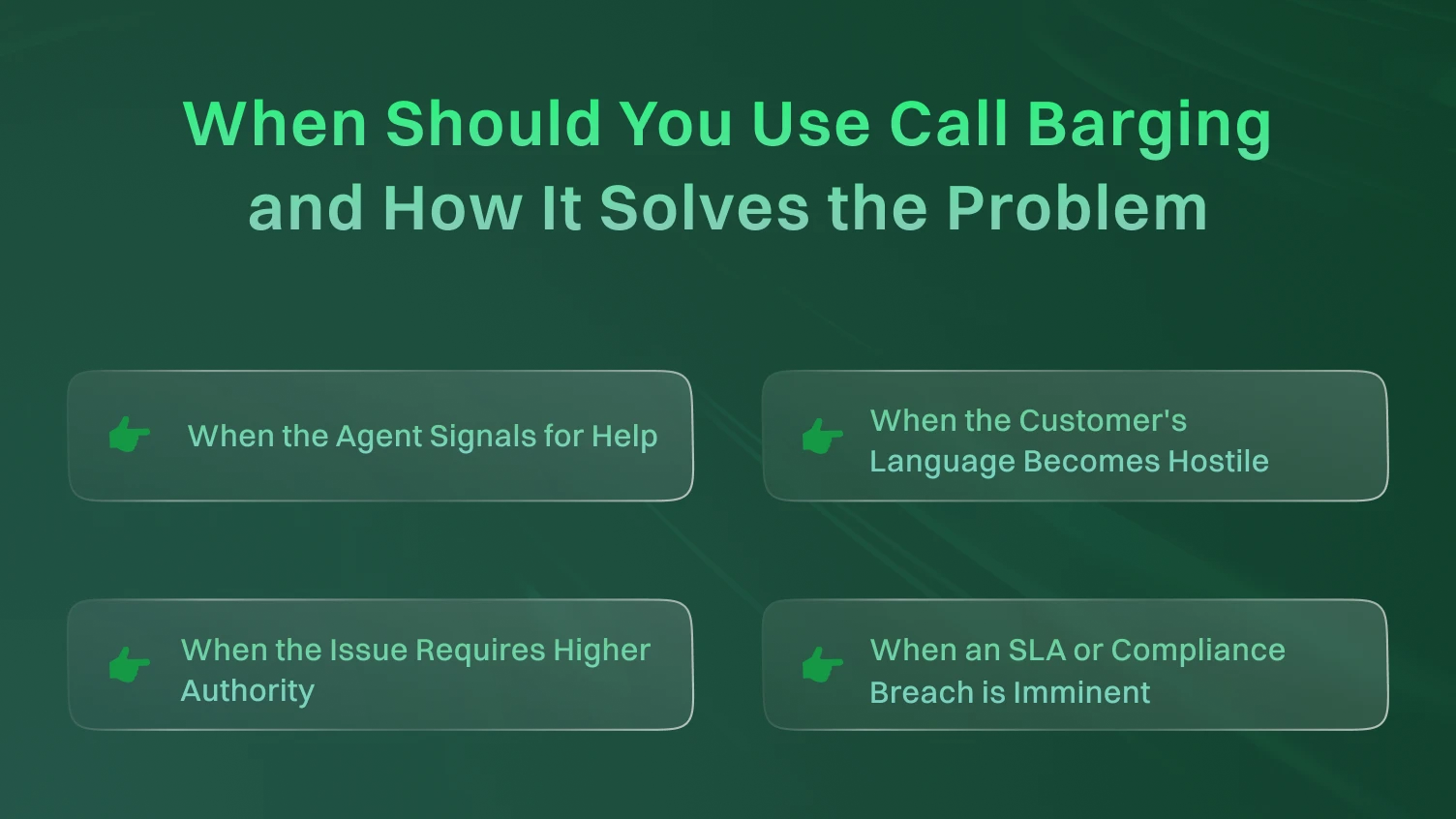
Here are the key moments to barge the call, and the specific problem it immediately solves.
Sometimes agents reach a point where they can’t solve the issue on their own. They might send internal signals like “Need help” or “Can someone jump in?”, a clear sign the call is escalating. Ignoring these signs only increases frustration and delays resolution.
That’s when the call barging feature proves its worth. It allows supervisors or managers to join the call instantly, support the agent, and provide answers in real time. This kind of live call barging helps resolve issues quickly, keeps the customer calm, and prevents long call times or damaged trust.
Customer frustration has a high potential of becoming hostile within a short period, which means that the mere monitoring of calls or call whispering will not suffice. Terms such as, this is unacceptable, I would like to speak to a manager, cancel my service, etc, are clear signs that something should be done right now before things take any other turn of events.
It is at that point that call barging as a component of a call center solution is invaluable. It enables managers or supervisors to come to the call in real time, de-escalate the customer, and lead the process to closure. This capability of real-time intervention assists in call resolution and safeguards your customer relations.
There are certain customer concerns, like big reimbursements or special exception cases, which must be cleared by the superior in the call center. Delay may occur when call center agents do not have the tools or the power they require in their call management system, resulting in frustrated clients and increased time consumption during calls.
With the call barging functionality available in your cloud contact center software, the supervisor or managers can actually be part of the call at the moment. This in-progress intervention makes decisions fast, enhances fault resolutions, and results in the generation of customer satisfaction, as there is no need to transfer calls or call back.
Alerts that are close to breaking service-level agreements (SLAs) or are possible sources of compliance issues need attention. The business may suffer severely in case an agent makes a dangerous promise unaware.
With call barging available in your call center software, supervisors can quickly join the call to prevent service-level agreement (SLA) or compliance breaches. This live call barging allows managers to steer the conversation back on track, ensuring the company meets legal and service standards while protecting customer trust.
Here are the biggest wins you’ll see when you use the call barging feature correctly:
The dreaded “manager callback” is where customer satisfaction goes to die. Every time an agent has to end a call to escalate it, your FCR rate takes a nosedive. The customer has to wait. Your manager has to play phone tag. The whole issue just festers.
With call barging, the escalation happens in real-time. A manager jumps in, provides the solution, and the issue is closed on that very first incoming call. This is the most effective way to improve your call resolution metrics.
This immediate fix leads directly to the next major advantage.
Angry customers usually leave. Customers who feel ignored or passed around definitely leave. A poorly handled escalation is one of the top reasons VIP customers churn.
A well-executed call barge-in, however, can turn a customer who is about to cancel into a loyal advocate. Why? Because it shows them you take their problem seriously. Having a manager personally step in sends a powerful message: “You are important to us.” This real-time intervention builds trust that a callback never could.
Happy customers are great, but your agents matter too.
Classroom training is theoretical. It’s hard to teach an agent how to handle a truly hostile customer until they’re actually facing one. Every time you barge in to handle a tough situation, it’s a live agent training session.
Your call center agents get to hear exactly how a seasoned manager de-escalates tension, phrases a solution, and takes control of a conversation. By reviewing the call recording afterward, you can turn a real-life incident into a concrete lesson.
This enhanced training has a powerful side effect.
Feeling helpless and unsupported is a primary driver of agent burnout. When people have to work with irate customers both day after day and without backup, it can be very tiring, and agents who are remote may end up feeling isolated. The fact that a manager will intervene when necessary is in itself a lifesaver.
It makes your center agents feel less stressed since they are confident that they do not have to deal with the worst calls on their own. This supportive culture, a core part of workforce engagement management, leads to higher job satisfaction and lower turnover.
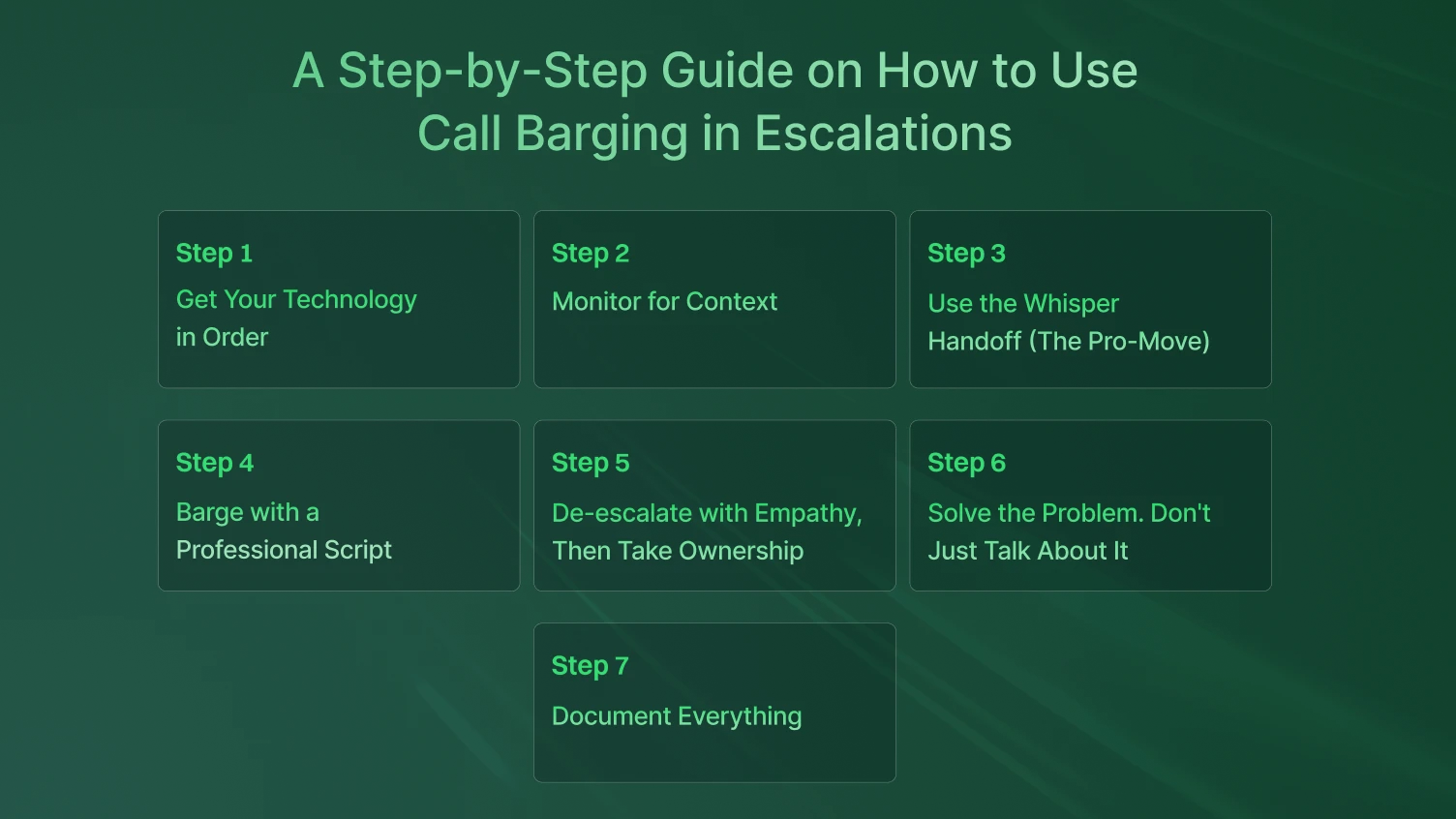
You’ve identified a trigger. You know you need to intervene. But a clumsy entrance can make a bad situation even worse. Here’s how to handle a call barge in with the grace and control of a seasoned professional.
This is non-negotiable. Before a crisis hits, you need to know your tools inside and out. Whether your barge call center uses Call Barge in Vicidial, Call Barge CUCM, Call Barge Horizon, or another cloud contact center platform, you must know exactly where the barging button is.
Do a test run with another manager. There’s nothing more amateurish than fumbling with your software and putting the customer on hold while you figure it out.
💡Tip: Modern call center software often comes with call monitoring, call whisper, and call recording tools. Use them all to stay informed.
Never, ever barge in blind. Use your call monitoring feature for at least 30 to 60 seconds. What is the actual root-cause problem? What solutions has the agent already tried? But who is to blame in this case, the customer, the company employee, or the company? Arriving with context is the difference between appearing as a hero and like someone who is an ignorant idiot and contributes to the clouding of waters.
This single step separates the great managers from the merely good ones. Use the call whisper feature to give your agent a quick, private heads-up.
A calm, “Hi Jen, it’s Mark. I’m going to jump in and help you with this one. You’re doing great, just follow my lead,” does two critical things. It prevents your agent from being startled, and it frames the intervention as a supportive team play, not a hostile takeover.
The way you come in determines how the rest of the intercourse will be. When you join in, you must use a calm, confident, authoritative tone in your voice.
Hello[Customer Name], and my name is [Your Name], and I am a Support Manager of this company. I have connected with [Agent Name] on the phone to ensure personally that we can get this out of the way on your behalf. I have been hearing, and I know you have been having a hard time. I came to assist.”
It checks out the presence of the agent, establishes your authority, demonstrates that you are aware of the situation, and then shows the immediate willingness to deal with the problem.
Right away, offer consolation to the customer with an assurance that you understand how she feels. Say things such as:
Then, pivot and take absolute ownership. “I am going to personally handle this for you right now.” This tells the customer the buck stops with you.
This is where you use your managerial authority to be the final stop. Don’t just offer another call transfer or, heaven forbid, dump them back into the interactive voice response (IVR) system. Provide the refund. Authorize the policy exception. Explain the technical solution clearly. Your job is to deliver the final call resolution.
As soon as the call ends, use your call center quality management system to document what happened, what triggered the barge, and what the final resolution was. This is not busywork. This information is like gold in training the future agents, as well as improving your quality management program and recognizing issues that seem to be frequently occurring in products or services.
By doing these, you will have reliable interventions. Secondly, we should determine the long-term rules of engagement so as to develop a healthy team culture.
Even the best tools backfire when used without care. Call barging isn’t about control; it’s about support. But a wrong move can make your team feel unmanaged and exposed.
To make sure you make the most of it, the following is a guide of how to make the best of it and what you should not:
| DO | DON’T | Why It Matters |
|---|---|---|
| Create a clear, documented protocol for when barging is allowed. | Barge into minor issues that the agent can handle on their own. | Clarity removes fear. Micromanaging kills confidence. |
| Be transparent about triggers and use policies. | Leave agents in the dark about when you might jump in. | Knowing the rules helps agents feel supported, not watched. |
| Acknowledge the agent’s work when joining a call. | Undermine or criticize agents in front of customers. | Validation builds trust. Public critique ruins morale and reputation. |
| Use call whispering when the agent is struggling, not failing. | Take over too quickly instead of letting them grow and develop. | Support learning by letting agents handle pressure with coaching. |
| Debrief privately with the agent after the call using call data. | Skip the follow-up or let issues fade without discussion. | Feedback loops create growth. No feedback = no progress. |
| Turn tough calls into learning moments for the team. | Keep escalations siloed and forget the opportunity to train others. | Real-life examples are the best training tools; use them to uplift the team. |
| Focus on resolution and supporting the agent. | Make it about ego or showing off your expertise. | The goal is to fix the problem and save the relationship, not to prove you’re the smartest in the room. |
Conclusion
Call barging is much more than a cool button on a supervisor’s dashboard. With proper usage, it is a strategic addressing tool in real-time that fundamentally enhances the resolution of issues, the confidence of the agent, and the customer experience of leveling up to memorable.
When you use live call barging along with considerate call monitoring, supportive call whispering, and a strong agent training program to work with, you can achieve a stronger, more efficient, and successful contact center.
Call Barging enables you to get your managers out of reactive problem-solving mode into a proactive coaching mode, and make themselves available to their agents when they most need it, and make what are some very negative experiences into something hugely positive.
Call Barging means a manager joins a live call between an agent and a customer, right in the middle. It’s used when things escalate fast and help can’t wait. It’s not spying. It’s steeping into fixing things instantly.
Call barging lets managers stop a heated call before it explodes. No need to say “we’ll call you back.” The issue gets fixed live, then the customer leaves calm, and the agent breathes again.
Yes, if you use call barging as coaching, not punishment. When managers step in and guide live, agents learn fast. Add a quick review after, and it turns into real training.
Call barging is legal in most places, but don’t skip the disclaimers. If your country or state needs consent, say it upfront, which means one sentence saves you a lawsuit.
Usually, no, call barging happens silently unless you tell them. But if your region has consent laws, you must disclose them. A quick heads-up like “I’m joining to assist” keeps things honest and earns trust.
Don’t use barging just to show off. If the agent’s doing fine, make sure to stay out of it if you’re angry, pause. Jump in only when it actually helps. Otherwise, monitor or whisper.
Jump into the live call when the agent signals they’re stuck. Call barging lets you solve the issue fast, right there on the same call. Keep it calm, back up your agent, and focus on fixing the customer’s problem without drama.
