

Blended Contact Center Issues: Fixing Agent Routing Conflicts


A customer calls in with an urgent issue. At the same time, your outbound team is in the middle of a campaign. Agents scramble to figure out which calls to take first. Customers wait longer. Sales opportunities slip away. Stress levels rise for everyone.
This is a common reality in blended contact centers. They handle both inbound and outbound calls. When done right, they’re a powerhouse of productivity. But when routing conflicts occur, chaos takes over.
In this guide, we’ll break down what blended contact center issues look like, why they happen, and how to fix them. You’ll also see how solving these challenges boosts agent productivity, improves customer experience, and lowers operational costs.
QUICK FIX CHECKLIST:
| ⚠️ PROBLEMS | ✅ QUICK FIXES |
|---|---|
| Improper Skill-Based Routing | Assess Current Routing Configuration |
| Poor Training and Manual Adjustments | Evaluate Agent Workload and Training |
| Mismanaged Outbound Dialers | Optimize Outbound Dialer Settings |
| Lack of Data and Ignoring Feedback | Enhance Data Visibility and Reporting |
| Cost Cutting and QA Gaps | Use Better Tools and Processes |
A blended contact center is an operational model where call center agents handle both inbound and outbound call traffic. Unlike traditional centers that handle only incoming or outgoing calls, a blended model lets agents switch between tasks.
This model helps contact center managers use resources more effectively. For example, if inbound traffic slows down, agents can switch to outbound campaigns. If call queues rise, they switch back to customer support.
Think of it as a dynamic system that adjusts to call volume in real time. Done right, it reduces idle time, keeps agents engaged, and delivers a smoother customer experience across multiple communication channels like phone, text messaging, and chat.
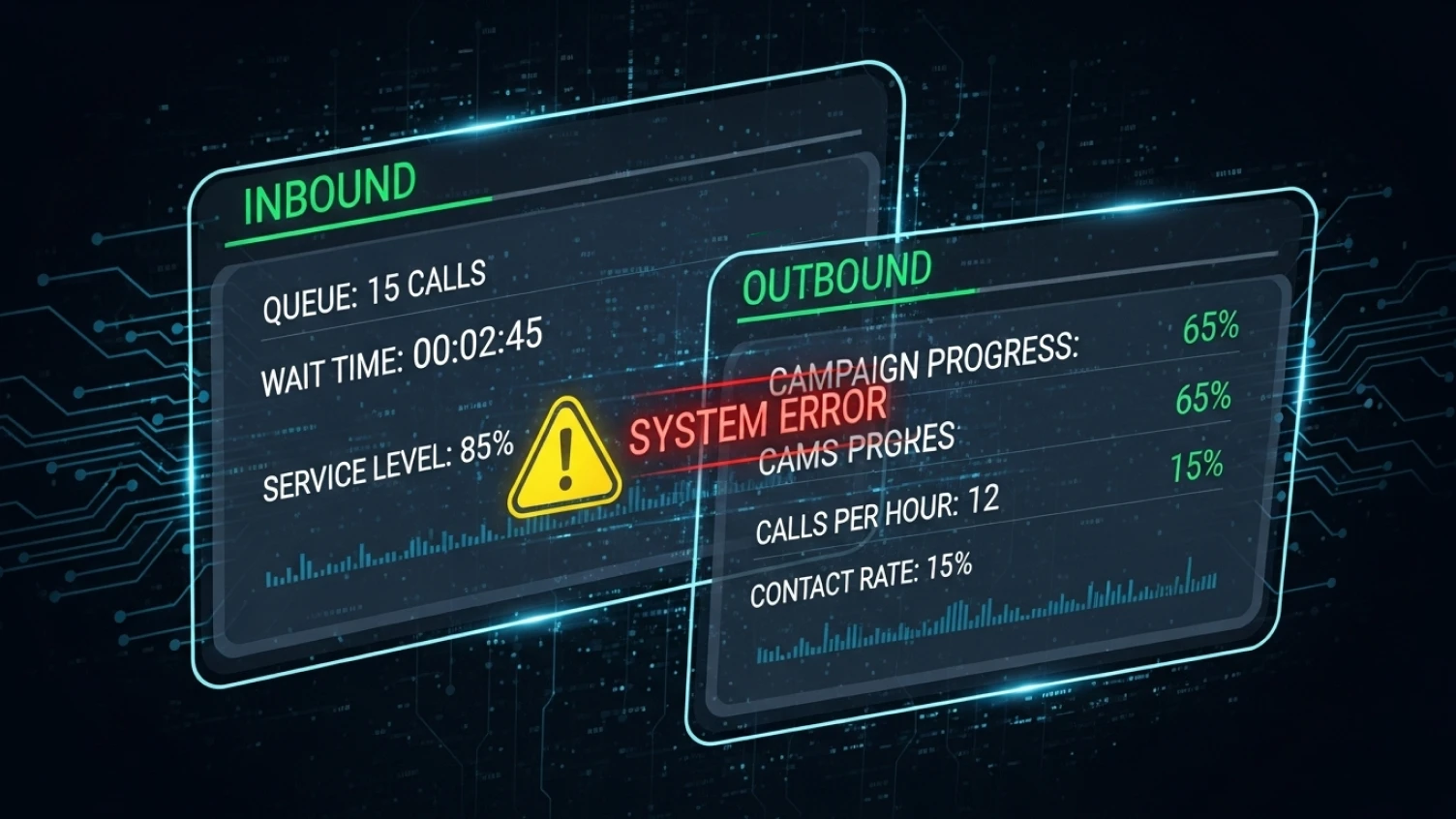
Blended contact center issues arise when a contact center loses the balance between inbound and outbound calling. This creates problems for both agents and customers.
Blended agents can become overwhelmed by outbound campaigns, while urgent incoming calls remain stuck in the call queue. This leads to increased idle time and frustration. These issues often occur due to improper skill-based routing, poorly managed outbound dialers, and a lack of real-time monitoring. The result is missed opportunities and longer wait times for customers.
All of these factors reduce agent productivity, harm customer interactions, and create management challenges for the center. To resolve these challenges, proper training and automated tools are essential. Implementing unified contact center solutions also helps maintain smooth and efficient workflows.
Blended contact centers sound great in theory, but without the right balance, things can quickly fall apart. Agents get stressed, customers wait longer, and efficiency drops. Here are the key causes of these issues:
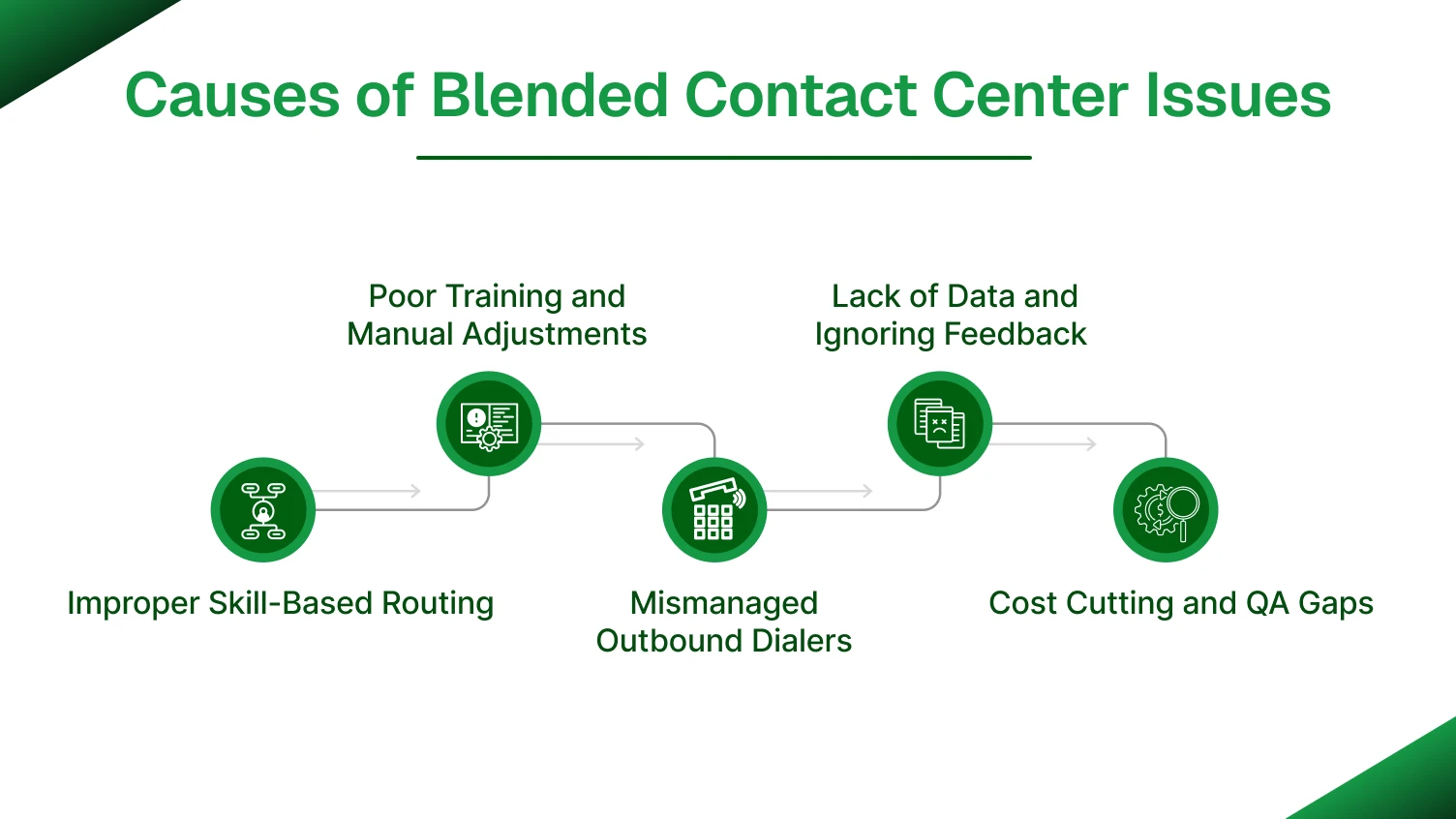
Sometimes calls go to the first available agent instead of the best one. Imagine a customer with a billing problem getting a technical support agent.
The call ends up being transferred multiple times, wasting time and frustrating the customer. Smart skill-based routing solves this by connecting each call to the right expert.
Blended agents switch between incoming and outgoing calls constantly. Without proper training on different types of calls and communication channels, they can feel overwhelmed.
For example, an agent might struggle with both a live chat and a phone call at the same time, lowering productivity.
Predictive or power dialers are great for outbound campaigns, but can become a problem if mismanaged.
Aggressive settings can block agents from answering inbound calls, causing long call queues. Balancing dialers with live traffic is crucial to keep agents stress-free.
Agents see the problems first. They know where routing conflicts happen. Ignoring their input means missing chances to improve workflows.
Also, keeping inbound and outbound data separate prevents managers from getting the full picture. This makes decisions harder and operations less smooth.
Many centers cut corners to save money by skipping training, delaying tech upgrades, or hiring fewer staff. While this may reduce short-term costs, it creates bigger long-term problems like poor service quality, higher agent turnover, and frustrated customers.
On top of that, quality assurance (QA) often focuses only on inbound calls, leaving outbound campaigns unchecked. This creates service gaps and inconsistency. QA should cover all blended interactions to maintain high standards and a seamless customer experience.
Fixing blended contact center issues isn’t just about having more people on the phones. It’s about using the right mix of tools, strategies, and training so agents can handle both inbound and outbound calls smoothly.
Here are the key resources and things you’ll need:
These are integrated platforms that centralize all communication channels like voice, email, chat, social media, and customer data. They move beyond basic automatic call distribution (ACD).
Why it’s needed: A UCCS gives agents one simple screen where they can see all customer details and past interactions. They don’t have to jump between different systems. This saves time and helps them solve problems faster.
Features to Look For: Strong skill-based routing, CRM integration, unified agent desktop, complete reporting, and omnichannel capabilities.
WFM tools use algorithms to forecast call volumes, schedule agents, and manage compliance. They optimize staffing levels based on predicted demand.
Why it’s needed: Blended environments have fluctuating inbound and outbound needs. WFM helps balance these. They make sure there are enough agents available during busy times and let agents focus on outbound tasks when things are quieter. This cuts down on idle time and helps prevent burnout.
Features to Look For: Forecasting capabilities, dynamic scheduling, real-time adjustments, adherence monitoring, and “what-if” scenario planning.
These systems collect, process, and visualize data from all contact center operations. They provide actionable insights into performance.
Why it’s needed: You can’t improve what you don’t track. Real-time dashboards show how long customers are waiting, which agents are available, how long calls take, and overall service performance. BI tools also highlight routing problems, training needs, and areas where outbound campaigns aren’t working efficiently.
Features to Look For: Customizable dashboards, historical reporting, trend analysis, sentiment analysis, and the ability to connect data from both inbound and outbound calls
Training isn’t just something agents do when they start. It’s an ongoing process that helps them handle different types of calls, chats, emails, and tasks confidently. Cross-training ensures they can easily switch between support and sales roles.
Why it’s needed: In a blended contact center, agents need to be flexible. They might answer an inbound support call one moment and make an outbound sales call the next. Continuous training gives them the knowledge, system skills, and soft skills like empathy and problem-solving to do both well.
Features to look for: Step-by-step skill development, practice through role-play, regular updates on policies, and learning new contact center tools or processes.
These platforms record and analyze agent-customer interactions across all channels. They provide structured feedback and coaching tools.
Why it’s needed: QA platforms allow you to evaluate interactions across all channels and both inbound/outbound. This ensures high standards are met everywhere. Integrated coaching tools turn these evaluations into actionable feedback, helping agents continuously improve their blended performance.
Features to Look For: Call recording and screen capture software, customizable evaluation scorecards, and coaching and feedback delivery tools.
These are systems and processes that actively gather feedback from frontline agents. Beyond formal reviews, they give agents regular opportunities to share concerns, offer suggestions, and provide insights from their day-to-day work. The goal is to make agents feel heard, valued, and genuinely part of the continuous improvement process.
Why it’s needed: Agents often have the clearest view of routing conflicts and operational challenges. Engaged agents feel valued and are more productive, which directly improves customer service strategies.
Key features to look for: Regular one-on-one meetings, anonymous suggestion boxes, internal communication platforms, and employee surveys.
These are tools that help customers solve problems on their own. Think of them as digital assistants. They include Interactive Voice Response (IVR) systems, smart chatbots, and online knowledge bases. They give customers quick answers and solutions without needing an agent.
Why it’s needed: Many customer questions are simple and common. Many customer questions are simple. Self-service tools handle these, freeing blended agents to focus on complex support or key sales calls. This reduces call volume, keeps agents happier, and gives customers faster help.
Key features to look for: User-friendly interfaces, clear navigation, comprehensive knowledge bases, and seamless escalation paths to a live agent when needed.
Thoughtfully investing in these resources and consistently improving how they are used helps contact centers. They can turn common blended operational challenges into great chances for growth.
This approach not only solves current problems. It also builds a more efficient, flexible, and customer-focused operation ready for what’s next.
Blended contact centers can be amazing because agents handle both incoming and outgoing calls. But sometimes, things get messy. Agents feel swamped, customers wait, and sales opportunities disappear. Let’s fix that.
Here’s a clear, step-by-step way to troubleshoot and solve those blended contact center issues:
Successfully resolving blended contact center issues delivers long-lasting advantages for both businesses and customers. Each benefit creates a direct impact on daily operations and future growth. Here are the following benefits:
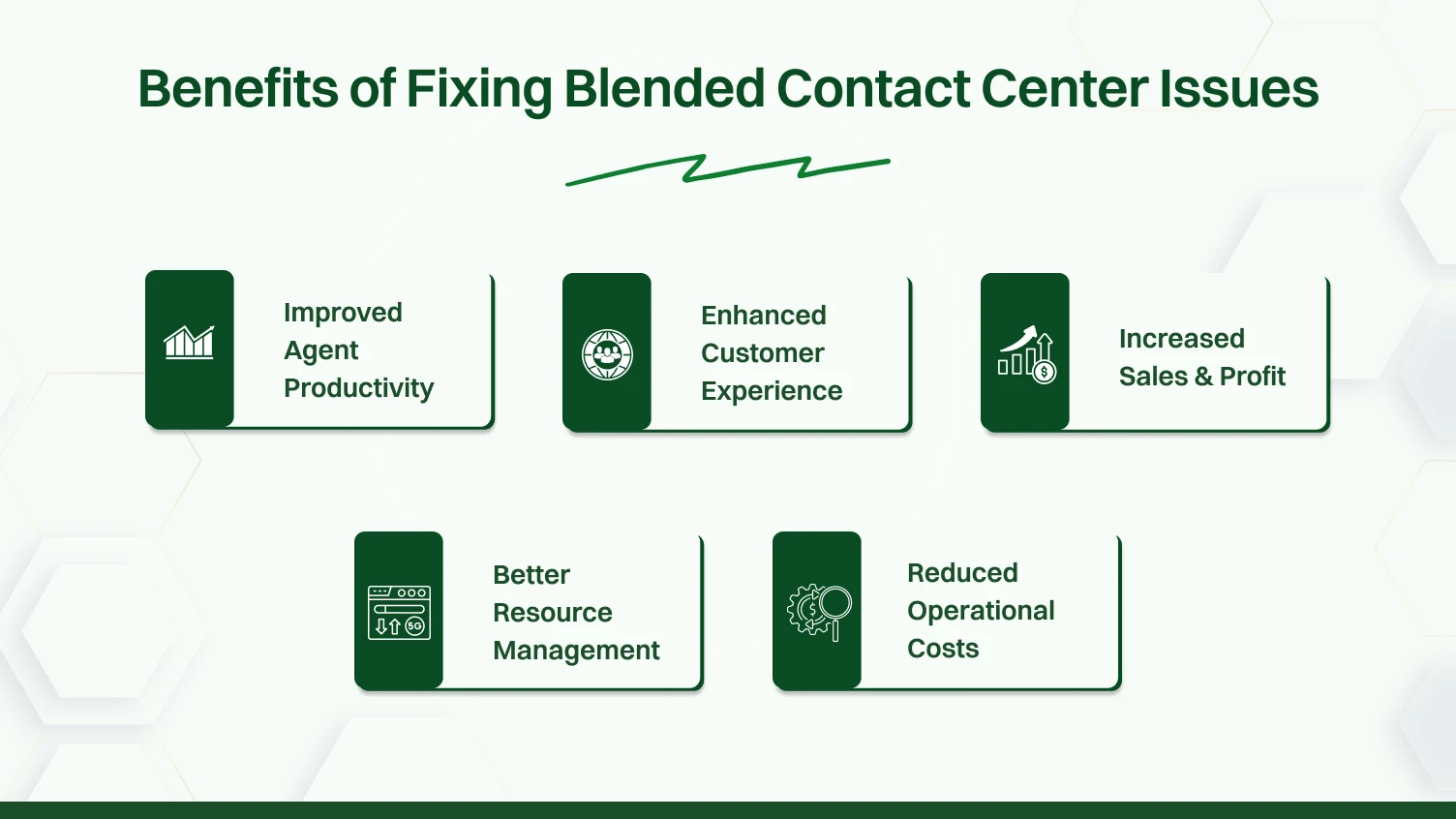
Blended agents handle both inbound and outbound interactions. They spend less time waiting for calls. This significantly reduces idle time. Idle time is a major drain on resources. This leads to higher agent productivity. Their valuable skills are utilized more effectively.
For instance, an agent might handle an inbound support query. Then, they immediately jump onto an outbound campaign for sales opportunities. This optimization increases the number of calls agents can handle. It boosts overall output without increasing staff.
Efficient skill-based routing is key to a better customer experience. It connects customers with the right agent quickly. This happens whether it is a complex inbound call or a proactive outbound call. The right agent is always engaged. This precision leads to more effective interactions.
It elevates service across all communication channels. This includes text messaging and traditional calls. Imagine a customer with a technical issue. Skill-based routing sends them to an expert. This creates a smoother, more personalized experience. It reduces frustration and builds stronger loyalty.
Optimized outbound campaigns directly lead to more sales opportunities. These might use dialers like a predictive dialer. Faster handling of inbound sales queries means fewer lost leads. Every incoming call is captured efficiently. Streamlining these processes reduces missed calls. Blended centers can significantly boost their bottom line. They maximize every interaction to sell, upsell, and engage. Every call becomes an opportunity to increase revenue.
For example, during busy times with many inbound calls, agents focus on solving customer problems. When call traffic slows down, they switch to outbound campaigns. This way, agents stay active and continue looking for new sales. It also makes sure no revenue is missed, which helps the business grow.
Effective center management helps assign resources in the right way. This is important for adjusting to changes in call volume. Blended agents can easily handle busy or slow periods, so there is no overstaffing or understaffing. Agents’ availability becomes more useful and flexible.
For example, on a Tuesday morning, many inbound calls may come in. In the afternoon, call traffic slows down. Blended agents can switch to outbound campaigns during these quieter times. This smart approach gives contact center managers helpful insights. It keeps the team aligned with demand and ensures smooth handling of both outbound and inbound calls without stress.
Maximizing agent efficiency reduces the need for more staff. This is a significant factor in lower operational costs. Blended call centers achieve more with existing resources. They avoid hiring separate inbound and outbound teams. Consider a blended center managing the same call volume with 15% fewer agents.
This saves substantial salary costs. Reducing idle time optimizes customer interaction flow. Expenses for facilities, training, and technology are minimized. This operational leanness makes your contact center more competitive. It frees up budget for other investments, like generative AI for self-service options.
To stop problems from coming back in your contact center, you need to be smart and always improve. It’s like learning from your mistakes and making things stronger.
Here’s how to make sure those blended contact center problems stay solved:
Training shouldn’t end after onboarding. Blended agents face dynamic challenges and need ongoing education. Update training programs regularly to cover all communication channels like voice, chat, email, and social media. Agents should confidently handle both inbound support and outbound sales. Refresh agents on new system features and existing tools so they can use your contact center solutions effectively.
Focus on soft skills such as empathy, listening, and problem-solving. Use scenario-based exercises that let agents practice switching between inbound and outbound tasks. This builds confidence and reduces stress during live operations.
Be proactive rather than reactive. Auditing your systems on a routine basis is a good idea. Review things like skill-based routing rules, outbound dialer settings, and IVR flows. Making sure that calls are being routed to the correct agent. Test for unusual scenarios and update your rules regularly as the agent skill set or products shift.
Make sure outbound dialers are not blocking inbound service. Consider regular reviews of system performance, integrations, and aging modules. Verify that all configuration meets your industry requirements, such as data privacy rules or call regulations.
Before making any improvements, let data be your guide. Track metrics like call volumes, agent idle times, customer complaints, and errors with routing. Review historical data to find trends and predictions. Begin utilizing predictive analytics to identify future call volume and staffing plans for inbound and outbound calls.
Testing adjustments, such as a new routing rule or outbound dialer settings, can now be tested against historical performance and compared with any changes. Make sure to combine all the data from inbound and outbound responses and provide managers with reports that present an overall picture of the data to influence their decisions or plans.
Feedback from agents and customers is key. Provide agents with safe and open channels to express their ideas via meetings, surveys, or internal chat. Listen to them and take their suggestions seriously. Agents often notice system problems or routing issues before managers do.
Also, collect feedback from customers through surveys to see how your blended contact center is working. Combine what agents and customers say to get a full picture. Create a culture where everyone feels encouraged to share ideas for improvement. When agents feel heard and valued, they stay motivated and help keep operations running smoothly.
Modern tools make blended contact centers more efficient. Keep your technology up to date with features like AI routing, conversational analytics, and omnichannel integration. Use automation for repetitive tasks like chatbots for FAQs, RPA for data entry, or AI for call summaries.
Provide a unified agent desktop so agents can see all customer information and channels in one place. Choose solutions that are scalable and flexible, ready to handle new communication channels. Maintain strong partnerships with vendors to stay informed about updates and best practices.
Quality Assurance (QA) should check every type of customer interaction, not only inbound calls. This means looking at outbound calls, emails, and chats as well. All of them should be checked using the same rules so the quality stays consistent.
Make sure QA evaluators score fairly and in the same way by reviewing their work often. Use the results from QA to give agents clear coaching and improve their training. Fix both small mistakes and bigger issues that affect the whole team. Share QA feedback with agents and managers so everyone can learn, improve, and keep customer service at a high level.
By doing these things every day, your contact center won’t just fix problems. It will become strong, efficient, and great for customers, avoiding the same issues again and again.
Even with the promise of efficiency, many blended contact centers fall into common traps. These mistakes can make blended contact center issues worse instead of solving them. Here are the following mistakes:
To improve a blended contact center, focus on agent training, AI for repetitive tasks, and a strong QA and coaching system. Use real-time analytics to track performance and optimize workflows. Build a positive team culture, and give agents the right tools with enough autonomy to deliver better results.
Here are the benefits of improvement in a blended contact center:
Calls should never be managed randomly. Categorize calls based on customer needs, and then assign agents who have the appropriate skills or language capability. Be sure to continue to revise these categories as the agents on your team develop new capacities. This prepares agents to connect customers with the best-fit agent faster.
Outbound calls need smart planning. Use predictive or preview dialers, but don’t overdo automation. Balance campaigns with real-time inbound traffic. This way, your team won’t miss urgent customer calls while still running sales or outreach programs.
Blended agents should feel comfortable managing calls as well as other communications. Train agents to manage calls, emails, chats, and even customer inquiries by using social media platforms. Soft skills such as empathy and problem-solving can apply to any interaction, so make sure you prioritize them.
Don’t let customer conversations go unused. Consider the recordings, chat transcripts, and messages. Check for patterns, repeated complaints, or service breakdowns. Use this data to adapt the routing rules, expand training, or make small adjustments to the process.
Scattered systems cause frustration for both agents and customers. A single, integrated platform gives agents a complete view of customer history. It also makes switching between inbound, outbound, and digital channels smoother.
Contact centers change by the minute. Real-time dashboards help managers see what’s happening instantly. If queues are long or agents are overloaded, adjustments can be made on the spot. Automation can also spread the workload more evenly.
Agents are at the core of blended contact centers. Manage schedules carefully to avoid burnout. Ask for feedback directly from your team, not just customers. Continuous coaching and recognition go a long way toward boosting productivity and morale.
Quality matters across inbound and outbound calls. Set clear criteria to measure performance. Regular reviews highlight strengths and weaknesses. Use findings to create personalized training plans and keep standards high.
Not every call needs an agent. Use IVR menus and chatbots to answer common questions. This frees agents to focus on complex cases where human interaction really counts. Customers also appreciate getting quick answers without waiting.
The future of blended contact centers is being shaped by AI and automation. These innovations won’t replace people. Instead, they will support blended agents, improve call routing, and reduce idle time. The result will be smarter operations and better customer interactions.
👉 Ready to unlock the full potential of your contact center? Discover smarter solutions with Dialaxy today.
The technical challenge includes dealing with system downtime, slow CRM tools, or call routing errors, which can delay customer support.
A blended process in customer service means agents handle both inbound calls and outbound follow-ups. They use the same system to manage both tasks smoothly.
The main problem in call centers is high call volumes. This causes long wait times for customers. Agents become stressed, and customer satisfaction drops.
The 80/20 rule in a call center means 80% of calls or issues come from 20% of customers or problems, which helps focus on the most common challenges first.
A blended call center handles both incoming and outgoing calls. Agents can switch easily between customer support and follow-up tasks. This improves efficiency and keeps workflows smooth.
