

VoIP Solutions for Schools: The Complete Guide You Need


Quick Overview:
VoIP Solutions to Schools is a replacement for old phones with internet-based systems that are cheaper, offer more features, and are more secure for both staff and students.
Modern schools need fast, reliable communication now more than ever. To link staff, update parents, or send emergency alerts, schools need systems that work quickly. This is why VoIP Solutions for Schools have completely changed how educational institutions operate every day.
Old phone systems had significant limitations, including high costs, outdated hardware, and limited growth. Cloud VoIP Solutions For Schools removes these problems, offering better communication at a lower price for tight budgets. Schools can handle calls, messages, and alerts using the internet.
As technology continues to transform classrooms, VoIP is becoming a key part of school communication. It helps teachers stay connected, parents remain current, and students stay protected and sound. This guide looks at cost savings, needs, benefits, problems, best providers, tips for choosing, and what’s next.

A modern communication platform must meet the diverse and demanding needs of today’s learning environments. Here are the core communication requirements that a successful VoIP for a school system must address:
Effective administrative communication requires a robust platform that instantly connects all staff and offices. Integrating with Microsoft Teams simplifies internal call flow and improves collaboration. This is vital for operations, making modern VoIP solutions essential for schools to function smoothly.
A flexible VoIP phone system ensures prompt parent contact for updates or emergencies, critical for K-12 schools. These VoIP solutions must allow schools to manage high-volume incoming calls and outbound alerts. This reliable communication platform helps maintain high family engagement and student safety.
The modern VoIP for the school district must support easy communication between classrooms, teachers, & counselors. An efficient call flow is needed to connect students needing help to the right support staff immediately. This essential feature allows teachers to focus on instruction & remote learning easily.
Safety requires quick emergency alerts through integrated PA systems. The communication platform must support rapid, one-touch emergency response across the entire campus. This capability ensures that K-12 districts can lock down quickly and manage any crisis with reliable VoIP solutions.
A growing enterprise business needs excellent system scalability across multiple buildings or distant campuses. Proper network optimization ensures consistent call quality & performance everywhere. A single, integrated cloud phone system is the only way for schools to manage their entire operations effectively.
Switching from a traditional phone system to a modern VoIP phone system offers immediate and long-term benefits across every aspect of school operations. Let’s have a quick look at what the benefits are:
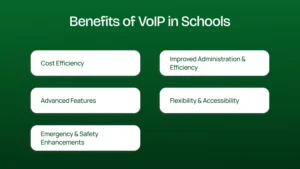
Switching to modern VoIP solutions provides significant savings compared to traditional phone lines. This system structure helps K-12 districts achieve seamless scalability without incurring proportional costs. These financial benefits allow schools to redirect budget toward other critical technology needs.
This communication platform offers great VoIP features, including call tracking, IVR menus, and smart call routing. A virtual receptionist answers and handles calls well. You can use tools like Microsoft Teams to put these features on every staff device.
Urgent communication features are built in for better safety in emergencies. The communication platform works with existing PA systems and broadcast messaging tools. This allows K-12 districts to send swift emergency alerts campus-wide using secure VoIP solutions for rapid action.
Centralized call analytics help the education enterprise make smart, data-driven decisions. The system can automate attendance and absence calls to parents, improving administrative efficiency. This streamlined call flow drastically reduces manual staff workload and errors.
Cloud VoIP solutions give staff total freedom to use the system on any device they choose. This mobility is key for field trips and remote learning environments. In those environments, online learning platforms can complement communication tools by giving students and teachers access to lessons, learning resources, and digital support. Low hardware requirements and effective network optimization enable schools to ensure reliable access for all teachers.
Dialaxy is a cloud telephony communication platform designed to streamline all admin tasks. It enhances student engagement & facilitates easy collaboration among staff. This VoIP for the school system supports global calling, SMS, and advanced contact center features, all easily accessible on mobile devices.
Features:
Pricing Plans:
Pros
Cons
Best for:
Dialaxy is ideal for smaller K-12 districts or schools focused on budget and high-volume parent texting. Its simple design helps allow schools to manage the call flow without deep IT support. This system is a flexible VoIP solution starter package for modern communication needs.
Nextiva offers a robust unified communications platform suitable for large school systems. It helps manage calls, collaboration, and even parent relationships easily. This enterprise business solution is built for high reliability and supports advanced business and administrative features.
Features:
Pricing Plans
Pros
Cons
Best for:
Nextiva is best for large K-12 districts seeking a highly reliable communication platform and rich administrative features. It is built to support complex call flow and vast systems. These complete VoIP solutions easily enable schools to operate with business-grade tools.
Zoom Phone is an excellent VoIP option for schools because of its deep integration with the widely used video platform. It easily supports hybrid learning, video meetings, and classroom collaboration. Its unified system seamlessly simplifies communication among teachers, staff, and students.
Features:
Pricing Plans
Pros
Cons
Best for:
Zoom Phone is ideal for schools already using Zoom or seeking excellent video and remote learning support. It integrates smoothly with Microsoft Teams and improves team collaboration. These robust VoIP solutions easily allow schools to manage hybrid communication effectively.
Ooma provides affordable VoIP solutions that offer the fundamental calling features despite its high price. It suits small schools that require simple, effective communication. The system has supported essential features, such as a virtual receptionist and dependable integration with PA systems, to ensure safety requirements.
Features:
Pricing Plans
Pros
Cons
Best for:
Ooma is a top choice for small schools or those with strict budgets. It offers reliable core calling and integrated PA systems at an affordable price. This excellent VoIP provider for schools can efficiently manage call flow while saving the institution money.
RingCentral provides an enterprise VoIP system with a truly unified communications platform. It combines all calling, messaging, and meeting needs into one app. This powerful suite helps schools handle high call volumes and complex administrative tasks efficiently across all devices.
Features:
Pricing Plans
Pros
Cons
Best for:
RingCentral is ideal for an enterprise business environment seeking the industry’s best features. It allows for deep SIS integration and supports a highly complex call flow. These top-tier VoIP solutions easily integrate with Microsoft Teams for superior team collaboration.
Dialpad is an AI-powered communication platform providing real-time call transcription and analytics. It unifies voice, video, and messaging to help K-12 districts manage modern needs. This advanced VoIP solution uses AI to enhance every staff conversation and quickly improve the administrative call flow.
Features
Pricing Plans
Pros
Cons
Best for:
Dialpad is best for tech-forward K-12 districts wanting real-time AI and excellent call analytics. It supports a unified communication experience and complex call flow management. These modern VoIP solutions easily integrate with Microsoft Teams to improve overall staff efficiency.
8×8 offers a highly reliable unified communications platform with guaranteed 99.999% uptime. It connects all staff globally with voice, video, and advanced security. This robust enterprise business solution is ideal for large organizations needing security and global reach for their VoIP solutions.
Features
Pricing Plans
Pros
Cons
Best For:
8×8 is best for large, security-conscious organizations needing maximum reliability. It offers global reach and complex call flow management. These comprehensive VoIP solutions easily allow schools to centralize all internal and external communication.
Vonage Business Communications (VBC) provides flexible VoIP solutions for voice, messaging, and video collaboration. It is built for seamless API integration. This unified communications platform helps allow schools to customize features, creating an efficient call flow for administrative and safety needs.
Features:
Pricing Plans:
Pros
Cons
Best For:
Vonage is ideal for growing organizations prioritizing cost-effectiveness and customization potential. Its API support helps allow schools to create custom integrations. This reliable communication platform provides excellent value by managing complex call flows with modern VoIP solutions.
Our support team is available to guide you step by step through the setup process and help your system running in minutes.
VoIP is highly dependent on reliable internet connectivity across all campuses. Calls, paging, and vital emergency signals are highly affected by outages. K12 districts need to implement network redundancy and failover to ensure the communication platform remains stable.
Voice quality is a significant issue in shared networks due to latency and packet loss. Laying calls will not be possible due to poor performance. Schools also need robust network optimization and VoIP QoS settings to optimize voice traffic and enable clear, professional conversations.
It is required to keep sensitive student and parent data secure. VoIP solutions need to use powerful encryption, firewalls, and safe provisioning protocols. This concentration helps schools meet compliance requirements and maintain confidence in the security of their systems.
VoIP cannot be easily integrated with older systems, such as intercoms, analog paging, and existing PA systems. Schools need to evaluate the trade-offs in adapting older hardware. Campus-wide announcements and emergency alerts require proper integration to function correctly.
The pricing system needs close examination with the need to balance between per-user and flat-rate plans. K12 districts will have to estimate costs that are not visible, such as storage fees for recording calls, call analytics access, and taxes, which will influence the overall cost of ownership.
In-depth employee training is also necessary to learn new VoIP solutions and ensure a successful transition. The transition away from the old phone systems needs time and communication. Change management reduces disruption and helps staff effectively use the new communication platform.

First, count every staff member, teacher, and office that needs a phone connection to size the system correctly. Note how many school buildings or campuses need service. Clearly stating your needs for emergency communication is the most essential starting point.
Decide on the features you absolutely must have for daily work, like automated answering (IVR), recording calls, and broadcasting pages across the school. Then list the features that would be helpful but not essential to your core daily operations.
Test the strength and reliability of your existing internet service across the entire network. Ensure you have sufficient internet speed to support a large number of clear phone calls simultaneously. Install Quality of Service (quality of service) on your network so that phone calls are never second.
Add all anticipated expenses, starting with any initial expenditures for equipment or installation. Arrange your monthly and annual subscription plans in the long run. Be aware of additional, unavoidable expenses, such as storage costs, overages, or specialized technical service.
First, test the new phone system at only one school office or building. This allows your personnel to test call quality and prominent features in a real working environment. It is essential to seek staff and parent opinions before implementing it on a board-wide basis.
Fraud check the guarantee assurances (SLAs) for fast repair and high system uptime. Ensure they can provide exceptional technical support with knowledge of school requirements and hours/day, 7 days a week. Make sure the system is expandable as the school district grows.
The communication landscape in education is quickly evolving, driven by deeper system integration, AI-driven automation, & a strong emphasis on system security. Schools adopting modern VoIP will be positioned to fully leverage these emerging capabilities to streamline operations and enhance safety.
The future involves the complete convergence of VoIP with existing Learning Management Systems (LMS) and student information platforms. AI will enhance safety by monitoring calls for keywords to flag security threats, and mobile-first deployment strategies will reduce hardware costs.
VoIP needs power and the internet. Schools must invest in a Battery Backup (UPS) for network gear and ensure staff have mobile apps to maintain emergency contact capability.
Traditional landlines transmit a street address. VoIP requires schools to manually register the exact physical location for every extension (e.g., “Room 214”) for first responders.
Yes, through a process called Number Portability. Schools transfer their current main office and extension numbers seamlessly to the new VoIP provider
Integration requires specialized hardware, such as an Analog Telephone Adapter (ATA) or a SIP paging adapter. The cost per required device can range from $150 to over $400, plus installation fees.
Successful adoption requires dedicated time for in-depth training on new features and softphone use. Schools must budget for several weeks of preparation and continuous support after launch.
