

Call Recording Disclosure – A Brief Guide


Have you ever picked up the phone and heard, “This call may be recorded for quality purposes”?
That simple statement is a call recording disclosure. It’s more than a formality; it tells the caller that their telephone call may be captured, and ensures your business follows call recording laws and consent laws.
In today’s world of call centers and phone systems, every recorded call relies on proper disclosure. In its absence, even one outbound call or telephone recording would result in legal issues.
The key to safe, transparent, and professional communication is to understand disclosure.
In a call center or when handling telephone calls on behalf of your business, it is important to have a clear call recording disclosure policy.
This is not merely following the recording law, but also developing trust and remaining within the laws of data protection. We can deconstruct the essentials you require.
You have to find out whether your area needs one-party consent or two-party consent before you record the conversation. Some areas, like parts of the United Kingdom, require all parties under the Regulation of Investigatory Powers. In the U.S., certain states follow federal laws that allow one-party consent.
Disclosures should be clear and direct. A simple message at the start, “This call may be recorded for quality and training purposes,” satisfies most call recording laws. You can deliver this via: Automated voice prompts on outbound calls, Agent scripts for live telephone recordings, and Visual notifications in phone systems or apps.
There should be a set duration of retention of recorded calls. This is in line with the laws of data protection and is used to mitigate legal risk. An example is to retain telephone recordings between 30 and 90 days to use in training and retain longer when necessary by law or company policy.
Access to calls recorded should be limited. Recordings should only be examined by designated personnel. That way, personal information is protected, and you are following the data protection principles.
Consent, notification, storage, and access, as outlined in this piece, work in concert to promote transparency and compliance with your call recording practices.
Following them avoids legal risks and strengthens trust in every telephone call your business handles.
In case you would like to record the call and still be in line with the laws of call recording, it is important to set up your system properly.
The following is a step-by-step guide based on the basis of practical experience in call centers and telephone systems.
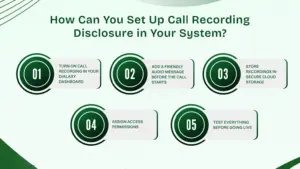
Start by enabling the recording device within your Dialaxy account. Make sure your system settings reflect whether you need one-party consent or two-party consent. This ensures every telephone call complies with consent law.
Checking this first prevents potential violations of data protection laws and regional criminal code requirements.
Next, include a clear call disclosure message at the beginning of every call. For example:
“This call may be recorded for quality and training purposes.”
This meets all party consent provisions in most jurisdictions, such as the United Kingdom, in the Investigatory Powers Act.
This upfront will guarantee informed consent and will secure your business and the personal information of the customers.
All the recorded calls should be stored in a safe place. Encrypted and controlled cloud storage. This complies with the laws of data protection and eliminates unauthorized access to telephone recordings.
The best practices to mitigate the risk in the future are regular backups and adherence to the digital media law projects.
Limit who can listen to recorded conversations. Only authorized staff or managers should have access. Set role-based permissions in your phone system and maintain audit logs.
This ensures compliance with protection laws and prevents misuse of personal information captured during calls.
Finally, run test calls to confirm that your recording device works, the disclosure message plays, and access restrictions are in place. Frequent testing helps catch issues before they affect real outbound calls or telephone calls with customers.
Regular tests maintain compliance with recording law and show your commitment to ethical practices.
Following these steps lets you record the conversation confidently, knowing your business meets consent law, data protection laws, and local criminal code requirements.
Even if you follow call recording laws, how you present the disclosure can impact customer trust and clarity. Optimizing your message ensures telephone calls feel professional and transparent.
Your disclosure should be concise. A simple statement like:
“This call may be recorded for quality and training purposes.”
Meets consent law requirements and ensures informed consent. Avoid long scripts that may confuse callers or make them hang up.
The tone must be human and friendly, whether it is pre-recorded or read by an agent. This will make the recorded conversation less mechanical and will assure the customers that their personal information is honored.
A natural voice also aligns with protection laws and data protection regulations.
Play the message before the call starts for outbound calls or at the beginning of inbound calls in a call center. This guarantees that all parties’ consent is properly obtained.
Positioning the message correctly avoids violations of two-party consent or all-party consent rules under local criminal code or Investigatory Powers Act regulations.
Check the recording device for volume, clarity, and distortion. Poor audio can lead to missed disclosures, which may breach recording law or data protection laws.
Regular monitoring keeps recorded calls compliant and ensures your call center delivers a professional experience.
Even with automation, agents should be aware of the guidelines for recording. They can politely remind customers that calls are being recorded when necessary.
Agent training ensures consent is obtained properly and reduces risk under call recording laws or protection laws.
Maximizing your call recording disclosure enhances compliance, increases transparency, and customer confidence. Legal risk is minimized when all telephone calls are professionally handled and trust is preserved.
Even the call centers that are experienced are occasionally caught up with recorded calls. Being aware of the pitfalls can keep you in line with the laws of call recording and the data protection laws.
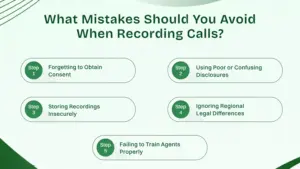
One of the biggest errors is the failure to obtain informed consent. Recording without permission is a breach of the Criminal Code or the Investigatory Powers Act in the United Kingdom in areas where two-party consent or all-party consent is required.
Always ensure the consent of all parties is properly obtained before you record the conversation. This prevents legal trouble and protects personal information.
The length or ambiguity of the message can make the callers oblivious to the fact that their telephone calls are being recorded. Do not use technical terms or disclaimers.
An easy, straightforward disclosure satisfies the consent law and makes recorded calls legally binding.
Leaving recorded calls in unprotected systems violates data protection laws. Use encrypted cloud storage, assign access permissions, and maintain audit logs.
Securing recordings ensures compliance with protection laws and protects sensitive personal information.
Call recording laws vary widely. For example, some U.S. states require one-party consent, while others need all parties’ consent. In Europe, data protection regulations are stricter.
Not checking local laws can result in fines or liability under digital media law projects or German Criminal Code provisions.
The most effective system cannot work without the appropriate training of the agents. Employees must learn how to report, how to document the call, and how to handle personal data.
Training can be used to make sure that your staff adheres to the rules of recording and minimizes the chances of legal liability.
These errors can be avoided to make all telephone calls compliant, transparent, and professional. Adequate configuration and knowledge safeguard your business and customer confidence.
Every call center and business has unique needs. Customizing your call recording disclosure ensures compliance with call recording laws while creating a better experience for your customers.
For outbound calls, you can record a friendly automated message:
“This call may be recorded for training and quality purposes.”
For inbound calls, agents can confirm verbally that telephone recordings are being made. This approach respects consent law and ensures informed consent is obtained for every recorded call.
In case your business is international, provide disclosures in more than one language. This will meet the data protection laws in various jurisdictions and will make sure that the consent of all parties is well established.
The availability of multilingual options will also enhance compliance with the Investigatory Powers Act and other protection laws.
You can link your recording device to your CRM system. This allows tracking of recorded conversations, storage, and access logs.
Integration ensures compliance with data protection laws while giving your team actionable insights from telephone calls.
Adjust the tone of your disclosure to match your brand voice. A friendly, professional tone makes recorded calls feel natural and reassures customers that their personal information is handled responsibly.
This customization meets guidelines for recording and strengthens trust in your call center operations.
In the case of recurring clients, your system will be able to track past consents received. New session reminders are automated to minimize errors and ensure adherence to the consent law and laws on call recording.
This will simplify your workflow and, at the same time, make sure that the consent of all parties is never violated.
Personalizing your call recording disclosure will assist your business to remain in line with the laws of call recording, data protection regulations, and offer an enhanced experience to all telephone calls.
The knowledge of call recording laws is very important to any business that deals with telephone calls. Compliance helps your company to avoid fines imposed by the provisions of criminal codes and handle personal information responsibly.
In the United States, rules vary by state. Some states allow one-party consent, meaning only one person on the call (usually the agent) must agree to record the conversation.
Other states require two-party consent or all parties consent. Failing to follow these rules violates consent law and could result in fines or legal action. Always confirm obtained consent before you record the call.
In case your company deals with international customers, telephone recording regulations such as GDPR (Europe) and PIPEDA (Canada) have very stringent demands.
These legislations focus on informed consent and safe management of personal data. Although a client may have already consented to recorded calls, you should still abide by the rules in his or her jurisdiction.
Legal requirements evolve. Guidelines on recording can be altered by the Investigatory Powers Act in the United Kingdom or amendments to the Digital Media Law Project.
Periodically update laws on call recording, educate your call center agents, and change your recording device settings. Being proactive ensures that all telephone calls are in compliance and reduces risk.
These fundamentals will make sure that your business does not violate consent law, protection laws, and local criminal code requirements. Compliance is not a rule but a promise of transparency and trust in all the recorded calls.
As your business grows, your call recording disclosure needs to scale. Planning ahead ensures compliance with call recording laws, data protection regulations, and consent law for every telephone call.
Automated disclosure messages help maintain informed consent even as your call center expands. Whether for outbound calls or inbound telephone recordings, automation ensures all parties’ consent is consistently obtained without extra manual effort.
This keeps your operations compliant under federal laws, Investigatory Powers Act, and other protection laws.
Legal requirements change. For example, updates to the German Criminal Code, Digital Media Law Project, or UK regulations can affect how you must record the conversation.
Regularly reviewing and updating your disclosure scripts ensures telephone calls remain compliant and protects your business from penalties under criminal code provisions.
Cloud-based phone systems make managing recorded calls easier. You can configure recording devices, store calls securely, and track obtained consent all in one platform.
Tools like Dialaxy also simplify auditing and ensure your call center follows data protection laws and consent laws consistently across teams and regions.
Future-proofing your call recording disclosure builds trust, ensures consistency, and demonstrates professionalism. By combining automation, regular updates, and secure cloud tools, every recorded call is handled responsibly and legally.
Learning from others helps you see how call recording disclosure works in real-life call centers. These examples show how proper telephone recordings protect businesses and build trust.
A mid-sized support team noticed complaints about missed or misunderstood calls. After implementing recorded calls with clear informed consent messages, customers felt reassured that their personal information was handled responsibly.
Following consent law and call recording laws, the team reduced disputes and improved satisfaction scores. Proper disclosures also ensured compliance with data protection regulations.
A sales organization that makes numerous outbound calls had to comply with the two-party consent states. They used a recording device integrated with automated disclosure messages.
By tracking obtained consent and securely storing telephone recordings, they stayed compliant with federal laws, protection laws, and local criminal code requirements. This prevented costly fines and legal risks.
An international firm handling clients in the United Kingdom and the EU faced strict data protection laws. They customized call recording disclosures in multiple languages and integrated them into their phone system.
This approach ensured all parties consent for every recorded conversation, aligning with the Investigatory Powers Act and GDPR rules. Clients appreciated transparency, strengthening trust across borders.
Real-world examples show that combining legal compliance, agent training, and secure recording systems delivers better results.
Following these practices ensures every telephone call is handled professionally, compliant with consent law, and respectful of personal information.
Call recording disclosure isn’t just about following call recording laws or avoiding penalties under the criminal code. It’s about clear, professional communication and protecting personal information in every telephone call.
Ensuring informed consent, following consent law, and respecting data protection regulations builds trust with customers. Proper disclosures make your call center more transparent and professional.
Every step from obtaining consent to securing recorded calls reinforces your commitment to ethical practices. Using tools like Dialaxy helps automate disclosures, store telephone recordings safely, and maintain compliance across teams.
Stay compliant, build trust, and keep every call secure — start with Dialaxy today.
Yes. Depending on your region, one-party consent or two-party consent may apply. Some places, like the United Kingdom, require all parties’ consent before you record the conversation.
A clear, upfront message works best: “This call may be recorded for quality and training purposes.” This ensures informed consent and meets call recording laws.
Retention depends on data protection laws and your business policy. Secure cloud storage with defined time limits helps comply with protection laws.
Only authorized staff should access telephone recordings. Implement role-based permissions to protect personal information and meet consent law requirements.
Violating call recording laws, criminal code, or data protection regulations can lead to fines, legal action, and loss of customer trust. Always ensure consent is obtained before recording.
