

Understanding SIP Gateways: Architecture, Features, and Benefits


Imagine running a business where every call matters, yet your trusted PBX system feels outdated.
Upgrading seems risky, expensive, and disruptive. This is the reality many organizations face today. A SIP gateway offers a smarter path.
It connects legacy phone systems, PBX systems, and IP phones to modern VoIP networks. With support for secure communication, data packetization, and Microsoft Teams integration, SIP gateways keep businesses connected and efficient.
In this guide, discover their architecture, benefits, and deployment use cases that ensure business continuity and cost savings.
A SIP gateway is a terminal or computer program that bridges the communication between the old phone infrastructure and the new VoIP infrastructure. It enables the PBX systems, analog phones, and telephone networks to interact with the IP phones, SIP phones, and VoIP gateways.
The gateway is used to encode voice signals into data packets to be used by IP networks and to decode protocols into SIP to be used in voice calls and video conferencing. Concisely, it is the connector that facilitates legacy phone systems to integrate with unified communications and modern communication systems.
The current competitive environment does not allow for keeping things as they are. SIP gateways bring a strategic edge as it is an important element that businesses can use to modernize without interruption.
Here’s why they are indispensable:
Businesses may use PBX systems, traditional telephone lines, and legacy phone systems. SIP gateway enables organizations to retain compatible SIP devices, pre-configured SIP networks, and available infrastructure. This will minimize interference and guard investment.
SIP trunking is less expensive than ordinary phone lines. It is also scalable, has secure communication, and is flexible in call routing. A SIP gateway translates old PBX systems into SIP trunking services to have access to the cost savings and dependable business continuity.
A lot of companies are relocating towards UCaaS or PBX clouds. SIP gateway enables a non-all or none solution where IP PBX and old systems are used, and new VoIP technologies. This ensures organizations can receive calls and forward calls without interruptions.
SIP gateways perform three main tasks. They handle media conversion by transforming the traditional analog or digital sound waves of a call into the digital IP packets that travel across the internet.
They provide signaling conversion by translating legacy protocols into SIP. They manage call routing to direct calls between PBX systems, VoIP gateways, and the public switched telephone network.
A SIP Gateway is primarily about connectivity and conversion. It bridges legacy telephony systems (analog lines, PBXs, PRI circuits) with VoIP networks by translating signaling and media into SIP/IP. Think of it as the translator that makes old and new systems speak the same language.
A Session Border Controller (SBC), on the other hand, is focused on security, control, and optimization. Sitting at the edge of your SIP trunk or IP network, an SBC protects against fraud and denial-of-service attacks, enforces policies, and ensures call quality. Think of it as the security guard and traffic manager for your SIP communications.
Simple Analogy:
SIP gateways are available in two primary forms, each with distinct advantages. Hardware gateways are physical appliances built for performance. They include rack-mounted units or small desktop devices with fixed ports.
Software or virtual gateways run on standard servers, virtual machines, or cloud platforms. They offer flexibility, scalability, and easier integration with VoIP technologies. While both types perform the core bridging function, they differ significantly in deployment, management, and ideal use cases.
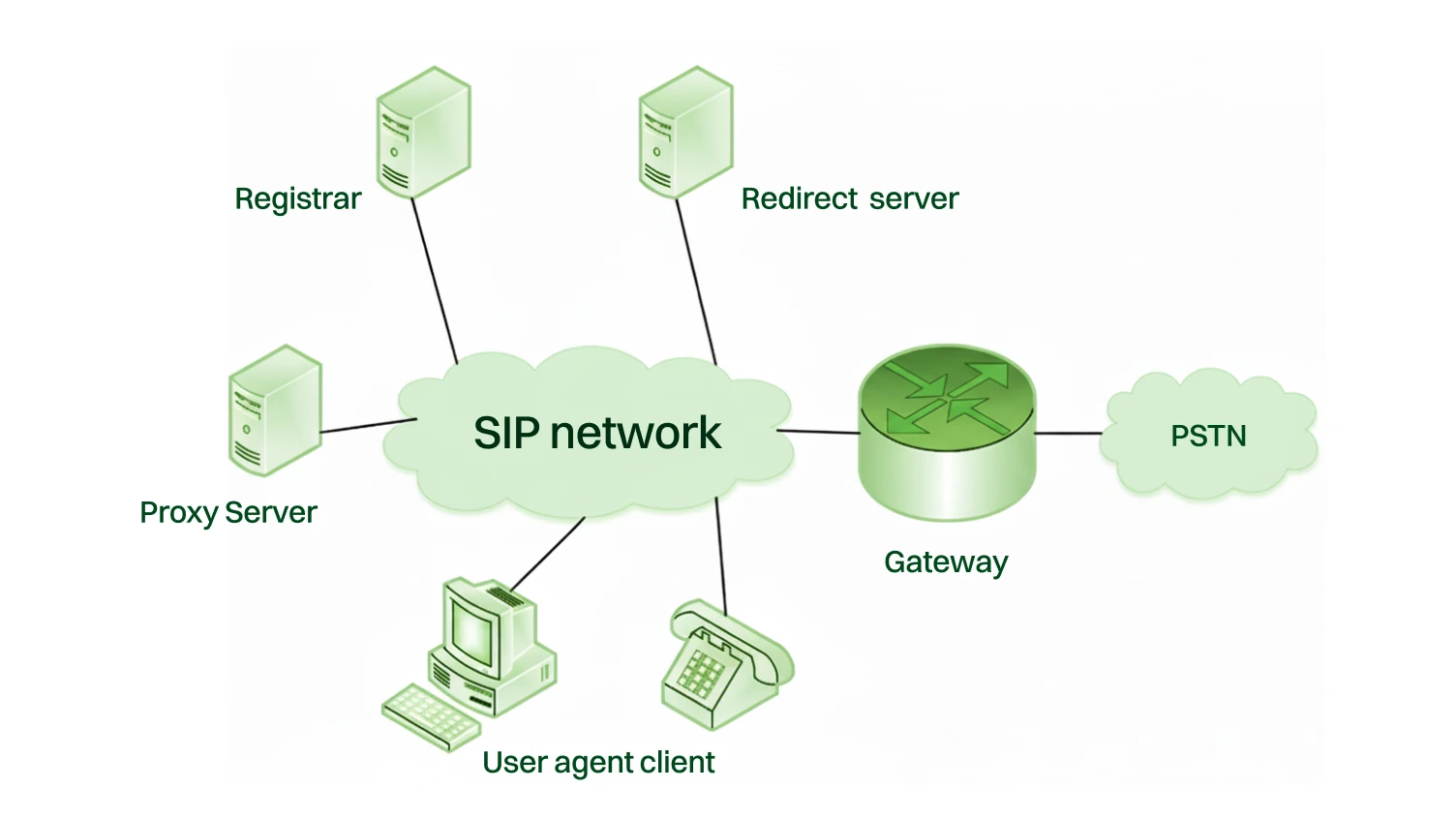
FXS ports connect to analog phones or fax machines. They supply dial tone, ringing voltage, and power. FXO ports connect to analog lines from the public switched telephone network or to PBX systems. Together, they support legacy phone systems and business continuity.
Digital interfaces connect to legacy PBXs or telecom trunks. T1 trunks are used in North America. E1 trunks are common in Europe and Asia. PRI supports multiple voice channels and signaling functions for efficient call forwarding and call routing.
When a voice call begins, the media travels through RTP on the IP network. The SIP gateway converts analog or digital sound into IP packets. It also converts packets back into voice for traditional phones. This ensures high-quality voice calls across both networks.
Signaling manages call setup and termination. The gateway translates legacy protocols like ISDN or SS7 into SIP. This allows IP phones, compatible SIP devices, and PBX systems to communicate with VoIP networks.
In a typical deployment, a SIP gateway is positioned on the network alongside a Session Border Controller. The SBC acts as a security guard, providing protection, quality of service, and advanced routing for SIP traffic flowing to and from the gateway. This arrangement safeguards SIP gateways, IP networks, and unified communications systems.
The gateway translates signals from PBX systems, telephone networks, and legacy phone systems into SIP messages. This ensures proper call setup, busy tones, and termination across different platforms.
The gateway manages audio streams. It performs transcoding to convert codecs like G.711 or G.729. Jitter buffering stabilizes packet delivery across IP networks. Echo cancellation removes unwanted noise for clearer voice calls.
Interfaces connect the gateway to multiple systems. Analog interfaces use FXS and FXO ports. Digital interfaces use T1, E1, or PRI trunks. IP interfaces use Ethernet connections for VoIP gateways, SIP trunking, and Microsoft Teams integration.
| Feature / Aspect | Hardware Gateways | Software / Virtual Gateways |
|---|---|---|
| Performance | Dedicated performance, lower latency | Dependent on server resources, potential for contention |
| Ports | Physical ports for analog, digital, or IP connections | Virtual interfaces, no physical ports required |
| Flexibility & Scalability | Fixed port capacity, less flexible | Highly flexible, easy to scale up or down |
| Deployment & Management | Purpose-built, often easier to deploy | Requires IT expertise, centralized management possible |
| Cost | Higher upfront cost, CapEx model | Cost-effective, OpEx model |
| Space & Power | Requires rack space, power, and cooling | Runs on existing servers or cloud infrastructure |
| Use Cases | Businesses with specific port needs, branch offices, and traditional phone lines | Enterprises with virtualized infrastructure, cloud VoIP, and rapid scaling needs |
👉Key Takeaway: Hardware gateways shine when reliability, dedicated ports, and low latency are critical, while software gateways excel in flexibility, scalability, and cost-efficiency. Choosing the right one depends on business needs and infrastructure.
With the architecture and deployment models clear, the next step is to explore the features and capabilities of modern SIP gateways. These functions truly enable seamless communication, security, and scalability in today’s business environments.
Modern SIP gateways act as more than protocol bridges. They serve as intelligent communication systems that enhance reliability, security, and performance.
Their features help businesses connect legacy phone systems with modern VoIP technologies while ensuring efficiency and business continuity.
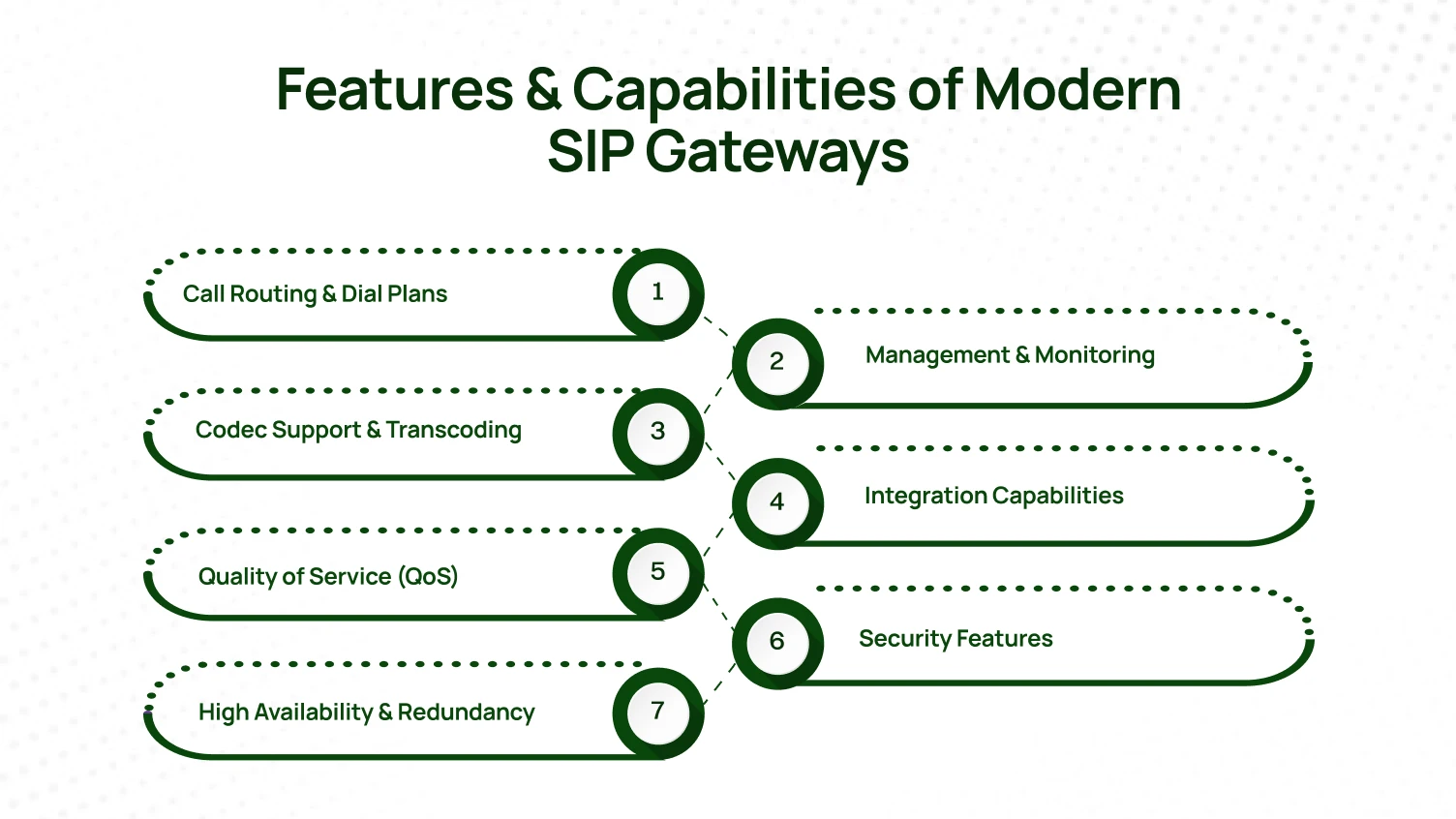
A SIP gateway can control how calls move across networks with dial plans. These rules enable efficient and flexible call handling across PBX systems, SIP trunking, and VoIP gateways. Businesses can use least cost routing to lower expenses.
Failover routing ensures calls continue when a SIP trunk fails. Extension dialing connects IP phones with legacy systems. Time-of-day routing directs calls to office lines during work hours and alternate destinations after hours.
Effective tools make gateways easier to manage. Most provide a web app with graphical dashboards for configuration and performance monitoring. Command-line access offers advanced control.
SIP trace helps troubleshoot signaling between IP phones and telephone networks. Logs and alarms notify administrators of issues so they can act quickly.
Different devices and providers use different codecs. Without compatibility, calls may fail or lose quality. SIP gateways resolve this by transcoding voice data between codecs in real time.
This supports communication between traditional phone systems, IP networks, and VoIP gateways. Common codecs include G.711 for high quality, G.729 for low bandwidth, G.722 for HD voice, and Opus for flexibility in modern apps.
A key strength of modern SIP gateways is their ability to integrate directly with leading UCaaS platforms such as Microsoft Teams, Zoom Phone, and Google Voice.
This enables hybrid communication where employees using traditional phones can connect directly with IP phones on cloud systems. Gateways also enable CRM features indirectly by linking PBXs with VoIP components that support click-to-dial or call logging.
Voice calls demand consistency. Network congestion can lead to delay, jitter, or packet loss. SIP gateways apply QoS to mark voice packets so routers and switches give them priority. This maintains reliable voice calls and protects unified communications traffic from disruption on shared IP networks.
Security is essential for VoIP networks. Modern SIP gateways use TLS to secure call signaling and SRTP to encrypt voice media.
These safeguards protect calls on both traditional phone lines and SIP trunking. Gateways can work with firewalls to block unauthorized access. VLAN support allows dedicated voice traffic, improving both quality and security.
Downtime can disrupt business continuity. Modern SIP gateways support high availability with active and standby setups. The primary gateway handles traffic, while a secondary device mirrors its configuration.
In case of failure, the standby takes over instantly. This ensures calls continue without interruption across telephone networks or PBX systems.
Understanding the architecture and features of a SIP gateway is valuable, but seeing how they solve real-world problems is where the true potential becomes clear. Real-world deployment examples show exactly how these versatile devices deliver tangible results.
The following three scenarios illustrate how businesses of different sizes can use a SIP gateway to modernize their communication, preserve critical investments in legacy hardware, and seamlessly connect with next-generation SIP trunking or UCaaS platforms.
The Goal: A small office (4-12 employees) wants to eliminate multiple, expensive analog phone lines and move to a single, flexible SIP trunk without replacing their existing analog phones and fax machines.
The Setup (Topology):
This is the most straightforward gateway deployment.
Existing analog phones and fax machines plug directly into the gateway’s FXS ports.
The SIP gateway connects via Ethernet to the office router, giving it access to the internet.
The gateway then registers with a cloud-based SIP trunk provider, acting as the bridge between the analog devices and the VoIP service.
How It Works (Dial Plan):
Key Considerations:
The Goal: A mid-sized company with a reliable digital PBX wants to replace its expensive and inflexible PRI or T1 circuits with modern SIP trunks while keeping the PBX to manage all internal extensions, call routing, and voicemail.
The Setup (Topology):
The existing digital PBX connects to the SIP gateway using its PRI, T1, or E1 port(s).
The gateway connects to the corporate network and communicates with the SIP trunk provider over the internet.
In this model, the PBX remains the brain of the operation, handling all call-handling logic. The gateway’s sole job is to act as a translator, converting the PRI signaling and media into SIP.
How It Works (Dial Plan):
Key Considerations:
The Goal: A large enterprise is migrating to cloud communications like Microsoft Teams but needs to maintain a legacy PBX for a specific department (like a call center) and provide secure connectivity for remote workers.
The Setup (Topology):
This is a more advanced, layered architecture.
A virtual SIP gateway (running as a VM on a server) connects the legacy PBX to the internal IP network.
All voice traffic flows through a Session Border Controller (SBC) positioned at the network edge.
The SBC is the central security and policy hub, connecting securely to Microsoft Teams Direct Routing, other UCaaS platforms, and one or more SIP trunk providers.
Remote users connect their softphones or IP phones securely through a VPN or SD-WAN.
How It Works (Integration & Routing):
The SIP gateway’s primary role is simple: convert the PBX’s legacy signaling (like PRI) into standard SIP.
The SBC does the heavy lifting:
This hybrid model creates a unified ecosystem. A call can originate from the legacy PBX, route through the gateway and SBC, and terminate on a Microsoft Teams user’s client anywhere in the world.
Key Considerations:
Deploying a SIP gateway is about more than just configuration. It is about protecting your voice network from real-world threats and being ready to troubleshoot at a moment’s notice.
Research shows that VoIP fraud costs businesses over $10 billion globally each year. A single breach can lead to catastrophic toll fraud or call interception.
That is why a strong defense strategy and a practical troubleshooting guide are critical to success.
Every phone call has two parts: signaling and audio. Both require encryption.
Action Item: Always enable TLS and SRTP on gateways, SBCs, and SIP trunk providers. Update certificates regularly to maintain trust. This creates the first wall of defense.
Your gateway should only communicate with trusted systems.
A firewall must restrict SIP and RTP traffic to known IP addresses, such as your trunk provider.
VLANs separate voice traffic from general data. This not only improves security but also helps enforce QoS.
Access controls matter too. Change default admin passwords immediately. Use long, complex credentials. A four-digit default PIN could be cracked in minutes.
By segmenting traffic and restricting access, the attack surface is greatly reduced.
SIP gateways are exposed entry points. Attackers often flood them with junk traffic or attempt password guessing.
DoS protection filters abnormal traffic surges to keep services available.
Rate limiting blocks IPs after repeated failed logins. Imagine a system that locks out a hacker after three failed attempts. This prevents brute-force attacks from escalating.
Security is never static. Vendors release updates that patch vulnerabilities. Running outdated firmware is like leaving a door unlocked.
A study by Positive Technologies showed that nearly 60% of VoIP devices run outdated software.
Schedule monthly checks for firmware updates and apply them after testing. This practice hardens gateways against evolving threats.
An SBC (Session Border Controller) acts as the bodyguard for your SIP gateway.
It hides the internal network, strips sensitive SIP headers, and enforces encryption.
For businesses beyond a small office, an SBC is not optional. It is essential for perimeter defense.
NAT often breaks SIP by rewriting IP addresses incorrectly. SIP ALG, a router feature meant to help, often makes things worse by corrupting packets.
The fix is simple: disable SIP ALG on your firewall. If no SBC is present, configure the gateway with its public IP or use STUN.
For example, a sales team may miss inbound calls because NAT blocks RTP streams. Correct handling ensures calls flow properly.
A classic issue where one side hears the call, but the other does not.
The cause is almost always blocked RTP traffic. Firewalls must allow inbound UDP ports, typically in the 10000–20000 range.
Forward these ports to the SIP gateway or SBC. For instance, a support agent might hear a customer, while the customer hears silence. Fixing RTP restores two-way communication.
SIP response codes pinpoint why calls fail:
For example, if outbound calls return 401, trunk credentials are incorrect. Understanding these codes eliminates guesswork.
Poor call quality signals network congestion.
Jitter happens when packets arrive irregularly.
Packet loss occurs when packets never arrive.
Latency creates noticeable call delays.
The fix is Quality of Service (QoS). Routers and switches should prioritize voice packets. Imagine file downloads choking bandwidth. Without QoS, calls distort. With QoS, voice traffic moves in the fast lane for clear audio.
Most gateways include SIP trace tools. These show call ladders such as INVITE → RINGING → 200 OK → ACK.
If the trace stops after INVITE, the provider never replied. SIP traces are a quick way to isolate signaling issues.
This confirms whether RTP left the gateway but failed to return. Tcpdump gives visibility beyond logs.
Wireshark displays full call flows. Analyzing INVITE, TRYING, RINGING, 200 OK, and ACK reveals exactly where the call failed.
For example, if ACK never appears, the PBX failed to confirm. Call flow diagrams save hours of blind troubleshooting.
A SIP gateway is not just technology. Its value is measured in business outcomes: high-quality calls, cost reduction, and strategic advantage. Once deployed securely, it delivers tangible returns.
Before discussing savings, performance must be ensured. Poor call quality frustrates customers and reduces employee productivity. Three key factors ensure high performance.
Sizing for Concurrent Calls: Gateways must handle peak call volumes. An undersized gateway is like a highway with too few lanes at rush hour. Calls get dropped, and audio quality suffers. Proper sizing guarantees resources for every call.
The Impact of Codecs: Codecs compress and decompress audio. The choice affects bandwidth and voice clarity.
Measuring Quality (MOS): The Mean Opinion Score (MOS) ranges from 1 to 5. A score above 4.0 is excellent. Correct sizing, codec choice, and QoS implementation ensure consistently high MOS scores.
Performance lays the foundation. The most compelling benefit is cost savings. Legacy PSTN services are expensive and inflexible.
PSTN Costs: PRI circuits range from $300 to $1000 per month. Individual analog lines often cost $40–$60 per month. These are fixed costs regardless of usage.
SIP Trunking Costs: SIP trunks are cheaper. Monthly fees are per channel or per minute. You pay only for capacity used. Eliminating a single PRI can often cover the entire cost of a SIP gateway in just a few months.
Estimating savings is essential. A simple ROI calculator can help:
This gives decision-makers clear numbers to support a SIP migration.
Technical specifications are important, but the real test of any technology is its impact on businesses. These case studies show how companies of different sizes used SIP gateways to solve communication challenges, reduce costs, and modernize operations.
The Client: A 12-person law firm relying on traditional analog phones and a dedicated fax line.
The Challenge: High monthly costs for multiple analog lines, no flexibility to add new lines, and no modern features like voicemail-to-email. Communication expenses were disproportionately high for the business’s size.
The Solution: The firm installed a compact 8-port SIP gateway. Analog desk phones and the critical fax were plugged into the FXS ports. The gateway is connected to the internet router and registered with a channel-based SIP trunk provider.
The cutover from analog to VoIP was completed over a single weekend to minimize disruption.
The Results:
The Client: A 150-employee manufacturing company with a digital PBX connected via two costly PRI circuits.
The Challenge: Long-term PRI contracts were expensive. The PBX could not integrate with Microsoft Teams. No disaster recovery plan existed, leaving voice communications vulnerable.
The Solution: A digital SIP gateway connected the legacy PBX’s PRI ports to a high-capacity SIP trunk. A Session Border Controller (SBC) was deployed to secure the network and provide certified Microsoft Teams Direct Routing.
The PBX continued supporting factory floor extensions, while office staff could make calls directly in Teams.
The Results:
These real-world examples demonstrate that SIP gateways deliver measurable savings, improved reliability, and smooth integration with modern UC platforms, making them a strategic choice for businesses of all sizes.
A SIP gateway connects legacy PBX systems to modern VoIP networks. It reduces telecom costs with SIP trunking, improves call routing, and integrates with Microsoft Teams. Features like auto attendant, IVR, and call queues boost efficiency and customer experience.
Businesses can scale easily without replacing existing phones. Upgrade your business communication today with Dialaxy.
Get your SIP Gateway Implementation Checklist, calculate ROI instantly, and book a free consultation to modernize your voice system without disruption.
SIP Gateways reduce telecom costs, enhance call quality, and increase scalability. They allow businesses to use existing phones while connecting to VoIP or UCaaS platforms, supporting remote users, multiple locations, and modern collaboration tools without replacing legacy infrastructure.
Key features include: protocol conversion (analog/digital to IP), call routing, support for multiple codecs, security through encryption, integration with UCaaS platforms, and scalability to handle additional lines or simultaneous calls as businesses grow.
Yes. SIP Gateways can bridge legacy PBXs to cloud-based platforms like Microsoft Teams, Zoom, or Google Voice. They enable direct routing, secure SIP connections, and support hybrid setups where on-premise phones and cloud applications work together seamlessly.
Common SIP Gateway codecs include G.711 (high-quality, high bandwidth), G.729 (compressed, low bandwidth), G.722 (HD voice), and Opus (versatile for modern applications). Gateways can transcode between codecs to ensure compatibility between different devices and providers.
Yes. Virtual SIP Gateways run on servers or cloud environments, providing flexible deployment without dedicated hardware. They integrate with existing PBXs, UCaaS platforms, and SBCs, offering the same routing, codec, and security features as physical gateways while supporting scalable enterprise architectures.
