

What Is Call Flow? Types, Benefits, and How It Works

Call flow can refer to two related things: the path a call takes through a phone system, and the structured conversation an agent follows once connected. In business phone systems, call flow is the path a call takes from the moment it reaches a business to the point where it is answered, resolved, transferred, or sent elsewhere. It can include greetings, IVR menus, call routing, queues, agent connections, voicemail, and other rules that determine what happens next.
This detailed guide will show you precisely what call flow is and why it defines your customer experiences. We will reveal the powerful types of call flow structures available.
You will also learn the core benefits of a well-designed call flow. Ready to transform a chaotic call experience into a positive, successful call every time? Let’s dive into the mechanics of superior communication.
When you finish reading this related article, you will possess three major takeaways.
Call flow represents the precise, mapped path an incoming telephone call travels within a business system. It functions as the ultimate blueprint for every customer interaction. This detailed path starts the moment a customer dials your number. It proceeds through all automated stages, like the interactive voice response (IVR).
The flow determines where the system should route calls next. This logic directs the conversation to the most qualified agent or department. A successful call flow ensures efficiency and minimizes frustrating wait times for customers. Its main purpose is to deliver quick resolution and exceptional customer experiences. A well-designed process is vital for managing call volume and building trust.
Every call flow starts with a clear purpose: to guide phone calls efficiently while reducing wait times and improving customer interactions. Understanding the mechanics helps businesses streamline call handling and enhance customer satisfaction.
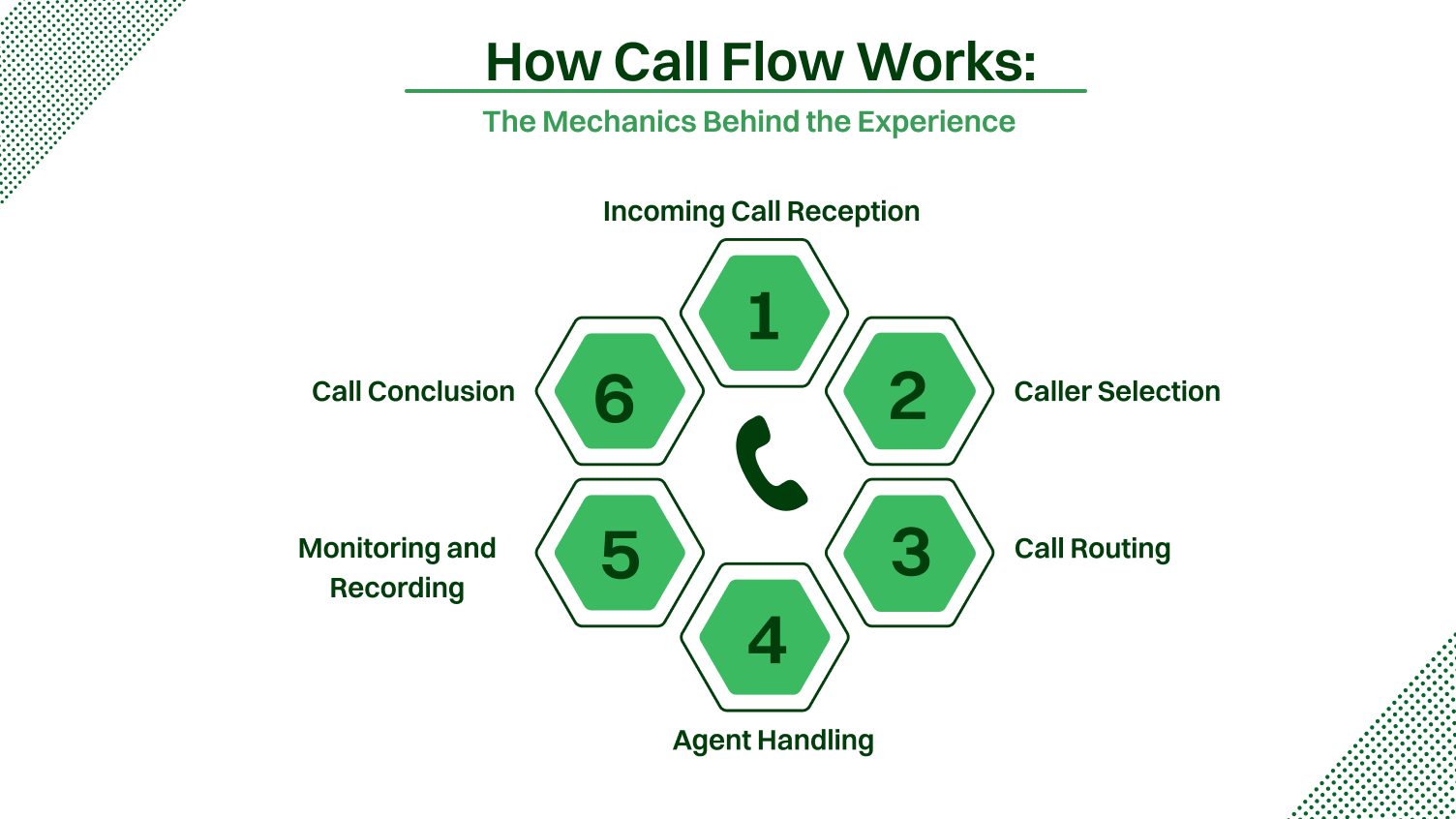
The incoming call reaches the system, triggering a friendly greeting or an interactive voice response (IVR). This first contact sets the tone for the customer journey.
The caller selects from menu options, such as support, billing, or appointments. The system identifies the need, ensuring calls follow the most effective path.
Call flow processes determine routing. A skill-based call flow directs the call to an agent with relevant expertise, while a linear call flow or round-robin call flow balances workload efficiently.
The center agent receives the call, supported by a knowledge base or previous customer stories. This ensures quick, informed responses, reducing handle time and enhancing resolution time.
The system may activate call recording for quality assurance and track call volume to optimize workforce engagement and call management system performance.
The conversation concludes with a resolution. Smooth conversation flow minimizes hold times, prevents difficult customers, and strengthens trust, leaving the caller satisfied and confident in the business.
Businesses require different routing strategies for optimal service. The best approach depends on your team structure and customer needs. Here are six essential types of call flow structures.
This is the simplest, most direct form of routing. The call follows a single, sequential path. It attempts to connect with Agent A first. If Agent A is busy, it moves to Agent B. If Agent B is busy, it moves to Agent C, and so forth. The linear call flow is easy to set up and manage. It works best for smaller teams with general expertise.
The round-robin call flow aims for equitable distribution of work. Calls are distributed evenly and cyclically among a group of available agents. If Agent A took the last call, the next one goes to Agent B. The third goes to Agent C, ensuring fairness. This method is excellent for reducing agent burnout. It ensures that the call volume is managed consistently across the team.
This system is an example of a truly intelligent routing method. The skillbased call flow prioritizes agent expertise. The IVR collects initial information about the customer’s need. The system then routes the call to the agent best qualified to handle the issue. For example, Spanish-speaking customers are routed to agents fluent in Spanish. This significantly improves resolution time and enhances customer satisfaction.
The IVR call flow is centered around the automated attendant. It uses interactive voice responses to guide the customer. Callers interact with a menu using voice commands or key presses. The IVR serves as the initial filtering mechanism. It can provide answers to common questions. It can also direct calls to a specific department or direct extension. This reduces the load on call center agents.
This adaptive flow adjusts routing based on the operational schedule. Calls received during business hours go directly to a team queue. Calls received after hours might be routed to a specific voicemail box. Alternatively, they could be sent to an outsourced after-hours team. This ensures every incoming call is handled appropriately, regardless of when it arrives.
This advanced flow assigns a priority level to certain callers or call types. VIP customers might bypass the general queue entirely. They are immediately routed to a specialized group of agents. Similarly, calls reporting critical system outages receive top priority. This ensures that high-value or high-urgency calls receive swift call handling.
A strong call flow supports both the organization and the customer on every call. It brings structure, clarity, and confidence into each interaction. It allows callers to move through the conversation without confusion. It also helps teams work efficiently while maintaining a consistent level of service.
Here are the key benefits explained clearly.
Customers feel truly valued when they quickly reach the right person. A streamlined call flow minimizes annoying transfers. It also shortens long wait times considerably. This efficiency translates directly into much better customer satisfaction. It means significantly fewer frustrated customers overall.
You will see many more positive interactions as a result. Your commitment to fast, accurate service builds loyalty. A good flow feels both intuitive and completely effortless for the caller.
Proper routing minimizes the time agents spend transferring calls. This directly reduces the average handle time per single call. When your center agent team is more efficient, they can handle a larger call volume. This increased productivity substantially lowers labor costs.
These savings are associated with call center operations. Operational improvement clearly leads to important financial savings. The system pays for itself through efficiency gains.
The skillbased call flow is key to achieving consistently higher FCR rates. Connecting customers to an expert immediately resolves the issue. This often happens on the very first successful call. This prevents frustrating callback cycles from happening.
It dramatically enhances overall customer experiences. Resolution on the first attempt is the absolute gold standard for service quality. It saves time for both the customer and the company greatly.
A clear call flow provides accurate data points for every call stage. This essential data informs better training protocols. It also allows for smarter resource allocation decisions. For your call center agents, a clear system reduces confusion. They know precisely who to transfer to if needed. This reduces job-related stress and improves workforce engagement. Agents feel more capable in their call handling duties.
For law firms or financial services, professionalism is everything. A system that promptly directs calls to the proper direct extension conveys competence. A well-designed call flow instantly builds trust effectively. It reinforces a professional, well-organized image for the company. Sloppy routing suggests internal disorder to callers. This is a perception customers should never have.
A well-documented call flow ensures a consistent experience for everyone. This remains true regardless of the company’s current scale. As the business grows rapidly, the underlying routing logic can be easily expanded. New call center agents or queues can be added without breaking the existing framework. This consistency is vital for maintaining brand standards. It ensures a unified, smooth customer journey always.
Every enterprise relies heavily on its ability to communicate. The flow of these communications is a direct reflection of internal health. Measuring the efficiency of the call flow is far more than an administrative task. It is a critical strategic imperative for every organization.
This practice transforms the contact center from a simple cost center into a powerful business asset. Neglecting this measurement can lead to systemic failures. These failures often result in deeply frustrated customers. Robust analysis provides the data needed for continuous, informed improvement. Here are the key reasons why call flow measurement is crucial for business:
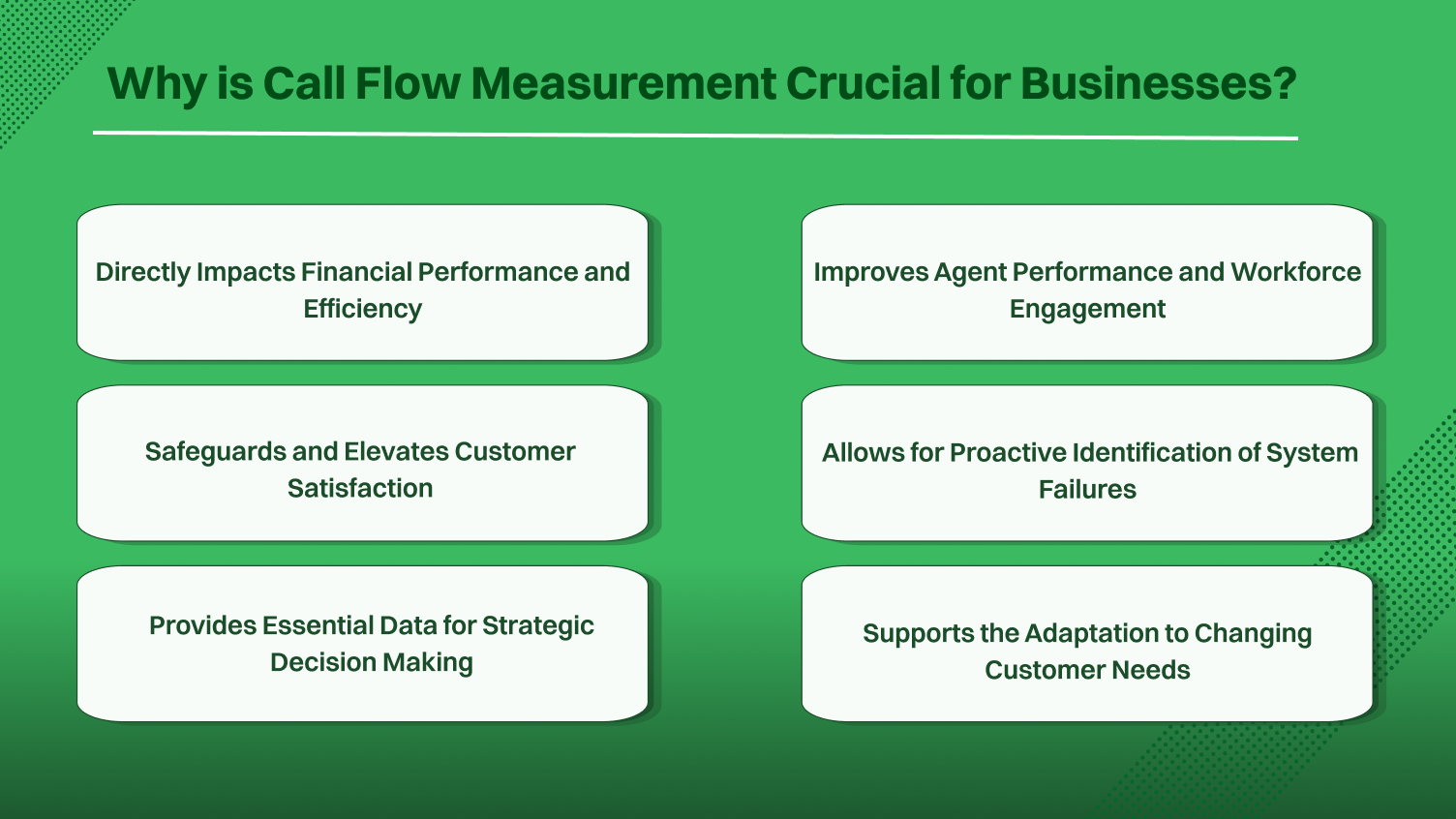
Measurement provides a clear window into operational costs. The efficiency of a call flow process in a business phone system directly affects profitability. High wait times and excessive handle time are expensive. They require more agents to manage the same call volume. By meticulously tracking metrics, the center manager can pinpoint bottlenecks.
They can identify where calls are stalling in the system. Optimizing the flow reduces the time wasted on misroutes or repeated transfers. This focused effort lowers labor costs and dramatically increases agent productivity. A well-measured system ensures resources are used effectively. This offers a clear return on the investment in the business phone infrastructure.
The ultimate measure of call flow success is customer satisfaction. A poor flow creates friction in the customer journey. Customers hate being forced to navigate overly complex menu options. They quickly become frustrated when they experience long hold times. Measuring the flow allows a business to see these pain points through the customer’s eyes.
It provides hard evidence of where the customer interactions are failing. By tracking the path to a successful call, companies can proactively eliminate frustration. This focus on smooth, efficient routing directly enhances the entire customer experience. Better flow instantly builds trust and loyalty.
Data gathered from call flow measurement is invaluable for the leadership team’s customer service call flow. The system provides comprehensive insights. It reveals which call routes are underperforming and which are robust. This information is crucial for long-term planning. It helps justify new technology investments like advanced IVR systems. Data on call volume patterns inform staffing levels and training needs.
This data-driven approach moves decision-making away from mere guesswork. It empowers the board of directors with concrete evidence. This evidence supports major strategic decisions about service delivery and market focus.
An ineffective call flow system demoralizes the center agent. Agents become stressed when they repeatedly receive calls outside their expertise. They struggle to maintain high workforce engagement in a chaotic environment. Measuring the flow identifies where training is lacking.
It reveals where better skillbased call flow logic is needed. When the system directs calls correctly, agents feel more capable and effective. They can use the knowledge base to achieve faster resolution time. This clarity and efficiency lead to higher job satisfaction and lower turnover.
Measuring the call flow acts as an early warning system. Sudden spikes in transfer rates or abandoned calls signal a breakdown. It could be an error in the IVR call flow programming. It might be a fault in the call management system or a poorly designed call flow.
Regular monitoring of these metrics allows the business to detect issues instantly. This practice prevents small technical glitches from turning into massive service disruptions. Proactive identification is the key to maintaining business continuity. It ensures a consistent and reliable customer journey at all times.
Customer expectations are constantly evolving, particularly across all digital channels. The modern call flow must be adaptable. Measurement provides the evidence required for necessary change. Analyzing customer stories and call patterns shows where new types of call flow structures are needed.
It helps businesses seamlessly integrate traditional phone calls with other methods like live chat. This flexibility allows the company to remain agile. It ensures the call flow continues to meet the dynamic needs of every single customer interaction.
A well-designed call flow only works if it is regularly monitored, optimized, and aligned with both business needs and customer experiences. Implementing best practices ensures call center agents handle inbound calls efficiently, reduces frustrated customers, and strengthens the overall customer journey.
Here are the tips that will help you elevate your call flow processes:
Before coding the routing, physically map out the customer’s likely path. Identify the top three reasons for an inbound call. Design the flow to address those major paths immediately. Use the IVR to collect the necessary context for intelligent routing.
Long, complex menu options are the enemy of good service. Limit main menus to four options or fewer. Use clear, concise language. Analyze which options have the highest drop-off rates. This points to where frustrated customers are giving up.
Rely on skillbased call flow whenever possible. A two-minute wait time for the right agent is better than an immediate connection to the wrong agent. Use your knowledge base to categorize the necessary skills.
Acknowledge the customer’s wait time. Offer alternatives like a callback option or the option to switch to live chat. Provide engaging music or important information during hold times. Transparency around the queue position reduces customer anxiety.
Your call flow should not exist in isolation. Integrate it with your digital channels and CRM. If a customer was just chatting on the website, transfer that context. This is the essence of modern unified communications.
Regularly review call recordings to identify flow-breaking moments. Do agents constantly repeat information that the IVR has already collected? That is a flow flaw. Do calls frequently loop back to the beginning of the IVR? That requires immediate fixing. Use these insights to coach agents and refine your call routes.
Call flow technology keeps getting better as companies look for smarter ways to handle customer conversations. These new developments are changing how businesses connect with people who reach out for help.
Artificial intelligence now helps your team during actual phone conversations by pulling up useful information quickly. Agents get suggestions for relevant articles or solutions without pausing to search manually. This makes problem-solving faster and keeps conversations moving naturally.
New systems predict which team member works best with each caller based on more than technical knowledge. The technology looks at personality fit and communication preferences to create stronger connections. Companies using this see happier customers and quicker resolutions.
People can now switch between phone calls and other contact methods without repeating their story. Everything stays connected, so customers pick up right where they left off. This matches how people actually want to communicate today.
Systems remember past conversations and adjust automatically when someone calls back. The technology spots what people might need based on recent account actions. This personal touch makes customers feel genuinely valued.
Customers control their own preferences for handling future calls with your business. Some want callbacks while others prefer staying on the line no matter what. Honoring these choices shows real respect for individual needs.
The effectiveness of a business often relies on its accessibility to customers. A robust, well-optimized call flow is the key to providing superior service quality. It transforms the confusing experience of navigating a complex phone system into a truly helpful interaction.
Remember, the primary goal is to make every successful call as completely efficient as possible. This smart approach benefits both the loyal customer and the business itself. Focusing on this area involves more than just implementing new technology. It is truly about prioritizing exceptional customer experiences every time. It is about ensuring every single customer interaction genuinely builds trust.
Take the necessary time to audit your current system logic rigorously. Simplify your existing IVR structure. Then, embrace skillbased call flow routing wherever possible. These critical steps will help ensure your business remains highly competitive. They will absolutely provide the high level of dedicated service your valuable customers deserve.
Partner with the experts at Dialaxy.
An ideal call flow is a clear, smooth path that guides a caller from the moment they dial in until their issue is resolved.
The basic call flow in BPO usually goes like this: greeting the customer, verifying details, understanding the issue, providing a solution, confirming satisfaction, and ending the call politely.
Support availability depends on the service provider. Many call centers aim for continuous coverage. Always confirm with the provider directly for exact support hours.
Yes, a well-designed call flow ensures consistently smooth customer interactions. It actively reduces the number of frustrated customers effectively. Efficient call handling and shorter wait times make customers feel truly valued. This positive experience directly encourages long-term loyalty and repeat business with your firm.
Businesses carefully track metrics like call volume and resolution time. They also monitor handle time and total hold times. Teams use call recording and analytics from the call management system. This helps them identify system bottlenecks to continuously improve their call flow processes.
