

The Ultimate Guide to E-commerce Call Center for Brands


In the competitive landscape of online retail, an effective ecommerce call center serves as a critical touchpoint, profoundly influencing customer perception and loyalty. This vital component of your brand directly impacts repeat business by shaping the overall customer experience.
A common challenge for many ecommerce enterprises is managing high call volumes, particularly during peak sales seasons. Inefficient handling of these surges often results in extended wait times, leading to customer frustration and ultimately, lost sales opportunities.
This comprehensive guide explains the strategies and insights necessary to develop and optimize a call center operation that not only manages demand effectively but also consistently delights customers, fostering enduring satisfaction and brand advocacy.
Your customers expect quick answers. When they can’t track an order or need to return a product, waiting frustrates them. A dedicated ecommerce customer service team changes this completely.
Think about your last great customer call experience. The agent knew your history. They solved your problem fast. That interaction built trust with that brand. Your ecommerce call center creates these moments daily.
Brand loyalty grows when customers feel heard. Research shows 89% of consumers stay loyal to brands with excellent support. Your contact center for ecommerce becomes a competitive edge, not just a cost.
Customer retention costs five times less than acquiring new customers. An effective ecommerce contact center keeps your existing customers happy. They spend more time. They recommend you to friends.
An ecommerce call center is a specialized customer support operation for online retail. It handles inbound and outbound calls and queries across communication channels.
Unlike traditional call center companies, an ecommerce contact center understands online shopping challenges. Agents help with order tracking, product questions, payment issues, and returns. They work across time zones to support customers whenever they shop.
Modern ecommerce call center software integrates with your store platform. Agents see customer order history, previous interactions, and browsing behavior. This context helps them resolve customer issues faster than generic call center solutions.
The center also manages proactive outreach. Your team contacts customers about delayed shipments before they call you. This prevents problems. It builds trust with your buyers.
The right infrastructure transforms how your team handles customer interactions. When these elements connect properly, your agents can focus on solving problems instead of fighting with systems. Let’s explore the essential building blocks that make your contact center for ecommerce effective.
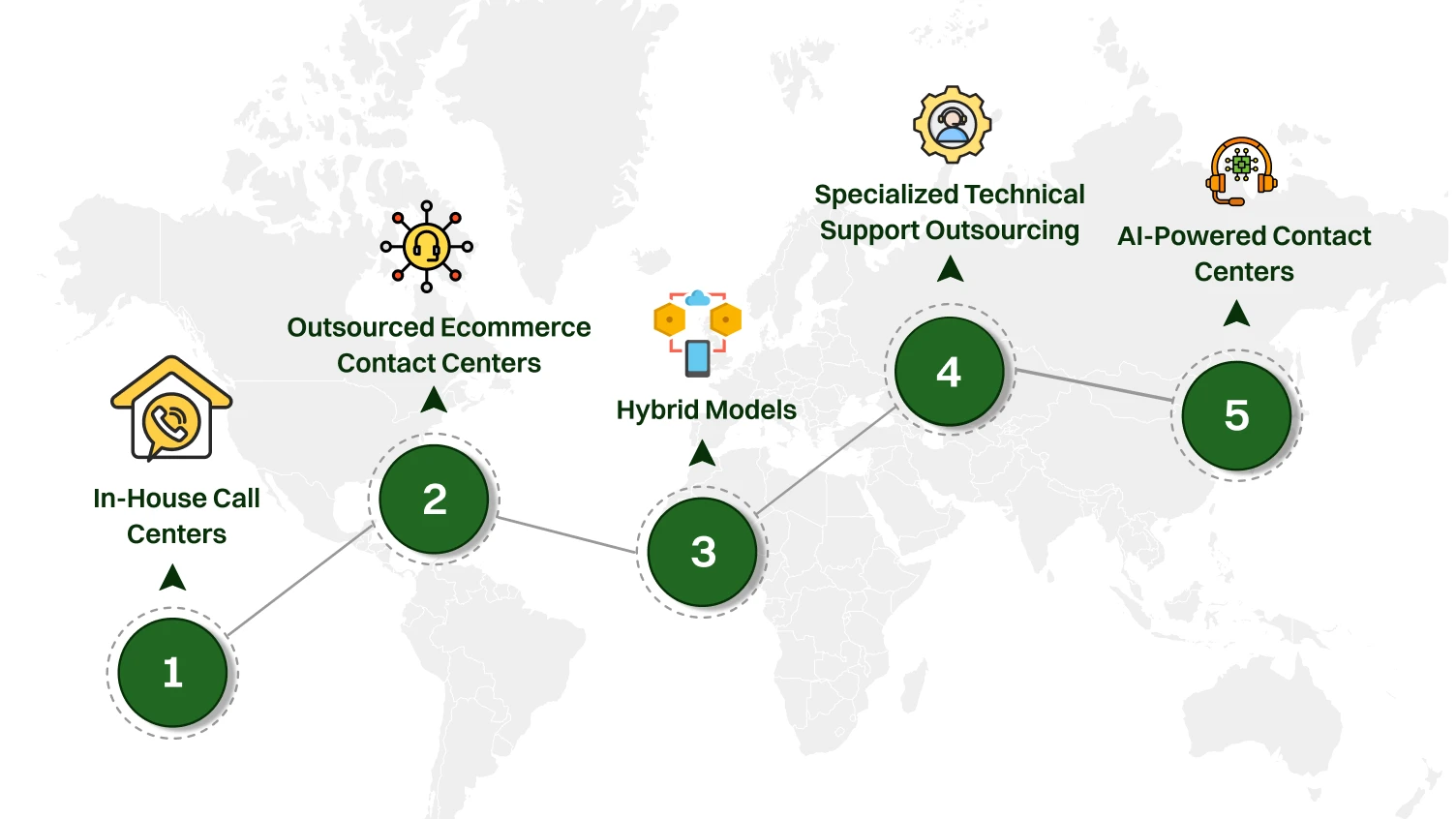
The right model for your ecommerce call center determines the whole customer support strategy of your company. Knowing the models enables you to choose the one that matches your business requirements.
Smart brands put their energy into metrics that matter to customers rather than simply focusing on vanity numbers. If used correctly, KPIs can reveal whether your contact center software and agents are a source of customer delight or dissatisfaction.
The metrics are what differentiate exceptional call centers from the mediocre ones. customer loyalty. Let’s examine the metrics that separate exceptional call centers from average ones.
Average Response Times: The time (most of the time in seconds) that shows how long customers wait before an agent answers. Customer satisfaction increases with faster response.
First Call Resolution Rate: The number of customer issues resolved in one interaction to the total customer issues. Higher percentages mean customer service representatives are more efficient, and customers do not have to call again. This not only increases customer loyalty but also lowers company expenses.
Customer Satisfaction Score (CSAT): After every interaction, customers provide a rating of their experience. This straightforward metric is a sure sign of whether the ecommerce customer service team meets the set standards.
Net Promoter Score (NPS): This score measures loyalty and poses the question of whether customers would recommend the brand. A strong call center solution for ecommerce gradually elevates the score.
Call Abandonment Rate: It refers to the proportion of those callers who decide to terminate calls within a certain time frame without talking to an agent. A higher abandonment call rate generally indicates understaffing or poorly directed calls.
Average Handle Time( AHT): The length of time agents talk with customers should be measured. Balance this with quality. Rushing customers damages relationships even if it looks efficient.
Investing in quality customer support pays off in multiple ways:
For Brands:
For Customers:
Offering choices enhances customer experience.
Modern contact center solutions integrate the skills of the staff with AI-enabled contact center technology. Consequently, the service is speedier, the expenses are lower, and the customers are more satisfied. Knowing the relationships between these parts will allow you to have a system that grows together with your ecommerce company.
| Process / Component | Purpose | Tools & Methods | Benefits |
|---|---|---|---|
| Call Routing & Workflow | Connect customers to the most qualified agent efficiently | Skill-based routing, priority routing, overflow routing | Faster response times, improved customer satisfaction, better handling of call volumes |
| AI Agents & Automation | Handle routine queries and repetitive tasks | Chatbots, AI virtual agents, NLP, automated follow-ups | Frees human agents for complex issues, improves average handle time |
| Natural Language Processing (NLP) | Understands customers’ spoken or typed requests naturally | AI software, voice recognition systems | Smooth interactions, reduced frustration, enhanced customer satisfaction |
| Inbound Call Management | Resolve customer inquiries, process orders | CRM-integrated scripts, customer data dashboards | Personalized service, improved first-call resolution, stronger brand loyalty |
| Outbound Call Management | Proactively update customers, conduct surveys, or follow up | Automated dialing, CRM notifications | Reduces inbound call load, increases customer engagement |
| Hybrid AI-Human Escalation | Transfer complex issues from AI to human agents | Conversation history sharing, seamless handoff | Eliminates repeated explanations, boosts customer delight, increases productivity |
| Automated Follow-Ups | Notify customers about order updates or collect feedback | SMS/email automation, AI follow-ups | Keeps customers informed, improves customer satisfaction |
| Continuous Feedback Analysis | Improve workflows and agent efficiency | Surveys, CSAT/NPS metrics, CRM reporting | Enhances customer retention, identifies recurring issues |
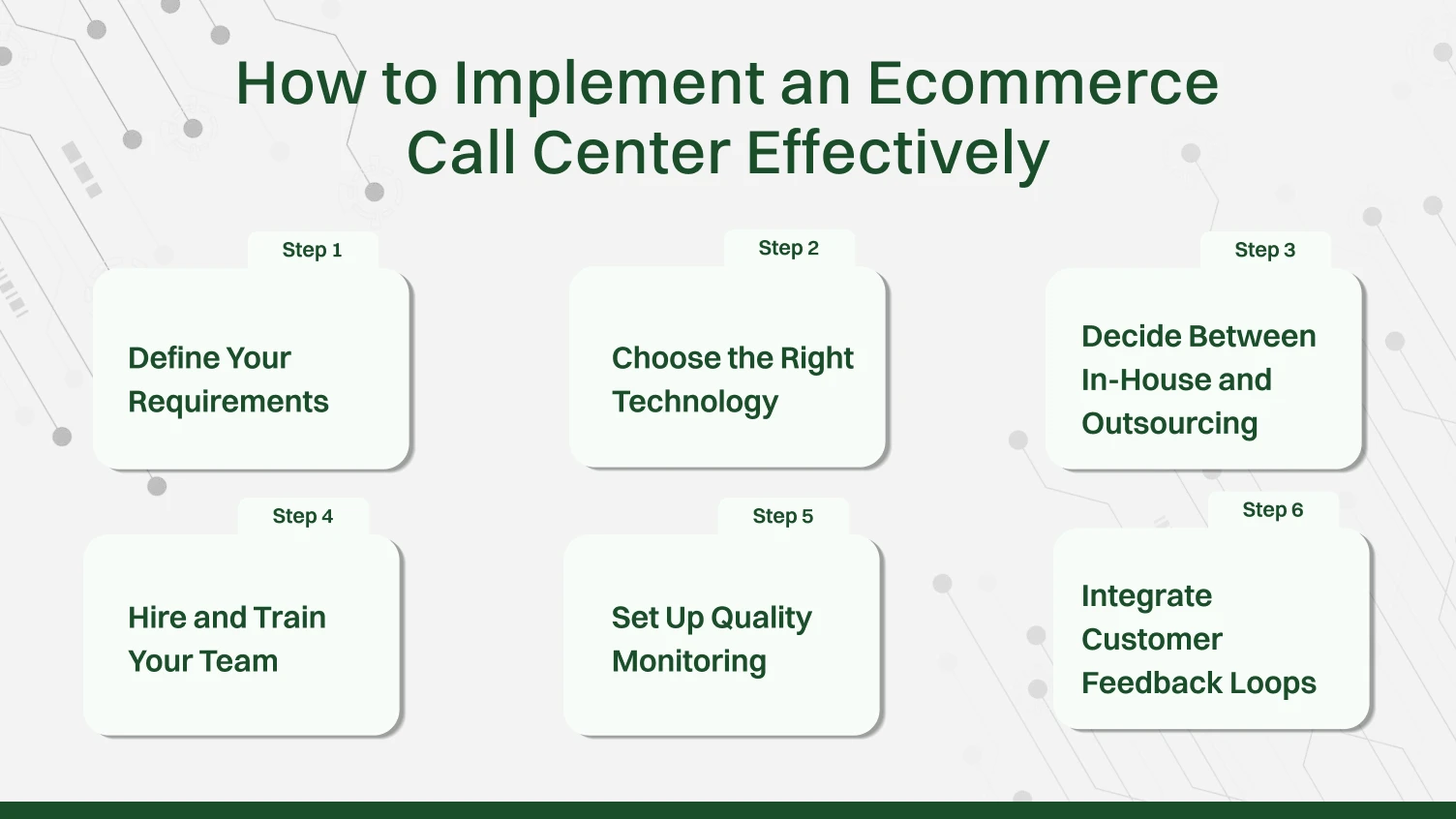
Building your ecommerce call center from scratch feels overwhelming. However, by dividing it into distinct stages, the operation becomes feasible. Apply this handbook to launch a new customer service center initiative that first-day wins.
Start by analyzing your current customer interactions. How many customer calls do you receive daily? Which communication channels do customers prefer? What are the most common customer issues?
Look at your call volumes by time of day and season. This data helps you plan staffing levels. Most of the online retail businesses record higher sales during the night, on weekends, and on holidays.
Research call center software options. They should integrate with your ecommerce platform. Test different contact center solutions with on-demand demos. Focus on systems offering strong call routing and reporting features.
Your business phone system should scale easily as you grow. Cloud communication extends the capacity without the need for hardware purchases. Besides, they allow remote agents, who may be located in different time zones, to work.
Find out whether forming an internal team or hiring an eCommerce call center suits your company better. Consider your money situation, the level of control you want, and your growth plans.
As a result of the initial cost being a major factor, numerous expanding brands decide to outsource their eCommerce customer service. You can bring the operations back locally when traffic levels are high enough to justify the investment.
Product training of the customer service team is a must, whether the team is in-house or outsourced. They should know your brand voice and values. Role-playing common scenarios is a way of gaining the necessary confidence before dealing with real customer calls.
Training should be continuously sustained and not be an event of a single day. Skills are updated via regular sessions that also cover new products, revised policies, and dealing with difficult situations. If building trust with customers is really your goal, then you should put money into your team.
Put in place systems to track the metrics that you have talked about earlier. It is through regular reviews of response times and customer satisfaction scores that you can find your next areas for improvement.
Try listening to calls with your team. Discuss what went well. Discuss what could improve. This coaching approach develops skills faster than criticism alone.
Create processes to capture and act on customer feedback. Your agents hear valuable insights during every customer interaction. These insights should flow to product, marketing, and operations teams.
Monthly reviews of common customer issues often reveal fixable problems. Addressing these improves overall customer satisfaction. It reduces future call volumes.
Even on-brand, well-established companies can suffer a blow when introducing their ecommerce contact center; these mistakes can cost the brand much money, and the bad part of it is that they erode customer relationships. By understanding the typical errors, you will have time and protect your good name.
If new agents are just thrown at live customer calls without them being properly prepared, then you are actually destroying your customer relationships. Customers are able to feel it when agents lack knowledge. Thus, this rapidly leads to a decrease in brand loyalty.
Solution: Develop comprehensive training programs. Cover products, systems, and soft skills. Shadow experienced agents before handling calls independently.
Limiting the support to only phones ignores those customers who choose other ways to communicate. The customer service team of your online store should be equally effective in dealing with e-mails, chats, and SMS messages.
Solution: Adopt omnichannel contact center software. This software consolidates all customer interactions into a single platform. Employees should be trained on the best practices for each communication channel.
Generic call routing frustrates customers. They get transferred multiple times. This wastes time. It damages the customer experience.
Solution: Map customer needs to agent skills carefully. Test your interactive voice response menu with real customers. Use real performance data to work on your routing rules.
Such a kind of environment, with unrealistic targets, will result in the burnout of your customer support teams. Consequently, the quality of service will be compromised due to the turnover.
Solution: Use workforce management tools to prevent overload. Recognize good performance. Develop career paths that keep gifted agents loyal to your company.
Forcing agents to handle every simple question wastes their skills on tasks AI agents can handle. This increases costs unnecessarily.
Solution: Implement AI-powered contact center features for routine tasks. Let human agents focus on complex customer issues. These require empathy and judgment.
Many ecommerce companies get overwhelmed during the holidays. Long wait times during your busiest season damage customer retention. This happens precisely when you should shine.
Solution: Plan capacity for peak call volumes months in advance. Partner with outsourced customer support teams to add temporary capacity. Use predictive analytics to staff appropriately.
Avoiding mistakes keeps you from failing. But best practices help you win. These strategies turn your ecommerce call center from adequate to exceptional, building customer loyalty that drives repeat business. Apply these proven strategies to exceed customer expectations:
Give your customer service team authority to resolve issues immediately. Waiting for supervisor approval slows resolution. It frustrates customers. Set clear guidelines. Then trust agents to make good decisions.
Empowered agents build trust faster. They create exceptional customer experiences. These generate positive word-of-mouth.
Use customer data to make interactions relevant. Reference past purchases. Acknowledge long-term customers. Small personal touches significantly enhance customer experience.
Your ecommerce call center software should surface this information automatically. Agents shouldn’t waste time searching multiple systems.
Train agents to fully resolve customer issues during the initial call. This improves customer satisfaction while reducing overall call volumes. Customers don’t want to explain problems multiple times.
Track resolution rates by agent and issue type. Identify patterns where additional training or process changes could help.
Don’t wait for customers to call about problems. Use SMS messages and emails to update them about the order status. Notify them immediately if issues arise.
This proactive approach shows you care about their experience. It prevents many frustrated inbound calls. It builds customer loyalty.
Review your routing rules quarterly. Customer needs and agent skills evolve. What worked last year might not be optimal now.
Analyze which routes lead to the fastest resolution. Adjust your interactive voice response options based on actual customer feedback and behavior patterns.
Your contact center solutions should connect directly with your store’s backend. Agents need real-time access to inventory, orders, and customer data.
Seamless integration reduces handle time and errors. Agents can process returns, update orders, and answer questions without switching systems.
Regular monitoring maintains consistent service quality. Review random call samples weekly. Provide specific, actionable feedback to improve performance.
Celebrate examples of exceptional customer service. Share recordings that demonstrate best practices. This positive reinforcement encourages similar behavior across your team.
A growing ecommerce company selling outdoor gear faced mounting customer complaints about long wait times. Their small in-house team couldn’t handle call volumes during peak season. Customer satisfaction scores dropped to 3.2 out of 5.
The Challenge:
The brand experienced a 300% call volume increase during holiday periods. Their existing business phone system couldn’t scale quickly. They considered hiring seasonal staff. But they worried about the quality of training and its costs.
The Solution:
They implemented a hybrid approach. It combined AI-powered contact center technology with strategic outsourcing:
The Results:
Within three months, the changes transformed their customer support:
The AI agent resolved 65% of routine queries without human help. This freed agents to focus on situations requiring empathy and complex problem-solving. The enhanced customer experience led to higher brand loyalty. It increased repeat purchases.
During their biggest holiday season, the seamless integration of in-house and outsourced teams handled record call volumes. Service quality didn’t degrade. Customers noted the improved experience in their feedback. Many specifically mentioned quick response times and knowledgeable agents.
The ecommerce industry continues evolving rapidly. Your ecommerce call center must adapt to stay competitive:
III. Predictive Analytics: Workforce management tools will use machine learning to forecast call volumes with high accuracy. This enables precise staffing. It balances costs with service quality. Brands won’t waste money on excess capacity. They won’t frustrate customers with insufficient coverage.
Your ecommerce call center software will identify opportunities to help customers before they struggle. If someone browses product pages without buying, an agent might proactively offer assistance through chat. This approach grows customers by removing purchase barriers.
An ecommerce call center is a specialized customer support operation. It handles inquiries, complaints, and assistance for online retail businesses. It works across multiple communication channels. These include phone, email, chat, and SMS messages.
Inbound calls are incoming calls from customers seeking help. They need help with orders, products, or issues. Outbound and inbound call programs also include proactive outreach. This includes shipment updates, follow-ups, and satisfaction surveys initiated by your customer support team.
It helps if you want to test customer service operations before building in-house. Or if you lack the budget for full-time staff and technology. Many successful ecommerce companies use hybrid models. These combine both approaches.
Essential advanced support features include:
An AI agent handles routine customer interactions automatically. These include order status checks, tracking updates, and common product questions. This reduces response times.
Monitor response times, first-call resolution rates, and customer satisfaction scores. Also track net promoter scores, average handle time, call abandonment rates, and cost per contact. These metrics identify improvement opportunities.
Plan capacity months ahead using historical data. Partner with technical support outsourcing providers for flexible scaling. Implement AI-powered contact center features to automate routine queries. Use workforce management tools to optimize scheduling. Balance your in-house and outsourced teams.
Customers expect to reach you through their preferred communication channels. Offering phone, email, chat, and SMS messages increases satisfaction and accessibility. An omnichannel contact center for ecommerce operations that unifies these channels provides the best customer experience.
