

How to Handle Difficult Customers Over the Phone


You do not read this because you enjoy being the victim of a diatribe of a complete stranger. You’re here because a customer yelled at you. Your team is stressed. Or you’ve finally realized that every one of these bad calls actively costs your business money.
Good. Acknowledging the problem is the first step.
This is not another fluffy corporate blog post. This is a direct, tactical playbook. You dissect the anatomy of a difficult call. We will arm you with a psychological toolkit. We will give you a step-by-step framework that works in the real world. We will cover the science, the business costs, the exact words to use, and the advanced moves that other guides are too generic to touch.
By the time you finish this, you will have a clear plan. You will stop dreading the ringing phone. You will start seeing every difficult call as an opportunity to prove just how good you are.
Why should your entire company obsess over this? Because every poorly handled call is a hole in your company’s hull. Enough of them will sink you. It is not just emotional damage. It’s real, it can be measured, and it’s bloody expensive.
Let’s quantify the damage. Research consistently shows it costs five to 25 times more to acquire a new customer than to keep an existing one. What is the top reason customers leave? It’s not the price. It’s poor customer service. One study found that a staggering 82% of consumers have stopped doing business with a company after a single bad interaction. You don’t get a second chance.
And that’s just scratching the surface. An upset customer talks. They talk to their friends. They leave scathing reviews online. That negative press can dissuade thousands of potential customers. It’s estimated that U.S. businesses lose $136 billion a year because of avoidable customer attrition.
Think about these costly and all-too-common scenarios:
These are costly operation flops. They culminate in lost business, agents with turnover rates that are through the roof, and a damaged brand image. Since you are aware of the financial harm to be done, it is time to find out how to prevent it.

An elementary fact: You can never win an argument with an angry person. It is impossible to reason with an emotional mess, and attempting to reason with a hurricane would be the same thing. Neurologically, you can attribute this to the reason. “Understanding” is your secret weapon.
When enraged, a customer goes into a condition termed as the Amygdala Hijack in the brain.
Imagine your brain has two parts for this call:
When a customer feels ignored, their amygdala hits the panic button. It hijacks the brain’s resources and shuts down the logical neocortex. Your customer is no longer thinking. They are reacting.
Your first job is not to solve their billing issue. Your first job is to calm their amygdala. Until you do that, nothing else you say will register. Here are the principles you use to achieve this.
These words are not the same.
Sympathy creates a bridge. It creates a message to the brain of the customer that you are not the enemy of the customer. It is the best de-escalation tool you could have.
This is not just being quiet. It is a focused technique to prove you are paying attention.
This process makes the customer feel deeply heard. It further calms their emotional brain.
It is hard-wired in humans to imitate behavior. Assuming you are always unswervingly serene and reflective, it puts tremendous mental strain on the other person to level with you. When one is so reasonable, it is very hard to continue shouting at him.
It is this fundamental psychology of knowing that underlies all the tricks that will be explained afterwards.
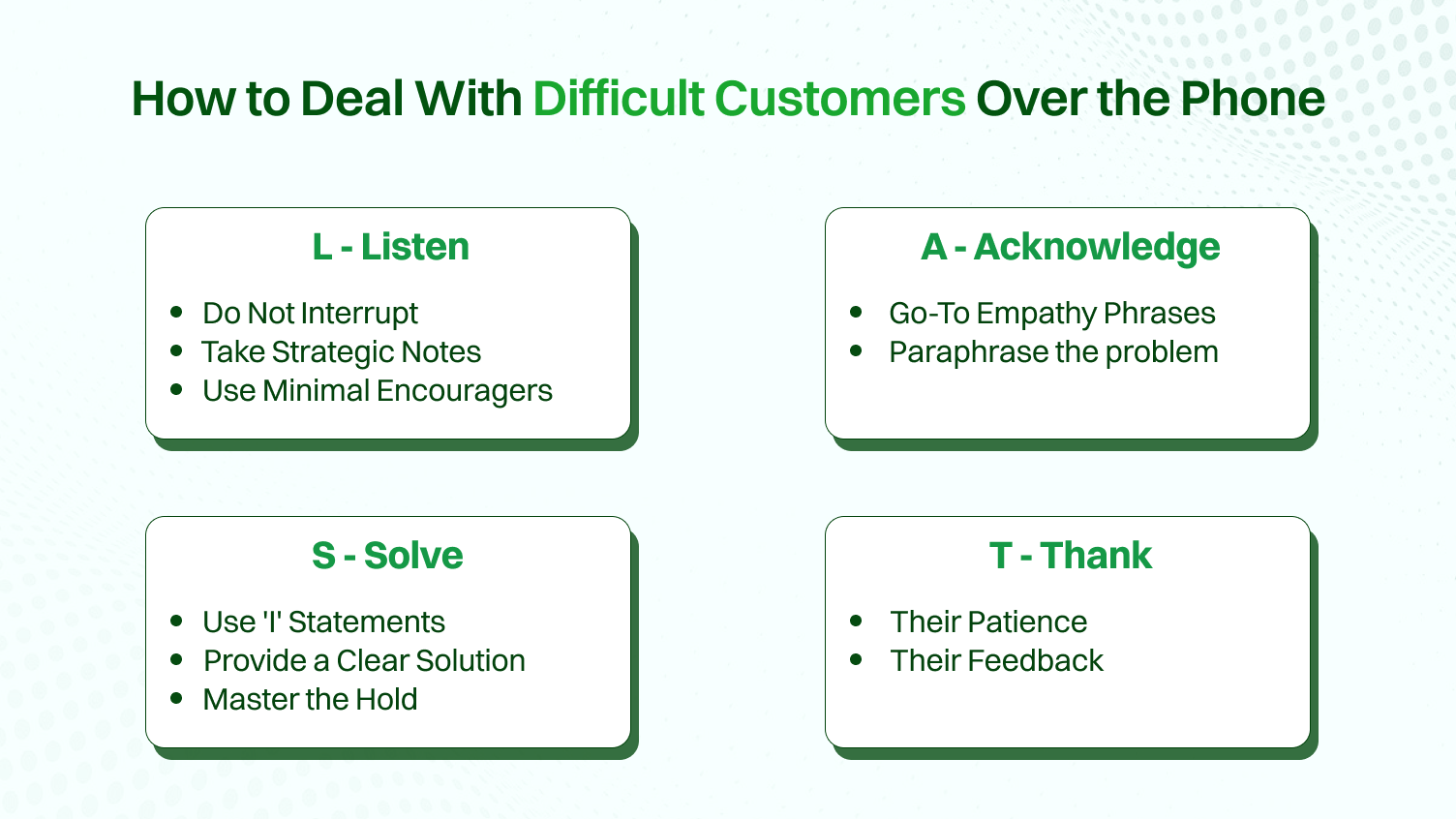
Theory is great. But you need a repeatable framework for when your heart is pounding. This is the L.A.S.T. method. Memorize it. Practice it. Use it every single time.
Step 1: L – Listen
This sounds obvious, but it’s the step almost everyone gets wrong. When a customer begins their rant, your only job is to shut up and listen.
The silence you provide is more powerful than any words at this stage.
Step 2: A – Acknowledge
Once they pause, the spotlight is on you. You must now defuse the bomb. You do this by validating their feelings and confirming you understood.
First, validate the emotion. Before you touch the technical problem, address the human. Use a sincere, powerful empathy statement.
Go-To Empathy Phrases:
Second, paraphrase the problem. This proves you were listening.
When the customer says “Yes, that’s right!” you will feel the entire tone of the call shift. You have now earned the right to move on.
Step 3: S – Solve
It is only now that you can switch to solving the problem. It’s time to project confidence and ownership.
Take Personal Ownership with “I” Statements: This is a crucial language shift.
Provide a Clear, Step-by-Step Solution: Banish all vagueness.
Master the Hold: If you need to put someone on hold, be mindful of their time… The same principle applies if a callback is needed; a clear, professional voicemail greeting on your end ensures that even when you can’t connect, you are still managing the customer experience professionally.
Step 4: T – Thank
You’ve solved the problem. Don’t rush the ending. Close the loop properly. Thank the customer for two things:
This final step ends the interaction on a note of mutual respect.
You’ve mastered the basics. But what about the customer who just won’t calm down? This is where you graduate to a true communication expert.
This is a powerful psychological reframe. You are not fighting the customer. You and the customer are a team, allied against the problem.
This simple shift from “me vs. you” to “us vs. the problem” can instantly change the call’s dynamic.
The Disarming Tactic of Radical Honesty: In extreme situations, do the most unexpected thing. Absolutely, go along with them.
For the most extreme cases, do the last thing they expect. Agree with them completely.
You are a professional, not a punching bag. If a customer starts swearing or using abusive language, you need a firm protocol.
Escalating a call is not a failure. It is a strategic tool. Frame it as a benefit to the customer.
These advanced skills will make you the go-to person on your team for call handling that makes everyone else want to hide under their desk.
Guides always focus on the customer. They forget about you. Constant conflict leads to burnout. High-performing agents protect their own well-being.
You cannot pour from an empty cup. Keep yours full.
You can’t just “feel” like you’re getting better. To prove your value, you need to track your progress with data. This is what separates professional teams from amateur ones.
Focus on these Key Performance Indicators (KPIs):
When you can show that these new techniques led to a 10% drop in escalations, you are no longer just talking about “good service.” You are speaking the language of business.
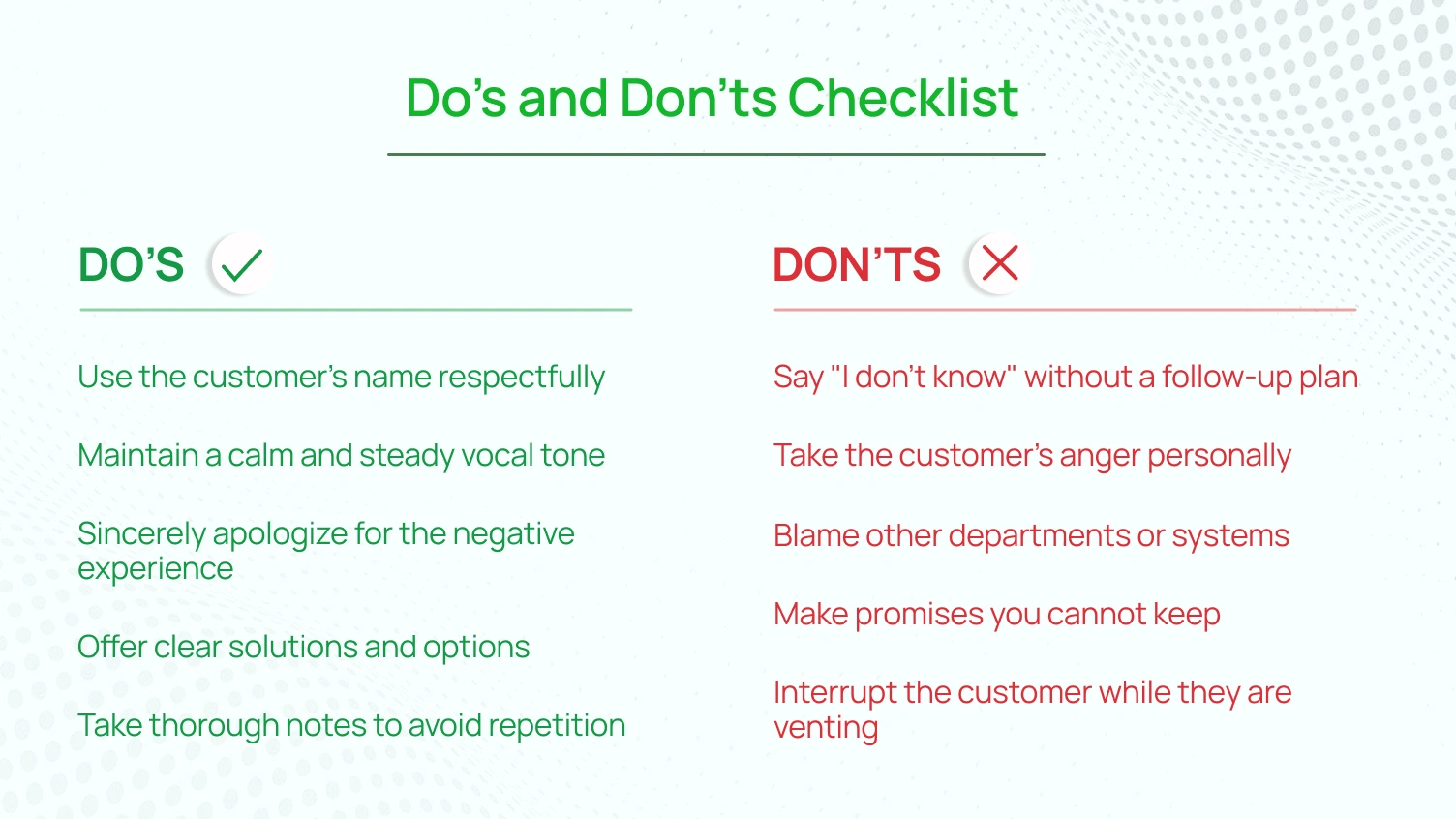
Every call center agent will face a customer on the phone who becomes upset or frustrated. Knowing how to handle an irate customer with calm communication and empathy can completely change the outcome. When agents follow the right steps for call center success, such as using the customer’s name, staying composed, and offering real solutions, they help create better customer experiences even during tense interactions.
Support from the center manager, proper use of tools like live chat, and training to handle angry customers are essential for long-term success. Even the most challenging irate customer can become loyal when they feel heard and helped by a professional agent who knows how to manage the moment.
Your Actionable Next Steps:
Are you ready to help your team convert challenging calls into successful calls by arming them with the tools? Check out our contact center software that has built-in call recording and AI analytics that allow every interaction to be measured so that it can be improved.
Stay calm, allow them to speak without interruption, and handle an irate customer by recognizing the problem, offering a heartfelt apology, and giving a clear path to resolve the issue. Escalate to a center manager when necessary; this is a key part of the steps for call center excellence.
Use empathetic phrases like “I know how you feel,” “I am here to assist,” “Let’s solve this together,” and “Thank you very much for your patience.” These can help improve customer experiences and encourage loyal customers to stay with your service.
Remain composed and professional. Don’t take the anger personally. Focus on listening, understanding the complaint, and offering a fast, clear solution. Handle angry customers with empathy and always look for ways to resolve the issue quickly.
Acknowledge their concern, apologize sincerely, and explain how you plan to fix it. For example: “I’m sorry that you had to experience this. Let’s fix it together.” These thoughtful responses can improve overall customer experiences and build trust.
Stay calm, let the customer speak, and validate their feelings. Speak slowly and clearly, and direct the call toward a resolution.
Stay respectful and professional at all times. Set clear boundaries, and if the behavior continues, inform the customer that you will escalate the issue to a center manager. Protecting agent well-being is part of effective workforce engagement.
Tell the truth and be open. Make an escalation suggestion or proposal. Inform the customer of what to expect next.
Follow these steps for call center success:
Addressing questions or concerns completely is key to turning unhappy callers into loyal customers.
