

How to Improve First Call Resolution Rates with Intelligent Routing?


Are you experiencing too many customer calls in your contact center that end without answers? If so, your first call resolution rate may be falling short. Any unresolved call increases operating costs and frustrates customers in the call center.
The solution is intelligent routing, a smarter method that ensures the right customer is connected with the right agent on the first attempt. Through the use of AI-powered data, experience analytics, and agent training processes, businesses can achieve improved first-call resolution rates, with fewer repeat calls and shorter wait times.
In this blog, we will discuss how to improve first call resolution rates, the most effective FCR improvement strategies, and which tools make the difference.
First-call resolution refers to resolving a customer’s issue on the first call without requiring follow-up calls. It is one of the most important metrics for evaluating a contact center’s capacity to solve problems within a short timeframe. A high FCR rate means fewer repeat calls and better client satisfaction.
By improving first-call resolution, there is a high reduction in customer effort. Customer would not like to repeat their issue several times.
Intelligent routing is a technology-driven approach that directs customer inquiries to the most appropriate call center agent. It relies on experience analytics and real-time data to enhance the quality of call handling. Instead of making calls randomly or checking the availability, it assigns the customer issue to the most qualified agent.
The routing method is much better than traditional contact center software setups.
Intelligent routing has a direct impact on increasing first-call resolution as it matches the right customer with the right call center agent. It avoids delays and ensures faster solutions.
Here’s how intelligent routing can help your team resolve more issues on the first call.
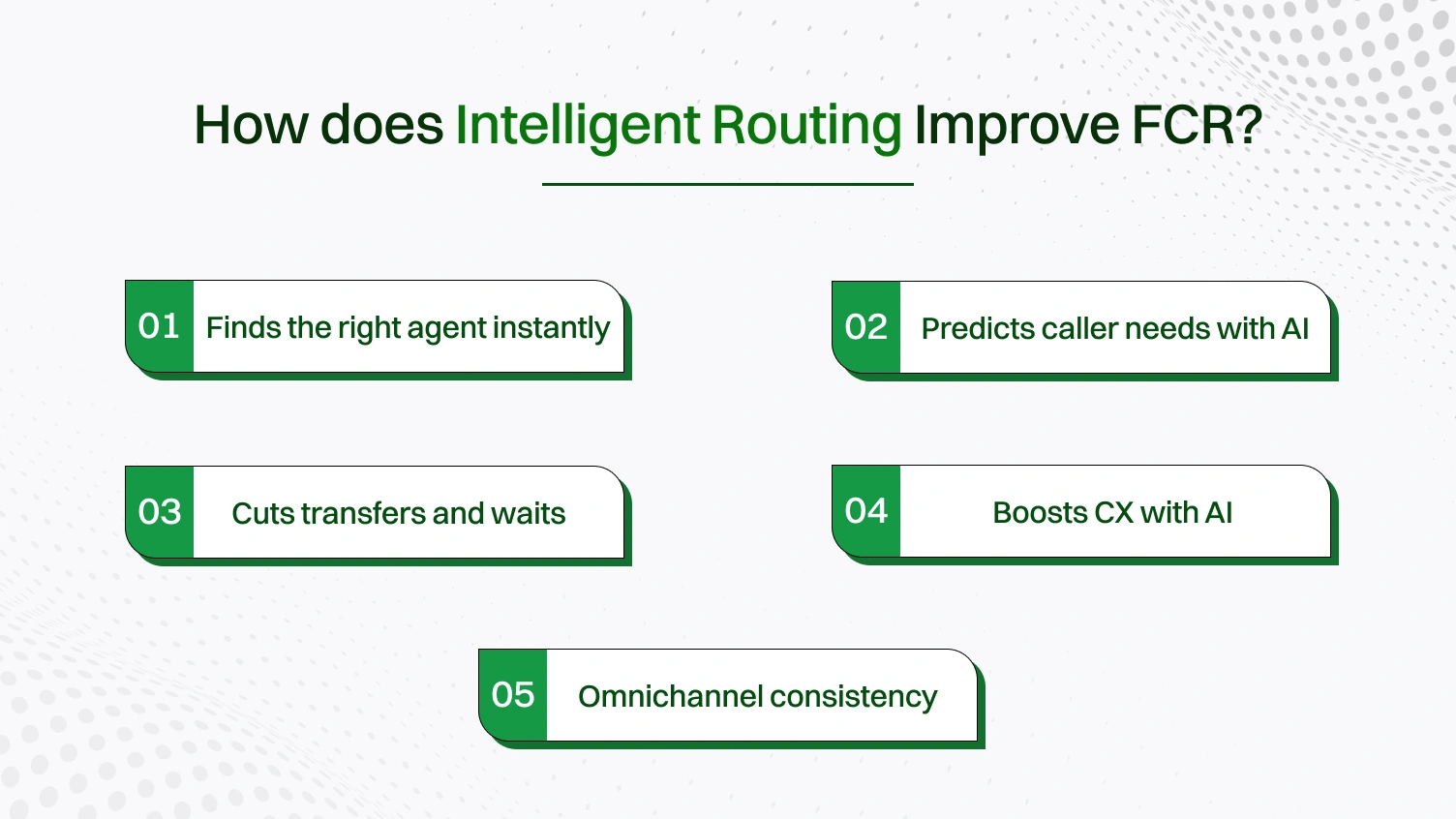
Intelligent routing links every customer call with the best call center agent based on skills, experience, and language. This improves the call resolution rate and reduces repeat calls caused by improper routing.
Through past customer feedback, interaction history, and behavior, AI predicts customer intent. This enables the routing systems to direct the best agent in order to resolve a contact quickly.
When calls are directly routed the first time, agents don’t need to transfer them. Wait times are reduced, agent performance improves, and first-call resolution rates increase on the first contact.
Intelligent routing enables agents to have access to CRM and experience analytics, allowing them to personalize the call. Personalization leads to a smoother customer experience and increases the chance of FCR resolution.
Whether it’s voicemail, SMS, or email, routing maintains trends and history of the contact center. This ensures that customer needs in contact centers are satisfied, irrespective of the contact channel used.
Contact centers cannot rely on basic routing tools to achieve a genuine improvement in first-call resolution. It requires specific strategies to improve the agent performance and the overall contact center.
Here are the intelligent routing strategies that can boost first-call resolution and enhance overall contact center efficiency.
Skill-based routing connects each customer inquiry to agents who align with specific skills, like product knowledge or language fluency.
To make skill-based routing effective, call centers should develop extensive skill matrices. These connect each agent to their certified capabilities, products, or services. Based on this data, routing engines can enhance agent training by identifying where agents need to improve their skills.
Predictive behavioral routing relies upon historical behavior and preferences to route calls.
The methodology is based on customer feedback, browsing, and past call resolution results. The insights are paired with agent profiles using the routing logic to facilitate more effective pairings. It is not just about speed, but about the right connection of individuals towards the best outcome.
Natural Language Processing (NLP) allows customers to describe their problem in their own words, which they understand before being routed.
Call resolution is improved using NLP. It not only examines the content, but also analyzes how it’s said. The system captures it and identifies the most effective agent match, which helps to solve the issues quickly and avoids escalation.
Real-time performance analytics show the current data on agent availability, call load, and response time.
If one queue is overloaded or an agent is performing poorly, the system will automatically adjust itself. This is a dynamic response that enhances FCR and stabilizes the center performance.
Intelligent routing is one of the ways to enhance FCR in contact centers, though many of them fail to do it. The reason is that a common barrier exists that even the most responsible call center agent cannot overcome in achieving a quick resolution FCR.
Here are some common challenges that often make it harder to resolve customer issues on the first call.
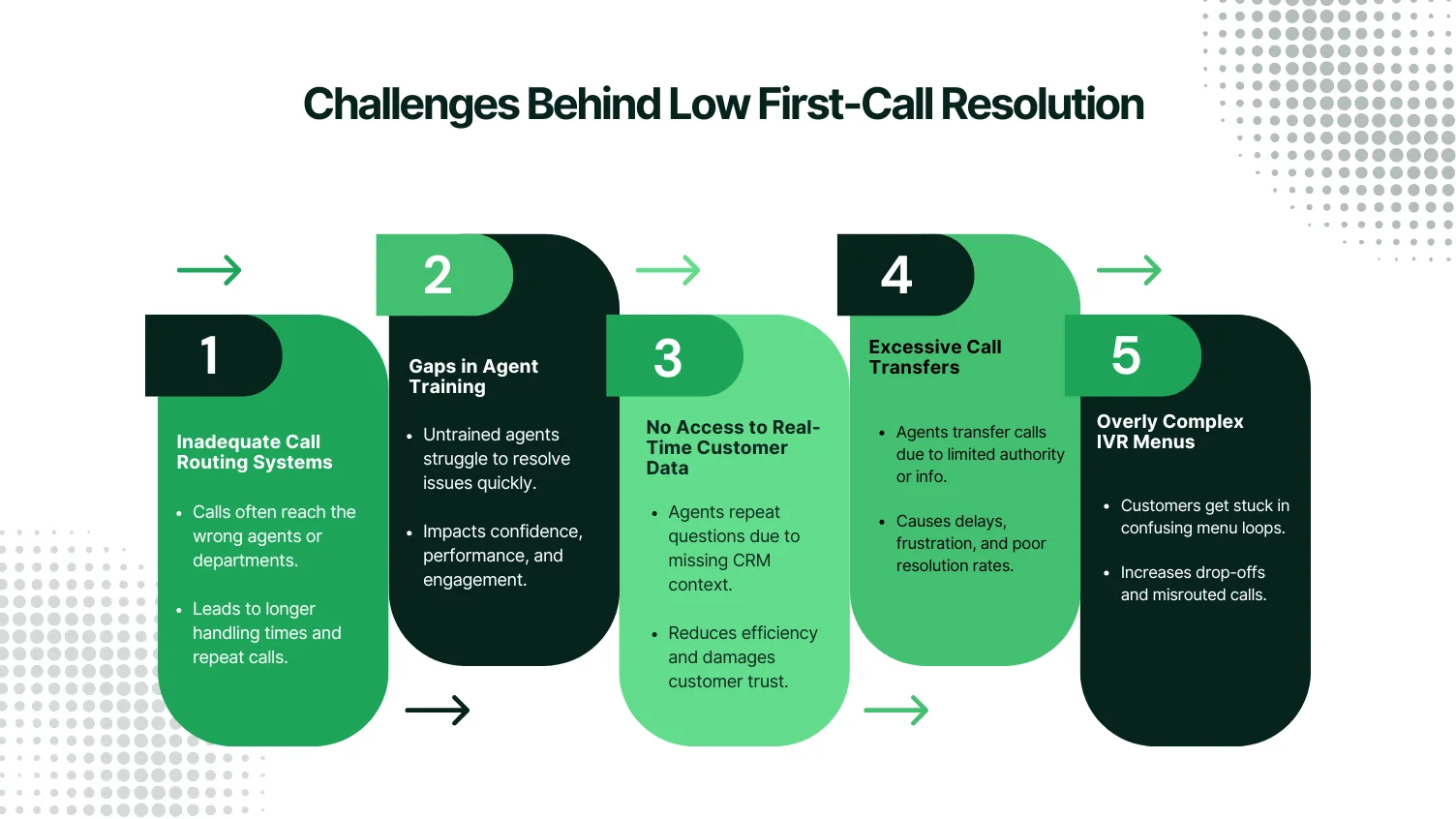
Without intelligent tools, customer calls will be misrouted or forwarded to the wrong place, and the staff will lack the necessary skills. It results in excessive call handling, unwanted transfers, and frustrated call center customers. Over time, it reduces the rate of FCR, leading to an increase in repeat calls.
When an agent is not keen enough on the product or service, it is challenging to address customer issues quickly. Poor agent training can lower confidence and delay call resolution. That is a direct impact on the agent performance and employee engagement.
Inadequate access to real-time customer information is also a problem in many call centers. Agents must ask repetitive questions without a CRM history with each consumer due to the lack of context. This makes it more of a customer effort, making it harder to follow best practices for resolution. Contact resolution and customer trust are enhanced with access to experience analytics and live information.
Frontline agents pass the calls to other departments when they lack the authority or knowledge to handle them. The result is long wait times, misunderstandings, and a lower contact resolution rate. Customers will feel unheard, which can harm your brand experience.
Complex IVR menus are a silent killer of first-call resolutions. When a customer’s call gets trapped in layers of menus or options, they would most likely give up. And even worse, they end up in the wrong hands entirely. Clear, direct IVR systems can help you improve your FCR since callers are directed to the correct destination.
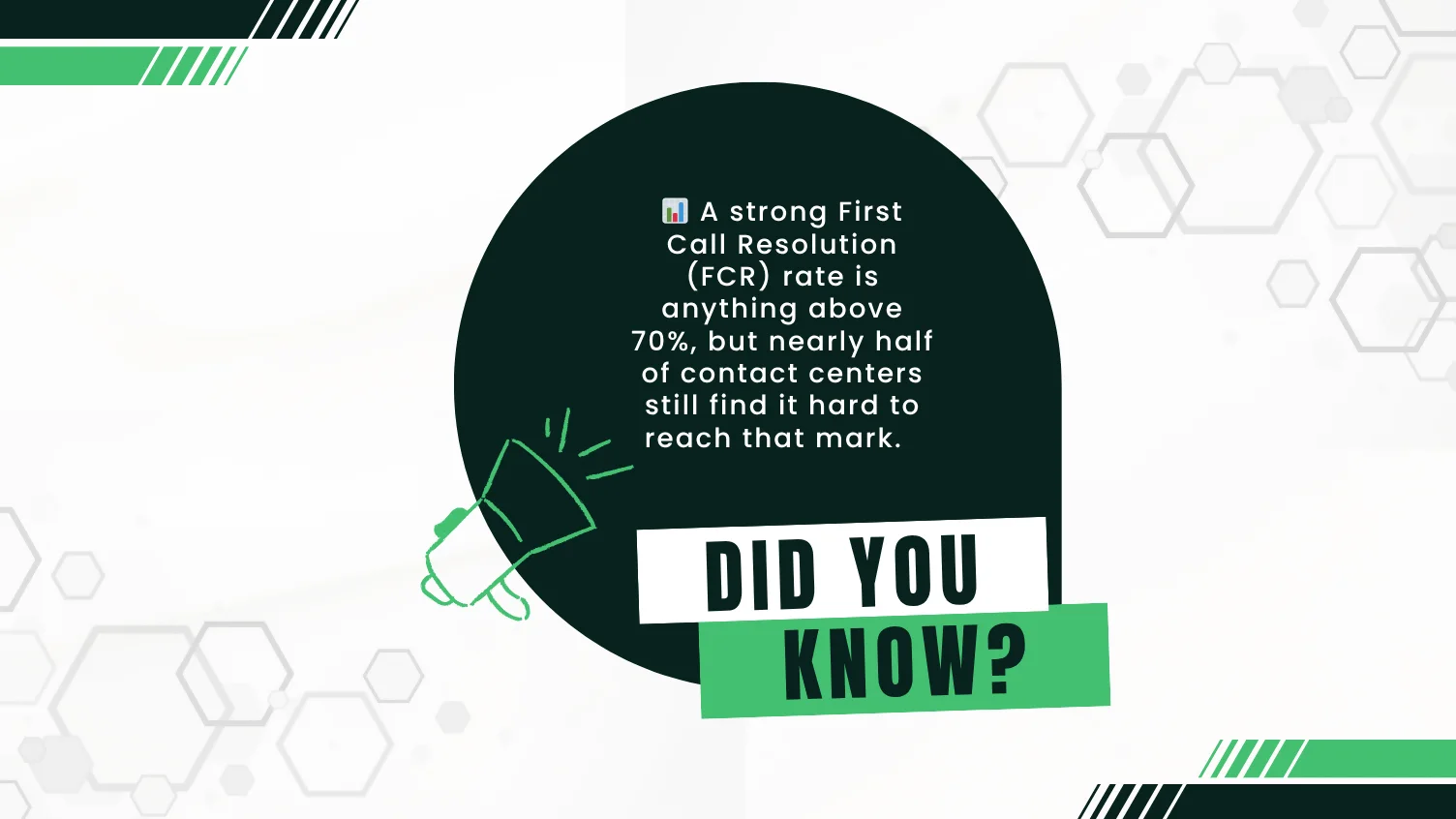
👉For more than 25 years of benchmarking, no telecom company has been able to achieve world-class First Call Resolution Rate (FCR) performance, highlighting the industry’s challenges, according to SQM Group. 📉📞💡
After intelligent routing, it is important to track the right metrics to continue improving the FCR. These KPIs help evaluate agent performance, operational efficiency, and the overall customer experience. Keeping track of numbers ensures your attempts to improve first-call resolution can indeed pay off in the long run across your contact center.
The following are the most important KPIs that help you in maintaining success in your call resolution FCR strategy.
The First-Call Resolution (FCR) rate indicates how customer issues are resolved within the first contact. A high score clears the way to fewer repeated calls and stronger customer relationships. It reflects that your agents are consistently applying proven resolution strategies across all contact channels.
The Average Handle Time (AHT) is a measure of the time it takes an agent to work in a call center to fix a call. It is best to make shorter calls, but one should not compromise quality with speed. A higher FCR value and stable AHT indicate that agents are using call resolution without rushing or missing important information during call handling.
Tracking the call transfer demonstrated whether your routing logic works effectively and whether agents are efficient. High turnover frequently indicates poor call routing or training gaps. Lower call transfer rates indicate the agents can deal with the issues directly, resulting in improved FCR and employee experience.
The Customer Satisfaction Score (CSAT) serves as a direct measure of customer satisfaction following call center engagement. An increase in CSAT often reflects better first-call resolutions and better call center experience. The score can be sustained in the long run through the collection of feedback using surveys or follow-up texts.
Net Promoter Score (NPS) indicates long-term customer retention and loyalty. This score increases when the customer’s issues are resolved during the first call and they are satisfied that they are understood. A high NPS indicates that you have a strong brand experience, which is usually the result of effective routing and strong agent training.
The assessment of critical agent performance metrics, such as first-call close rate, talk time, and satisfaction rating, proves the efficiency of the use of resolution best practices by frontline agents. The information is used in identifying overall issues and training needs, which can guide the improvement of quality management.
The first step to achieving an optimal outcome of your own FCR is to get the right tools and training, as well as workflow processes aligned in your contact center. Technology, including the AI-driven insights and experience analytics, can be critical to success. However, it requires the best practices to come into effect that will help the agent and the customer to achieve the desired results.
Here are the best practices necessary to improve first-call resolution and call resolution rate.
It is better to provide call center agents with the complete customer history so that issues can be understood faster. By retrieving previous interactions and preferences, the agents will avoid presenting repetitive questions. This reduces the workload for the customer and speeds up call resolution. A better contact center experience is enabled by using more integrated call center software that connects the CRM data.
A shared knowledge base provides agents with convenient access to product information, troubleshooting guides, and FAQs. This helps agents deliver accurate answers when receiving calls. Centralized resources increase the effectiveness of agents by reducing hesitation when making decisions and eliminating guesswork.
Agents on the front line must have the authority to resolve problems without requiring any call transfers. Proper tools and training can help agents resolve customer issues quickly when they arise. It reduces repeat calls and improves staff interaction. Brand experience is enhanced by empowerment, where the customers realize that their problems matter.
Evaluating first-call resolution and rewarding top performers motivates people to resolve issues quickly. The inclusion of FCR in quality management will encourage the teams to practice best practices in resolutions. Recognition programs linked to FCR increase morale and overall center performance.
Customers tend to switch between SMS, email, social media, and multiple phone numbers when trying to reach support. Ensuring smooth service across all contact channels, agents will always have access to complete customer data. It cuts down customer effort and increases contact resolution rates. Consistency in experience management creates belief and a higher NPS.
Selecting the right contact center software is crucial for achieving higher first-call resolution. The best platforms offer CRM integration, AI-driven routing, and real-time experience analytics.
Here are some of the best tools in the market that help call centers optimize call handling and reach contact resolution.

Dialaxy is one of a kind, featuring a user-friendly interface and robust AI-driven routing capabilities.
It operates on the real-time analytics services to connect customers with the appropriate agents. Dialaxy has omnichannel contact channels and powerful reports to measure FCR and enhance agent training.
Genesys offers an all-in-one solution that enables AI-driven routing and omnichannel support. It provides advanced speech analytics and can be easily integrated with popular CRMs. It can be
NICE’s platform focuses on quality management and employee engagement. It is a combination of predictive analysis and NLP to make efficient call routing. NICE helps prevent repeat calls through workflow automation and AI-driven insights.
Five9 is recognized for its cloud-based contact center solution. It includes skill-based routing and real-time monitoring. AWS service integration offers an in-depth experience analytics to facilitate agent workflow optimization.
Talkdesk is a contact center that features a modern system with robust AI capabilities. It helps to provide real-time routing, built-in analytics, and quality assurance with AI. Talkdesk is easy to integrate with suitable CRM tools and offers omnichannel support.
Below is a list of some of the most significant advantages and weaknesses of these tools.
| Platform | Pros | Cons |
|---|---|---|
| Dialaxy |
|
|
| Genesys |
|
|
| NICE |
|
|
| Five9 |
|
|
| Talkdesk |
|
|
First-call resolution goes beyond first-call speed, requiring accuracy, planning, and supportive equipment.
Repeat calls can be reduced in call centers with intelligent routing, better agent training, and on platforms like Dialaxy, where wait times are lower and the contact center experience is improved. It results in increased customer satisfaction, better agent performance, and effective call handling.
To maintain the outcome, teams must regularly monitor other key metrics, such as FCR rate, call transfer rates, and Net Promoter Score (NPS). These ideas can help make more intelligent choices and stronger employee engagement. A data-driven approach to the best practices in resolution enables frontline agents to deliver superior results and improve the entire brand experience.
Traditional call routing connects customers to the next available call center agent, regardless of their issue or the agent’s expertise. Intelligent routing uses AI-driven insights, agent performance data, and customer profiles to direct customer inquiries to the best-qualified agent.
Reducing resolution time starts with strong agent training and access to a centralized knowledge base. Use experience analytics to pinpoint where delays happen, then streamline workflows to speed things up without sacrificing service quality.
Conversions often occur during the first interaction, so timing and relevance are crucial. Powerful contact center software and well-trained agents play a role. Train agents to identify upsell opportunities and use customer feedback to refine offers and enhance overall experience.
Use skill-based routing so that the caller is sent to the appropriate agent on the first try. Cross-train your workforce so they can deal with more problems. Monitor the transfer rates as well, which can be typical indicators of routing gaps or elements where the agents would require added assistance.
Dialaxy, Genesys, NICE, Talkdesk, and Five9 are popular platforms all featuring intelligent routing. Seek out features such as routing enabled by AI, integration with CRMs, real-time dashboards, and multi-channel support in order to boost their first-call resolution.
Not at all. The principle of smart routing operates on various media, such as SMS, email, and social media. It guarantees service consistency, maintains a history of the conversation, and enables better resolution of the issues, irrespective of the mode that customers use to contact any of them.
First Call Resolution (FCR) is not enough, at least not the entire story. Monitor Average Handle Time (AHT), Customer Satisfaction (CSAT), Net Promoter Score (NPS), and the efficiency of the agents. These metrics, in combination, will give you a better picture of how your team performs and what needs to be fixed.
