

What are Nuisance Calls?

Quick Overview:
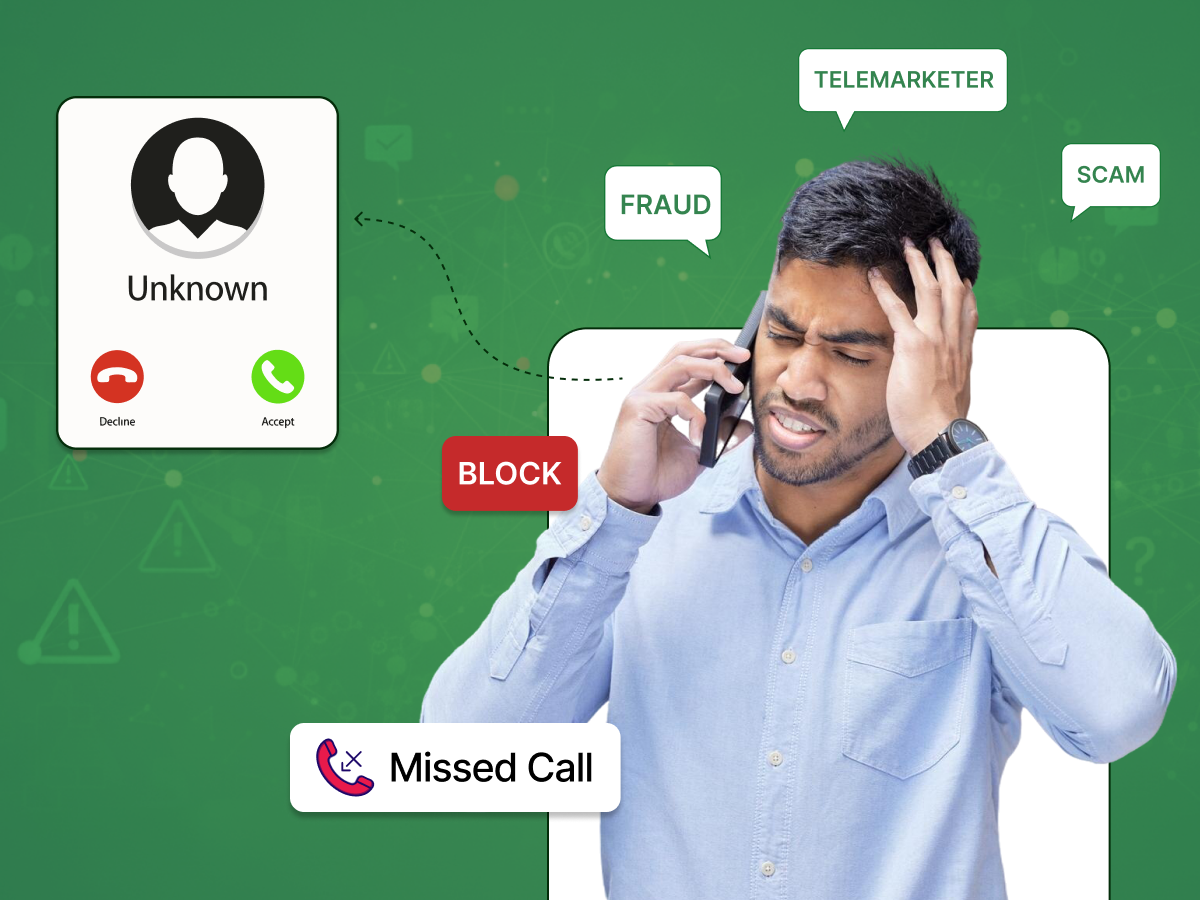
Nuisance calls are unwanted phone calls that disrupt your day. They include robocalls, telemarketing pitches, scam attempts, and harassment. These calls waste your time, put your personal information at risk, and can lead to financial losses if you’re not careful about how you respond.
Your phone buzzes for the fifth time today. Another unknown call.
You hesitate, could it be important? Probably not.
Like millions of people, you’re caught in the exhausting cycle of screening calls. This leaves you wondering which inbound calls are legitimate and which are trying to scam you out of money or steal your information.
Nuisance calls have become more than an annoyance; they’re a threat to your time, security, and peace of mind. Here’s what you need to know to fight back.
Most of us know that sinking feeling when the phone vibrates at the worst possible time, but nuisance calls are much more than just a case of bad timing.
It isn’t just a simple wrong number. We are talking about unsolicited calls that can range from a pushy sales pitch for a product to a calculated attempt at fraud.
Whether it is a human voice on the other end or a sudden, automated text message about a refund you never asked for, these reach you without a shred of permission.
This isn’t just a few random people making mistakes, either. Behind the scenes, these are often orchestrated by nuisance marketers or rogue company directors who are perfectly willing to ignore the law if it helps them hit their targets.
Organisations like Citizens Advice and the Financial Conduct Authority (FCA) are constantly pushing for stricter rules and better compliance to keep your personal information safe. But the sheer flood of calls and texts makes it feel like a constant, daily battle for your peace of mind.
Once you realize these interruptions are often a breach of the law, you can stop treating them as bad luck and start seeing them as a problem you have the power to fix.
Now that you understand what nuisance calls are, let’s break down the different types you might encounter and how to recognize them.
Not all nuisance marketing is built the same. Some callers are trying to sell you a legitimate company service, while others are phone scammers looking for a way into your accounts.
Even if they represent a real business, if you’ve registered with the TPS (Telephone Preference Service) or a call registry, they are likely breaching telephone preference regulations.
Identifying a nuisance marketing call usually comes down to trusting your gut. But there are specific traits that help you separate a legitimate company from a nuisance marketer. Here’s what to look out for:
They want to create a sense of panic so you don’t have time to check the official website or look for guidance from regulators like the FCA.
A phone scammer or a rogue organisation will be evasive.
If the caller is hiding their details or pushing you for an immediate purchase, don’t feel bad about hanging up; you’re likely saving yourself from serious fraud.
These calls aren’t just annoying; they carry serious consequences that affect both your wallet and your well-being.
It is easy to think of these calls as just a minor bug in our daily lives, but the damage they leave behind can be surprisingly serious. Whether it’s a hit to your bank balance or just the constant stress of the phone ringing, the “cost” of nuisance marketing adds up quickly.
By the time you realise the firm isn’t a legitimate company, the money is often long gone.
Plus, many households now feel forced to invest in call blocker units or call blocking solutions just to get some peace and quiet.
This is why regulators like the PSA (Phone-paid Services Authority) and Trading Standards work so hard to shut these operations down.
The true cost isn’t just a sneaky charge on your phone bills; it’s the mental drain of never knowing if a call is from a real person or a scammer.
The good news? You don’t have to be a victim; here’s how to identify and prevent nuisance calls before they reach you.
So, how can you identify and stop unwanted calls? Here’s a simple checklist you can follow:
To identify nuisance calls:
To prevent nuisance calls:
While manual blocking unwanted calls helps, technology can do most of the heavy lifting for you. There are several call blocking solutions available, depending on how you use your phone.
These are your first line of defense, automatically sending any mobile number not in your contacts list straight to voicemail so you don’t have to deal with the interruption.
These tools check incoming signals against a database of known scam callers in real-time, often flagging a call as “Potential Scam” on your screen before you even answer.
If a nuisance marketer tries to reach you, the app recognizes the pattern and kills the call instantly.
That means a real person has to announce themselves or press a specific key to make the phone ring. This effectively shuts out automated “robocalls” entirely.
Therefore, setting up a call blocker or tweaking your smartphone settings might take five minutes, but it buys you back months of peace and quiet.
Theory is helpful, but let’s see how organizations across different industries are actually putting these prevention strategies into action.
It isn’t just individuals who are tired of the constant ringing. The entire industry is now coordinating to shut down nuisance marketing for good.
From new law updates to high-tech voice filtering, here is how different sectors are fighting back against millions of complaints hitting regulators every year.
The giants behind our telephone network are no longer just passive providers. Major carriers now use AI to identify patterns of spam calls before they even reach your mobile number.
By analyzing the volume and frequency of calls, they can flag “Likely Scam” on your screen or block the voice traffic entirely at the source.
Banks are on high alert for phone scams that target a pension scheme or individual accounts. Under FCA (Financial Conduct Authority) rules, financial institutions monitor for unusual activity that often follows a scam call.
If a customer suddenly tries to move a large sum after a suspicious call, the bank’s compliance team steps in to take action.
For people managing health conditions or families caring for a relative with dementia, a nuisance call isn’t just a bother; it’s a risk.
Healthcare providers are increasingly using encrypted communication and verified IDs so that patients know when they hear a voice, it is a real person from their doctor’s office and not a nuisance marketer.
The Data (Use and Access) Act, which comes into sharper focus by 19 June 2025, gives regulators like the ICO and Ofcom more power to go “upstream.”
Instead of just fining the caller, they are going after the organisation or the rogue company directors providing the data in the first place, using heavy fines to force improvement in industry practices.
Legitimate companies selling a washing machine or TV rely on “leads,” but nuisance marketers often steal these lists.
Retailers are now using digital “watermarking” on their information to track where leaks happen, ensuring that if you buy a fridge, your details don’t end up in the hands of a firm selling fake white goods insurance.
Small business owners can’t afford to waste work hours on scams. Many are now installing advanced call blocking solutions and call blocker units that require a caller to press a specific number to prove they aren’t a bot.
This keeps the lines open for real customers while shutting out the noise.
Whether you use an iPhone or Android, your mobile phones now have built-in tools to “Silence Unknown Callers.”
Tech developers are leaning into on-device AI that can answer a call on your behalf, ask for the caller’s details, and provide a live transcript. All this so you can decide if it’s a legitimate company or a nuisance marketing call.
Since many scam calls originate outside the country, Police Scotland and other agencies work with international partners to track down the organisation behind the fraud.
This cooperation is vital for stopping the flow of nuisance marketing calls that jump across borders to evade local law.
Groups like Citizens Advice and the TPS (Telephone Preference Service) are leading the charge in teaching the public a simple rule: Refuse to Engage.
By spreading the word through a newsletter, video content on Vimeo, and news updates, they empower people to hang up immediately, which remains the most effective way to stay safe.
These real-world examples demonstrate that nuisance call protection isn’t one-size-fits-all. Every sector faces unique challenges and requires tailored solutions to safeguard its communications and maintain trust with its stakeholders.
Prevention is your first line of defense, but when nuisance calls persist, it’s time to take official action.
Knowing when to move from simply hanging up to taking formal action is key to protecting yourself and others. While a single unwanted call is a pest, certain situations require you to get the regulators involved.
You should definitely escalate the situation if you are dealing with repeat calls from the same firm despite telling them to stop. If there is any hint of financial loss or scam attempts, such as someone asking for your bank details or pushing a fake pension scheme, don’t wait.
Caller impersonation, pretending to be from a legitimate company like a bank, is a major flag. Finally, if they are ignoring opt-out requests or calling a number registered on the TPS (Telephone Preference Service), they are breaking the law.
Different organizations handle different types of complaints:
You have more power than you might realize. Under current compliance rules and the Data (Use and Access) Act, companies must follow strict consent rules for marketing calls. If you haven’t given permission, they shouldn’t be calling.
You also have Do Not Call protections through the national Do Not Call registry and the TPS. Furthermore, you have specific rights against automated and prerecorded calls; a business cannot legally use a robotic voice to sell you a product like a fridge or TV without your prior “opt-in.”
The law has teeth. Regulators can issue massive fines and sanctions, sometimes reaching hundreds of thousands of pounds, to companies that ignore the rules. We are also seeing more carrier-level blocking, where providers shut down suspicious mobile number ranges entirely.
In the most serious cases, there is legal action against repeat offenders, including holding the rogue company directors personally responsible for their company’s nuisance marketing tactics.
To make your report stick, you need a bit of paper trial. Use a reporting tool or a simple notebook to keep call logs and timestamps. Note the mobile number or the ID shown on your landline. If you have voicemail recordings or scam texts, save them.
Pattern tracking helps authorities prove the calls are persistent and frequent.
You might wonder if your single report matters among millions of others, but it does. Complaints are used to build cases against nuisance markets and to spot new scams early.
While enforcement timelines can take a while, your data helps the ICO and Ofcom decide where to aim their next investigation.
Reporting remains vital because it provides the evidence needed to force industry-wide improvement and protections under the new Act to be as strong as possible.
Whether it’s a pushy salesperson asking about your washing machine or a dangerous phone scammer eyeing your pension, nuisance calls are a drain on our time and mental energy. The fight against nuisance marketing is a collective effort.
Every time you block a mobile number or report a scam, you’re making the digital world a little bit safer for everyone. Stay vigilant, don’t give out your personal information under pressure, and remember: you have the right to hang up.
Beyond individual action, here’s what industry experts and researchers are saying about where nuisance call prevention is headed.
As we move through 2026, the battle against unwanted calls has shifted from a simple game of “block and ignore” to a high-tech arms race.
Experts are seeing two major shifts: the arrival of scarily accurate AI and a massive hammer coming down from regulators, thanks to new law changes.
The biggest trend we are facing right now is the “indistinguishable threshold” of AI. According to research highlighted by Fortune and cybersecurity firm DeepStrike, voice cloning has reached a point where a few seconds of audio create a perfect digital replica of a relative or a manager.
In fact, the Hiya State of the Call 2025 report recently found that 1 in 4 spam calls now use AI-generated audio. This isn’t just a robot reading a script anymore; these are scam calls that can react to your questions in real-time.
Because these scams feel so personal, they are much harder for the public to spot, leading to projected global vishing losses that could hit $40 billion by 2027.
On the legal front, the game changed when the Data (Use and Access) Act received Royal Assent on 19 June 2025. This wasn’t just another piece of paperwork; it gave the ICO (Information Commissioner’s Office) and Ofcom significantly more power to punish nuisance marketers.
Another major trend is the “upstream” crackdown on international spam calls. Ofcom research showed that 42% of users received a suspicious call in late 2025, often with a “spoofed” mobile number that appeared to be from the UK.
To fight this, Ofcom proposed new rules (with a final decision expected early this year) that require providers to block international calls that display a +447 mobile ID unless they can be verified as a legitimate roaming user.
Companies like O2 are already leading the way, reporting that they now block roughly 50 million suspicious calls every single month before they even reach a customer’s landline or cell.
The trend for 2026 is clear: compliance is being forced on companies through massive financial risk, but phone scammers are getting smarter with AI. The FCA and Citizens Advice continue to urge people to stay skeptical.
If a voice on the phone asks for your details or tries to pressure you into a quick pension scheme move, hang up, even if they sound like someone you know.
As nuisance call tactics grow more sophisticated, staying informed about emerging technologies and regulatory changes will be your best defense against evolving threats.
Nuisance calls are a major headache, but you aren’t stuck with them.
By using tools like the TPS and your phone’s built-in filters, you can protect your personal information and reclaim your quiet time. Don’t give nuisance marketers the satisfaction of an answer.
If you’ve been targeted recently, take action by reporting the call to the ICO. Your report provides the evidence needed to impose the fines these firms deserve.
Nuisance calls are unwanted, unsolicited, or spam calls, from silent calls and automated marketing messages to dangerous phone scams designed to steal your personal information.
Register your mobile number and landline with the TPS (Telephone Preference Service), use “Silence Unknown Callers” on your smartphone, and consider installing a physical call blocker for your home phone.
You can report marketing calls to the ICO, and for scam calls or fraud, you should contact the authorities. You can also text the details of spam calls to 7726.
Always block the number. Blocking prevents that specific nuisance marketer from reaching you again and helps your phone’s built-in reporting tool identify and flag that number for other users in the future.
