

What are Dumb Phones?

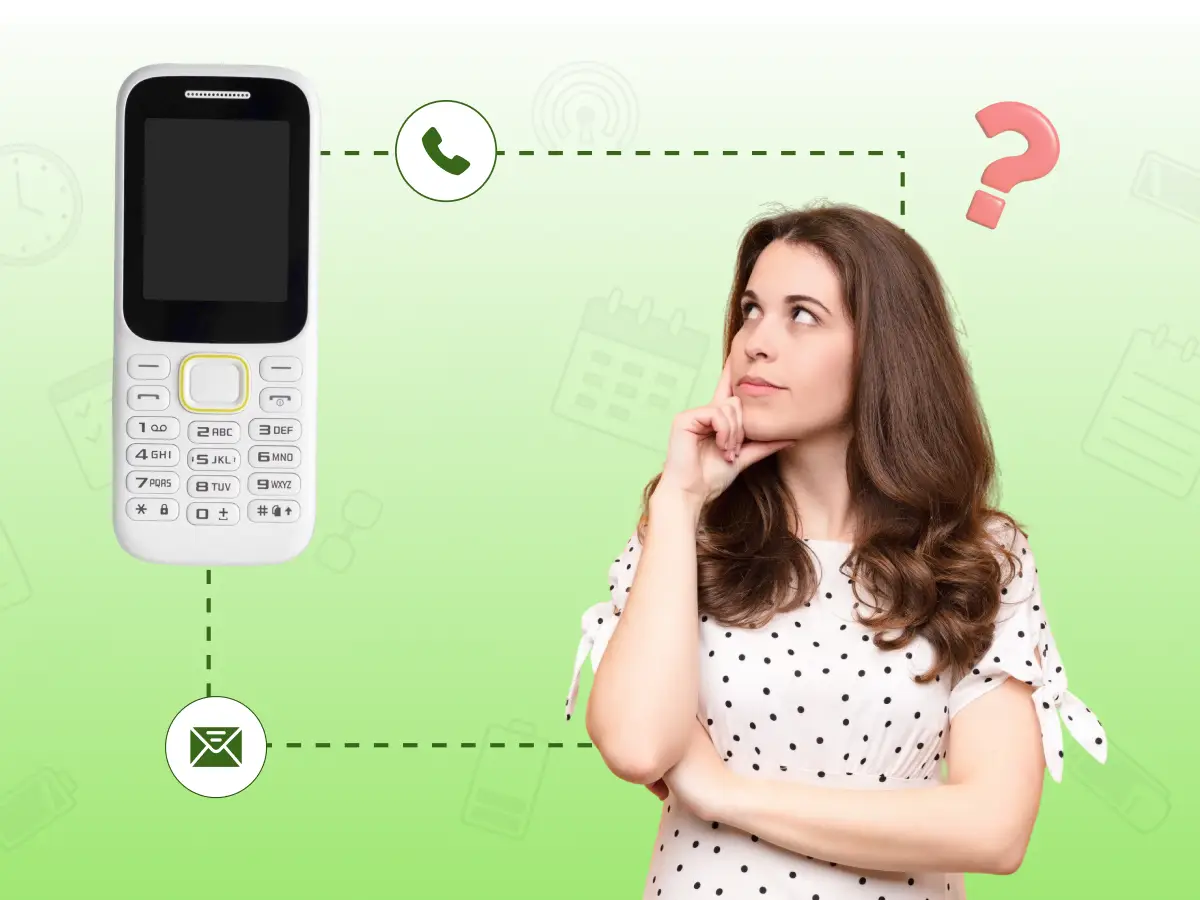
These phones use physical buttons instead of touchscreens, offer minimal distractions, and deliver exceptional battery life lasting days, focusing on essential communication without constant notifications.
We interact with our phones an average of 2,617 times a day. Think about that for a second.
Thousands of taps, swipes, clicks; most of them automatic, none of them really necessary. Somewhere along the way, phones stopped being tools and started being habits.
But a quiet shift is happening.
People are trading their smartphones for something simpler, something that doesn’t demand constant attention.
They’re going back to dumb phones, and it’s not nostalgia; it’s survival.
A dumb phone/dumbphone is basically your old-school mobile that makes calls and sends texts. That’s pretty much it. Think back to those chunky Nokia phones or flip phones from the 2000s, same concept, just brought into today.
These devices have actual buttons you press, not touchscreens. The screens are small, and if there’s internet, it’s so clunky you probably won’t bother using it.
You’re not getting Instagram, TikTok, or even a decent web browser. What you do get is a phone that rings when someone calls and lets you call and send SMS.
Some people call them feature phones, basic phones, or brick phones. The name “dumb phone” stuck because, well, compared to smartphones, they don’t do much. But that’s exactly why people want them.
You might see classic flip phones that snap shut with that satisfying click, or newer stripped-down models that look a bit more modern. The whole idea is the same, though, cut out everything except what you actually need to communicate.
It’s not about going backwards. It’s about having a phone that doesn’t constantly demand your attention or make you feel like you’re missing out.
So what exactly can these basic devices handle? Let’s see what dumb phones are actually capable of.
Look, feature phones aren’t totally useless. They just stick to basics instead of trying to be your whole life in a pocket.
Here’s the real breakdown on what these things can actually handle.
Can you text and call on a dumb phone?
Yeah, obviously. That’s the main point. You can make calls, send texts, save contacts, all the stuff phones did before apps took over.
A bunch of newer models run on 4G and have VoLTE, so call quality is actually pretty solid. You get your call log, can set up voicemail, and maybe block some numbers. Nothing complicated, but it all works fine.
Most dumb phones throw in some basic utilities. Alarm clock, calculator, calendar, stuff like that. They’re not connected to anything, so your calendar won’t remind you about meetings across devices.
But you can set an alarm or do quick math. Some have a flashlight feature too.
This is where it gets slightly more interesting. Lots of feature phones have cameras, though, don’t expect miracles. The photos look pretty bad compared to what you’re used to, and there’s no front-facing camera for selfies. But you can snap pictures if you need to.
A bunch of these phones work as a music player if you load songs onto a memory card. No Spotify or streaming, but if you’ve got MP3 files, you can listen to them. Some even have FM radio built in, which is nice when you just want something playing in the background.
Do dumb phones have internet?
Sort of. Most feature phones have some version of a web browser. Slow, clunky websites look terrible. A few newer minimal phones let you use basic apps for navigation or messaging, but the experience isn’t smooth.
It’s there for emergencies more than actual browsing. Some can even share wifi as a hotspot, though that depends on the model.
The whole setup is stripped down on purpose. No app store, no constant notifications, nothing trying to grab your attention every two seconds. What you do get is crazy good battery life, days, sometimes over a week on one charge.
The phones are usually pretty tough, too. And because there’s barely anything running, they don’t freeze up or glitch out like smartphones.
Therefore, feature phones won’t do everything, but they weren’t meant to. They handle communication and a few extras without turning into a black hole for your time. For many people, that’s actually ideal.
Now you know what basic phones can do, but how do they actually stack up against the smartphones everyone carries? Let’s look up the real comparison.
It’s pretty obvious that dumb/brick phones and smartphones aren’t the same, but what does that actually mean day-to-day?
Let’s break down where they differ and what that means for how you’d use each one.
| Feature | Dumb Phone | Smartphone |
|---|---|---|
| Primary Purpose | Calls and texts | Everything: communication, work, entertainment, social media. |
| Internet Access | Limited or barely usable | Full internet, fast browsing, streaming |
| Apps | Few or none, no app store | Millions of apps available |
| Notifications | Minimal; mostly calls and texts | Constant emails, messages, social media, and news |
| Battery Life | Days to a week or more | Usually needs daily charging |
| Screen | Small, often not a touchscreen | Large touchscreen, high resolution |
| Camera Quality | Basic or low quality | High-quality, multiple lenses, front-facing camera |
| Distractions | Almost none | Endless scrolling, apps competing for attention |
| Durability | Generally tough, built to last | More fragile, often needs a case |
| Cost | Cheap, usually under $100 | Ranges from a few hundred to over $1000 |
| Privacy & Data | Minimal tracking, less personal information collected | Tracks location, browsing, and collects lots of data |
| Updates | Rare or none | Regular software updates |
| Navigation | Basic or none | Full GPS with real-time directions |
| Music & Media | MP3 player, FM radio (sometimes) | Spotify, Apple Music, YouTube, podcasts |
| Messaging Options | SMS/MMS only | SMS plus WhatsApp, iMessage, Telegram, etc. |
| Emergencies | Can call emergency services | Can call emergency services, plus share location and medical information |
The gap between these devices is huge, but that’s intentional. Smartphones are built to do as much as possible. Brick phones are built to do less, and for some people, that’s exactly what they’re looking for.
It all comes down to what you actually need from a phone versus what’s just noise.
The differences are clear on paper, but that doesn’t explain why so many people are ditching their smartphones and going back.
What’s driving this shift?
You’ve probably noticed more people talking about ditching their smartphones. It’s not just a weird trend; there are actual reasons behind it.
Smartphones grab your attention all day long. Notifications won’t stop, apps are designed to keep you scrolling, and before you know it, an hour’s gone. A 2025 report found that the average American adult spends about 5 hours and 16 minutes on their phone daily.
Dumb phones don’t have any of that. You text someone back, and that’s it. People who’ve switched say it’s like their brain calmed down for the first time in years.
Constantly being on your phone messes with your head. You’re comparing yourself to people online, feeling like you have to respond to everything immediately, seeing everyone’s fake, perfect life.
Basic phones take most of that away. You’re not staring at a screen that makes you feel worse about yourself. A lot of people say they’re less anxious and actually feel better after switching.
No apps means no distractions. That’s really all there is to it. You’re not losing time because you thought you’d “just check something” for a second.
Work gets done faster, you actually finish books, and conversations happen without your phone sitting there tempting you.
Your smartphone knows everything about you. Where you went today, what you searched for, who you talked to. All that information gets collected and sold.
Feature phones can’t do most of that tracking because they’re too basic. If the idea of companies watching everything you do bothers you, a feature phone makes more sense.
Flip phones are back, and honestly, they look pretty cool now. There’s something nice about how simple things used to be. Younger people especially like them. Gen Z missed out on flip phones the first time around.
And yeah, using one when everyone else has an iPhone says something. You’re choosing to step away from all that.
These things last forever. Days without charging, sometimes a whole week. Meanwhile, smartphones die every single night. If you’re traveling or just sick of looking for outlets everywhere, that battery life is huge.
People have different reasons, but it’s the same idea underneath. Smartphones took over way too much of daily life.
Switching to a basic phone isn’t about going backwards; it’s about deciding what actually needs your attention and what doesn’t.
But feature phones aren’t for everyone. So who actually benefits most from making the change?
You might assume these gadgets are only for people who hate technology, but the crowd swapping their Apple iPhone or Google Pixel for a simpler device is actually pretty diverse.
If you have been scouring the web using a dumbphone finder to escape the digital noise, you fall into this bucket. With 3 in 4 Gen Zers admitting they spend too much time on smartphones, it’s clear that this isn’t a minor concern anymore.
These folks are tired of social media algorithms dictating their mood. Devices like the Punkt MP02 or the Light Phone III are perfect here.
They often feature black and white screens (E-ink) that don’t trigger an addictive dopamine hit. It’s mostly about protecting your peace and keeping your personal information private, rather than feeding the data machine.
Are dumb phones good for kids? Absolutely. Handing a child a fully loaded smartphone is like giving them the keys to a Ferrari and hoping for the best. A basic phone is a safer bet.
You get essential calling options and a call log to keep track of them, but without the dangers of an unrestricted app store or anonymous messaging apps. It keeps them connected to you, not the entire internet.
Are dumb phones suitable for seniors? Definitely. Modern touchscreens can be a nightmare if your eyesight isn’t perfect or you just prefer tactile buttons. A classic flip phone just works.
It looks and feels familiar; you open it to talk, you close it to hang up. There is no complex close menu gesture to memorize, and emergency calling features are usually front and center.
Sometimes you need to get work done without your pocket buzzing every thirty seconds. Ironically, high-performing professionals often grab devices like the Jelly Star or a Light Phone.
Why? Because many still offer Wi-Fi hotspots. You can tether your laptop to answer emails, but the phone itself won’t distract you with navigation music or news alerts. It’s strictly business.
Is a dumb phone good as a backup or emergency phone? It is probably the best option out there. Because cell phones like these aren’t running fifty background processes, the battery life is legendary.
You can toss one in your glovebox or a hiking bag, and it will likely hold a charge for weeks. If your main smartphone dies, this little backup is your lifeline.
Knowing who they’re best for helps, but let’s be realistic about what you’re actually getting into. Let’s weigh its pros and cons.
So, are dumb phones worth it? It really depends on what you are willing to trade. Before you swap out your current smartphone, let’s look at the real good and bad sides of making the switch.
The trade-offs are clear: you gain simplicity and lose convenience. But what about safety? Are these basic phones actually more secure than smartphones?
There is a common belief that swapping a smartphone for a brick makes you digitally invisible. But are dumb phones more secure than smartphones? The answer isn’t a straight yes or no; it’s more of a trade-off.
Hence, dumb phones offer better privacy and fewer vulnerabilities, but they’re not bulletproof. If you’ve decided one’s right for you, here’s how to pick the best option.
Not every feature phone is the same. Some work, some don’t, and some will just annoy you. Here’s what actually matters when you’re picking one.
This is huge, and people mess it up all the time. Older networks are getting shut down, so tons of basic phones don’t work anymore. You need one that does 4G or VoLTE. Check what your carrier uses and make sure the phone supports it.
Don’t just assume it’ll connect; plenty of people buy phones that are basically paperweights on their network.
What do you actually want this thing to do? Just calls and texts? Need a camera or music player? Maybe a tiny bit of internet for emergencies? Something like the Light Phone III is suitable.
Other models have more built-in features. Don’t buy extra features you’ll never touch, but also don’t go so minimal you’re frustrated a week later.
Is it gonna break if you drop it? Flip phones usually hold up better because the screen’s protected when it’s closed. Check reviews to know whether buttons stop working or hinges snap after a few months.
Yeah, dumb phones last way longer than smartphones. But some last longer than others. A few days versus a full week makes a difference. Check the battery size and what actual users report, not just what the company claims.
You’re probably going back to pressing actual buttons. T9 texting is weird if you haven’t done it in forever. Some phones have bigger buttons that are easier to hit. If you text a decent amount, pay attention to this, or you’ll hate yourself.
Call your carrier before buying anything. Ask them straight up if the model you want will work. Even if the specs look right, some carriers won’t activate certain devices.
Some newer basic phones charge with USB-C instead of that old micro-USB. Means you can use the same cable as everything else. Not critical, but makes things easier.
Get it from somewhere that does returns if possible. A phone that sounds good might feel terrible when you’re actually using it. Buttons too small, menus confusing, whatever. Better to find out early.
Picking a feature phone isn’t rocket science, but you can’t just buy whatever’s cheap and hope it works. Spend ten minutes checking compatibility and features so you don’t waste money on something useless.
Now you might be wondering if this is just a passing trend or something bigger. Are dumb phones actually making a real comeback?
Feature phones are stripped-back mobile devices designed to do one thing: connect us without the chaos. No apps, no infinite feeds, just calls and texts. But why are dumb phones trending again in an era of AI and 5G?
The driving force isn’t just nostalgia; it’s a survival mechanism. 53% of Americans wanted to cut down on phone usage in 2025. Fueled by a desperate need for digital detox and better mental health, a massive feature phone trend is sweeping through Gen Z.
Are younger people using dumb phones now? Surprisingly, yes. They are leading this digital “anti-tech” movement, trading dopamine loops for minimalism and focus.
Of course, swapping a smartphone for a feature phone requires a shift in mindset. You save money and gain extra battery life, but you lose modern features like high-speed GPS and banking apps.
Yet, for many, that’s the point. The surge in feature phone popularity proves that people are willing to sacrifice convenience for freedom.
The numbers back this up. The global feature phone market was valued at USD 2,351.2 million in 2024 and is expected to grow at a steady 2.30% annually through 2031. It’s not a massive explosion, but it’s a growth in a market many assumed was dead.
As the minimalist phone movement forces the market to adapt, we have to ask:
Are minimalist phones the future of well-being, or just a quiet rebellion against the algorithm?
Either way, the flip phone is officially back.
The numbers suggest dumb phones are resurging, but what do people who study technology and behavior actually think about this shift?
Research on digital minimalism shows that it can help your mental health, but it’s not the same for everyone. How well it works depends on how you actually use it.
Some studies found that using your phone less makes a real difference. One trial had people keep their screen time under two hours a day. They felt less depressed, slept better, and had lower stress compared to before they started limiting usage.
So, it’s not just correlation, but cutting back might possibly cause those improvements.
Research on digital detox shows similar things. Taking breaks from your devices helps with depression and compulsive internet use, especially if you were already struggling with those issues. But when it comes to stuff like overall life satisfaction or general stress, results are mixed. It really helps some people and barely does anything for others.
Behavior researchers found that people who are more mindful and have better self-control use their phones less compulsively. Practicing detox seems to strengthen that self-control over time.
What experts keep saying is that digital minimalism, less screen time, simpler phones, whatever approach you take, can help you focus and break the constant checking habit. But it’s not a miracle fix and doesn’t work identically for everyone.
You’ll get better results by figuring out what fits your life instead of just doing what worked for someone else.
The sudden rise of the dumb phone trend proves that we are craving a break from the digital noise.
Whether you go fully analog or just practice digital minimalism on your current device, the goal is the same: reclaiming your time and focus.
You don’t have to reject technology entirely to feel the benefits. By consciously managing your screen time and prioritizing real-world connections, you can improve your mental health.
The future isn’t about no tech; it’s about better tech habits.
It’s a basic mobile phone designed mainly for calls and texts. It doesn’t have an app store, social media, or a high-speed internet browser.
They already are making a comeback. Sales are rising as more people look for ways to unplug from the internet and improve their mental health.
Gen Z is buying dumb phones to escape the pressure of social media and constant notifications. It helps them focus better and feel less anxious.
Mostly no. Classic dumb phones only play MP3 files. However, some modern “hybrid” phones allow basic streaming.
It depends. A super basic phone won’t, but many modern “feature phones” now come with a simple version of WhatsApp installed.
