

Difference Between VoIP & VoLTE: Why Understanding It Matters

Quick Overview:
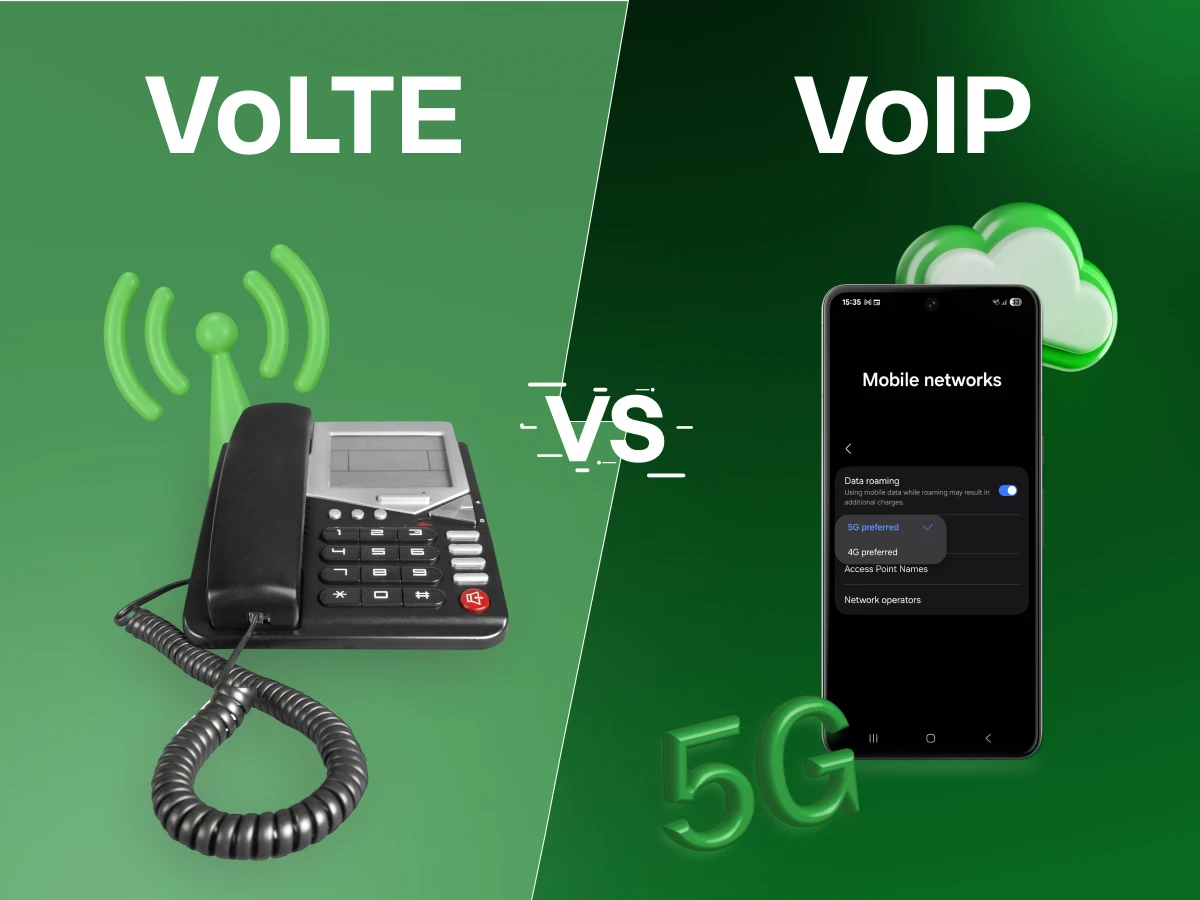
Both VoIP and VoLTE deliver digital voice, but use different networks. VoIP relies on the internet data network as an inexpensive, flexible method to make call, & VoLTE uses 4G LTE as the network to make call, establishing a call faster and in HD voice, but also as a reliable mobile connection over distance.
For a business to foster, the key factor is communication. To better it, understanding the difference between VoIP & VoLTE can enhance business efficiency, reduce costs, & improve customer satisfaction. The selection of an appropriate system guarantees both comfort in voice communication and accessibility to the global network of any company.
VoIP and VoLTE are digital voice communication and operate in different ways. Being aware of their strengths and weaknesses enables businesses to make the most suitable choice and effectively improve performance, mobility, call quality, and compatibility with current communication networks.
This guide clearly explains the difference between VoIP and VoLTE. We provide definitions, detailed comparisons, practical scenarios, and expert advice. You will get a complete understanding to make the best possible communication decisions for your organization.
VoIP (Voice over Internet Protocol) is a system that doesn’t require traditional phone lines, allowing users to make calls and send texts over the internet. Voice is converted into digital packets sent over the internet, supported by computers and specific IP devices.
This professional technology offers significant flexibility, reduced operational costs, and many advanced communication features, making it a superior alternative to older landlines. A reliable and strong internet connection remains strictly necessary for maintaining high-quality call functionality for VoIP.
Your voice is recorded and changed into digital signals when you talk. In this process, the original sound waves are converted into a format the computer can understand so that the network can send your voice without any trouble and with precision.
The digital messages are divided into numerous small data packets. The packets contain a fragment of your voice and information about the order and destination, which ensures that everything is reassembled correctly on the other side.
These packets traverse the internet via various network paths. Routers direct them most efficiently, minimizing delay so that voice information travels faster across long distances and remains complete and reliable.
Once the digital packets arrive at the receiver, the receiver’s gadget collects and sorts them in the proper sequence. The binary information is then converted to audio, so the person hearing your voice can listen to it clearly.
VoLTE, also known as Voice over LTE, is a mobile technology that routes voice traffic over 4G LTE networks rather than older 2G and 3 G networks. It offers superior audio, quicker call set up and greater reliability for daily mobile communication.
VoLTE sends analog voice signals as digital data over LTE networks, using dedicated bandwidth for improved voice quality. It is integral to Long-Term Evolution standards & shows clear superiority in VoLTE vs. VoIP comparisons, particularly against traditional phone system technologies.
VoLTE converts your analog voice signal into a digital signal that LTE networks can process and transmit effectively. This digitalization maintains pronunciation, reduces distortion, and maintains high audio quality to provide more transparent, more reliable communication.
After digitization, your voice is divided into structured data packets, like the VoIP technology. The LTE network can quickly and accurately convey voice data using these packets, whilst ensuring audio integrity and reducing call delays.
The voice packets are sent over dedicated 4G LTE channels, which reserve bandwidth to prevent congestion. This will reduce the time required to make a call, eliminate network delays, and make communication faster and easier than with older 2G or 3 G mobile systems.
The devices at the other end of the network gather the packets sent to them, assemble them sequentially, and deliver clear HD voice. Such an organized recombination will ensure uniform performance and that mobile device users have high-quality voice conversations across compatible devices.
VoLTE can be easily integrated with VoIP solutions, SIP trunks, and device administration applications through technology partners. This will enable businesses and users to trust in current, scalable communication solutions rather than rely on outdated POTS infrastructure.
Look, if your company wants to save money and have clear calls, you have to know about VoIP and VoLTE. Figuring out the difference now means you can pick the right technology to support your business best. So, let’s quickly break down the key contrasts.
Both methods rely on the Internet Protocol (IP) to communicate and locate the voice data. They digitally convert your voice into data packets for sharing over a data network; thus, they do not go through the traditional fixed phone systems at all.
Voice signals are broken down into small digital packets in both cases, whereas in the old circuits, this was done differently. This modern, efficient method allows multiple calls and data streams to share the same network infrastructure simultaneously.
Both were made with the intention of providing clearer, High-Definition (HD) voice quality. To make your conversations clearer and richer than those on regular analog phone calls, they use advanced digital coding standards.
Both types of solutions can easily be extended with extra features beyond just simple voice. The list of these can be very long, e.g., video conferencing, instant messaging, and call switching without interruption, which are just a few of the versatile communication tools’ features.
Most importantly, both solutions dispose of a copper-based phone network (PSTN) that is outdated; thus, they no longer need it. Going digital makes it cheaper, more future-ready, and more convenient for a modern business and a person on the go.
VoIP and VoLTE are the latest solutions for voice transmission, and each has its optimal environment for devices and networks.
VoIP functions as the best possible replacement for POTS and offers a comprehensive IP phone solution, including video conferencing, call routing, & the integration of SIP trunking integration.
VoIP is an economical way to make large volumes of voicemail calls, voicemail systems, voicemail services, and voicemail communications by using existing data networks and communications, such as Broadband and Wi-Fi, rather than cellular minutes.
As long as there is a network connection, this method is valid for various instruments, i.e., desktops, laptops, tablets, and even specially designed VoIP phone units. Moreover, it simply converts analog voice signals using adapters.
With the help of the VoIP system, it is possible to carry out very complex services in the communications sector, such as call routing, messaging, and multi-line numbering. If the situation demands that a business expand on a larger scale, it will be very easy for them to do so without changing their existing lines.
VoLTE enables cellular users to make HD voice calls by carrying analog voice signals over a reserved LTE channel. It offers the best possible voice-quality experience for cellular users.
As the carrier has complete control of the route, VoLTE gives data packets priority over voice, so call setup time is extremely fast, and voice communication is very low in latency and crystal-clear.
VoLTE is energy-efficient. Making a VoIP call through the cellular network’s traditional voice over LTE solution is more effective in terms of battery life than any other VoIP solution available for the cellular network.
The primary cause of a handover without issues between LTE cell towers is VoLTE, which allows a conversation to continue without delays & preserves voice quality. By doing so, VoLTE services can be the most appropriate for individuals with occupations that require them to travel and talk at any given moment.
A support center uses a VoIP phone system to manage global voice calls through strong data networks. By converting analog voice signals into data packets, agents improve call quality using VoIP phones, IP phones, CRM tools, and integrated SIP trunk services.
Retail branches rely on VoIP gateways to link older phones with modern Voice over Internet Protocol systems. This setup enhances voice communication, improves VoIP call stability, reduces operating costs, and acts as a reliable POTS replacement compared to outdated traditional POTS infrastructure.
A delivery team depends on Voice over LTE for clear HD voice across 4G LTE networks. VoLTE uses dedicated bandwidth to boost call setup speed, stability, and performance, showing the difference between VoLTE and VoIP in mobile workforce communication.
Medical teams use VoLTE-enabled phones to maintain reliable mobile communications while transmitting voice calls through LTE networks. Since VoLTE manages data packets efficiently, staff experience excellent voice quality across various devices without depending on Wi-Fi or traditional POTS systems.
However, many believe VoIP is applicable only to businesses, which is not the case. Free or low-cost VoIP calls are made by personal users using apps across different devices. Voice over Internet Protocol supports daily communication, as it is flexible, offers high-quality calls, and is low-cost for calls worldwide.
It is estimated that VoIP suffers from poor voice quality, though this depends on the internet speed and the VoIP provider. VoIP calls sound very clear, and with stable data networks, modern VoIP phones, and optimized data packets, their quality compares with or beats that of existing calling systems.
VoLTE supports video, contrary to myth. New phones use it for calls while running data apps. It enables HD voice and video meetings by carrying both voice and data over the LTE network. Video meetings are possible because LTE networks can transport both voice and data.
VoIP can be viewed as an insecure option, but it is safe when encrypted, protected by SIP trunking, and delivered over secure data networks. Contemporary Voice over Internet Protocol networks secure voice communications, providing reliable, secure voice calling for businesses and personal calls.
VoIP or VoLTE is a matter of choice, determined by your business requirements, mobility, and connectivity. Both technologies provide excellent voice communication, and awareness of their strengths can help achieve the best call quality, efficiency, and cost. We will examine some perfect situations of each.
VoIP suits users who make frequent international voice calls over the Internet Protocol. It also lowers costs by sending analog voice signals as data packets over reliable data networks, while maintaining a high-quality call experience with many types of devices.
Firms that implement cloud, IP, or VoIP phone systems benefit from integrated SIP trunks. VoIP enables the smooth operation of voice and video communication, as well as collaboration, on desktops and mobile devices; hence, it is suitable for office operations.
A strong internet connection makes VoIP calls clear. High-speed data networks handle data efficiently, improving voice quality, reducing lag, and providing reliable communication without traditional phone systems.
VoIP will lower the local and international voice costs. By substituting a conventional POTS line, businesses can access an affordable communication solution with device management and modern VoIP gateways that provide professional, scalable, and flexible calling infrastructure.
VoLTE is most suitable for mobile users. Using voice over LTE within 4G networks, it provides clear HD voice calls, ensuring call quality remains high even when employees are on the move.
Volte works well on a strong 4G LTE network, which allocates bandwidth so as to reduce the time and congestion for setting up a call. Thus, high-quality voice communication is ensured across different devices using a technology older than mobile communication.
VoLTE allows users to make voice call over mobile data by simply converting analog voice signals into data packets, without interrupting browsing, applications, or messaging. The combo is excellent for boosting worker productivity, particularly for field workers or remote workers.
VoLTE offers faster call setup and stable HD voice by using the Long-Term Evolution (LTE) protocols. The technology improves overall voice quality, making it an ideal option for mobile professionals who require excellent voice communication across different places and devices.
Tip:
A hybrid system is often used by companies: VoIP in the office and remote systems, VoLTE in the field. This optimizes efficiency and coverage across data networks and provides cost-effective, high-quality communication solutions.
Knowing the distinctions between VoIP and VoLTE helps companies pick those systems that lead to better call quality, greater mobility, and higher efficiency. Understanding these two technologies thoroughly is an excellent support for making better decisions, resulting in improved operational effectiveness, elevated customer experience, and a stable foundation.
VoIP is a good tool for office-based operations, as it supports a range of devices, is relatively cheap, and offers a wide array of features. In contrast, VoLTE is a power source for mobile users, providing HD voice and stability. Many enterprises have both in their arsenal, thus having a well-balanced, up-to-date communication strategy that is still efficient, scalable, and ready for the future.
At last, it’s up to you to choose the one that best matches your business or personal needs.
Yes. VoIP is typically international or long-distance voice as it transmits voice over the internet. This makes international calling simpler and more convenient than using mobile networks such as VoLTE.
No. VoLTE requires a steady 4G LTE network to provide HD voice and fast call connections. A poor LTE signal can force your device to revert to older networks, which often have poor call quality.
Yes. Numerous organizations integrate both technologies: VoIP for offices and VoLTE for mobile employees. This hybrid (mix) setup offers better coverage, is less expensive, and maintains similar call quality across locations.
Typically no. VoIP will cease when power or internet becomes unavailable unless you have a backup 3G or UPS, mobile hotspots, or LTE failover systems to maintain the connection.
VoLTE is also operating on LTE channels and does not use the standard data plan. Carriers process voice independently, so you get HD calling without using up your mobile data plan.
