

How to Get a Toll-Free Number for Your Business (Step-by-Step Guide)

You’ve got a business phone, but your customers aren’t calling. Have you ever thought about why they aren’t calling? Maybe your number looks random, or maybe they think they’ll be charged for the call. That’s where toll-free numbers come in to help.
A toll-free number gives your business a clean, professional look. It shows customers that you’re serious. It also makes it easier for customers to call without worrying about cost.
This guide walks you through the process of obtaining a toll-free number with a step-by-step guide, even if you’re just starting out.
Before we show you how to get a toll-free number access, it’s essential to understand what it is and why it’s different.
A toll-free number is a telephone number that allows the caller to call a business without being charged for the toll of the call. Your business pays the toll on these incoming calls, hence the toll part of toll-free. This is definitely a good thing and is a great way to facilitate contact with your business. That’s why they say “toll-free”. Toll-free numbers are commonly known to be comprised of prefixes that begin with 800, 888, 877, 866, 855, 844, and 833.
Toll-free numbers operate on mobile devices, cloud phone systems, and through VoIP service providers. You can forward incoming calls to your individual phone, a team, or a full-fledged call center. It features great tools like call forwarding, caller ID, call recording, and voicemail, making it easy to take control and manage incoming customer calls from anywhere.
If you utilize international toll-free numbers, they also accept international calls. This is fantastic for international enterprises because it means that clients in other countries can contact you for free.
It’s a simple way to improve your brand image, connect with more people, and give better support. And yes, it works on mobile devices as well, which means no office is required.
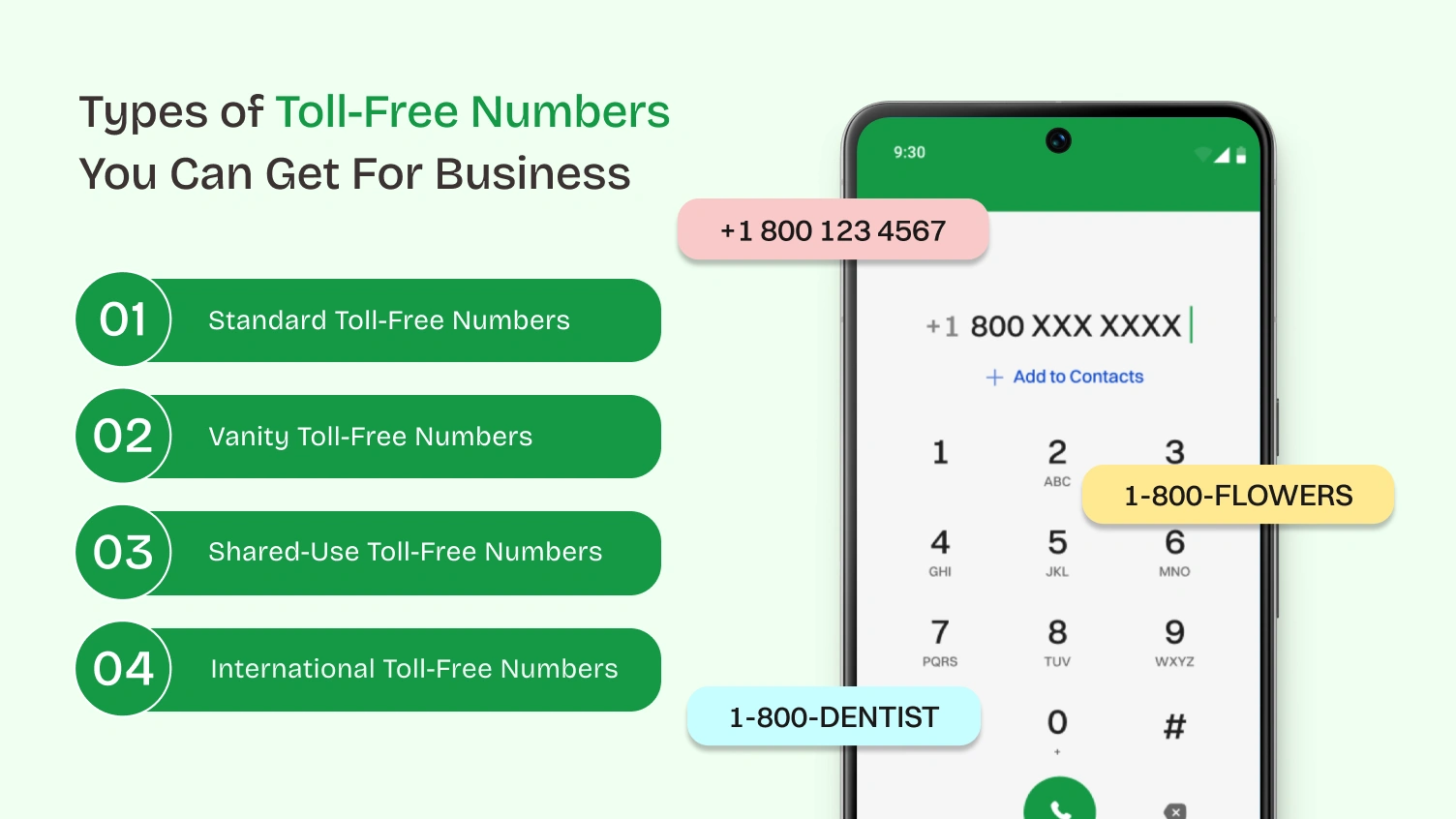 Toll-free numbers are not all the same. You can choose from many sorts based on how your firm operates. Each has special qualities and advantages. Let’s break them down:
Standard toll-free numbers are the most common type of toll-free number. They begin with numbers like 800, 888, 877, or others. You are given a basic number that clients can call for free. It is compatible with cloud phone systems, VoIP providers, and mobile phones. This is a good choice if you’re just starting off or need something simple.
Customers are familiar with these numbers, and they are simple to set up. For a more polished experience, they also enable caller ID, voicemail, and call routing.
For example, a business such as “GreenFresh Delivery” may utilize 1-888-GET-FRESH to make their business phone seem reliable and reachable.
Vanity phone numbers are toll-free phone numbers that have words or phrases associated with them on a phone keypad. They were extremely popular before the era of the smartphone when people could not simply search for that number on a mobile app. Even today, they are a clever way to distinguish yourself from everyone else.
Vanity phone numbers can be very memorable and are often seen in advertisements, on billboards, or heard on the radio. They enhance your branding and allow customers to easily connect with you.
For example:
Multiple businesses across different areas or services use the shared use toll-free numbers. A toll-free service provider manages the number and routes each incoming call to the right business using call routing and location data.
For example, HVAC companies across the U.S. might share a toll-free number, such as 1-800-COOL-AIR. The system connects callers to the closest provider.
This setup saves money and gives your business a clean, professional appearance with one easy-to-remember number.
International toll-free numbers allow your overseas customers to contact you for free. Similar to standard toll-free numbers, you pay for the incoming calls. Regardless of the country of origin, the caller is not charged anything for the call.
These numbers are excellent for businesses with an international presence. If your organization is using a VoIP provider or a cloud phone system, you can manage international calls simply.
ITFS makes your brand effortless to contact from anywhere around the world. It also enhances trust and confidence among new customers, regardless of the country.
Large corporations are not the only ones with toll-free numbers. They help businesses of all kinds stay connected, look professional, and reach more people. Here’s why smart companies employ them:
Begin by identifying the purpose. Whether it’s for customer support, sales, or marketing, your goal shapes your choice. A vanity phone number works well if you want something memorable. Otherwise, a standard toll-free number is enough for general use.
Select from common prefixes like 800, 888, 877, or 866. Older prefixes, such as 800, often feel more credible to customers. Newer ones provide more options if popular numbers are taken. Select a prefix that aligns with your brand image and is easily recognizable.
Select a provider that aligns with your business needs. There are options such as Dialaxy, Grasshopper, Nextiva, or RingCentral that offer a range of features. Check if they support call forwarding, caller ID, and voicemail. Confirm compatibility with your mobile phone or VoIP provider.
Use the provider’s search tool to find available numbers. If your first choice isn’t free, try similar numbers or opt for a vanity number. Choose a number that’s simple and aligns with your business branding.
Please provide your business details and payment information to complete the registration process. Activation can be instant or take a few hours. Complete any verification or documentation required. After this, your toll-free number will be ready to receive calls.
Set up call forwarding to route calls to your team, mobile phone, or VoIP system. Use call routing to manage incoming calls by time or department. Add features like call recording or voicemail to enhance the customer experience.
Place your toll-free number on your website, email signature, ads, and product packaging. Highlight vanity numbers to boost memorability. Track calls using analytics or CRM tools to measure how your number supports your business goals.
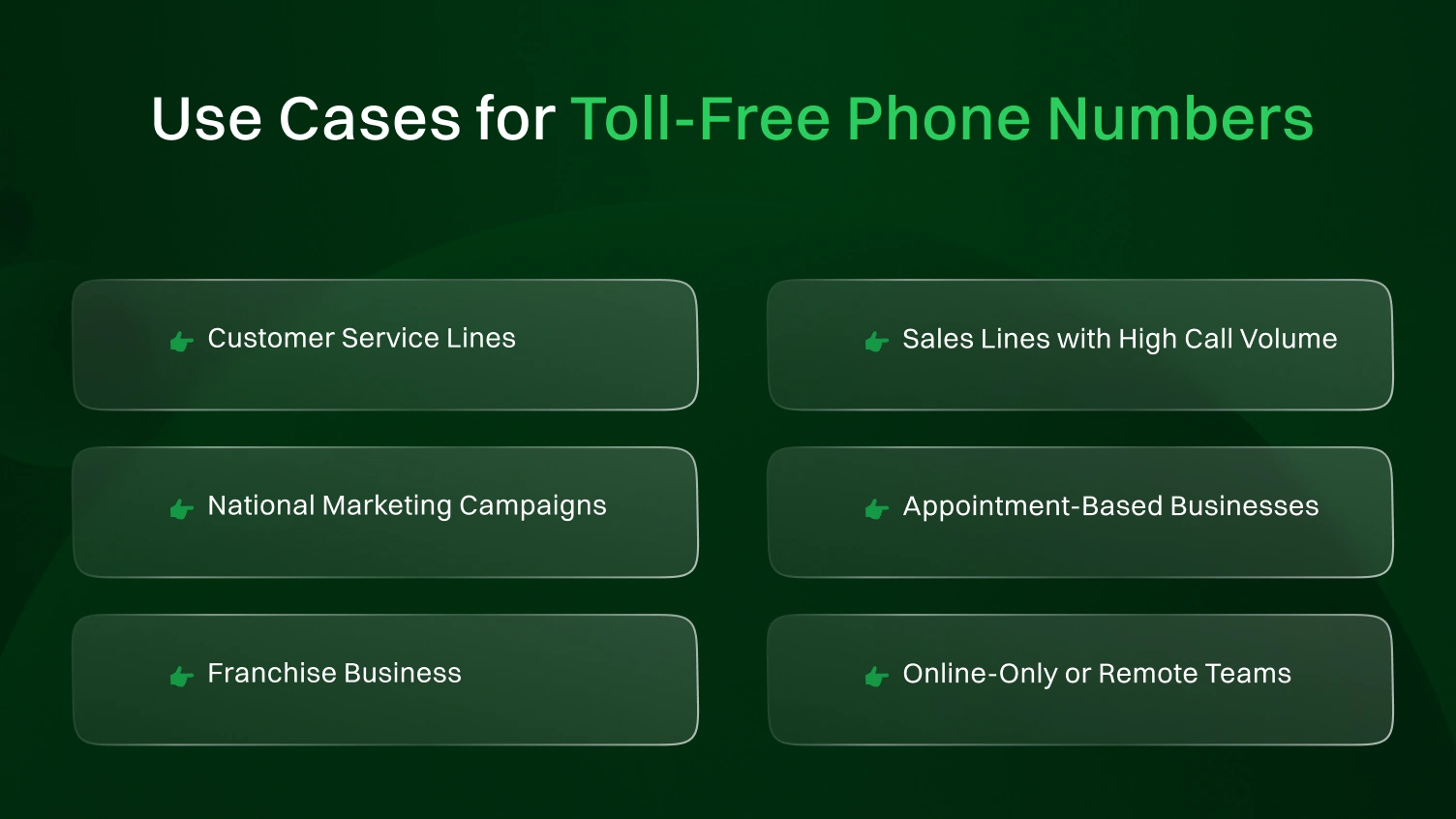
Toll-free numbers work for more than just large companies. They help small businesses grow, enhance customer experiences, and handle more calls with less stress. Here’s how different types of companies use them every day.
Customer support is one of the biggest reasons businesses use toll-free numbers. Customers can easily contact your team without worrying about the expense. Toll-free lines enable you to manage support more effectively with features such as call forwarding, voicemail, and caller ID.
Calls can be routed straight to your VoIP provider setup, your contact center, or your remote agents. This keeps consumers happy and speeds up response times. It also lets customers know that your company is available and willing to assist.
All of your advertisements can be connected by a single toll-free number. A single number can strengthen your brand image and increase your nationwide reach, whether you use digital advertising or printed advertisements. It helps to make your business look bigger and more trustworthy.
You may even want to use the number with call tracking tools to see how each advertisement performs. You can even protect your leads with call routing that will direct leads to the appropriate team member depending on region or campaign. You might see more responses and more leads being converted at no expense to the consumer.
For all locations, franchises frequently require a single main line. With a toll-free number, everything is kept in order. The system detects the area and sends the call to the right branch or store whenever someone makes a call. Using the shared use toll-free numbers, this setup is often done. It helps in saving time and avoiding confusion.
The customers always get the closest location and don’t have to remember several different numbers. It also remains consistent with branding the voice you want every city or region to convey.
Many sales departments love to use toll-free numbers for a better experience. A free number helps prospects overcome the obstacle. They are more inclined to place orders, call, or ask queries. Your company phone becomes a tool for generating leads. VoIP systems and cloud phone tools manage overflow with ease when volume surges.
Features such as call recording can be added to track performance or coach your team. Even on hectic days, you maintain control, and clients don’t have to wait long to talk to someone.
Many businesses run on the basis of bookings, such as clinics, repair services, or consulting firms. It helps in taking advantage of toll-free lines. The number builds trust, particularly if you are working with new customers. Dialing is easier, and it’s free. You appear more reliable and open for business.
Additional features such as SMS confirmations, call forwarding, and voicemail make your appointment management more efficient! A toll-free line also means a decreased number of missed calls. This creates a sense of reliability with your service and a polished brand image.
Toll-free phone numbers help remote teams to sound local. If there isn’t a physical office, you’ll gain the benefit of sounding connected. Customers will call a single number and be connected to your team, regardless of their location.
A toll-free number connects to a VoIP provider or a cloud phone system. When integrated with call routing, calls can go to the right person, maintaining speedy and organized support.
A toll-free number also separates your personal phone from work and business calls, creating a cleaner appearance and maintaining trust with customers.
Not all phone numbers function in the same manner. Some are designed to be used locally. Others back tech features or branding. Customers can call toll-free lines for free, which is one of the main reasons they stand out. However, that is only one aspect.
Let’s make a comparison between toll-free numbers and other phone number types that help to pick the best fit for any business:
As local numbers tie you to a certain area. Local numbers work well for many shops or services that serve a single city or region only. But local numbers limit your reach, which affects any business.
Toll-free numbers do not do this. They give your brand a more generalized feel. Customers can call from anywhere and still feel like they are dealing with a trusted national company.
Toll-free numbers allow for call forwarding and call routing. If you need to send calls to different teams or locations, a local number typically does not offer these advanced options unless it is connected to a VoIP provider.
VoIP numbers do not rely on phone lines but rather on the Internet. They work well for remote teams and are adaptable. Toll-free numbers are another feature that many VoIP systems provide as part of a cloud phone setup.
VoIP provides features such as call tracking, clever caller ID, and auto-attendants. By eliminating financial obstacles for the caller, toll-free lines offer value. Combining the two gives you flexibility and a reliable client experience.
Callers feel more comfortable reaching out, and you gain control over how calls are handled. It’s a good setting for companies that value trust and technology.
A vanity number is a unique type of toll-free number. It means something, some word or phrase, for example, 1-800-FIX-MY-CAR. It is easier for advertisements because it is easier to remember.
Toll-free numbers enable customers to call you at no charge. Vanity numbers help them remember how to call you toll-free. Vanity numbers offer both trust and branding benefits. They are just harder to get and may cost more.
Lots of big brand companies use vanity numbers, so you are more likely to remember who they are. Vanity numbers help market what you sell or provide while also making it easier for you to be contacted.
While at first an apparent convenience, using your personal mobile for business leads to issues quickly. Customers do not know if they are calling a business or a person’s phone. It lacks professionalism and can interfere with your personal life.
Using a toll-free phone provides your business with a dedicated solution. You can still forward calls to your mobile, but customers only see your business number. It supports your brand and benefits caller ID, voicemail, call tracking, and more while maintaining a professional appearance.
Now let’s compare Toll-free Numbers vs. Other Phone Number Types, highlighting the main differences to assist in selecting the one that best suits your company:
| Feature | Toll-Free Numbers | Local Numbers | VoIP Numbers | Vanity Numbers | Personal Numbers |
|---|---|---|---|---|---|
| Call Routing & Forwarding | Advanced options for multiple teams | Limited, usually static | Robust routing, IVR, and forwarding | Same as toll-free | None |
| CRM Integration | Strong provider support | Limited | Excellent in cloud systems | Same as toll-free | Limited/none |
| Caller ID Features | Built-in | Varies | Advanced options | Same as toll-free | Personal ID only |
| Geographic Reach | Nationwide/global | Local area only | Global (internet-based) | Nationwide/global | Personal use |
| Branding Value | Builds trust | Local recognition | Custom numbers | Spells words/phrases | None |
 Toll-free numbers are no longer just for receiving calls. If utilized correctly, they can create real growth for your business. They enable you to do more with the resources you presently have, from more effective marketing to better customer service.
Let’s look at how you can advance your toll-free number from “just a number” to an asset for your business.
Calls are not the only thing that a toll-free number can perform. It enhances consumer satisfaction and helps you expand your business. Call tracking reveals which advertisements get the most calls. Campaigns can reduce expenses and concentrate on what works by using unique numbers.
With different toll-free numbers to track each separate ad or marketing campaign, you can pinpoint the channels driving engagement. When you’re tracking incoming calls by source, you can identify what campaign or platform is really working, which gives you the ability to measure the return on investment for that campaign accurately. You will no longer be guessing. You will start making smart marketing decisions and making data-driven choices that yield results.
Easy-to-remember terms, such as 0800-FIX-CAFE, are used in vanity phone numbers to offer added value. They increase calls and brand recognition by helping people remember your number. To stand out, businesses employ them on billboards, packaging, and advertisements. The best vanity number for engagement can be found by testing various ones.
Vanity numbers that are memorable increase recall and maintain brand awareness. By conveying a consistent and unambiguous message to your audience, you also improve branding. In nationwide marketing or promotions, where visibility is crucial, this approach works particularly well. A/B testing with several vanity numbers is another way to see which generates the most calls.
Integrating with CRM or helpdesk software improves call handling. Agents access customer history as soon as calls connect. This speeds up resolutions and boosts satisfaction. Most VoIP and cloud phone systems support these features, such as Caller ID and call notes, which help keep communication organized.
By having access to customers’ live profiles while on calls with them, the team is better equipped to provide a personal touch, which enables more effective and timely responses and reduces overall call duration. Customers will enjoy a more consistently professional service experience, and every service interaction will look the same overall. Finally, integration is easy and intuitive with major phone systems and CRM systems in place.
Smart Call Routing and IVR systems make calls easier. For quickly connecting with the appropriate team, callers push numbers. Agent availability, location, and hours can all be used to route calls. This reduces missed calls. It benefits both large companies and small enterprises.
Interactive voice menus (IVRs) reduce wait times and confusion by effectively directing callers to the appropriate department. Depending on your configuration, calls can be routed to VoIP phones, mobile devices, or conventional landlines. Additionally, routing can be tailored by caller location, team availability, and time of day. This guarantees a more seamless client experience and enhances call handling generally.
Call analytics provide information on customer behavior and call volume trends. They show typical call durations, missed calls, and peak calling hours. These indicators help make decisions about staffing, training, and service enhancements. By tracking call statistics, a toll-free number can be used as a tool for business information.
By examining call volume patterns, you can predict times of high demand and allocate resources appropriately. Finding service gaps and peak hours might help identify areas that require operational enhancements. Call duration and dropped calls are indicators of your team’s performance. All of this results in data-driven, more intelligent decisions that enhance your service and financial performance.
There are challenges in setting up toll-free numbers. Being aware of typical issues will help you maintain the functionality of your business phone system. Let’s see the common challenges:
Finding the ideal toll-free number is challenging because many well-known ones are either inactive or already in use. This may cause your setup to take longer than expected or compel you to choose less desirable solutions. Inactive numbers can occasionally appear to be available, but when assigned, they cause routing issues.
Carrier and network are variable components when discussing call quality. Some carriers or networks can introduce static on calls, dropped calls, and, of course, delays that may frustrate customers and will compromise the branding you have worked to develop. This is often the failure of a poorly designed or overloaded network.
Foreign toll-free numbers occasionally encounter geographical restrictions. Calls from specific nations can be restricted or result in unexpected fees. This confuses foreign clients and limits your global calling reach.
Callers using toll-free numbers may be scammers or spammers. These pointless calls divert your staff and waste resources. Spam can overwhelm your contact center if it isn’t properly filtered, which would reduce productivity.
Workflows are slowed down by a toll-free line that isn’t connected to your helpdesk or CRM program. Agents may overlook caller information or improperly log calls, which lowers the standard of customer service.
Sales & Marketing
Sep 22, 2025
Read More
Phone Numbers
Jan 30, 2026
Read More
Let’s take a look at the latest trends influencing the use of toll-free numbers:
It’s easier to text than to call. Instead of waiting on hold, clients can send brief messages using toll-free SMS. It seems intimate without being overly professional and works well for follow-ups, reminders, and assistance. Nowadays, more companies use SMS to enhance engagement through surveys, marketing, and customer assistance.
Your toll-free calls can now be answered by using AI. It welcomes clients, provides basic information, and routes calls to the appropriate individual. When you’re busy, this helps keep things moving and saves time. AI shortens wait times and frees up your team to concentrate on specific client requirements.
It is not necessary to have a number for each country. There are several places where a hybrid virtual number can function. Without the need for additional phones or offices, it makes multinational teams sound local. This provides businesses with an affordable means of building trust across several geographies.
Certain toll-free numbers are now compatible with chatbots. These bots manage messages and routine duties around the clock. They keep clients satisfied even while you’re offline, respond quickly, and lighten your workload. This trend incorporates automation into your customer care strategy, thereby speeding up response times.
Not all toll-free number providers offer the same features. Some work well in small groups. Others work well for big contact centers.
Here is a brief overview of the best resources for getting started with toll-free numbers and eliminating technical hassles:
| Provider | Price | Key Features | Ease of Use | Customer Support |
|---|---|---|---|---|
| Dialaxy | Affordable plans | VoIP support, call routing, CRM tools | Very easy to set up | Fast and helpful |
| RingCentral | Mid-range | Call forwarding, IVR, mobile app | Easy for teams | 24/7 support available |
| Grasshopper | Budget-friendly | Toll-free + local numbers, voicemail tools | Beginner-friendly | Good for small businesses |
| Nextiva | Custom pricing | Call analytics, CRM integrations | Simple dashboard | Priority business support |
| 8×8 | Mid to high-end | Global toll-free numbers, AI voice tools | Great for scaling | Tech-focused assistance |
Having a large office is not necessary to create an impression of an actual company. Having a toll-free number gives your business a professional look and establishes instant trust. This will work with any type of phone, including VoIP providers, and opens up the possibility of more customers calling your business, as they won’t have to worry about paying for the call.
Toll-free numbers are easy to recall, marketing perfect, and have some great features that come along with them, such as call forwarding, caller ID, and call routing. Whether you are dealing with international calls or just starting, this one tool is more than just answering the phone.
Now that you know how to obtain a toll-free number, it’s time to make your business easier to reach and more complicated for customers to forget.
Yes, you can transfer your toll-free number to a new VoIP provider or cloud phone system. The responsible organization that manages the number handles the verification process. This keeps your company name visible and helps maintain a consistent customer experience.
Many modern business phone systems support texting from toll-free numbers. Some cloud phone platforms allow you to send and receive texts on both mobile phones and desktop apps. Texting helps your contact center handle more incoming calls and customer queries without extra hassle.
Yes, international toll-free numbers (ITFS) are available in many countries. These allow customers to call your business without being charged for the call, even from overseas. They improve accessibility and make your business phone look more global. But keep in mind that some locations may involve an additional charge or setup steps.
Most toll-free numbers for businesses activate within minutes, especially when using a cloud phone or VoIP provider. The verification process is quick and simple. Once set up, you can start to receive calls, forward them, or use call routing based on your team structure.
Your toll-free number may be deactivated and returned to the pool if payment stops. This could harm your brand’s professional appearance and cause missed incoming calls. Some providers may give a grace period but always check the terms. Losing your number means losing a trusted channel for customers to call.
