

UIFN vs ITFS: Which Toll-Free Number Is Best for Your Business?

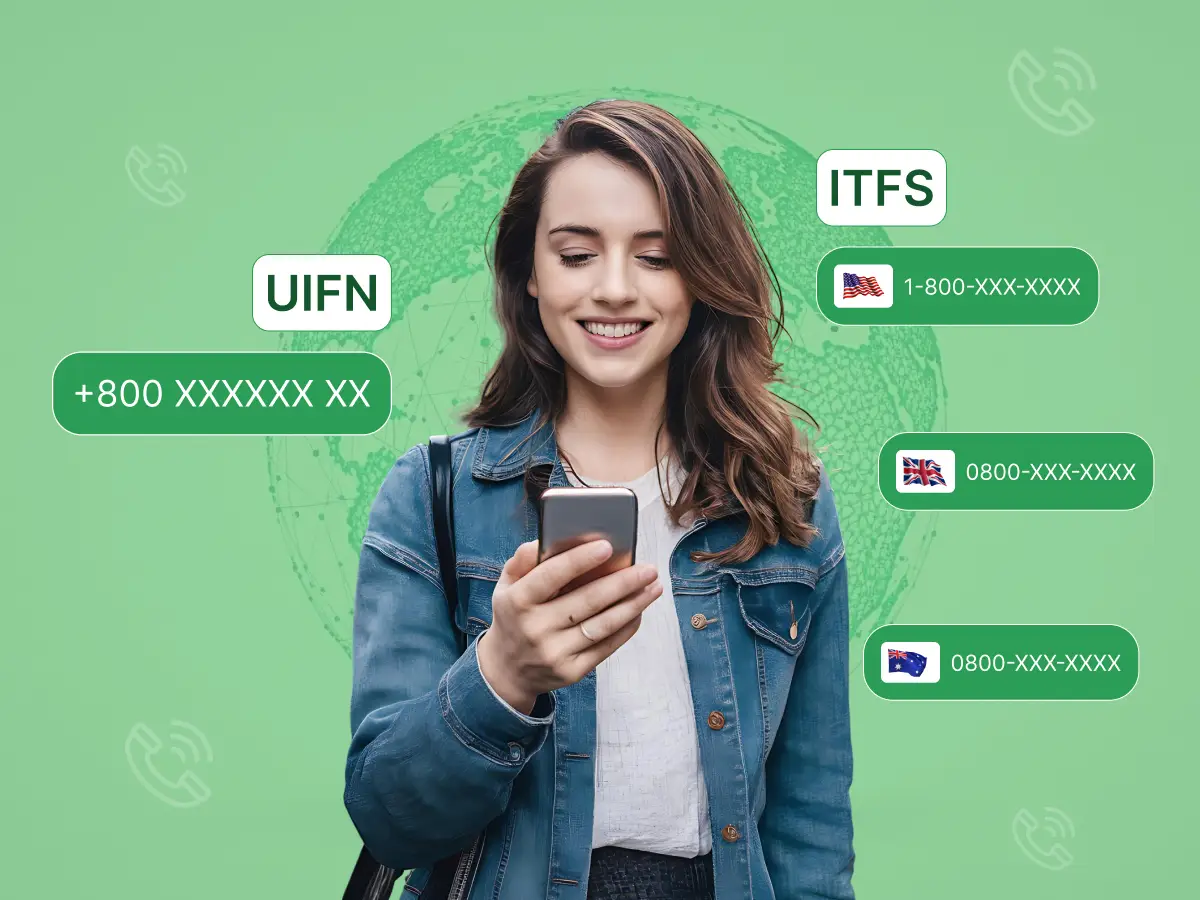
Global businesses face a massive hurdle today. You have customers in London, partners in Sydney, and prospects in Tokyo. You want to speak to them. But they do not want to pay international fees to call you. If you put up barriers to reaching out to you, they will simply get in touch with your competitor. This is the point where the mix, up begins. You look for an answer and come across two acronyms: UIFN and ITFS.
Both promise global reach. Both claim to be the best business phone solution. But choosing the wrong one can cost you thousands in setup fees. It can leave you with a number that your international customers cannot even dial from their mobile phones.
This guide is your deep-dive comparison. We go beyond the basic definitions. We explore the major differences between UIFN and ITFS, the hidden costs, the technical limitations, and the role of the modern contact center. We also show you how to layer AI products and cloud communication tools to turn these numbers into growth engines.
So, with these resources, how would you really go about making the customers happier while also increasing your income is something that you will have figured out by the very last page of this manual.
Before we fight the battle of UIFN vs ITFS, we need to understand the battlefield. Why do you need these numbers?
When you operate locally, trust is automatic. When you operate globally, trust is the hardest thing to earn. An international phone number is not just a utility; it is a psychological signal. It tells the customer, “We are here. We are established. We are safe to do business with.”
ITFS stands for International Toll-Free Service. Think of an ITFS number as a local branch office that lives in the cloud. You are physically located in the United States (or anywhere else), but you own a phone number that belongs to France, Germany, or Australia.
When you buy an ITFS with a toll-free number, you are buying a number that uses the specific toll-free prefix of that country.
When international customers call this number, the call is free for them. The business phone system instantly forwards the call to your office, your mobile, or your support team, regardless of where they are sitting.
ITFS provides the path of least resistance. It is psychological. When a customer sees a number format they recognize, they trust it. It feels local. It feels safe.
If your communication strategy is to enter the German market, buying a German ITFS number makes you look like a German company. You do not need a physical office in Berlin. You just need the right cloud communication provider.
UniversalUIFN means Universal International Freephone Number.
This is the “one ring to rule them all” approach. A UIFN is a single number that is registered across multiple countries. It is managed by the ITU (International Telecommunication Union).
A UIFN usually follows a specific format: +800 followed by 8 digits.
For example: +800 1234 5678.
If you register this number, you can activate it in participating countries. A customer in France dials that number. A customer in Japan dials the exact same number. They both reach your support team.
Here is the secret that many providers don’t tell you upfront. It is not exactly the same dialing experience everywhere.
To dial a universal international freephone number, the caller must enter their country’s International Access Code (IAC) before the +800.
Consequently, it is necessary for you to inform your customers of the manner in which they are required to dial the number depending on where they are.
This is the most critical part of your decision. We will break down the major differences between UIFN and ITFS. We will look at cost, reach, usability, and technical integration.
ITFS wins on pure coverage. You can get an international toll-free number in roughly 150+ countries. If you need to reach customers in a smaller developing nation, ITFS is likely your only choice.
UIFN is more exclusive. It is currently available in about 50 to 60 countries. These are mostly developed nations with advanced telecom infrastructure. If your business targets a country not on the UIFN list, the universal international number simply won’t work there.
Pricing models differ significantly. This is where your budget gets decided.
ITFS Number Cost:
UIFN Cost:
The Verdict on Cost: If you are only in 2 or 3 countries, ITFS is much cheaper. If you are in 20+ countries, the administrative cost of UIFN might balance out, but the initial setup fee remains high.
This is the “deep intent” detail that saves you headaches.
ITFS is robust. It works from payphones, landlines, and almost all mobile networks. It is treated like a standard toll-free call in that country.
UIFN has struggles. In some countries, mobile carriers block calls to UIFN numbers. Or, they charge the caller a fee to dial them (defeating the purpose of “toll-free”).
How fast do you need to launch?
It is not enough to just buy a number. You need to connect that number to a virtual contact center that can handle the traffic. This is where business growth actually happens.
Modern telephony is not about a phone ringing on a desk. It is about data, routing, and AI.
Whether you choose UIFN or ITFS, the number must point to your contact center software. This integration allows you to:
The goal of any business calling strategy is to enhance customer satisfaction.
Pro Tip: If you run a contact center, you can actually mix and match. You can use ITFS numbers for your sales lines (to maximize inbound leads) and a UIFN for your specialized “Gold Support” line for enterprise clients who travel frequently.
To help you make a fast decision, let’s look at the ITFS limitations, pros, and the UIFN trade-offs in a structured way.
Pros:
Cons:
Pros:
Cons:
We analyze data from thousands of businesses. Here are the traps they fall into when setting up international phone lines.
In the world of business calling, “Toll-Free” means the business pays for the call. However, when dealing with international freephone numbers uifns, regulations vary. Even though the call is free, in certain countries local mobile carriers might still charge the caller for airtime minutes.
The Solution: It is better to always have a disclaimer on your website saying: “Calls are free from landlines; mobile charges may apply. ” Such openness is a customer trust builder.
You buy a number for the UK, but your team is in California. The UK customer calls at 10 AM London time. That is 2 AM in California.
Specific countries have strict rules. To get a toll-free number in countries like Germany, France, or Indonesia, you may need to provide proof of address, business registration, or a Letter of Intent (LOI).
Inbound is great, but robust outbound call center software strategies drive aggressive growth.
You have chosen between UIFN and ITFS. Now, you need to make that number perform. A phone number is just a pipe; the value comes from the AI products and software you attach to it.
Here is how to optimize for business growth using modern tech.
Listening to hours of call recording files is impossible for a busy manager. Yet, the data in those calls is gold.
Cultural nuances matter. The way you sell to a US customer differs from how you sell to a Japanese customer.
Inbound is great, but outbound call strategies drive aggressive growth.
People read texts. Text messages have a 98% open rate.
The sun never sets on a global business. Your call management strategy must reflect this.
When you operate an international phone system, you are subject to the laws of those countries. Ignoring this can lead to fines.
In the US, many states are “one-party consent” (only one person needs to know the call is recorded). In Europe, under GDPR, you often need “two-party consent.”
Some countries require that data about their citizens (including call logs and voicemails) be stored on servers within their borders.
To help you decide UIFN vs ITFS, let’s look at how specific industries use them.
You now understand the complexity of UIFN vs ITFS. You know you need more than just a number; you need a communication strategy.
This is why businesses choose Dialaxy. We don’t just sell numbers; we build connection infrastructure.
Setting up an international freephone number UIFN can be a bureaucratic nightmare. We handle the paperwork. We navigate the carrier regulations. You just log in to your dashboard. We make the difficult process of reaching customers abroad simple.
When calling internationally, line quality is the biggest risk. Jitter and latency destroy trust. We have optimized our network for global businesses. We ensure that a call from Singapore sounds like it is coming from next door. This clarity is essential for accurate call transcription and speech-to-text accuracy.
We don’t make you buy separate software for intelligence. Our platform includes AI products for text generator summaries, sentiment analysis, and automation. We turn your phone data into business insights.
Whether you need one number or one thousand, our pricing is transparent. We help you mix and match. You can have a UIFN for your main brand and ITFS numbers for your local campaigns. We support your business growth at every stage.
Choosing between UIFN and ITFS isn’t just a technical decision, it’s a strategic one that defines how the world perceives your brand.
If you are scaling rapidly, testing new markets, or need a cost-effective way to look local in specific countries, ITFS is your agile powerhouse. It offers speed, mobile accessibility, and budget-friendly flexibility. However, if you are an established enterprise protecting a unified global brand identity across major economies, investing in a UIFN sends a powerful message of stability and prestige.
Ultimately, the number itself is just the starting point. The real competitive advantage lies in what you do with it, integrating AI analytics, optimizing routing for 24/7 coverage, and delivering a flawless customer experience from the very first ring.
Don’t let borders limit your business potential. Whether you choose the local trust of ITFS or the universal prestige of UIFN, the most important step is simply being available where your customers are.
Ready to take your business global?
Stop guessing and start connecting. [Get your custom international number with Dialaxy today] and build the communication infrastructure your global customers deserve.
The key differences lie in coverage and format. ITFS (International Toll-Free Service) uses a unique, local-looking number for each country (e.g., a UK number for the UK). UIFN (Universal International Freephone Number) is a single number (+800) that can be dialed from multiple countries.
No. This is a major advantage of ITFS. Since the number is country-specific, it works like any local toll-free number. The caller does not need to know any special access code. You typically only need an IAC when dialing a universal international number.
Yes, but it depends on the provider and the country. Modern cloud communication platforms like Dialaxy often allow you to “text-enable” your business numbers. This lets you use text messaging and bulk sms features using the same number that customers call.
For 90% of small businesses, ITFS is the better choice. The ITFS number cost is significantly lower because you avoid the steep ITU registration fees. It also offers better accessibility from mobile phones, which is how most customers call today.
There are approximately 50 to 60 participating countries. This includes major economies like the UK, France, Germany, Australia, Japan, and China. However, coverage is not worldwide. If you need to reach customers in non-participating countries, you must use ITFS.
Yes. Dialaxy offers a comprehensive inventory of both country-specific toll-free (ITFS) and global toll-free (UIFN) numbers. We also provide the phone system software to manage them, including features like call forwarding, call recording, and AI analytics.
Absolutely. With a VoIP system, distance is irrelevant. You can perform live call monitoring on a call originating from Italy just as easily as a local call. This is essential for maintaining brand image and quality control in global businesses.
AI helps by breaking down language and data barriers. Using speech-to-text, you can transcribe calls instantly. Using a text generator, you can create summaries of long conversations. This helps managers oversee a global contact center without needing to listen to every minute of every call.
Generally, no. The quality depends on the carrier network and your VoIP provider, not the number type. However, ITFS calls stay on local networks longer before hitting the international leg, which can sometimes offer slightly more stability in developing regions. Dialaxy optimizes routing for both to ensure HD voice quality.
