

Voice Biometrics and VoIP: Next-Gen Security for Call Centers


Call centers deal with sensitive customer information on a daily basis. Security questions and passwords are not sufficient anymore. Voice biometrics and VoIP authentication is a more intelligent approach to identity protection and making calls efficient and smooth.
By combining voice recognition systems with your existing VoIP setup, you can prevent fraud, secure partner portals, and improve operational efficiency.
According to a study conducted, the global voice biometrics market was valued at around USD 2.53 billion in 2022 and is estimated to grow at about 23.48% from 2023-2028.
Voice biometrics is one new invention that has completely changed how businesses confirm identities. Utilizing the unique characteristics of each person’s speech, voice biometrics provides an advanced means of security.
This blog provides in-depth information about voice biometrics and how it works in call centers, along with some benefits and common challenges.
Your call center handles sensitive information every day. Customer identities, account details, and personal data flow through calls, emails, and chat. Yet, many businesses assume basic security is enough.
Let’s take a closer look at how secure your operations really are.
Conventional authentication, such as security questions or a password, is not sufficient anymore. Voice biometric authentication provides an additional step. It identifies identities using the voiceprint of a person.
This minimizes fraud and safeguards customer information. Begin by using it together with multifactor authentication to ensure maximum safety.
The current voice recognition can be used to identify suspicious behavior and stop fraud before it occurs. Passive voice biometrics operate in the background, and active voice biometrics authenticate identity in urgent communication.
Real-life example:
These systems identified repeated attempts of fraud early in a financial call center, saving thousands of dollars in losses.
It is important to make sure that your software is up to date so that the system can record the changing vocal features and background noise patterns.
The most effective technology will not work when your team has not been trained. Train agents on how to deal with sensitive information and how to verify customers safely.
They should be encouraged to use the partner portal in a safe manner and adhere to operational efficiency practices.
Relate this to real-life situations: in cases where the identity of a caller is properly checked by the agent, this would save undue confrontations and increase customer confidence.
Your voiceprints must be stored in your biometrics software, and all data must be encrypted. Do not use conventional techniques that can easily be violated.
Voice biometrics in the call centers will mean that a hacker may have gained access to the system, but still, the customers will not be identified.
This ensures the safety of your workforce as well as your clients.
Security isn’t one-time work. Regularly check systems for vulnerabilities. Track fraud incidents and improve authentication processes accordingly.
Use real examples: after reviewing their call center security, one company upgraded to active and passive voice biometrics, cutting identity fraud by 70%.
Voice biometrics is a technology that uses a person’s voice to identify and authenticate them. According to this technology, every individual has a different frequency pattern and set of vocal characteristics.
It analyses a set of characteristics that can be used to identify the individual, such as rhythm, pitch, frequency, and tone.
This technology uses machine learning algorithms and voice databases. It analyses and compares the data of known voice features with the unknown ones, and if there is a match between the voices, the voice biometrics system will determine who is speaking.
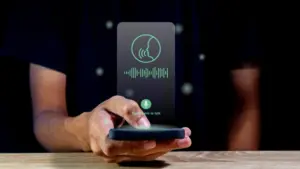
When a customer speaks, the system captures their voiceprint. Each voice has subtle traits, tone, and speech patterns that are almost impossible to mimic. The system compares the voice against stored data and grants access if it matches.
Using passive voice biometrics, verification can even happen without interrupting the conversation. This improves operational efficiency while protecting customer data.
Consider a call center in a bank. Fraudsters would be able to guess the answers to security questions or utilize stolen passwords without voice biometrics. In active voice biometrics, agents immediately identify the identity of the caller.
This helps to avoid fraud and minimizes the time of dispute resolution. Most centers record reduced cases of fraud when voice biometrics are installed in the call centers.
Customers want their personal data to remain secure. The use of voice biometric is a sign of security. It also simplifies the verification process, and calls are quicker and more secure.
Voice biometric authentication keeps your staff and your customers safe, regardless of whether you are dealing with sensitive financial information or sensitive health information.
Using voice recognition systems doesn’t just reduce fraud. It also supports multifactor authentication, ensuring multiple verification layers. Agents can focus on assisting customers rather than repeatedly confirming identities.
This creates a secure and smooth experience, connecting technology with human touch.
The following are the two main types of voice biometrics.
An active voice biometric is simply where the user is expected to actively participate. This means repeating a particular phrase multiple times to set up the voiceprint in the biometrics system and other things.
This type of voice biometric is most commonly used in high-security situations where an additional layer of security is required.
With a passive voice biometric system, the user does not have to actively participate by repeating a specific phrase to set up their voice data.
It is more of a user-friendly approach to voice biometrics, as this method uses the user’s voice during a regular conversation.
Many call centers already rely on VoIP systems to handle calls efficiently. Adding voice biometric authentication doesn’t require replacing your setup. Instead, it layers security on top of what you already have.
This means you can protect customer identities without slowing down operations.
Modern biometrics software can connect directly to your voice recognition system. It captures a voice sample during the call and compares it to stored voiceprints.
Both active and passive voice biometrics work with VoIP, allowing verification without interrupting conversations. This improves operational efficiency while keeping fraud attempts at bay.
In the case of VoIP integration, alerts can be sent immediately in case of suspicious activity. As an example, a system flags a call when the vocal characteristics of a caller do not match those stored.
A large number of centers record a decrease in fraud cases after voice biometrics on call centers is implemented. Relating this to multifactor authentication will provide several levels of verification for sensitive transactions.
Instead of re-authenticating customers, agents can concentrate on assisting the customers. The automatic verification of identities by the system allows your team to make more calls with confidence.
Such tools as partner portal and biometrics software dashboards are useful to track the activity and preserve sensitive data.
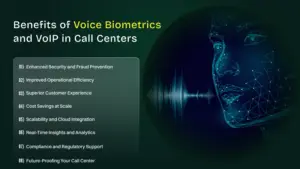
Voice biometrics is also a secure technology by nature since no two individuals have the same voiceprint, and it is very hard to duplicate it correctly.
You have a proactive and responsive security framework when VoIP is combined with its capacity to route and monitor digitally.
Voice biometrics can significantly reduce Average Handle Time (AHT) by eliminating time spent on manual verification.
Customers today expect fast, secure, and frictionless interactions. Voice biometrics and VoIP deliver all three.
The result? Higher Net Promoter Scores (NPS), stronger customer loyalty, and fewer complaints about security hassles.
While there is an initial investment in integrating voice biometrics and upgrading VoIP infrastructure, the long-term ROI is substantial.
Because both VoIP and voice biometrics are cloud-ready, they’re ideal for businesses planning to scale operations, expand to new regions, or shift to remote/hybrid call centers.
Cloud-based platforms also allow integration with CRMs (like Salesforce or HubSpot), making it easier to personalize interactions securely.
VoIP systems allow for detailed call logging and real-time transcription. When combined with voice biometrics, this data becomes more powerful.
Voice biometrics data can also fuel predictive analytics, helping call centers better prepare staffing and security protocols.
Regulatory bodies increasingly require strong authentication and audit trails for customer interactions. Voice biometrics simplifies compliance by providing:
For industries like finance, healthcare, and insurance, where security and compliance are non-negotiable, voice biometrics is more than a convenience—it’s a legal safeguard.
Technology is evolving fast. Adopting voice biometrics and VoIP today positions your business to stay ahead of:
Companies that embrace these technologies today will be in a better position to change and compete as the future of customer service is becoming more automated and intelligent.
Companies that are forward-looking and implement voice biometrics and VoIP not only secure their customers- they stand out as unique in the market.
When the customers are confident that their data is secure, brand trust is enhanced.
Advanced security is a feature you can market and develop a brand image of a modern, secure, and customer-first brand.
Voice biometrics is a potent weapon, yet it does not lack its difficulties. When call centers adopt and expand these systems, they tend to face barriers that may affect accuracy, user experience, and efficiency.
We are going to discuss the most widespread challenges and their impact on the practical implementation of voice biometric solutions.
VoIP call quality can be inconsistent due to poor internet connectivity, jitter, or packet loss, especially in remote work environments or with customers using mobile phones.
A person’s voice is not always consistent. Factors like illness (e.g., cold or sore throat), stress, aging, or emotional state can change vocal characteristics.
Enrollment of voiceprints is essential for case authentication in the future. Not every customer is, however, comfortable or willing to join biometric programs.
While voice biometrics is generally secure, deepfake technology and synthetic voice tools are advancing rapidly, raising concerns about spoofing.
However, not all vendors offer robust protection out of the box.
Like any biometric system, voice recognition may occasionally misidentify a user (false positive) or fail to authenticate a legitimate one (false negative).
Voice biometrics integration in the existing VoIP or CRM systems can be resource-consuming and complicated.
The most effective technology will never work without appropriate agent onboarding and process alignment.
Voice biometrics involves collecting and storing sensitive biometric data, which is subject to strict regulations under:
Deploying a voice biometrics solution can involve significant upfront costs:
Some voice biometric systems are susceptible to multilingual environments or high-regional accents, particularly when the model was not trained on a wide range of data.
Nevertheless, these problems notwithstanding, the majority of the difficulties that are linked to voice biometrics in call centers can be prevented through adequate planning, an appropriate technology partner, and training of employees.
As the technology evolves, it will become more accurate, more integrated with AI, and accepted by the masses.
Many call centers use call recording to track conversations. While it stores audio for later review, it does not verify a caller’s identity.
Voice biometrics, on the other hand, analyzes a person’s unique vocal characteristics in real time. This makes it a proactive security tool rather than a passive record.
| Feature | Voice Biometrics | Call Recording |
|---|---|---|
| Purpose | Verifies caller identity in real time using voice biometric authentication and voice samples | Captures conversations for compliance, training, or dispute resolution |
| Security | Prevents fraud, protects customer identities, and works with multifactor authentication | Does not prevent fraud; used for documentation only |
| Technology | Uses voice recognition systems, biometrics software, and stored voiceprints | Uses basic audio recording through the VoIP system |
| Operational Impact | Enhances operational efficiency, reduces verification time, and allows passive voice biometrics | Helps monitor performance, but does not speed up verification processes |
| Real-Life Benefit | Blocks unauthorized access before it happens, and reduces fraud incidents in call centers | Provides evidence for audits, quality checks, or customer disputes |
| Integration | Works directly with voice biometrics for call centers and partner portals | Can be stored alongside call center software for review, but does not integrate with security systems |
Cloud telephony is changing how call centers operate. Voice biometric authentication is becoming a key part of securing cloud-based calls.
By integrating voice recognition systems directly into cloud platforms, companies can verify customer identities in real time without relying on traditional passwords. This protects sensitive data while improving operational efficiency.
Future biometrics software will work seamlessly with cloud telephony and voice biometrics for call centers.
Calls can be authenticated automatically using passive voice biometrics, reducing friction for customers and minimizing fraud incidents. This lets agents focus on helping clients rather than repeating authentication processes.
Next-generation systems will analyze vocal characteristics and speech patterns more accurately. AI will detect anomalies in real time, preventing fraud before it affects customers.
Combining this with multifactor authentication ensures multiple layers of security.
Voice biometrics won’t just verify identities on calls. It will secure partner portals, protect sensitive customer data, and even assist with regulatory compliance.
Call centers adopting voice biometrics software will see stronger security, fewer disputes, and better customer trust.
A cloud-based financial call center implemented both active and passive voice biometrics. Fraud attempts dropped sharply, and agents handled calls faster because identity verification was automatic.
Integrating voice biometrics technology with cloud systems proved both efficient and secure.
Your customer’s voice is more than just a way to communicate. It’s a unique identifier that can protect their identity and secure sensitive data.
Using voice biometric authentication, call centers can verify customers instantly, reducing fraud and boosting trust. This makes every call safer without slowing operations.
Every person has distinct vocal characteristics and speech patterns. Voice recognition systems capture these traits in a voice sample and create a secure voiceprint.
This ensures only the authorized customer can access their information, complementing multifactor authentication for extra protection.
Imagine a financial call center. Without voice biometrics, agents rely on passwords or security questions, which can be stolen. With voice biometrics for call centers, the system verifies the caller automatically.
Fraud attempts drop, and agents spend less time on verification, improving operational efficiency.
Customers appreciate convenience and safety. By relying on voice biometric systems, you protect both customer identity and your call center’s reputation.
Secure calls become faster, safer, and more trustworthy, connecting technology with a human touch.
Voice biometrics allow strong identification verification and are a groundbreaking advancement in security technology.
They offer a smooth and user-friendly authentication process, improving security as we become more dependent on digital interactions. Voice biometrics is also going to change the way we handle and safeguard sensitive data in the future.
To summarize the above article, we have mentioned all the necessary information regarding voice biometrics and how it works in call centers. We hope you enjoyed reading this blog post.
As always, we recommend that all our readers do their research before considering implementing it in their small business.
Voice biometrics is a new technology that recognizes and identifies individuals based on their unique vocal and other characteristics.
Voice biometrics provide a more secure method compared to traditional passwords due to the unique characteristics of each person’s voice, authentication capabilities, and integrated anti-cyber threat measures.
Voice biometrics enhances the customer experience in call centers by simplifying the authentication process with voice verification, reducing agent wait times, and improving security measures.
The following are the challenges you might face while using voice biometrics in your call system.
The following are the industries that use voice biometrics besides call centers.
