

Proactive vs Reactive Customer Service: Key Differences

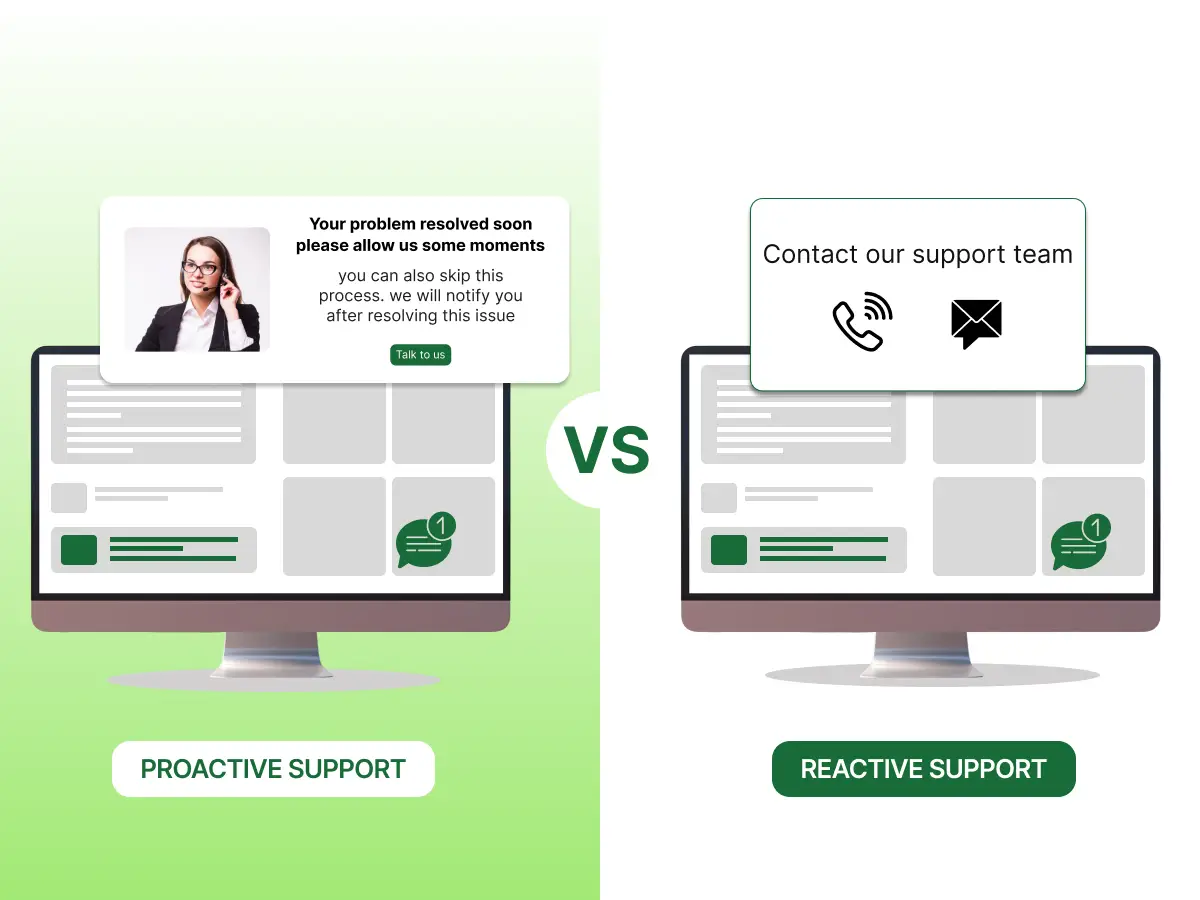
Stop waiting for complaints to destroy your brand reputation. In today’s cutthroat marketplace, scrambling to fix issues after the damage is done is a guaranteed way to bleed revenue.
This guide shows you how to balance proactive and reactive customer service. You will learn to move from just “putting out fires” to building a strong plan that keeps customer loyalty high and puts you ahead of the competition.
We move beyond simple definitions to reveal how you can transform your support team from a traditional cost center into a powerful growth engine.
The main difference between proactive and reactive service is how you handle potential issues. Reactive service is about fixing mistakes, while proactive service is about preventing them. Below is a table that differentiates the two based on their core features.
| Feature | Reactive Customer Service | Proactive Customer Service |
|---|---|---|
| Trigger | Starts when a customer feels a pain point. | Starts when a company anticipates issues. |
| Effort | High effort for the customer to get help. | Low effort as the company prevents issues. |
| Speed | Based on your team’s response time. | Instant, as it happens before a ticket is made. |
| Focus | Solving a specific, existing problem. | Strengthening long-term customer success. |
Feature Breakdown and Examples
In a reactive model, the customer interaction begins because of a failure. In a proactive model, you implement proactive steps based on data.
Reactive service requires the user to stop what they are doing to find help. Proactive service allows support teams to remove hurdles before the user even sees them.
Reactive support is always one step behind the problem. Proactive support is one step ahead, which builds trust and makes customers feel valued.
The reactive goal is “recovery,” getting the user back to where they were. The proactive goal is “retention”, keeping the user happy so they never want to leave.
Any advanced support plan requires strong reactive customer service. Since it is not possible to foresee every human mistake or technical failure, your team has to be prepared to react to situations where the unexpected happens.
Some problems appear without warning. Whether it is a sudden power outage or a global shipping crisis, you cannot always get ahead of the news.
Reactive support handles these “black swan” events that no communication strategy could have foreseen. It ensures customers never feel abandoned during a crisis.
Not every issue has a simple fix. High-level technical problems often require a deep dive that only starts once a user reports a specific, rare error.
This reactive approach allows support teams to solve the “heavy lifting” problems. These are the complex issues that automated preventive measures simply cannot catch.
A reactive channel acts as a promise of reliability. Knowing they can reach a human creates a positive customer feeling and builds long-term confidence in your brand.
When you wait for customers to bring you their toughest problems, you prove your competence. This baseline of support is required before you can successfully implement proactive tools.
Proactive support is not only a customer service unit; it is a tool to increase revenue and retain customers. By being in control, you lead the user through the customer journey and eliminate the causes of churn.
By contacting customers first, you prove that you are concerned about them. It creates trust and makes the relationship resemble a partnership rather than just being a transaction.
This strategy leads to better customer stories and higher advocacy. When customers feel looked after, they are much less likely to switch to a competitor.
Proactive work stops the “flood” of repetitive questions. By solving a problem for everyone at once, you keep your agents’ inboxes clear for more important tasks.
The math is simple: fewer tickets mean lower costs. This efficiency improves satisfaction for both the employees and the customers.
A positive customer who just received a proactive tip is much more likely to buy again. You can turn a support moment into a sales moment without being pushy.
Proactive support helps customers successfully hit their goals. When they see results, they are happy to invest more in your customer success programs.
Sales & Marketing
Sep 9, 2025
Read More
Call & Contact Center
Dec 8, 2025
Read More
Think of it this way: proactive service isn’t just about being “efficient”, it’s about how you make people feel. When you get ahead of a problem, you move the relationship from a boring transaction to a real partnership.
Here is why that works so well in simple terms:
When you do something nice for someone before they even ask, their brain naturally wants to return the favor. In the business world, that “favor” is them staying loyal to you for years.
Imagine a hotel sees it’s your birthday on your ID and leaves a cupcake in your room before you even check in. You’ll probably tell all your friends about that stay!
Nobody likes having to stop their day to call support or dig through a “Help” page. When you fix the issue first, you’re giving them back their time and energy.
For instance, an app sends you a quick ping: “Hey, we saw your upload failed because your Wi-Fi cut out, we went ahead and restarted it for you.” You didn’t have to lift a finger.
Real trust isn’t built when things are perfect; it’s built when a customer realizes you’re always looking out for them. It makes them feel safe.
Let’s say your bank calls to ask if you really just bought a TV in another country. They caught a thief before you even knew your card was missing.
Unexpected help makes people happy. It’s a pleasant surprise that sticks in their memory way longer than a standard “we fixed your bug” email.
For example, a car shop notices your tires are getting dangerously smooth during a simple oil change. They call you with a discount on new ones before you end up stuck on the side of the road with a flat.
Changing from reactive to proactive support means that instead of just waiting for a call, you should start using the data to detect issues beforehand.
The shift also involves changing the customer service culture from one that solves problems to one that prevents them. It is done by recognizing the customer journey points that can frustrate customers before they do so.
The first step is to look at what is already breaking. Review your reactive customer tickets to find questions that appear every single week.
Most users would rather find answers on their own than call a support line. A strong knowledge base is a great preventive step that you take proactively.
You can anticipate issues by watching how people move through your digital product. If someone gets stuck on a specific page, reach out right there.
Good customer care also involves honesty when things are not going well. Inform your users in case you have a service outage ,instead of them having to ask why the site is down.
Use your data to spot a “quiet” user who might be unhappy. A sudden drop in how often someone logs in is a major signal that they might leave.
AI and automation act as the engine for modern proactive and reactive customer care. These tools monitor thousands of users at once and act in real-time. By implementing proactive tech, you can meet customer expectations much faster than a human team could alone.
Predictive analytics looks at customer behavior to find patterns. It spots when a user is struggling, such as when they click the same link many times. It then alerts a project manager to help before the user gets angry and quits.
Today’s bots do not just wait until customers type a message. They can send in-app messages based on what a user is doing on your site. Through this, the bot can provide the necessary assistance at the exact moment the user gets stuck or confused.
During a tech crash, you do not want your call centers to be flooded with the same question. AI-monitored status pages find system errors instantly and update a public page to let everyone know you are already fixing it.
Sentiment analysis “reads” the mood behind social media posts and emails. It helps your customer care team see if there is rising customer frustration about a specific feature before it becomes a major public problem.
Smart machines can now check themselves for errors. They report problems directly to the company. This creates a positive customer experience because the machine is often fixed before the owner even knows it was broken.
AI can track how often a person uses your app to create a “health score.” This helps you deliver proactive help to people who have a low score and might be thinking about leaving your service.
AI can read what a user is typing into a support form and suggest a help article right away. This proactive and reactive mix helps the user solve their own problem before they even finish sending the message.
To deliver proactive customer service, you must measure how well you are preventing problems. It is not enough to just track how fast you fix them. Using these metrics helps you see if your customer service strategy is actually working to improve satisfaction.
These numbers show how well you handle a crisis. They measure the work your team does when they wait for customers to ask for help.
Proactive metrics are indicators of the value of your preventive measures. It proves that taking measures before issues arise saves the company both time and money.
Making customers happy is not about picking just one way to help. It is about using both models together. While reactive support is your safety net for surprises, proactive service is your secret tool for fast growth. By using data and AI to solve problems before they happen, you do more than just close tickets. You build real trust and customer loyalty.
Do not let your business be known only for how well you say “sorry.” Instead, be known for how well you stop mistakes from happening. You now have the tools and steps to succeed. It is time to stop looking back at errors and start looking forward at ways to help. Start helping your customers today, and watch your success reach new heights.
Don’t let a missed call become a lost lead. Turn every “no-answer” into a professional touchpoint with Dialaxy’s Custom Voicemail Greetings. Set clear expectations, provide instant info, and build trust even when you’re away.
No human error or technical failure can be predicted. That’s why every business still needs a reactive support team to handle complex issues, unexpected situations, and customer problems that proactive tools cannot prevent.
Proactive customer service increases customer loyalty, improves retention, and reduces support ticket volume. By preventing issues before they occur, businesses lower support costs and turn customer service into a growth driver instead of a cost center.
AI continuously monitors customer behavior and identifies potential issues before they become problems. Technologies such as predictive analytics, chatbots, and sentiment analysis help deliver timely, personalized support.
Track metrics such as ticket deflection rate, customer churn rate, customer satisfaction (CSAT), and retention. If support requests decrease while customer loyalty increases, your proactive strategy is working.
You don’t need expensive software to get started. Review past support tickets to identify common questions, create helpful knowledge base articles, and send welcome or check-in emails to new customers to prevent issues before they arise.
