

Predictive Dialer vs Auto Dialer: Key Differences

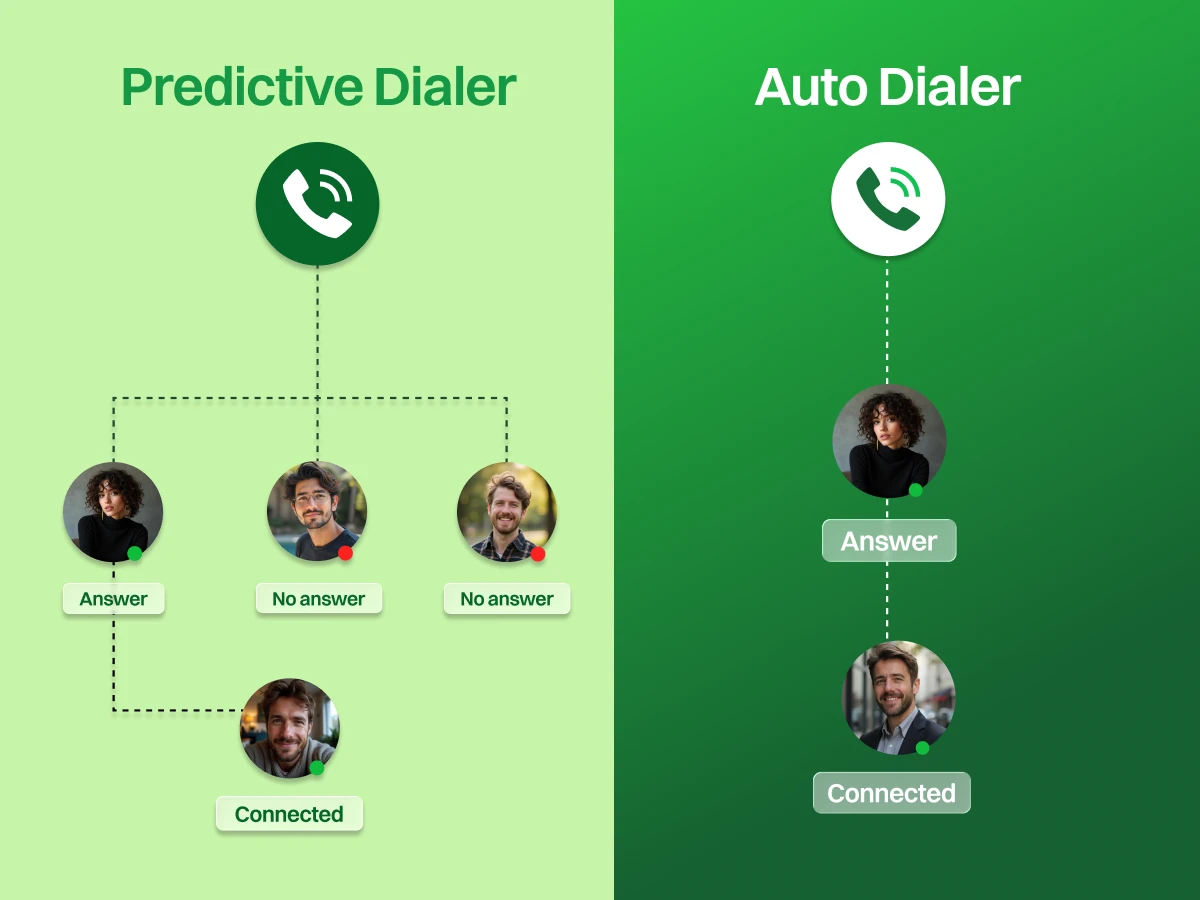
A predictive dialer calls multiple numbers at once and uses agent availability to decide when to connect answered calls. An auto dialer typically calls one number at a time and moves to the next contact when the agent is ready. The main difference is how aggressively each system places calls and manages agent availability.
Let’s explore how these tools work. This guide will show you the real truth behind predictive dialer vs auto dialer for success.
An auto dialer is a reliable tool that automatically calls one person at a time. It works through a preloaded list and moves to the next name after each call. This system ensures that an available agent is always ready when someone finally picks up. Most modern versions of this technology are actually known as a power dialer in reality.
An auto dialer is much better for high-ticket sales, where every conversation is valuable. Small to medium teams love this because it creates a very high-touch customer experience. You can focus on building trust instead of just rushing through thousands of cold names. Using auto dialer software allows your agents to be fully prepared before the call starts while maintaining consistent call metrics across campaigns.
Key Benefits of Auto Dialers
A predictive dialer is a type of automated phone system designed to increase outbound calling efficiency. It dials multiple numbers at the same time, even before an agent is actually free. This outbound predictive dialer uses a pacing ratio to stay ahead of the calling queue.
If the algorithm thinks three agents will be free soon, it might dial ten numbers. This strategy is perfect for large-scale telemarketing or when you are doing debt collection. Modern predictive dialer software uses machine learning to get better at predicting agent wrap-up times. This is the ultimate tool for teams of ten or more people with cold lists. It maximizes the number of live connections your team makes during every single working hour.
Key Benefits of Predictive Dialers
To choose the best outbound calling strategy, it is essential to understand how different automation tools handle call initiation and agent idle time. While both systems eliminate manual dialing, they optimize for different goals: Auto Dialers focus on steady, high-quality outreach, whereas Predictive Dialers prioritize massive call volume and agent talk time.
The table below highlights the main differences between predictive and auto dialers so that you can figure out which system meets the needs of your call center operations.
| Feature | Auto Dialer | Predictive Dialer |
|---|---|---|
| Calls per hour | Moderate number of calls, focused on quality | Very high number of calls, focused on quantity |
| Risk of dropped calls | Low, because calls only go through when the agent is ready | Higher, multiple calls are dialed simultaneously |
| Agent preparation time | High, agents can review the lead before each call | Minimal, calls connect immediately to available agents |
| Cost per lead | Higher due to slower dialing and fewer calls | Lower due to more calls per hour and automation |
| Legal compliance level | Easier to comply, low risk of abandoned calls | Moderate, requires pacing and monitoring to stay legal |
| Dialing method | Sequential dialing, one after another | Algorithm-driven, predictive pacing based on agent availability |
| Agent wait time | Minimal, the agent is always ready for the next call | Nearly zero, the system predicts availability to reduce idle time |
| Call volume capacity | Medium, suitable for smaller campaigns | Very high, can handle large outbound call campaigns |
| Ideal team size | Small to medium teams, personalized approach | Large teams, optimized for high call volume and efficiency |
| Complexity and cost | Simple setup, lower cost | More complex setup, higher implementation and maintenance cost |
| Compliance risk level | Low risk, fewer abandoned calls | Moderate to high risk if not monitored properly |
When you use an automated dialer system, you aren’t just making phone calls. You are stepping into a heavily regulated legal landscape. In 2026, the rules for predictive dialer vs auto dialer usage have become even stricter to protect consumers from annoying robocalls. If you don’t follow these guidelines, your business could face massive fines for every single illegal call.
The Telephone Consumer Protection Act (TCPA) is the most important federal law you need to know. For predictive dialers, the biggest danger is the 3% Rule. Because predictive dialers call multiple people at once, sometimes a customer answers when no agent is available to talk.
If this happens, the call is considered “abandoned.” By law, your abandonment rate must stay below 3% per campaign over a 30-day period. If you go over this limit, you are officially in the “danger zone” for lawsuits. Modern dialers now include “Safe Dial” features that automatically slow down the calling pace if the abandonment rate gets too high.
In 2026, the FCC will have fully implemented the STIR/SHAKEN framework. This is a digital “handshake” that verifies your phone number is real and not spoofed.
When your calls have a low rating, they show up as “Spam Likely” or “Telemarketer” on the customer’s screen. Using a high-quality predictive auto dialer that is properly registered helps you maintain a high trust score, so people actually pick up the phone.
The law regarding consent has changed recently. If a customer says “stop calling me” or “remove me from your list,” you used to have 30 days to process that request. As of 2025 and 2026, you now only have 10 business days to remove them from your database.
Whether you use an automatic dialer or a predictive dialing system, your software must be able to sync with your CRM integration immediately. This ensures that an agent doesn’t accidentally call a person who just opted out, which is a very common way businesses get sued.
While federal laws are important, states like Florida, Maryland, and Oklahoma have passed their own “Mini-TCPA” rules. These states are even more aggressive.
For example, some states prohibit calling residential numbers on Sundays or after 8:00 p.m. local time. Your outbound calling strategy must use “Time Zone Protection” features so you never accidentally call someone in Seattle at 6:00 a.m. just because it is 9:00 a.m. in New York.
If you are using an outbound predictive dialer for marketing, you almost always need prior express written consent. This means the person must have checked a box or signed a form saying they specifically want to hear from your company. You cannot simply buy a list of numbers and start using an autodialer on them without checking their consent status first.
| Legal Requirement | Why It Matters | Key Action / Compliance Tip |
|---|---|---|
| National DNC Registry | Prevents calling people who opted out of telemarketing | Scrub your contact lists every 31 days to remove registered numbers |
| Call Recording Laws | Protects privacy and avoids legal penalties | Ensure both parties consent if required by state law before recording |
| Caller ID Transparency | Builds trust and prevents spam complaints | Display a valid and reachable phone number on every outbound call |
| Internal DNC List | Honors individual requests to stop receiving calls | Maintain and regularly update your own list of people who asked not to be called |
Let us look at two different scenarios to see the real-world impact. Imagine you have a team of five agents selling luxury real estate coaching. These leads are very expensive, and you only have a few hundred names. An auto dialer is the winner here because it protects your lead quality. You cannot afford abandoned calls when each lead costs fifty dollars to get.
Now imagine a team of twenty agents doing a nationwide survey. You have one million phone numbers, and the goal is just data collection. A predictive dialer is the best choice because it ignores busy signals. It filters out the answering machine hits and only gives agents live humans. The predictive dialer benefits shine when you need to churn through data at high speed. You can verify your potential savings using a VoIP ROI calculator.
Choose Auto Dialer if:
Choose Predictive Dialer if:
Many successful businesses do not just pick one system and stay with it forever. They use a hybrid approach to get the best results from their outbound call center. For example, you might use a predictive dialer for initial cold outreach to find interested people.
Once a lead shows interest, you can move them to a high-priority list. Then, your top agents use a power dialer to follow up and close the sale. This strategy keeps your agents’ talk time high while also protecting your most valuable relationships.
The world of contact center solutions is changing fast thanks to new artificial intelligence tools. Modern predictive and auto dialers are getting much smarter about who they choose to call. New systems use AI voice and speech analytics to understand how a customer is feeling.
Instead of just looking at agent availability, the software looks at who is likely to answer. This reduces the number of busy signals and answering machine hits your team deals with. AI can also give agents live tips during a call to help them close sales. These API integrations connect your crm integration data directly to the dialing algorithm for better results.
Choosing between these systems depends on your unique business goals and your specific team size today. If you want to build deep trust with expensive leads, the auto dialer is your best friend. It keeps every conversation personal while ensuring your agents are always ready to talk professionally.
However, if you need to reach thousands of people quickly, the predictive dialer is the right choice. It uses smart math to keep your agents busy and your call rates very high. Most successful companies eventually use a mix of both tools to grow their sales faster. By focusing on both quantity and quality, you can create a winning outbound strategy. Start evaluating your current lead lists to find the perfect balance for your contact center.
Stop wasting time on manual dialing. With Dialaxy’s smart dialing solutions, boost agent productivity, reach more prospects, and turn every call into a sales opportunity.
Yes, you can use it, but you must follow all TCPA compliance and state laws.
Yes, an auto-dialer can work with VoIP if the VoIP system supports bulk or automated calling features.
The pacing ratio in predictive dialing is the ratio of live calls dialed to available agents, used to control call flow and avoid dropped calls.
You can prevent your numbers from being marked as spam by registering them with caller ID services, avoiding excessive cold calls, and keeping a good call reputation.
Auto-dialers aren’t always illegal, but they violate laws like the TCPA when used to call cell phones without consent or make robocalls to the public.
A manual dialer requires a person to dial each number by hand, while an auto dialer dials numbers automatically and can connect calls to agents.
