

Call Center Security Checklist: 10 Must-Have Practices for Compliance

In 2023, the average cost of a data breach soared to $4.45 million.
Call centers hold sensitive customer data like PII, PHI, and payment card details, making them prime targets for cyber threats and insider risks. Every interaction is a potential point of attack, raising financial, reputational, and legal stakes.
This guide offers a proactive 10-step call center security checklist. You gain a framework to reduce risks, comply with PCI DSS, HIPAA, and GDPR, and build lasting customer trust.
Cybercriminals focus on call centers because they combine immense value with unique vulnerabilities. A contact center is a central hub where sensitive data, human interaction, and complex technology converge. This mix creates a perfect storm for security risks.
Agents handle a constant flow of sensitive information every day:
With data at rest in storage and data in transit during calls, one breach can expose thousands of records. Attackers see this as a direct path to sensitive customer data.
Even strong security measures fail when human error occurs. Agents are trained to be helpful and empathetic, but that makes them easy targets. Social engineering and phishing trick them into revealing data or credentials.
Without continuous monitoring, agent security training, and strict role-based access control, this weakness remains. The checklist ahead shows how to reduce this risk.
Call center operations run on CCaaS platforms, CRMs, and multiple communication channels. Remote work expands exposure to unsecured home networks and personal devices. Every new integration or vendor creates a possible entry point.
Without intrusion detection, encryption, and a tested incident response plan, one gap can compromise the entire system. The next section will outline how to secure this footprint.
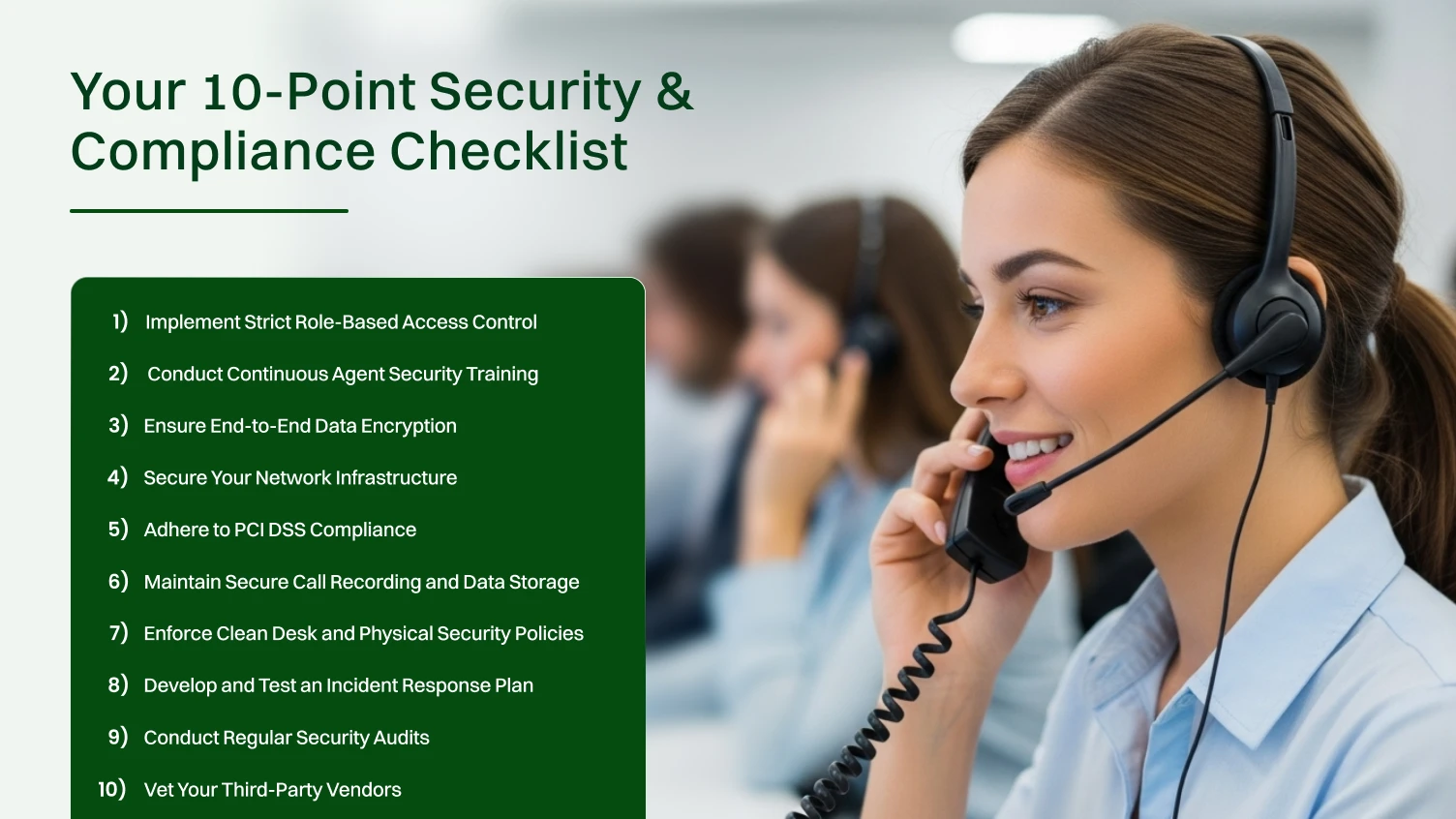
This checklist helps reduce risk, protect sensitive customer data, and strengthen compliance across call center operations. Each point builds a stronger security posture.
Why It’s Critical?
Not every agent needs access to all call center data, which is why an identity governance solution can help enforce the right permissions for each role. Role-based access control prevents unauthorized access and reduces insider threats.
Applying least privilege limits the impact of human error or account takeover. Sensitive customer data at rest stays safe when access is strictly managed.
Best Practices in Action
☐ Apply the principle of least privilege for all roles
☐ Enforce multifactor authentication across systems
☐ Review and revoke inactive or outdated accounts quarterly
Compliance Connection
PCI DSS, GDPR, HIPAA, SOC 2
Compliance with PCI DSS is essential for protecting payment card data and preventing security breaches in call center operations.
Together, these regulations form a strong compliance framework that protects sensitive information and supports call center security best practices.
Why It’s Critical?
Agents face phishing, social engineering, and insider threats daily. Human error causes data breaches and reputational damage. Security training transforms agents into defenders of sensitive customer data.
Well-trained agents protect communication channels and ensure data handling meets compliance standards.
Best Practices in Action
☐ Run phishing simulations monthly
☐ Train agents on customer identity verification
☐ Educate on handling PII, PHI, and payment card data
Compliance Connection
PCI DSS, HIPAA, ISO 27001, GDPR
Why It’s Critical?
Data encryption protects information at rest and in transit. Without encryption, unauthorized access exposes PII, PHI, and payment card details. Encryption strengthens trust and prevents data loss.
Best Practices in Action
☐ Encrypt all call recordings and CRM data
☐ Use TLS to secure communication channels
☐ Require VPNs for remote call center agents
Compliance Connection
PCI DSS, HIPAA, GDPR
Together, these standards ensure data security, reduce the risk of data loss, and build customer trust.
Why It’s Critical?
Weak network infrastructure exposes call centers to cyber threats. Attackers exploit unsecured Wi-Fi, poor access control, and outdated systems. Intrusion detection and monitoring prevent suspicious activities.
Best Practices in Action
☐ Segment networks to protect sensitive customer data
☐ Deploy updated firewalls and intrusion detection systems
☐ Enforce secure Wi-Fi and continuous monitoring
Compliance Connection
PCI DSS, ISO 27001, SOC 2
Together, these standards guide call centers in building secure communication channels, preventing data loss, and maintaining customer trust.
Why It’s Critical?
PCI DSS protects payment card information. Noncompliance risks financial penalties, customer trust loss, and reputational damage. Call centers must comply when processing card data.
Best Practices in Action
☐ Use DTMF masking for card data entry
☐ Pause call recordings during card transactions
☐ Never store CVV or authentication codes
Compliance Connection
PCI DSS
PCI DSS sets strict requirements for protecting payment card data during call center operations. It requires secure data handling, access control, and encryption to prevent unauthorized access.
Compliance reduces the risk of data breaches, financial penalties, and reputational damage. Meeting PCI DSS standards also strengthens customer trust and ensures that sensitive customer information remains secure at every stage of processing.
Why It’s Critical?
Call recordings contain sensitive information and are prime targets for cyber threats. Poor data storage risks breaches and data loss.
Best Practices in Action
☐ Encrypt call recordings at rest and in backups
☐ Apply strict data retention and deletion policies
☐ Redact sensitive customer information from stored files
Compliance Connection
GDPR, HIPAA, PCI DSS
Together, these regulations ensure call centers handle recordings responsibly, reduce the risk of data breaches, and maintain customer trust.
Why It’s Critical?
Physical security prevents unauthorized access. A single exposed password or document can trigger major data breaches. Clean desk policies strengthen call center security.
Best Practices in Action
☐ Restrict personal devices in secure call center areas
☐ Lock screens when agents leave desks
☐ Securely dispose of printed customer information
Compliance Connection
ISO 27001, SOC 2
Both frameworks highlight that strong physical safeguards support data protection, prevent data loss, and build customer trust in call center operations.
Why It’s Critical?
Security incidents are inevitable. Without a tested response plan, data breaches escalate and cause reputational damage. Plans reduce response delays.
Best Practices in Action
☐ Define clear roles for incident response teams
☐ Run regular breach simulations and drills
☐ Prepare reporting and notification procedures in advance
Compliance Connection
GDPR, HIPAA, PCI DSS
Together, these standards ensure call centers minimize data loss, maintain compliance, and protect customer trust during security incidents.
Why It’s Critical
Unidentified vulnerabilities expose call center systems. Security audits and penetration tests reduce the risk of data breaches.
Best Practices in Action
☐ Perform annual third-party penetration tests
☐ Run monthly vulnerability scans
☐ Audit role-based access control and suspicious activities
Compliance Connection
PCI DSS, SOC 2, ISO 27001
Together, these standards ensure call centers address cyber threats proactively and maintain strong customer trust.
Why It’s Critical?
Vendors handle sensitive customer data and communication channels. Weak vendor security leads to breaches, insider threats, and reputational damage.
Best Practices in Action
☐ Review vendor compliance certifications yearly
☐ Scrutinize data processing agreements carefully
☐ Monitor vendor incident response and risk assessments
Compliance Connection
GDPR, HIPAA, PCI DSS
These regulations ensure call centers reduce insider threats, prevent data loss, and protect customer trust when working with external providers.
Keep this checklist as a practical reference tool, reviewing and updating it regularly to ensure your call center stays compliant, secure, and resilient against evolving threats.
Implementing a security checklist is only the beginning. To truly protect sensitive customer data, call centers must embrace security as a core business principle.
Technology, compliance, and training are effective, but without a security-first mindset, defenses remain incomplete. Every policy, every process, and every agent decision must prioritize protecting customer information.
The next section explains why adopting a security-first approach is no longer optional. It shows how financial costs, reputational damage, and operational disruption make call center security a business-critical priority.
Call centers handle sensitive customer information every day. A security-first mindset is no longer optional.
Without it, businesses face financial loss, reputational damage, and operational chaos. Security must guide hiring, training, technology, and compliance decisions to protect customer trust.
A data breach creates immediate financial damage. GDPR fines can reach 4% of global revenue. PCI DSS violations add monthly penalties.
Legal fees, forensic investigations, and credit monitoring costs quickly rise. Direct losses also include customer compensation, higher insurance premiums, and downtime expenses.
Without strong security measures like access control and encryption, financial risk multiplies and business continuity collapses.
Reputational damage lasts longer than financial penalties. A single breach shows failure to protect sensitive customer data. Customer trust declines sharply, and churn increases.
Negative press spreads quickly, creating brand erosion that is hard to repair. Competitors gain an advantage while call centers struggle to rebuild credibility. Without secure data handling and intrusion detection, reputational harm becomes irreversible.
Security incidents cause major operational disruption. Systems may go offline during incident response, creating days of downtime. Agents face distractions as they manage angry customers and emergency procedures.
Operations are forced to adopt hasty compliance-driven changes. These adjustments drain resources and reduce productivity. Strong incident response planning, continuous monitoring, and security training prevent this level of disruption.
Regulatory compliance is non-negotiable. PCI DSS requires strict controls for payment card data. HIPAA protects health information in healthcare call centers.
GDPR enforces encryption, access control, and data loss prevention for sensitive customer data. CCPA increases pressure on businesses to secure communication channels and prevent unauthorized access. Failure leads to penalties, reputational damage, and customer trust loss.
The 10-point checklist secures call centers today, but threats and compliance requirements evolve constantly. Future strategies must anticipate new risks and adopt stronger defenses. These trends show where call center security is heading next.
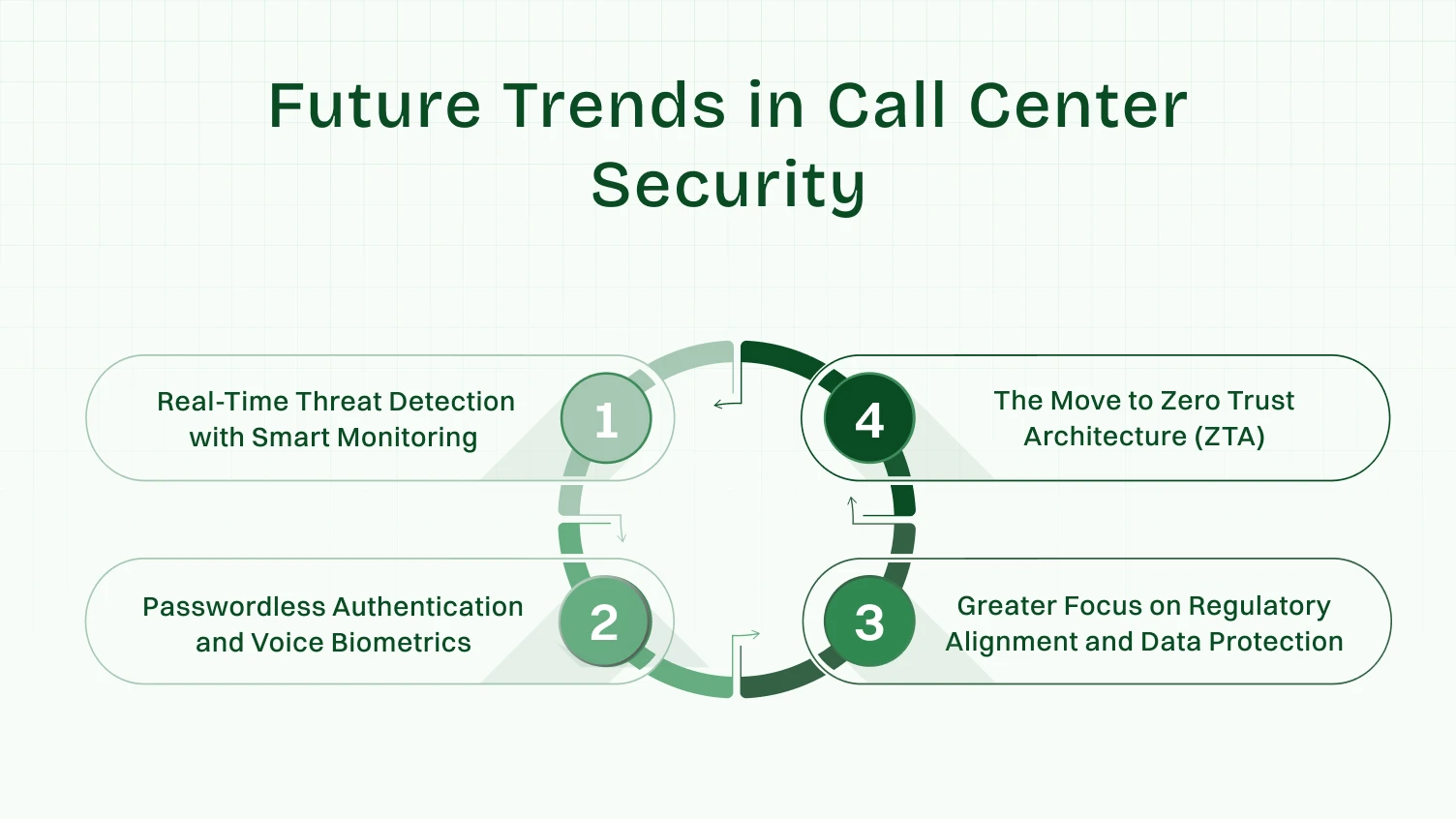
Traditional audits review breaches after they occur. The future focuses on prevention with live monitoring and continuous analysis. Smart systems will track call center data, communication channels, and suspicious activities in real time.
They will detect social engineering attempts, insider threats, and unusual access control patterns. Alerts will reach supervisors instantly to stop data breaches and protect sensitive information. Real-time monitoring will reduce human error and prevent unauthorized access before damage occurs.
Knowledge-based authentication is outdated and risky. Answers like pet names or addresses are easy to find online. Passwordless methods will take priority in call center operations.
Voice biometrics will verify customers by creating unique voiceprints from speech patterns. Within seconds, identity verification will be completed without long security questions. This reduces customer frustration and protects sensitive customer data from account takeover.
Strong authentication methods like biometrics align with PCI DSS and GDPR standards. This shift ensures secure access while building customer trust across communication channels.
The old model that trusted everything inside a network no longer works. Call centers now rely on cloud platforms and remote agents. Zero Trust Architecture enforces strict access control for every request.
Each login is verified for device health, role-based access control, and data sensitivity. Agents must pass multifactor authentication whether on-site or remote. Sensitive data at rest and in transit remains protected.
Intrusion detection and encryption strengthen the defense further. Zero Trust reduces insider threats, prevents unauthorized access, and ensures compliance with PCI DSS, HIPAA, and ISO 27001.
Regulatory compliance will grow more complex as new standards emerge. Call centers must prepare for stricter data protection regulations. Beyond PCI DSS, HIPAA, and GDPR, frameworks like CCPA demand stronger safeguards.
Future compliance will require real-time monitoring, role-based access control, and encryption for sensitive data. Continuous audits will become standard to prove compliance and protect customer information. Vendors will also face higher scrutiny, as third-party risks increase.
Strong compliance practices reduce reputational damage, prevent fines, and maintain customer trust. Call centers that align early with these regulations will reduce risk and strengthen long-term operations.
Call center security is more than a checklist; it is a culture. This 10-point framework gives you a roadmap to build it.
By applying these practices, you protect operations from financial loss, prevent reputational damage, and maintain regulatory compliance. A strong security-first mindset builds lasting customer trust.
Dialaxy provides the secure-by-design platform your call center needs.
Ready to take the next step?
Schedule a demo with Dialaxy today and see how enterprise-grade security strengthens your business.
Start with a risk assessment and a Role-Based Access Control (RBAC) audit. Controlling access to sensitive data delivers the fastest improvement in call center security.
The human element. Technology is vital, but social engineering and phishing target people first. Continuous agent security training builds awareness and reduces human error.
They are even more critical for remote work. Enforce secure, company-managed VPNs, require Multi-Factor Authentication (MFA), and apply clean desk policies in home offices.
Yes. If your call center processes or transmits payment card information, PCI DSS compliance is not optional. Non-compliance risks large fines and loss of payment processing rights.
