

Call Center Cost Reduction: All You Need to Know

Running a call center is expensive. You deal with everything from wages to tech costs. Keeping those call center expenses under control is key for any business. We all know cutting costs per call is a constant worry. That’s why Call Center Cost Reduction is always a top priority for smart managers.
This guide from Dialaxy is your complete roadmap. We will show you effective ways to lower your call center costs. You can cut spending without hurting your service quality. Getting a handle on your contact center costs is simpler than you think. We will break down everything you need to know.
Clear Understanding of Call Center Cost Reduction: You will see cost management as a strategic imperative. It is an investment in future stability, not just a cut.
Effective Strategies and Tools: You will get practical, actionable methods. These will help you reduce call center costs immediately and over time.
Measurable Results and Insights: You will learn the definitive metrics. You will know exactly how to calculate your costs per call and prove ROI.
Running a call center is expensive. Many businesses focus only on revenue growth and overlook how much money slips through call center expenses. Reducing these costs is not just about saving money. It is about creating a smarter, more efficient operation that benefits both customers and the company.
Here are the reasons why call center cost reduction is so important:
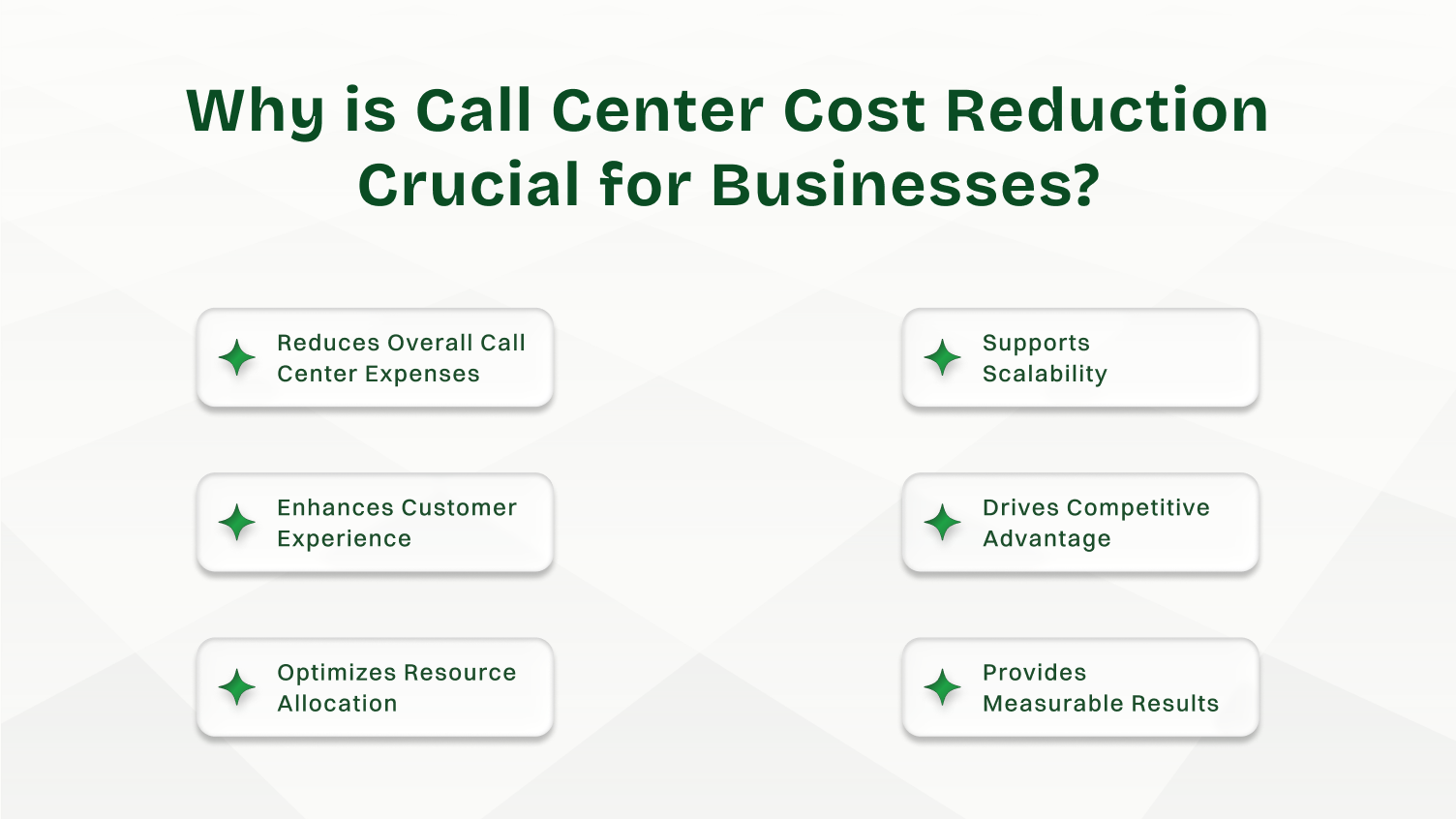
Running a call center involves more than just agent salaries. Infrastructure, software, training, and call center expenses all add up quickly. By focusing on call center cost reduction, businesses can cut unnecessary spending without impacting service. Even small improvements in cost per call or optimizing shifts can result in significant savings over time. Lower expenses free up funds for innovation, employee development, or expanding support channels.
You might think cutting costs harms service, but the opposite can be true. When a business focuses on call center cost savings, it often improves processes. Agents spend less time on repetitive tasks and more on solving complex problems. Customers get quicker responses, fewer transfers, and better overall support. Reducing wasted effort can make service feel more personal and responsive.
A high customer support cost doesn’t always equal better service. Businesses that track average cost per contact call center and measure cost per call can allocate resources smarter. Instead of overstaffing during quiet hours, you can shift focus to peak times. Instead of expensive manual processes, technology like IVR or chatbots can handle repetitive queries. Smart allocation keeps costs down and efficiency up.
As businesses grow, call center expenses grow too. Without a strategy to reduce call center costs, expanding your team or services can get costly and hard to handle. Cost-conscious planning lets you expand support teams or locations without doubling expenses. Automation, optimized scheduling, and performance tracking ensure growth doesn’t break the bank.
Companies that control call center costs gain flexibility. They can invest in new tools, training, or customer outreach. Competitors with bloated call center cost per call calculation struggle to match efficiency. A business that balances cost and quality can offer better pricing, faster service, and more personalized support. That’s a clear edge in a crowded market.
Tracking call center cost savings creates actionable insights. You can identify trends, spot inefficiencies, and prove ROI. Managers can see which initiatives reduce the call center cost per call the most. This data-driven approach ensures every effort has a purpose, making the cost reduction strategy more sustainable and credible.
There are many ways to approach reducing call center costs. Here are some effective strategies.
Overstaffing leads to unnecessary expenses, while understaffing results in long wait times that frustrate customers. You can use workforce management software to predict call volumes accurately. This ensures you have the right number of agents at the right time. These optimization directly impacts your call center cost per call.
Many customer queries are repetitive and can be resolved without live agents. You can use tools like FAQs, knowledge bases, and chatbots to handle common questions. This reduces call volume, empowers customers to find answers themselves, and allows agents to focus on complex issues, lowering overall costs.
Resolving customer issues on the first contact reduces follow-up calls and saves money. Each additional call increases call center expenses, so improving FCR is essential. Provide agents with comprehensive training and equip them with the right tools and information. This ensures issues are resolved quickly, enhances efficiency, and significantly lowers call center costs.
Investing in modern call center technology improves efficiency. This includes CRM systems, intelligent routing, and AI-powered tools that automate repetitive tasks. They also provide agents with real-time customer information. This leads to greater efficiency. It directly impacts your ability to reduce call center costs.
Well-trained agents handle calls more efficiently, make fewer mistakes, and solve issues faster. Training in product knowledge, communication, and problem-solving improves service quality and reduces average handle time, lowering call center costs.
Quality assurance is not just about customer satisfaction. It also identifies areas for improvement. Monitor agent performance regularly and provide constructive feedback. This helps agents become more efficient, uncovers process gaps, and allows you to address them. Implementing these improvements leads to significant cost savings and ensures consistent, high-quality service delivery.
You cannot manage what you do not measure. Accurately calculating your call center cost per call is the foundation of any successful call center cost reduction effort. This metric, sometimes called the average cost per contact call center use, is the best benchmark.
The Basic Formula: Call Center Cost Per Call Calculation
The calculation is straightforward, but gathering the correct data is the tricky part.
Cost Per Call (CPC) = Total Contact Center Operating Costs/Total Number of Handled Contacts
This is where many companies make mistakes. You must include everything. Do not just count agent wages. To understand the true cost of a call center, include all of the following:
This is where many companies make mistakes. You must include everything. Do not just count agent wages. To understand the true cost of a call center, include all of the following:
This category accounts for roughly 70% to 80% of your entire budget. Every hour paid must be factored in.
These costs keep the lights on and the connections reliable. Ignoring them gives you a false sense of efficiency.
It is incredibly easy to make errors when trying to calculate your true call center cost. These mistakes lead to bad decisions.
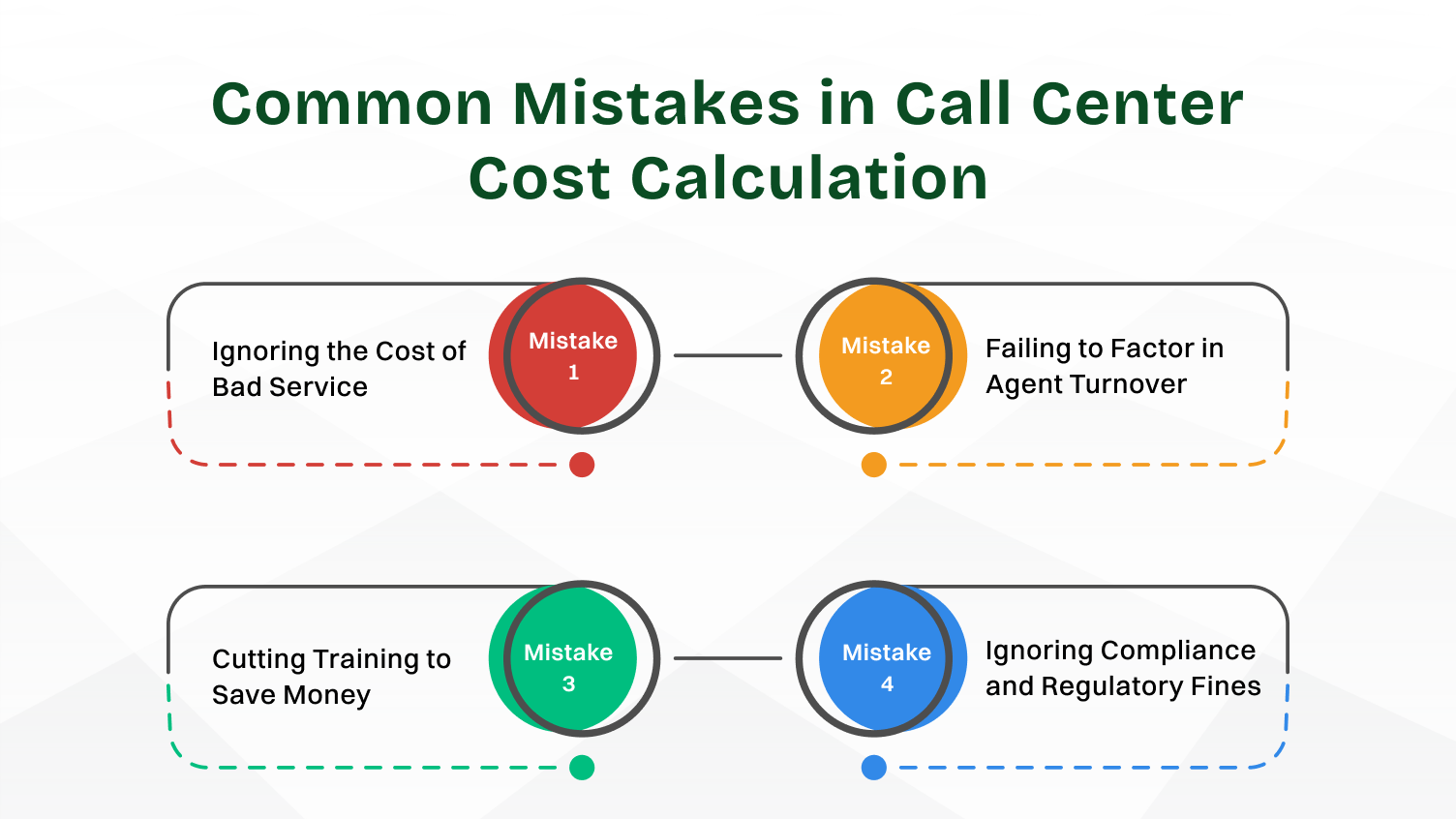
Many businesses fixate on AHT, wanting agents to get off the phone quickly. They measure the cost per call for that single interaction. However, when an agent rushes a customer, the issue is often left unresolved. That customer calls back within 24 hours. Now you have paid for two interactions, not one.
This hidden expense is the cost of low FCR. Trying to save thirty seconds on one call ends up costing you an extra ten minutes on the follow-up call. The real cost per call center rate is much higher than you think. Reducing call center operational time is good, but FCR is better.
As mentioned earlier, labor is the biggest expense. The cost of replacing an agent is staggering. You lose time with the supervisor who interviews candidates. You spend money on recruitment platforms. You dedicate training staff hours to the new hire.
If your annual turnover rate is high, this replacement cost is a massive, recurring drain on your budget. When you calculate call center expenses, you must factor in this overhead. Ignoring it gives you a falsely optimistic view of your operational efficiency.
When budgets get tight, training is often the first thing to go. This seems logical in the short term, but it is deeply counterproductive to reducing call center costs. Untrained agents struggle with complex issues. They rely on supervisors for help. They take longer on every call. They make mistakes that require supervisor intervention or repeat calls.
Cutting training increases your AHT and lowers your FCR. The immediate cost savings from training are instantly negated by higher operating costs per call in the following months. Investment in training is an investment in long-term quality assurance. It is non-negotiable.
Compliance failure is not an operational cost. It is a financial disaster. Think about privacy rules like GDPR or HIPAA. If your agents are not properly trained on data handling, the resulting breach can mean massive, instant fines.
These potential fines are a shadow call center expense you must account for. Investment in security training, compliance software, and audits is a necessary defense. You might save $10,000 on training today, but you risk a $1 million fine tomorrow. Strategic cost savings never come at the expense of regulatory safety.
A mid-sized e-commerce company, “ShopSmart,” faced increasing call center expenses. Their average cost per contact call center was climbing. They noticed a high volume of calls about delivery status. Also, they observed many basic product inquiries. Their call center cost per call calculation showed this was unsustainable.
ShopSmart implemented a few strategies. First, they deployed an AI chatbot. This chatbot handled common FAQs. It also provided real-time order tracking. Second, they enhanced their agent training. This focused on first-call resolution. Agents received better tools. These tools gave them faster access to information. Lastly, they started a quality assurance program. This monitors agent performance. It provided targeted feedback.
Within six months, ShopSmart saw significant results. Their costs per call decreased by 20%. Call volume to live agents dropped by 30%. Customer satisfaction scores improved. Agents felt more empowered.
The chatbot handled over 40% of routine inquiries. This allowed live agents to focus on complex issues. ShopSmart achieved substantial call center cost savings. They did this without sacrificing service quality. In fact, service quality improved. This is a testament to effective call center cost reduction.
Takeaway
ShopSmart reduced call center costs without hurting service. A chatbot handled routine queries. Better training and quality assurance improved first-call resolution. Cost per call dropped, customer satisfaction increased. Smart tools and processes created sustainable call center cost savings.
A structured roadmap is essential. Use this phased approach to ensure long-term success.
Goal: Establish the baseline and fix the cheapest leaks.
Goal: Invest in technology and training that drives FCR.
Goal: Turn cost management into a continuous process.
Goal: Replace old equipment and perfect call routing.
Goal: Lock in savings and build a continuous improvement culture.
Reducing call center costs is about more than saving money. It improves efficiency, boosts service quality, and increases overall profitability. Focusing on first-call resolution ensures customers get answers quickly, which lowers repeat contacts and wasted time. Smart automation handles routine queries, freeing agents to solve complex issues. Combining technology, agent training, and quality assurance creates a sustainable approach to cost reduction.
Regularly tracking your average cost per contact call center provides valuable data for informed decisions. A dedicated cost monitoring tool makes that habit part of daily operations instead of a once-a-quarter scramble. With these strategies, businesses can lower expenses without compromising service, keeping both customers and agents satisfied.
Stop Planning, Start Saving. Get Your Dialaxy Virtual Number & Cost-Saving Setup Guide
The single most effective way to reduce call center costs is to maximize First-Call Resolution (FCR). A high FCR rate reduces the number of expensive repeat calls and contacts. This directly lowers your overall call volume and agent labor costs.
You can reduce costs without sacrificing service quality by optimizing workflows, using automation for routine tasks, and training agents efficiently. This keeps service high while lowering operational expenses.
Cloud-based call center software gives the best ROI. It reduces infrastructure costs, improves scalability, and enhances agent productivity.
Improving first-call resolution is better because it boosts customer satisfaction and reduces repeat calls, even if handle time is slightly longer.
