

How to Optimize International Call Routing to Reduce Drop Rates and Improve Answer Rates

International communication plays a huge role in modern business.
Whether it’s customer support, partner outreach, or global sales, inbound calls can make or break relationships. But handling those calls across borders isn’t always smooth.
Dropped calls. Low answer rates. Lagging audio. All of these issues frustrate both customers and teams. If you’re managing global operations, you’ve likely dealt with these more than once. The reason often comes down to how your call routing system is set up.
Learning how to optimize international call routing to reduce drop rates can make a significant difference.
But don’t worry, most of these issues are avoidable. With a better call routing strategy and the right tools in place, you can reduce call failures and improve answer rates.
Let’s start with what causes the trouble in the first place.
Before we dive into the common causes, let’s quickly understand what call drops actually mean. Imagine being mid-conversation and the call suddenly ends without warning; that’s a call drop.
In international call routing, this often happens due to weak network links, high latency, or technical hiccups between global carriers.
Even with solid tech, international calls can struggle to reach the right person. There are many small things behind the scenes that interrupt the routing process.
Here’s what usually gets in the way.
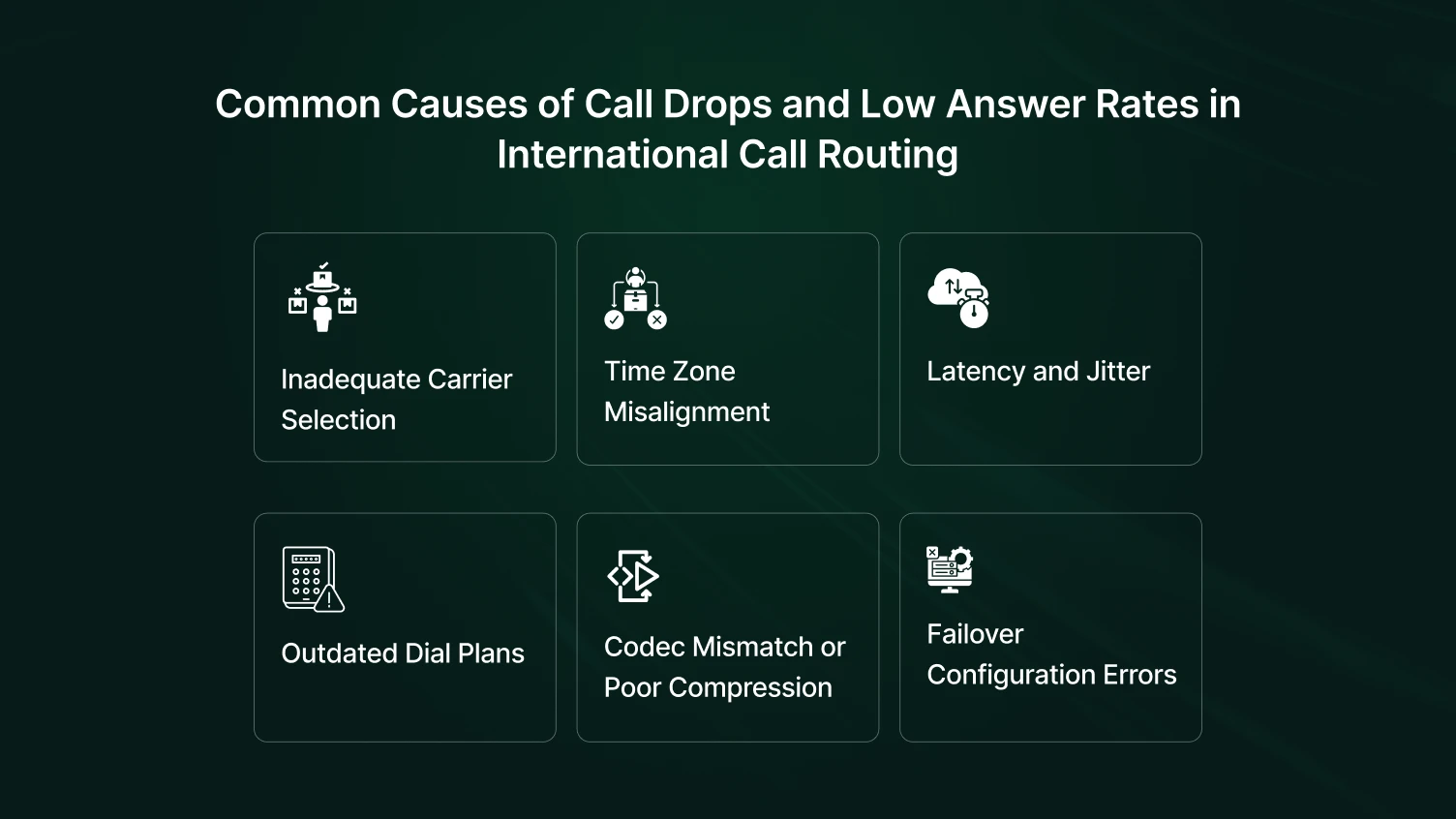
Carrier quality is crucial. Some are cheap, but unreliable. If your business depends on just one low-cost provider, you’re rolling the dice every time a call goes out.
Not all carriers can handle different regions well. Sometimes the route looks good on paper, but the audio is poor, or the call gets dropped halfway through.
Calls to agents need to be stable, especially in contact center environments. A weak carrier doesn’t just cost you money; it costs you calls. Choosing the wrong carrier creates weak links that damage both performance and trust.
Time zones are easy to overlook. You might route calls based on your local schedule, but your customers live somewhere else entirely.
When calls are routed to a region during non-business hours, they often go unanswered, or worse, go to voicemail. This leads to longer call queue times and eventually more missed calls.
Latency is the delay between when you speak and when the other person hears you. Jitter means when your voice breaks up or skips. Both happen when call data travels over unstable or long-distance paths.
International calls are especially sensitive to this. When routes pass through too many networks, the call flow breaks down. The result? Calls feel slow, robotic, or incomplete.
Dial plans are the rules your system uses to process phone numbers. If they’re not updated regularly, calls won’t reach their destination, or may be blocked altogether.
Different countries have different number formats. Mobile prefixes change. Landline structures shift. Without updates, even the best routing software sends calls down the wrong road.
Every voice call is converted into digital data using a codec. If the codec isn’t right, or if there’s a mismatch between systems, call quality drops instantly. Sometimes, calls don’t even connect.
In international routing, this happens more than you think. Businesses use different VoIP tools, devices, and configurations. Some prioritize bandwidth savings, which results in poor audio clarity.
No routing system is perfect. That’s why backup plans, called failed rules, are so important. But if your failover setup is missing or broken, calls won’t redirect when something goes wrong. They just disappear.
Thus, automatic failover must be implemented. In case of failover by one carrier, the system must immediately attempt to use another carrier. This is an automatic call distribution-related process and is a requirement of any global routing system.
These are some of the silent matters, which sometimes nobody notices until the customers begin to grumble or end-to-end performance goes down. The only way to address them is to understand them.
After you discover the cause of the dropped or unanswered international calls, the next step is to set it up in such a way that those problems never repeat.
It is not just about routing smarter, but rather about creating a flow that is responsive in real-time, adaptable to various conditions, and that ensures that your callers are always connected to the right person and that they never come to dead ends.
Let’s understand what actually works in detail.
Least Cost Routing (LCR) is a basic tool, but it only really works if you go beyond the cost. With dynamic LCR, you don’t just look at price. You check how the route is actually performing. If it’s dropping calls or having issues, you route somewhere else.
This kind of setup keeps your calls stable. Such systems let you track live statistics like how many calls are unanswered (ASR) and how long people stay on the line (ACD). That’s how you know if a route is really working or not.
Things change fast in international calling. A route that works great today might be terrible tomorrow. That’s why using live metrics like Answer Seizure Ratio (ASR) and Average Call Duration (ACD) is crucial.
If those numbers drop, your routing should automatically switch to a better-performing option. This is a big deal if you’re handling lots of inbound calls, especially through a call center software. It keeps your call flow smooth.
Geo-routing lets you direct calls based on where the caller is. You can send them to the nearest team, or even a location that speaks their language. Pair that time with time-based routing, and you avoid ringing someone at 2 a.m. when no one’s working.
This is a big step towards reducing waiting times and boosting your call resolution rates. You can even build call routing rules around local business hours. So if your UK team is off, calls are routed to your US or Asia teams instead.
Here’s something most businesses forget: not all carriers perform the same everywhere. If you’re using just one or two carriers and not testing them regularly, you could be sending traffic down a bad route without knowing it.
That’s why carrier testing is a good habit. Run regular checks, compare results, and make sure your routing setup prioritizes the best performers. Think of it like checking the oil in your car. Doesn’t take long, but if you skip it, things break.
Even with the best setup, things still go wrong sometimes. That’s why failover logic matters. Let’s say a route is down. Without failover, the calls fail. But with failover in place, the call automatically tries another route. You won’t have to jump in to fix it.
Failover works behind the scenes. The caller won’t know that something went wrong. All they experience is a smooth connection. This setup is suitable if you deal with high call volumes or if you’re using a business phone system with teams in different regions.
Codecs can make or break your call quality. They decide how your voice is compressed. The wrong one will make your audio fuzzy or cut in and out. Some codecs (like G.729) save bandwidth, but the trade-off is lower clarity. Others (G.711) need a stronger connection.
What works best depends on where you’re calling and what your network can handle. A smart routing system adjusts codecs based on the call path. If you’re using transcoding, make sure it’s done properly. Bad transcoding creates awkward delays or robotic calls.
Getting these things right doesn’t require a huge reset. Most of it comes down to using the right tools and adjusting a few key settings.
Once you have a routing strategy, you require appropriate tools to support the strategy. Not every platform is international traffic-focused, and not all call routing software is created alike.
We can discuss some of the main aspects and services to make it easier to route across borders safely and more effectively.
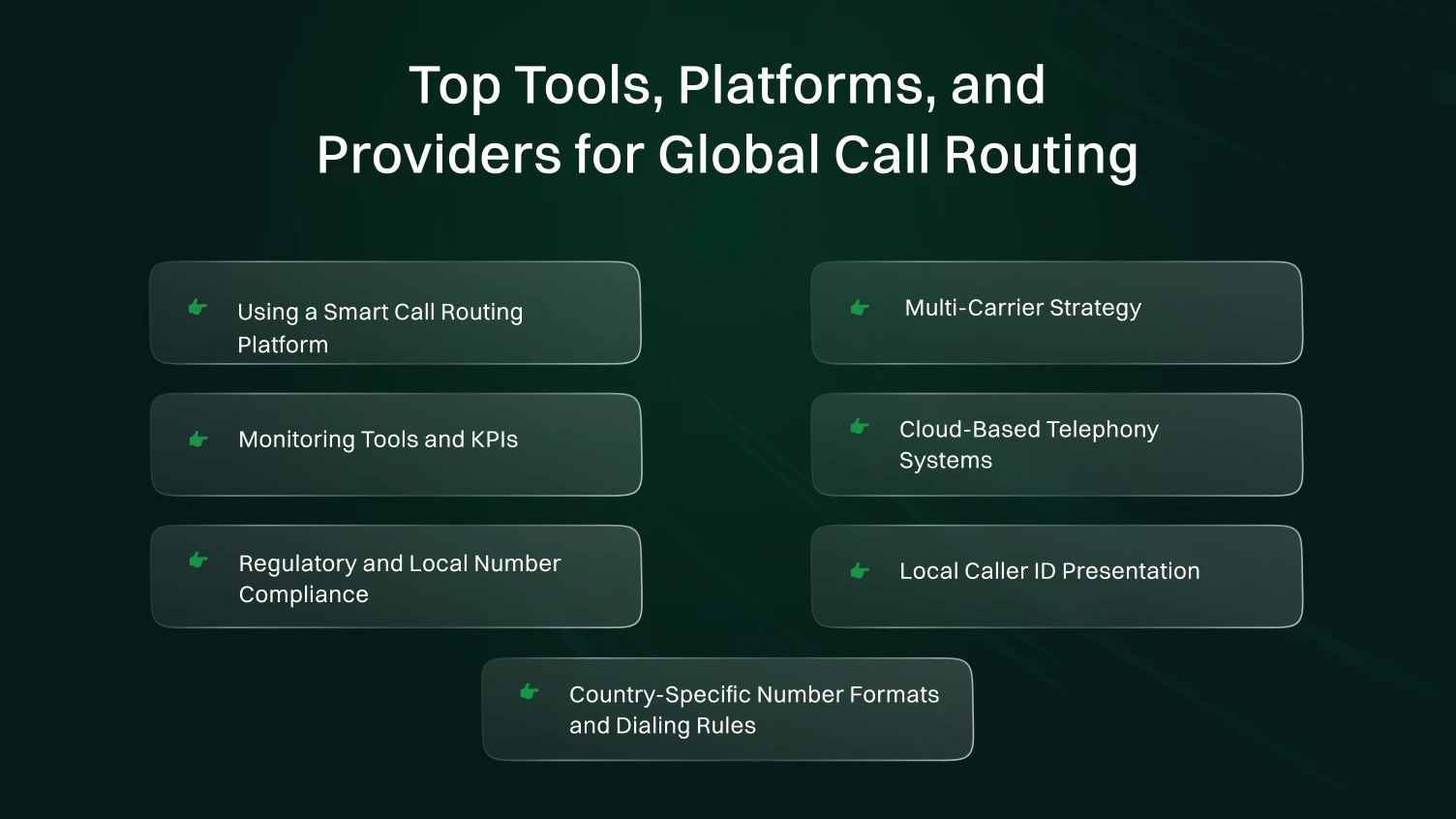
A smart routing platform does more than send calls; it reacts to what’s happening in real time. These systems track call outcomes, adjust routes instantly, and support advanced call management features like skills-based routing and automatic call distribution.
They let you set up routing calls based on caller location, business hours, and team availability. Always look for platforms with a flexible dashboard, live monitoring tools, and support for both round robin and priority-based rules and criteria.
Never rely on a single carrier. The most reliable setups use multiple providers across regions. That way, if one route fails, others can take over. This helps you maintain high call resolution rates and avoid missed calls during outages.
A solid multi-carrier strategy also allows you to route calls to available agents based on cost, quality, or even region, whatever fits best.
You can’t improve what you don’t measure. Choose routing platforms that include real-time dashboards, reporting, and alerts for key metrics such as ASR, ACD, failed call rate, delay, and jitter.
With these insights, you can fine-tune your call routing options without guessing.
Moving to the cloud makes global calling easier. Cloud systems give you access to global routing systems, better failover capabilities, and remote setup. They also scale fast when call volumes spike.
These tools often come with an app marketplace integration and offer more flexible ways to customize your IVR menu, auto attendant, and routing rules.
Every country has its own rules. From caller ID to dialing formats, compliance issues can disrupt calls or even get your number flagged.
Good platforms help you stay compliant with local number formats, country-specific regulations, and approved routes and gateways. This protects both your operations and your customers’ experiences.
Using a local number increases answer rates. When a customer sees a familiar area code or country prefix, they’re more likely to answer. This boosts performance for sales, support, and all kinds of inbound calls.
Your platform should let you assign local DID (Direct Inward Dialing) numbers or dynamically present numbers based on the destination.
Dialing isn’t universal. Some countries need extra digits. Others block certain prefixes. If your system doesn’t follow the right format, your incoming call may never connect.
Use tools that auto-format numbers and support regional rules. This keeps your routing clean and your calls consistent.
Smart routing isn’t just about speed and cost. It’s also about safety.
Let’s look at what protects your system from bad actors and a poor reputation.
Carriers are getting stricter about spam. If your number gets flagged even once, your answer rate drops fast. Avoid rapid dialing, fake numbers, or calling outside business hours. Use routing software that lets you spread traffic across numbers and control priorities.
Keep your numbers “clean” by respecting local habits and avoiding aggressive patterns.
Caller ID spoofing is illegal in many countries. It also gets your calls blocked quickly. Most modern systems use STIR/SHAKEN protocols to verify that your ID is legit.
This builds trust with carriers and receivers. Always choose those providers who follow these rules.
Your voice calls are data. Like any data, they can be intercepted. Secure systems use encryption to protect calls in transit. This is especially important if you’re dealing with sensitive topics, customers, or financial information.
Look for platforms that support SRTP (Secure Real-Time Transport Protocol), TLS (Transport Layer Security), and encrypted call storage if needed.
Beyond spam and security, you also need to follow rules about call recordings, data storage, and consent for outbound dialing.
What’s legal in the US may not be okay in Germany or France. Make sure your routing tools support local laws and offer features to stay compliant.
Fraudulent traffic can cost thousands. Whether it’s robocalls, call pumping, or fake calls to the agent, a good system will detect and stop the pattern before it spreads.
Real-time alerts help you act fast. Some platforms even auto-block suspicious routes or shut down unusual call bursts.
Now, let’s bring it all together. If you want your international calls to be heard, not ignored, stick to these key practices.
The chances of people picking up calls with local numbers are comparatively high. You can use intelligent call routing to present familiar area codes.
Local call routing options help build trust. When they have a local number displayed before them, customers are less likely to consider it as spam. Add to that the geo-routing, and your calls will be automatically redirected to the most appropriate team or branch.
No one wants to answer a business call during dinner or at midnight. Consider the time zones before timing your calls.
With proper call routing rules, you can define when each region receives calls, so customers get contacted only during their preferred hours.
Avoid dialing the same number too often. Space your outreach, keep your calls targeted, and track engagement.
Too many repeated attempts from the same number end up getting flagged. Routing systems that include logic for call distribution, ACD can spread out calls across numbers and avoid detection. This keeps your caller ID reputation clean.
Always follow local rules, even if they’re tricky. Non-compliance can get your calls blocked or fined.
Some regions require local presence or have rules for custom greetings, IVR systems, and contact center solutions. Use call center software that adjusts to different rules for each country.
Avoid wasting time by leaving long voicemails. Use AMD to detect machines and adjust scripts or hang-ups cleanly.
But be careful, overusing AMD can sometimes cause a person to be mistaken for a machine, resulting in missed calls. Test and tweak your AMD settings regularly for better results.
Old numbers, wrong country codes, and bad formatting ruin your reach. Clean lists lead to cleaner calls.
Bad data can lead to dropped calls and failed routes. Use a call routing system that checks number formats before dialing. This reduces failures and improves call flow by making sure each call gets routed to the appropriate agents or departments.
Smart tools can auto-schedule calls based on the recipient’s time zone. That means you get more live answers.
Platforms that support routing and call forwarding during active hours help avoid unanswered calls. Some even allow setting call priorities depending on region, client tier, or campaign urgency.
Remember to check your routing statistics weekly or monthly. Flag underperformers and rotate routes based on results.
Look at trends in ASR, call waiting, and abandonment rates. Such minor checks will enable you to identify problems before they become common and try out the new distribution systems without affecting the entire system.
These two indicators, ASR and call abandonment rate, are loud and clear. Keep track of these performance indicators and therefore have an idea of what is working and what is not, and improvise accordingly.
When you find a falling ASR in an area, it might be time to take a look at a new route or carrier. Also, high call abandonment could point to poor call queue setup or a lack of available agents.
Following these practices won’t just help with answer rates; they’ll make your overall system stronger and more flexible, leading to increased productivity by improving customer experience.
And if you want to put these ideas to work fast, platforms like Dialaxy are designed to support exactly this kind of optimized, global setup.
Let’s see what Dialaxy offers to help streamline the entire routing process.
If you want a cost-effective platform with advanced tools, Dialaxy can be a good choice for you.
With all these features working together, Dialaxy gives you the flexibility to handle global calls with ease. Whether you’re routing by time zone, caller location, or agent availability, everything stays smooth and reliable.
International call routing doesn’t have to be messy or unpredictable. When you understand the causes of dropped calls, apply the right strategies, and use trusted platforms like Dialaxy, the process gets smoother.
You don’t need to overcomplicate things. Just route smarter, protect your calls, and keep adjusting as you grow. That’s how you reduce drop rates and get more people to answer calls, no matter where they are.
Some common reasons for frequent international call drops are poor carriers, outdated dial plans, or codec mismatches.
To improve answer rates for international calls, use local numbers, respect time zones, and avoid spammy calling patterns.
Yes. A multi-carrier strategy gives better uptime and backup options.
To avoid call quality issues, you can track jitter, latency, and codec performance. Adjust your routing and provider choices accordingly.
Absolutely. People trust local numbers and are more likely to answer.
You can test international call quality by running test calls to different regions. Monitor ACD, ASR, and call setup times to evaluate your routes.
