

What is the Difference Between a Hot Call and a Cold Call?

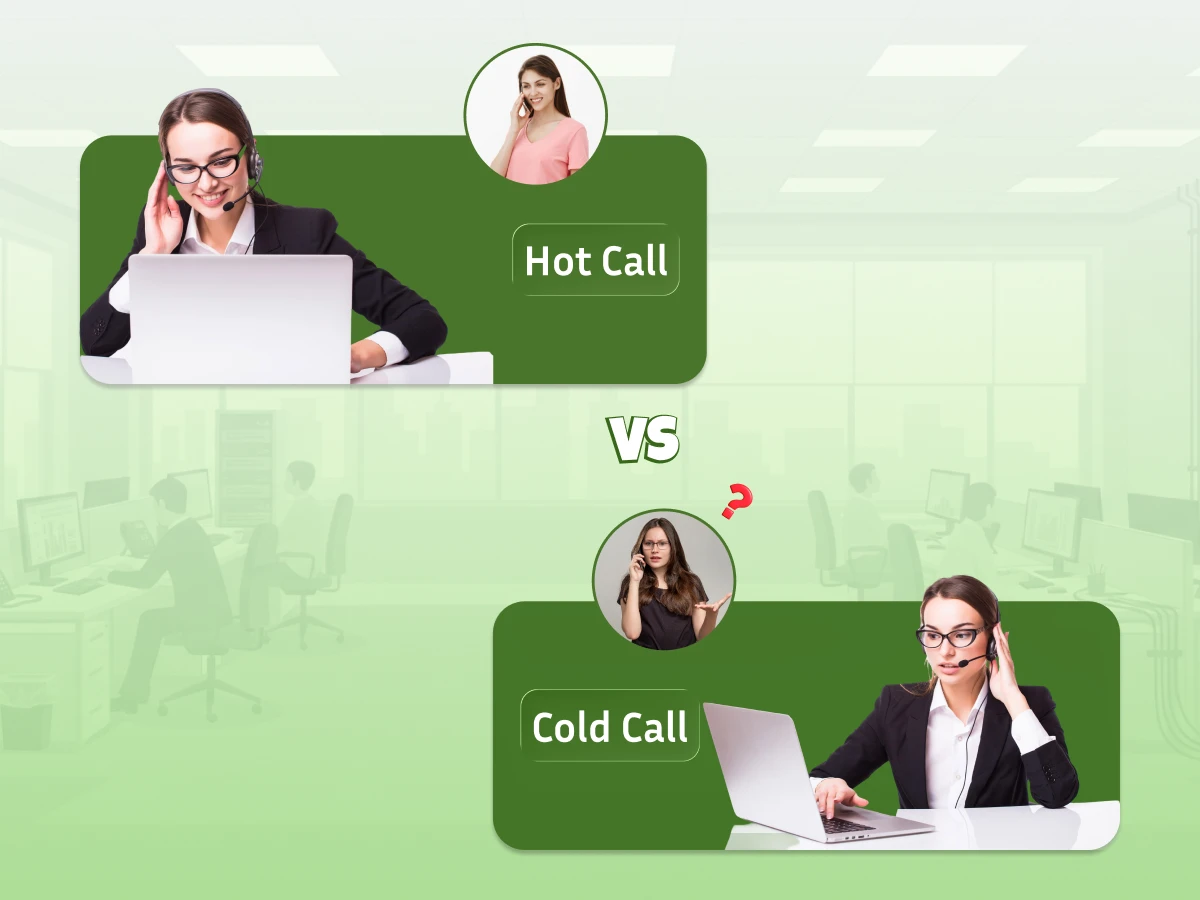
In modern sales, picking up the phone is only half the battle; knowing who is on the other end is what actually closes deals. Many reps struggle with conversion rates because they treat every prospect the same.
Treating a ready-to-buy lead like a stranger is a surefire way to kill a deal, while pitching aggressively to someone who doesn’t know your brand guarantees a hang-up. So, what is the difference between a hot call and a cold call?
It ultimately comes down to intent, familiarity, and timing. In this guide, we break down the definitions of cold, warm, and hot calls and explore how to use AI and intent signals to turn icy prospects into sales-ready leads.
A cold call is an outbound sales tactic where a sales rep contacts potential customers who have had no previous interaction with the company. These prospects aren’t expecting your call, and they haven’t expressed any interest in your product or service yet.
For example, a sales rep at a logistics company might call a local manufacturer’s operations manager to pitch shipping services without any prior engagement.
Because there is no relationship yet, these calls often feel like an interruption to the recipient. To be successful, a caller must quickly identify pain points and offer a clear value proposition. Since the prospect hasn’t signaled a need, cold calls typically have lower success rates and require a high volume of dials to fill the sales funnel.
A family is living in a poorly constructed house. Their pain point is living in a small place. They are the potential customers of a real estate company, but they might not want to buy a house right now. A cold call to the family will help clarify the situation, but it won’t necessarily convert them into a buyer.
A hot call occurs when a lead is ‘sales-ready’ and has actively signaled a high intent to purchase. Unlike cold calls, the prospect is often waiting for your phone calls because they initiated the contact.
For example, if a business owner fills out a “Request a Quote” form on your website or asks for a product demo through a social media ad, the follow-up conversation is a hot call.
As the individual has already expressed a specific need, the chances of successful conversion are much higher. The call requires less “convincing” and more “consulting” to close deals. In this scenario, your role shifts from a cold solicitor to a helpful sales assistant who provides the final details needed to sign a contract.
In a hot call, the customer is already aware of the product/service. They have prior engagements or interactions that build a relationship. Now, the sales representative has to convert the customer into buying it.
A warm call is an outreach to a prospect who has already shown some level of interest in your brand but hasn’t explicitly asked for a sales meeting. Unlike cold calls, there is a prior engagement that acts as an “icebreaker,” making the conversation feel more natural and less like an interruption.
For example, you might call a lead who recently signed up for the service you provide on your website.
Since the person already recognizes your company name, warm calls have much higher success rates than cold outreach. You aren’t starting from zero; you are building on an existing touchpoint to move them further down the sales funnel.
The main difference between a hot call and a cold call is the previous interaction and level of interest from the person you are dialing. A cold call involves reaching out to a stranger who has no prior engagement with your brand, while a hot call is a response to a lead who has specifically requested to speak with you.
Understanding the difference allows your contact center to apply the right calling strategies to improve conversion rates.
| Component | Cold Call | Hot Call |
|---|---|---|
| Initial Contact | Outbound (Rep initiates) | Inbound (Customer initiates) |
| Familiarity | None (Cold prospect) | High (Existing lead) |
| Success Rate | Low (Needs high volume) | High (Needs quick response) |
| Lead Quality | Unverified / Low intent | Verified / High intent |
| Main Objective | Generate new leads | Close deals |
In a cold call, the sales rep starts the conversation without any warning. This is a classic outbound sales tactic used to find potential customers.
Conversely, a hot call happens because a prospect took an action, such as filling out a form on your website or requesting a callback through an interactive voice response (IVR) system.
Cold Example: A rep calls a list of local dental offices to pitch a new scheduling software they’ve never heard of.
Hot Example: A prospect clicks “Call Me Now” on a pricing page, and your center platform routes the call to a rep immediately.
Cold calls target people who may not even know your company exists, requiring the rep to build trust in seconds. A hot call involves a lead who is already deep in your sales funnel. They likely know your product, your pricing, and your brand, which makes the conversation much smoother.
Cold Example: You call a CEO who has never visited your website or seen your ads; you must explain who you are from scratch.
Hot Example: You call a lead who has already watched three of your customer stories and followed your company on social media.
The chances of successful outcomes are much higher with hot calling. Because the lead has a pressing need, your success rates for setting an appointment or making a sale are significantly boosted.
Cold calling is a volume game that requires workforce engagement to handle many phone calls to find one interested buyer.
Cold Example: A rep makes 100 phone calls and only manages to book two discovery meetings.
Hot Example: A rep follows up with 10 people who requested a quote, resulting in 6 signed contracts.
While hot calls boast high close rates, industry benchmarks for 2025/2026 show that the average cold calling success rate hovers around 2% to 3%. This means roughly 1 in every 30 to 50 cold calls turns into a tangible opportunity. Despite this low percentage, 80% of B2B sales leaders still consider phone outreach an essential part of a healthy sales pipeline.
A cold lead is just a name on a prospecting list until they prove otherwise. A hot lead is a “sales-ready” contact who has usually provided their details directly to your center platform. This high-quality data means the rep can spend less time qualifying and more time solving the prospect’s pain points.
Cold Example: Calling a general ‘info@’ email address or a main office line, hoping to find a market decision-maker.
Hot Example: Dialing a direct mobile number provided by a lead who specifically asked about pricing for the ‘Enterprise Plan’.
The goal of cold calls is to create an opening and spark interest where none existed. The goal of a hot call is to provide the final piece of information or the right pricing to finalize a contract. In a hot call, you are acting more as a sales assistant, helping them cross the finish line.
Cold Example: The rep’s goal is simply to stay on the line long enough to identify the prospect’s pain points.
Hot Example: The rep acts as a sales assistant, answering technical questions to move the lead to the ‘Closed-Won’ stage.
Intent is the foundation of every successful sales strategy because it determines how you should approach the conversation. When you understand why a person is on the phone, you can tailor your message to their specific stage in the sales funnel. High-intent prospects are looking for solutions, while low-intent prospects may not even realize they have a problem yet.
By focusing on intent, a contact center can prioritize leads that are more likely to close deals. This shift from “dialing everyone” to “dialing the right people” significantly improves customer experiences and boosts your overall success rates.
| Component | Low Intent (Cold) | High Intent (Hot) |
|---|---|---|
| Call Approach | Educational & Disruptive | Consultative & Urgent |
| Response Time | Flexible (Scheduled) | Immediate (Real-time) |
| Customer Success | Building Awareness | Solving Pain Points |
| Data Source | Third-party lists | Website behavior |
| Tool Used | Outbound Dialer | Conversational AI / IVR |
The intent level dictates your tone. With low intent, you must be a storyteller who can quickly spark curiosity. With high intent, the prospect already wants what you have.
For example, on a low-intent call, you might say, “Most managers in your shoes struggle with X.” On a high-intent call, you say, “I see you’re looking for a solution for X; let’s talk about how we fix that.”
Intent has an expiration date. High-intent leads require a fast response because their “buying window” is open. Wait times can kill a hot lead.
For instance, if a lead fills out a form (high intent), calling them within 5 minutes increases conversion rates by 100x compared to calling an hour later, based on the monthly report of Dialaxy.
Understanding intent helps you align with the customer’s goals. Low-intent calls focus on the “why,” while high-intent calls focus on the “how.”
As an illustration, for a cold prospect, success is getting them to agree to a 10-minute discovery call. For a hot prospect, success is a signed contract or a scheduled demo.
Modern contact center software uses signal data to track intent. Knowing someone visited your pricing page five times provides much more “intent” than a static name on a prospecting list.
For example, using workflow automation to flag a lead as “Hot” because they downloaded three case studies in one hour.
Different tools help capture and measure intent. Interactive voice response (IVR) and virtual agents can qualify intent before a human even picks up the phone.
For instance, a virtual agent asks a caller if they are a new or existing customer, instantly identifying the intent and using call routing to send them to the right department.
Turning a cold lead into a hot one is all about timing and relevance. Using conversational AI and call center automation, you can move a prospect from “who are you?” to “let’s talk” before you even pick up the phone.
By leveraging signal data, you stop guessing and start connecting with people who are already showing interest. Here is a step-by-step guide to using AI in customer outreach to warm up your cold leads.
Here’s a step-by-step guide to using AI in customer outreach to warm up your cold leads.
| Step | Action | AI Tool Category |
|---|---|---|
| 1. Identify | Find prospects with high “propensity to buy.” | Predictive Analytics |
| 2. Enrich | Auto-fill pain points and recent news. | Data Enrichment |
| 3. Warm Up | Send a hyper-personalized video or email. | Generative AI |
| 4. Trigger | Call the moment they engage with your content. | Intent Tracking |
| 5. Guide | Use real-time prompts during the call. | Conversation Intelligence |
Instead of calling a random prospecting list, use AI to score leads based on their ‘fit’ and ‘intent’. Tools like HubSpot or 6sense analyze thousands of data points to tell you who is most likely to convert.
Tip: Stop dialing low-score leads and focus your workforce management on the top 10% who are actively searching for your service.
Deep research used to take 20 minutes per lead; now, AI agents can do it in seconds. These tools scrape LinkedIn and company newsrooms to find a “hook” for your call.
Tip: Instead of a generic greeting, your AI-powered sales assistant gives you a script mentioning their recent $50M funding round or a specific social media post they made.
Never let a cold call be the first touchpoint. Use workflow automation to send a personalized LinkedIn message or email first. AI tools can draft these messages to sound human, not robotic.
Tip: If the prospect opens your email three times, the AI flags them as “warm,” moving them to the top of your calling queue in the center platform.
The best time to call someone is when they are thinking about you. Use website tracking to get an alert the moment a lead visits your pricing page or downloads a case study.
Tip: Call within 5 minutes of their action. You aren’t cold calling anymore; you are responding to a live signal, which drastically increases success rates.
Once you are on the phone, use conversational AI (like Gong or Chorus) to listen to the call. It can provide live pop-ups with rebuttals to objections or technical data from your knowledge base.
Tip: When a prospect mentions a competitor, the AI instantly displays a “battlecard” on your screen, allowing you to build trust and close deals with expert precision.
Automate Your Success! Dialaxy’s AI-powered tools help you turn cold outreach into warm conversations.
In the world of outbound sales, staying compliant is just as important as your success rates. Regulations like the TCPA (Telephone Consumer Protection Act) in the US and GDPR in Europe govern how you can use phone calls to reach potential customers.
Ignoring these rules doesn’t just hurt your customer relationships; it can lead to massive fines and damage to your brand.
By using a modern center platform with built-in compliance security, you can set up an automated calling solution for the legal part of your calling strategies and focus on your pitch. Let’s look at some critical compliance components.
Consent is the ‘green light’ for your sales strategy. For cold calls, you generally rely on ‘legitimate interest’, but for hot calls generated via a website form, you must have a clear checkbox where the user agrees to be contacted.
The National DNC Registry is a list of consumers who have requested not to receive cold calls. Calling someone on this list is a fast way to get sued.
You cannot call a prospect whenever you feel like it. Federal law restricts phone calls to the hours of 8:00 AM to 9:00 PM in the prospect’s time zone.
The Truth in Caller ID Act prohibits sales reps from using false or misleading “spoofed” numbers. You must provide accurate information about who is calling.
If a prospect says, “Please don’t call me again,” that is a legal revocation of consent. This must be recorded across your entire team.
The modern sales environment is faster and more data-driven than ever. To succeed, you can’t just rely on commitment or high volume; you must be a strategic consultant who uses technology to solve customer problems.
Whether you are making warm and hot calls or prospecting into new accounts, your goal is to provide value at every touchpoint.
The best sellers today act as a sales companion to their prospects, guiding them through a complex buying journey with empathy and precision. Let’s look into efficiency vs effectiveness that sales rep can use to make their work easier.
| Strategy | The Old Way (Inefficient) | The Modern Way (High Performance) |
|---|---|---|
| Research | Manual Google searches | AI-driven signal data alerts |
| Outreach | Single-channel (Only phone) | Multi-channel (Email, LinkedIn, Phone) |
| Data | Messy, outdated CRM notes | Clean, automated workflow automation |
| Meeting Prep | Generic pitch | Tailored solution for specific pain points |
| Follow-up | Expression of ‘Just checking in’ | Providing a case study or new insight |
Now, let’s dive into the four best practices modern sales representatives should use to improve call success rates.
Modern potential customers are everywhere, in their inbox, on social media, and on their phones. You don’t have to rely on a single method. Use a combination of touchpoints to increase your connect rate.
You can send a LinkedIn voice note or a personalized video before your first cold call. It builds familiarity, so you aren’t a stranger when the phone rings.
Success isn’t about how many dials you make; it’s about who you dial. You can use sales assistant tools to identify warm signals. It can be a prospect visiting your pricing page or a target company going through funding rounds.
You have to spend the first 30 minutes of your day calling ‘Hot’ leads who engaged with your content overnight before moving to your general prospecting list.
When you get a prospect on the line, don’t just read a cold calling script. Use the “80/20 rule”, listen 80% of the time and talk 20%. Your job is to uncover the reality about their business challenges.
You can ask open-ended questions like, “How is the particular industry trend affecting your revenue success this year?” It forces the prospect to move past surface-level objections.
A common problem for SDRs is losing time to administrative tasks. Leverage workflow automation to handle CRM updates, meeting bookings, and email follow-ups so you can spend more time in live conversations.
You can use a sales companion tool that automatically records and summarizes your phone calls, so you never forget a detail from a previous interaction.
Misjudging whether a lead is cold, warm, or hot can sabotage your sales strategy. If you treat a cold prospect like they are ready to buy, you come off as aggressive; if you treat a hot lead like a stranger, you frustrate them with unnecessary questions.
Let’s discuss the frequent misinterpretations of the lead intent in the table below.
| Mistake | The False Signal | The Reality |
|---|---|---|
| The Silent Lead | They didn’t reply to my email. | They are cold/uninterested. |
| The Social Lead | They liked my LinkedIn post. | They are a hot lead. |
| The Old Lead | They bought from us 3 years ago. | They are still a warm lead. |
| The Curious Lead | They downloaded a whitepaper. | They want a sales demo. |
| The Fast Lead | They asked for pricing immediately. | They are ready to close today. |
Now, let’s look into how to handle these calls that are misinterpreted.
A common trap for sales representatives is thinking a polite conversation means a lead is “hot.” Just because a prospect stays on the line doesn’t mean they have a high likelihood of buying. In reality, they might just be polite or have a hard time saying no.
Without a specific pain point identified or a request for a follow-up meeting, the prospect remains a cold lead, and assuming they are ‘hot’ can lead to inaccurate revenue forecasting.
Seeing a prospect “like” your company update is a great sign, but it doesn’t automatically mean they are ready for a sales pitch.
Many reps make the mistake of calling and asking for a meeting based on a single click, when the reality is that social media engagement is usually a “low-intent” signal, even though being a hot lead.
The information should be used as a conversational icebreaker to build familiarity rather than a signal to move straight to a demo.
Temperature is not permanent; it changes rapidly based on your response time. A lead that was hot on Monday because they requested a quote can feel cold by Friday if they haven’t heard from you.
In reality, wait times kill intent, and if you treat a delayed follow-up like a hot lead, you may find the prospect has already moved on to a competitor who was faster to reach out.
Not every content download is a request for a phone call, yet many reps treat every PDF download as a high-intent signal. If a prospect downloads a general industry report, they are likely just in a research phase; treating them like a hot lead ready for pricing resources creates a disconnect.
You must recognize that this is a warm call opportunity where the goal is education and knowledge management, not a hard close.
Many reps ignore previous interactions from a year or two ago, assuming the relationship has totally reset to zero. The mistake here is approaching a former customer or a lead who went dark as a total stranger.
As there is a history of prior engagement in your center platform, you have a unique advantage to build trust faster than a standard cold call by referencing their past needs or interests.
Mastering the art of the phone pitch requires more than just a persuasive script; it demands deep situational awareness. Knowing exactly how to categorize your prospects allows your sales team to stop guessing and start consulting.
While traditional outbound dialing remains a vital strategy, leveraging modern AI tools, tracking buyer intent, and executing multi-channel outreach lets you warm up leads before you even dial.
Remember, treating a hot lead with a cold approach frustrates the buyer, whereas rushing a cold prospect comes off as overly aggressive. By prioritizing true intent over sheer volume and staying strictly compliant with calling regulations, you can drastically improve your overall conversion rates.
Ready to Transform Your Sales? Join thousands of high-performing teams using Dialaxy to master their calling strategy.
No, cold calling is still a vital outbound sales tactic, especially in B2B markets. While it is more difficult to reach people today, using signal data and social media to research prospects makes the call approach more effective.
Cold calling is legal as long as you follow specific regulations like the TCPA in the US or GDPR in Europe. It only becomes illegal if you call numbers on the National Do Not Call Registry, use “spoofed” caller IDs, or dial people without a legal basis.
On average, it takes between 18 and 25 dials to actually connect with a market decision-maker. Because success rates for cold outreach are typically low (around 1–3%), modern sales reps use workflow automation and multi-channel sequences to increase their chances of successful bookings.
Yes, a cold call becomes a hot call the moment a prospect expresses an urgent need or asks for a demo. This transition happens during the conversation as you identify their pain points and move them from being unaware of your product to being a high-intent lead ready to close deals.
You can take legal action against cold callers if they violate consumer protection laws, such as calling you after you’ve asked to opt out or calling a number registered on the DNC list.
