

How to Set the Right Business Hours for Your Company


Did you ever just walk to a store, only to realize it was closed when you needed it most? Frustrating, right?
Imagine now that your customers think of your business in the same light. Having the appropriate business hours, you will not have your business doors shut on customers who need you the most. Based on data and customer insights rather than guesses, you can align your schedule with demand, increase satisfaction, and take more opportunities.
By the end of this blog, you will understand how to determine the correct business hours that suit the customer’s needs and increase overall profitability.

The first thing one should know before getting into time setting is what business time really is. Business hours refer to the standard time period during which a business or organization is open and operates to serve customers or conduct regular activities.
Business hours are a term used for more than just “we are open” or “we are closed.” They represent the hours your business is available. This availability can be physical, for instance, entering a store. It can also be a digital one, like visiting a website. Or it may be through several customer service channels, for example, a phone line or an online chat.
These hours come from a strategic choice you make. They show that a company really understands its market.
Many things come together to shape the perfect business hours for any company. It is important to know about these factors.
Here are the main factors that determine businesses’ operating hours.
Customers’ daily routine directly influences when they’ll engage with your business. If you ignore their patterns, you really risk becoming irrelevant.
Imagine the daily lives of your perfect customers. Are they doing a regular Monday to Friday job? Therefore, they might require your services in the evenings or on weekends. Are people who go out late in need of a later closing time? Their schedules and plans affect when they connect with your business.
What your company can handle internally and what you can afford financially determine the business hours you can keep. These internal limits are not flexible.
How does your delivery schedule fit into your operations? Do the times you get new stock and prepare things affect when you can actually be open? You need to be fully ready and functional during your open hours. This means having enough products on hand and finishing any necessary prep work before customers even walk through the door.
The insights that you get by looking at what your competitors are doing are really valuable. It helps you identify both opportunities and what’s considered normally in your industry.
Find out when your competitors are open. This helps you discover times when no one else is serving customers. It shows chances to do something different, like being available for urgent requests through online or SMS channels when others aren’t.
Knowledge of international time zones is essential for businesses that operate online or have international clients. You will have 24/7 digital open hours to use automated transactions.
However, active customer support might need to align with specific global markets for real-time help. This factor expands your thinking beyond local physical hours to worldwide digital availability. It requires a strategic approach to provide support across different days of the week.
Setting the best business hours calls for a structured approach. It moves past just guessing and into informed planning.
Let’s break this process down into clear steps to help you make data-driven decisions.
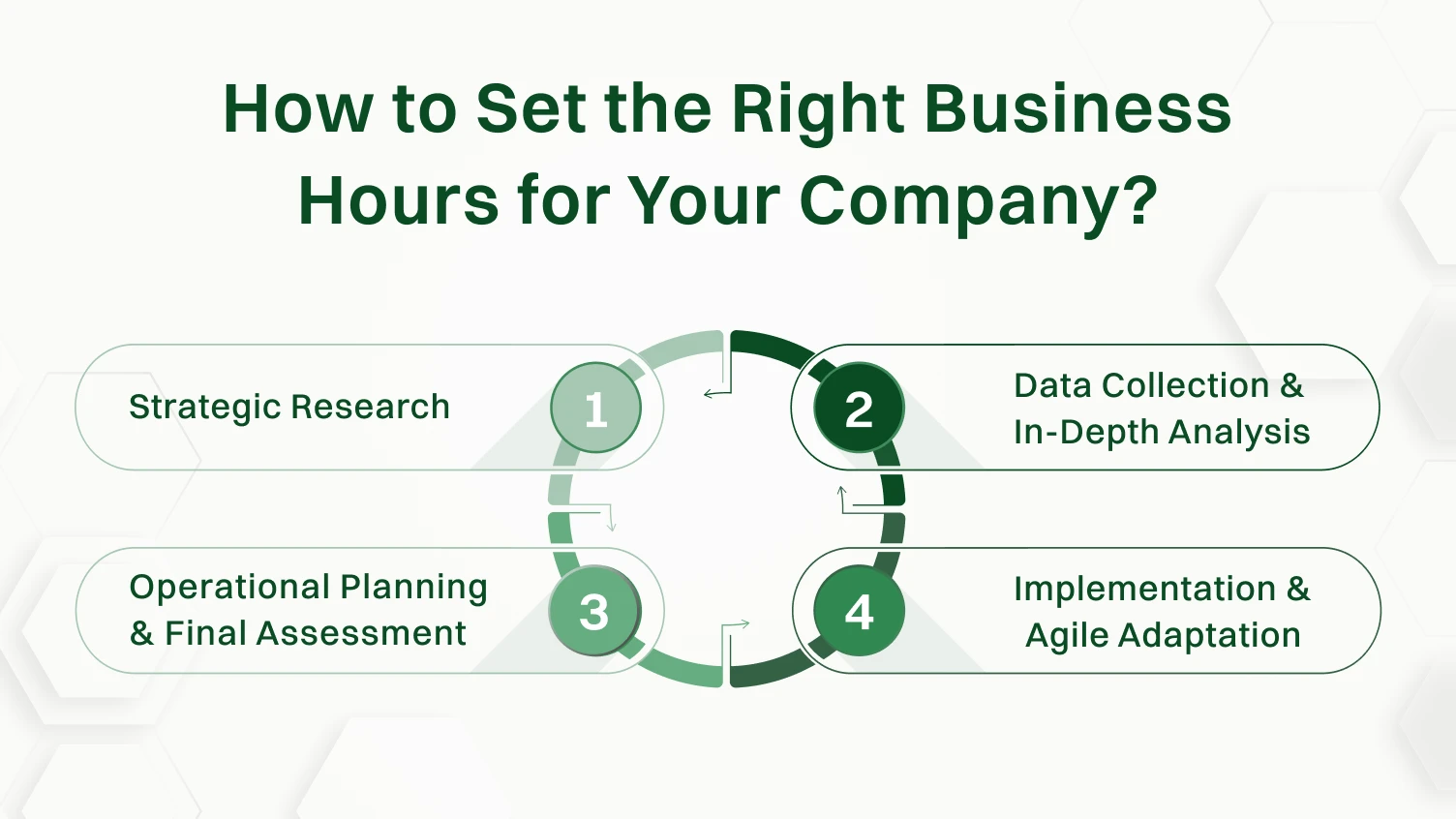
This first step builds the core understanding you need to make smart decisions. It involves looking closely at both your own business and the broader market.
In this step, raw information turns into useful insights. Without this step, your business hours would be based on assumptions rather than what’s actually happening in the real world.
Once you have all your information, the next thing is to convert your insights into action plans. This is to make sure that the number of hours you want is favored by your customers. It also ensures those hours make sense for your business.
The last step is implementing your plans. It focuses on continuous verification and the ability to make changes.
Taking a data-driven approach to your business hours brings some real benefits. These benefits spread across your entire organization.
Let’s take a look.
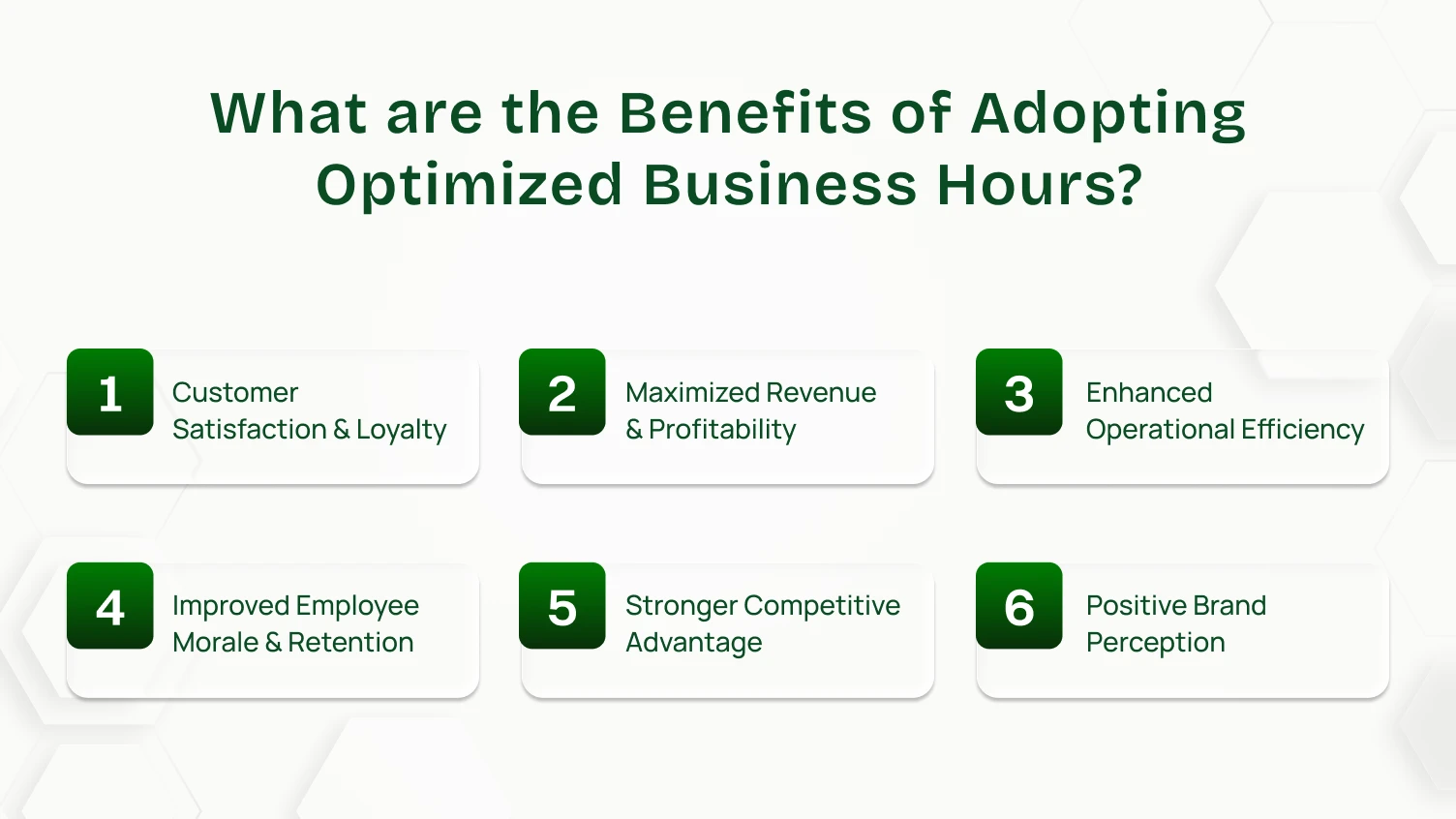
It is more convenient for customers as they can see you where and when they need you. This builds stronger, more dependable relationships. Satisfied clients become repeat clients. They will be more inclined to revisit and give third-party reports of your business. They really like the convenience that you offer.
Capturing sales during your hectic times is essential. It also means you waste fewer resources during quiet periods. This significantly improves the efficiency and productivity of every hour you’re open. More profitable operations are the result, because you’re putting your resources to work when they will generate the most money.
Better resource allocation is a direct gain. This includes staff, utilities, and inventory. It causes less stress in daily activities. It also eliminates bottlenecks and lowers the total expenses. When you have what is required, your business is easier and you waste less time.
More predictable and manageable schedules can help fewer burnout. This encourages a balanced work-life. It fosters a strong, engaged team environment.
Satisfied workers tend to work longer, which lowers the turnover costs and retains quality knowledge in your organization. When their schedules are well considered, they feel valued.
Being different from your competitors offers benefits. This could mean being much more accessible or convenient. It might involve offering unique service times that others overlook. This creates a clear position for your business in the market, allowing you to attract customers that your rivals can’t reach.
Your chosen hours shape how people see your company. You can be seen as customer-focused and responsive.
Communicate your commitment to customer needs through consistent hours and clear business communication. It also shows you’re managed smartly. This fits well with what modern consumers expect, building a reputation as a thoughtful and dependable business.
Let’s look at an example of how smart changes can lead to big improvements. Sunrise Brew Cafe is a great example of success driven by data. This story truly shows how powerful careful analysis can be.
Let’s look at an example of how smart changes can lead to big improvements. Sunrise Brew is a great example of success driven by data. This story truly shows how powerful careful analysis can be.

Seeing your initial business hours is only the beginning. It is important to continuously improve them to achieve long-term success.
Let’s look at some practical ways to make your business hours work better for everyone.
Setting your hours and then forgetting about them is not the way to go. Schedule formal reviews of your operating times every quarter or half-year. This prevents things from becoming stale. Market conditions, customer habits, and local events are constantly changing, so your hours should be changing as well.
Adjusting for seasonal changes should be a part of your plan. Besides, holidays and local events should not be left unattended. Keep looking for sudden changes in customer behavior and market conditions.
It is very important to be agile, as it gives you the opportunity to quickly adjust to new demands or respond to unexpected drops in customer traffic.
Your employees who deal directly with customers often have incredibly valuable insights. They see real-time customer traffic patterns. They also know operational issues that happen at different times.
Give them a chance, as they can be ground-level and give real-life information that data may not even be able to record.
Ensure your correct and current business hours are displayed everywhere. Use all channels: your site, Google My Business, and social media. Physical signs in your store and even your email signatures can help.
Clarity reduces confusion and goodwill with your customers by ensuring they are always aware of when they can contact you.
Use online ordering and appointment booking systems. Chatbots and strong e-commerce platforms can really help. These serve customers and capture potential leads even when your physical doors are closed. Technology allows you to extend your accessibility beyond your main office hours.
Physically operating hours can be cleverly combined with 24/7 digital access. This provides customers with the most excellent convenience and increases the reach of your service. It is the best of both worlds, meeting the needs of both in-person and online customers without any hassle.
Despite the best intentions, there are traps to avoid when deciding on office hours. Prevention of such widespread mistakes is as important as implementing positive practices.
Here are the common mistakes you should watch out for to ensure your business hours work effectively.
Making big decisions based only on intuition is risky. It ignores a careful look at hard facts.
Choices based on data are almost always better. They rely on real proof rather than guesses about how customers behave or what they want.
It is a mistake to ignore how poorly planned hours can affect your staff so heavily. It causes individuals to burn out, lose morale, and turn over.
Employee well-being is important because an unhappy team directly affects customer service. It also affects your business’s overall performance.
Any change in operating hours must be communicated clearly, generally, and proactively to customers and employees to avoid confusion.
Open communication builds trust. A lack of it can lead to frustrated customers showing up to a closed business or confused employees struggling with new schedules.
Being unwilling to change hours after you’ve started them is harmful. This happens despite the accurate data or customer response indicating that something needs to be changed.
Adaptability is essential for a healthy business, as market conditions and customer expectations are constantly changing.
Forgetting to include all the extra expenses is a common error. This includes labor, utilities, security, maintenance, and even marketing. This applies when considering longer hours.
A slight increase in open time can quickly lead to significant unexpected costs that reduce your profits.
Assuming competitor optimal hours will automatically work for your unique business is a mistake. Your target audience and how you run your operations are different.
Tailor your plan to your specific situation. Your competitor’s success with certain hours might be due to factors unique to their brand, location, or customer base.
Frequently changing hours without telling anyone frustrates customers. It leads to confusion and weakens trust.
Consistency builds reliability, and customers appreciate knowing they can count on your stated business hours. Constantly shifting schedules signals disorganization and can push customers away.
Once new business hours are in place, it’s important to measure their impact. These numbers offer clear signs of success or areas where you can improve. It allows for objective evaluation and smart future adjustments.
Here are the key metrics to track your business hours’ success.
This is a direct and powerful way to measure financial performance. It shows how effectively you’re making money during your new or adjusted hours. Calculating this helps you find your most profitable times and spot periods when you’re not earning much.
This tracks foot traffic, online visits, and customer questions. It measures how much customers are engaging and how accessible you are during specific periods.
For example, a rising count during newly extended hours shows you’re successfully attracting new demand.
How well are visitors or leads turning into sales during different operating hours? This pinpoints your most productive periods. If you have lots of traffic but few sales during a certain hour, it might mean you don’t have enough staff or your service doesn’t quite match the demand at that time.
Are customers spending more or less during particular operating windows? This number can help you plan staffing and promotions.
For example, if ATV is higher in the evenings, you might schedule more experienced sales staff during those times to capitalize on it.
This monitors the efficiency and cost-effectiveness of your staffing. It compares labor expenses to the money you’re making.
High overtime costs without a proportional increase in revenue might mean your scheduling isn’t efficient. You may also need to rethink those extended hours.
These directly show how customers feel about your availability and convenience. Surveys and reviews are valuable sources. Look for comments about how easy it is to reach you, how smooth it is to do business with you, or suggestions for different operating times.
This is a critical comparison. It ensures that longer or changed hours are still financially sound and profitable. The revenue must justify the costs. Opening an hour earlier saves you a lot on your utility bill but brings in very little extra money, so it might not be a smart move.
Setting business hours isn’t a one-time job; it’s not just about checking off tasks. It’s an ongoing, data-informed, and strategic process. This approach is important for a business to succeed over time. It guarantees your business stays in tune with its market.
Smartly optimized hours are a compelling strategic advantage. They can boost a company’s revenue and efficiency. They also improve employee well-being and build lasting customer loyalty. Don’t just settle for “standard business hours”. Actively search for your unique operating window. The customized approach is what sets successful businesses apart.
Never miss a customer. Manage your business hours with Dialaxy!
The longest shift you can legally work depends a lot on your country, state, or city, and your industry. Most labor laws don’t set a hard limit on a single shift but focus on maximum hours per day or per week, required breaks, and rest between shifts.
For example, some U.S states cap shifts at 12 or 16 hours for certain jobs before requiring specific rest.
A DuPont schedule is a rotating shift system that provides 24/7 coverage using 12-hour shifts in a four-week rotation. It balances work and rest by giving employees regular long breaks while ensuring continuous operation.
There’s no single “most efficient” shift schedule for all businesses. The best schedule depends on industry needs, workload, cost, and staff preferences. Common efficient schedules include 8-hour rotating shifts, 10-hour shifts, or 12-hour shifts, as used by DuPont.
The 3-6-3 schedule is another 12-hour rotating shift. It involves working three 12-hour days, then three days off. Then six 12-hour days, then three days off. It ends with three 12-hour days, followed by a more extended six-day break. This cycle repeats, giving a longer time off regularly.
To find the best business hours, follow the steps mentioned below:
