

Top Customer Communication Management Software: A Complete Review

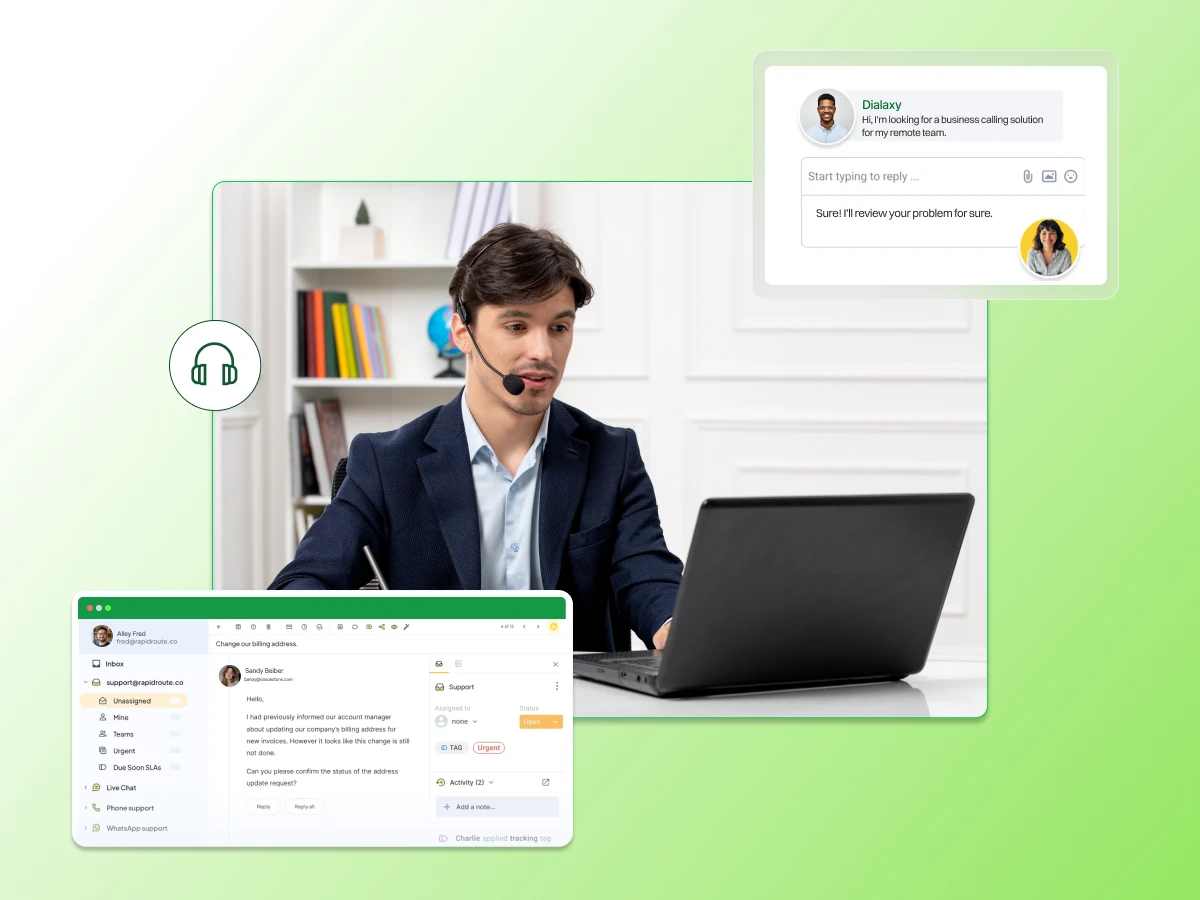
Customer communication management software helps businesses create, manage, personalize, and deliver customer communications across channels such as email, SMS, voice, chat, and print.
The best solution depends on whether you need enterprise document management, customer support, messaging, or voice communication. Below, we compare 14 customer communication management platforms for different business needs in 2026.
Gartner defines customer communication management (CCM) as applications that improve the creation, delivery, storage, and retrieval of outbound and interactive communications. It is more than just sending emails. Modern CCM solutions allow you to manage high-volume documents and personalized messages, helping you deliver customer communications at scale.
A standard CCM solution includes a design tool, a composition engine, and a workflow engine. These tools handle communications processing across multiple print and digital channels. The software has evolved from simple document production into advanced platforms that use AI for customer engagement. These software platforms help you maintain a consistent customer voice while managing customer communication at scale.
Understanding the differences between these software solutions is vital for your digital transformation. Each CCM, CRM, and CCaaS serves a specific purpose in your communication strategies.
Unlike marketing automation platforms, CCM focuses on the creation and delivery of personalized communications. It handles the heavy lifting of document composition and regulatory compliance.
| Aspect | CCM | CRM | CCaaS |
|---|---|---|---|
| Focus | Communication creation & delivery | Data management & sales pipeline | Contact center operations |
| Primary Output | Personalized documents, messages | Customer records, deals | Voice calls, agent interactions |
| Best For | Regulated industries | Sales teams, marketing | Support centers |
A customer relationship management (CRM) system manages your customer base and sales deals. It is a data hub. Contact Center as a Service (CCaaS) focuses on live agent interactions like voice calls. While they overlap, a dedicated CCM platform ensures your individual customers receive high-quality, branded documents every time and helps businesses deliver personalized communications.
Choosing the right tool starts with understanding the types of customer communication you handle daily. Different teams have different needs. A marketing team needs social media tools, while a legal team needs document archives.
| Type | Primary Channel | Best For |
|---|---|---|
| Voice Communication | Phone calls | Sales teams, support centers |
| Helpdesk Software | Tickets (email, chat, phone) | Issue resolution teams |
| Messaging Tools | Email, SMS, WhatsApp | Customer support, marketing |
| AI-First Solutions | All channels | Teams seeking automation |
| Enterprise Document CCM | Print, email, secure portals | Regulated industries |
Organizations enable digital customer interactions through these specific channels. Voice-focused tools like Aircall handle phone systems. Helpdesk tools manage tickets and a knowledge base. Messaging tools often use a shared inbox for team collaboration. Enterprise CCM focuses on secure, high-volume print management and digital document automation.
Choosing the right CCM software platforms requires looking at your specific team goals. Different software platforms excel at different tasks. Some focus on heavy document production, while others prioritize real-time digital customer interaction.
Here are the leading CCM options for 2026.
These modern CCM solutions help large organizations manage complex, high-volume document automation. They are built for industries that need strict legal and compliance oversight, ideal for regulated communications.
These communication solutions use artificial intelligence to speed up response times. They help customer-facing teams handle more queries with less manual effort and enable more responsive customer interactions.
These software solutions focus on solving problems and managing tickets. They help your customer service team track every customer interaction from start to finish.
These CCM tools are aimed at strengthening internal teams to enhance external communication. They have a common inbox, so that no customers’ messages are missed.
These are platforms that are mobile-first and centered around communication. They enable communication between local businesses and their customers by sending them text messages.
Open-source platforms provide full control over your data. For organizations with particular data security needs or custom needs, these are excellent for organizations.
Each CCM software platform has its own pros and cons. These are important considerations to make when making a decision. New CCM solutions provide huge advantages for digital transformation. They also require a great deal of time and training, however.
Communication Fundamentals
May 20, 2026
Read More
When you evaluate CCM software platforms, focus on your specific business goals. Do not just buy the most famous brand. Look for features that solve your current bottlenecks and offer strong capabilities.
This table summarizes the key features of the leading CCM tools. Use it to compare pricing and AI capabilities at a glance.
| Platform | Category | Starting Price | AI Capabilities | Omnichannel | Best For |
|---|---|---|---|---|---|
| Dialaxy | Customer Communication & Cloud Telephony | $15/month | Moderate | Yes | Small & growing businesses |
| Quadient Inspire | Enterprise | Custom | Moderate | Yes | Document-heavy enterprises |
| OpenText Exstream | Enterprise | Custom | Yes | Yes | Regulated industries |
| Smart Communications | Enterprise | Custom | Moderate | Yes | 650+ enterprise orgs |
| Messagepoint | Enterprise | Custom | Yes (Content AI) | Yes | Business-user control |
| Aircall | AI-First Voice | $30/user/mo | Strong (AI Agent) | Yes | Voice-centric teams |
| Intercom | AI-First Messaging | $29/user/mo | Strong (Fin AI) | Yes | AI-powered support |
| Freshdesk | Helpdesk | $15/user/mo | Moderate | Yes | Growing support teams |
| Zoho Desk | Helpdesk | $7/user/mo | Moderate | Yes | Small businesses |
| Salesforce Service Cloud | Enterprise Helpdesk | $25/user/mo | Strong (Einstein) | Yes | Large enterprises |
| Front | Messaging | $19/user/mo | Moderate | Yes | Collaborative teams |
| Missive | Messaging | $14/user/mo | Moderate | Yes | Remote teams |
| Podium | SMS/Local | Custom | Yes | Yes | Local businesses |
| Chatwoot | Open-Source | Free | Yes | Yes | Developers |
Your business needs should dictate your choice. A bank has different requirements than a local coffee shop. Think about your team size and the volume of messages you send.
Many companies fail to see the results they want from CCM. This usually happens because of poor planning. Avoid these common mistakes to ensure your success.
| Pitfall | Solution |
|---|---|
| Poor visibility across platforms (48%) | Choose a CCM with a unified dashboard and reporting. |
| Difficulty capturing customer data (46%) | Ensure strong CRM integration and data sync. |
| Integration challenges (44%) | Prioritize open APIs and pre-built connectors. |
| Lack of best practices (49%) | Choose vendors with a strong partner program and support. |
| Insufficient AI investment (48%) | Select AI-native platforms like Aircall or Intercom. |
| Organizational silos | Use role-based access and cross-department workflows. |
The market for customer communication management software is growing fast. It was estimated to be $2.07 billion in 2023. Experts expect it to reach $4.80 billion by 2030 at a CAGR of 13.2% from 2024 to 2030.
AI adoption is the biggest driver of this change. Gartner predicted that agentic AI, together with conversational AI chatbots, can resolve 80% of common customer issues without any human intervention.
Personalization is no longer optional. McKinsey says that 71% of consumers expect personalized services today. We are seeing a convergence of CRM and CCaaS. The contact center is becoming the “source of truth” for customer data.
Generative AI is transforming interactions from simple chats into dynamic insights. This helps you understand your customer base better than ever before.
Communication Fundamentals
Jun 26, 2026
Read More
Sales & Marketing
Jun 3, 2026
Read More
Customer communication management is no longer just about document production. It’s about orchestrating personalized conversations on all channels. The gap between ambition and execution remains wide.
Very few companies manage to leverage AI for conversational interactions that are truly human-like. The software you select will depend on your industry, team size, and technical resources.
For large companies, Quadient Inspire provides unsurpassed document composition. Aircall is the clear winner for those who are looking for the best AI-first voice tool. For small businesses, consider using Zoho Desk as it is affordable. Chatwoot is awesome for developers. Podium is best suited for local businesses.
Pick a platform that empowers you to use existing customer data to enhance customer satisfaction & the customer experience today.
Dialaxy combines virtual phone numbers, call management, and team collaboration in one platform without enterprise pricing or complexity.
CCM focuses on creating and delivering the actual messages and documents. CRM focuses on managing the data and the relationship history. You use CCM to send a bill and CRM to track if the customer paid it.
Yes. Even small businesses need to ensure consistency in their messages. Affordable tools like Zoho Desk or Missive help you manage customer communication without a massive budget. It helps you look professional from day one.
Regulated industries need it most. This includes banking, insurance, healthcare, and the public sector. These organizations must manage complex legal and compliance rules in every document they send.
Most modern CCM solutions offer integrations with popular CRM systems such as Salesforce and HubSpot. This allows you to use your customer data to create more personalized communications. Always check for an open API before buying.
