

How to Get a Business Phone Number? – A Complete Guide

Your personal phone rings constantly. A client has an urgent question. Your family needs you. This mix of personal and business calls creates confusion. It leads to missed opportunities. Using a personal number for work looks unprofessional. It compromises your privacy. It stops your business from growing effectively.
This guide shows you how to get a business phone number and set up a professional system. You will learn to choose the right type of number. You will set up a professional system in minutes. This process ensures you build credibility. It helps you streamline communications from day one.
Choosing a business phone number is a foundational decision for your company. It impacts customer perception, team productivity, and your ability to scale. To make an informed choice, you must look beyond the number itself and evaluate the system behind it. This detailed guide explores the critical factors you need to consider.
Your business phone shows how professional your company is. Bad call quality makes your business sound unprofessional. Missing features can slow down work. These things are not optional. They are necessary.
High-Definition (HD) voice makes calls clear and easy to understand. It carries more sound details. This makes conversations sound better and more natural. Normal voice quality can sound weak or unclear. It can cause mistakes in communication.
Imagine a customer is providing their credit card details over the phone. Choppy audio or static could lead to an incorrect number being entered. This results in a failed transaction and a frustrated customer. HD Voice, powered by wideband audio codecs, ensures every word is heard with precision. Whether they are calling your desk phone or mobile device, this is the bedrock of a professional phone presence.
This commitment to quality is the first thing you should verify with any potential provider.
Modern phone systems offer powerful tools. These tools automate tasks. They improve your customer service. They make your small business operate like a larger enterprise.
These features are crucial for a professional system. Now let’s discuss how they are priced.
Business phone pricing can be confusing. Providers structure their plans differently. Understanding the common models and potential hidden fees is crucial for choosing a plan that fits your budget.
The most common pricing model is “per user, per month.” If a plan costs $25 per user and you have a team of four, your monthly bill will be $100. This model is highly scalable. As your team grows, you simply add another user to your plan.
Flat-rate plans are less common. They might offer a package with a set number of lines and a pool of shared minutes for one price. This can be cost-effective for a local business with very predictable needs and low call volume. However, it offers less flexibility for growth.
The advertised price is not always the final price. You must be vigilant about potential hidden fees that can inflate your monthly bill.
Providers incentivize longer commitments with discounts.
After establishing your budget, the next step is to see how the system fits into your existing technology stack.
A modern business phone system should not be an isolated tool. Its greatest value is unlocked when it integrates with the other software platforms you use every day. These connections automate tasks and provide valuable business intelligence.
Connecting your phone system to a CRM like HubSpot or Salesforce is powerful. Imagine a customer calls your business. Your phone system recognizes their number. Their entire contact record from your CRM instantly pops up on your screen. You see their order history. The call log is automatically saved to their profile after you hang up.
Integrations go beyond CRMs. You can connect your phone system to helpdesk software like Zendesk. A voicemail can automatically create a new support ticket. You can connect it to collaboration tools like Slack. A missed call can post a notification in a team channel, so everyone is informed.
These connections boost team productivity. The right features also depend on your
team’s size.
Your communication needs will change as your company grows. A good phone system provider offers plans and features that can accommodate your business at every stage of its journey.
An individual business owner’s primary needs are professionalism and separation. A dedicated business number is the first step. A powerful mobile app is the most critical tool. It creates a “phone within a phone” on their personal device.
This keeps business contacts, call logs, and voicemails completely separate from their personal ones. Simple call forwarding ensures they can answer business calls anywhere, while features like business hours allow them to “switch off” after work.
As a team grows, collaboration becomes key. The focus shifts to features that enable shared responsibility.
Larger businesses require more sophisticated tools for management, analytics, and high-volume call handling.
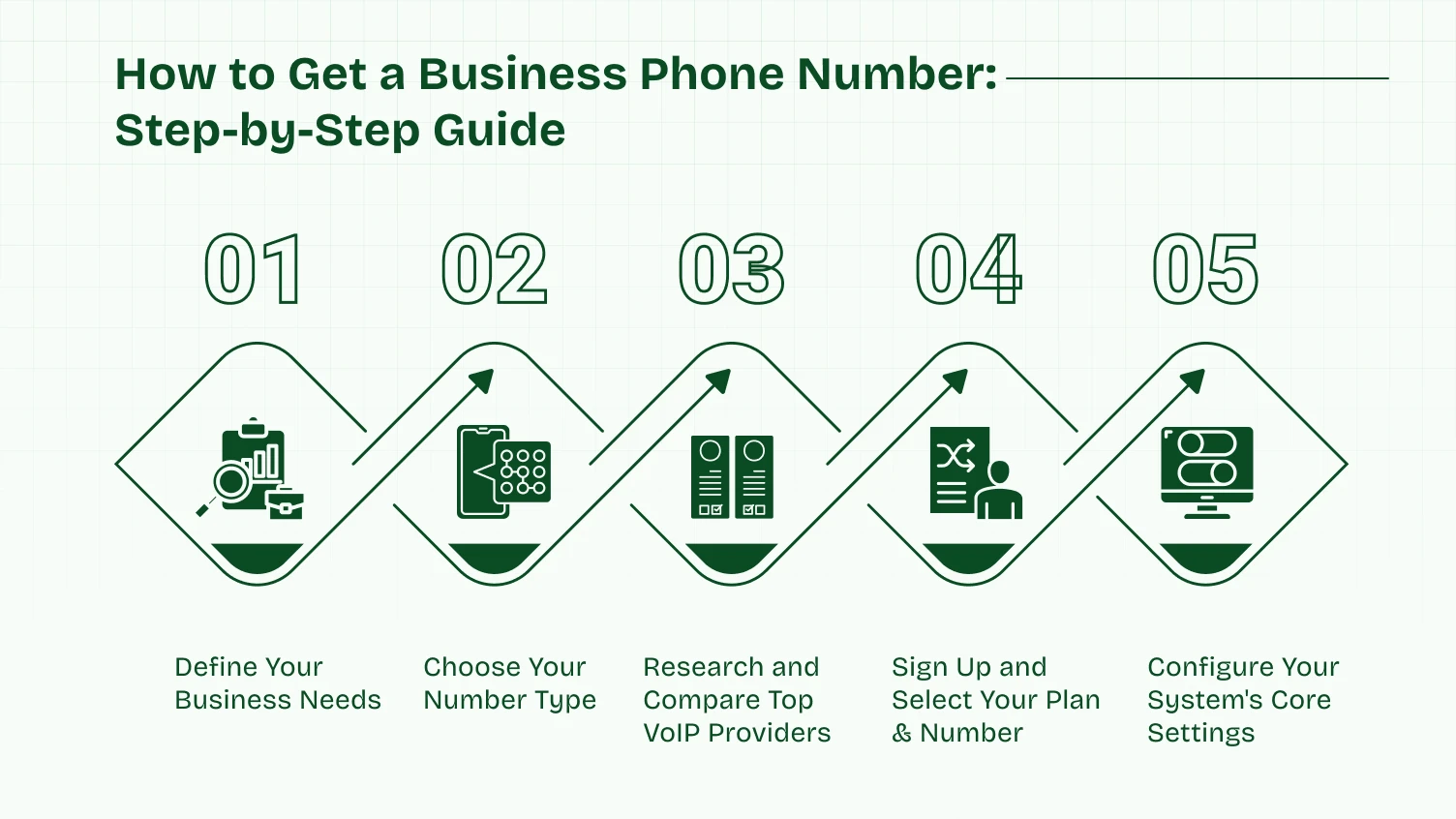
Getting a professional phone number for your business is a straightforward process. You can complete these steps in less than an hour. Following this guide ensures you set up a system that is effective, professional, and ready to help you grow.
Before you start shopping for a provider, you must know what you are looking for. This initial step prevents you from overpaying for features you do not need. It also ensures you get a system that meets your core requirements.
Create a simple checklist to guide your search:
With this checklist, you are ready to choose your number type.
Your phone number is a branding and marketing tool. The type of number you choose sends a specific message to your customers. Each type has a clear strategic value.
Once you know the type of number you want, it is time to find a provider.
There are many providers available. Do not simply choose the first one you find. Proper research ensures you select a reliable and trustworthy partner for your business communications.
Focus on these key areas during your research:
After comparing providers on these points, you will know which one is the best fit. You can then sign up confidently.
The sign-up process for most providers is quick and entirely online. You will first select the plan that matches the feature checklist you created in step one.
Next, you will get your number. You have two options. You can choose a brand-new local, toll-free, or vanity number from the provider’s inventory. Alternatively, you can port your existing business number. This means you can keep the number you already use. Your new provider will handle the entire transfer process for you.
With your account created and number selected, the next step is personalizing your system.
This is the “first-hour” setup, where you customize the system to fit your business. Most providers have a simple, user-friendly dashboard to manage these settings.
Focus on these initial configurations:
Your system is now configured. The final step is to ensure everything works perfectly.
Before you advertise your new number, you must test every function thoroughly. Have your team download the provider’s mobile and desktop apps. This allows them to use the business line on their cell phones and computers.
Then, conduct a full test run from an outside phone line:
This final check guarantees a smooth and professional experience for your very first customer call.
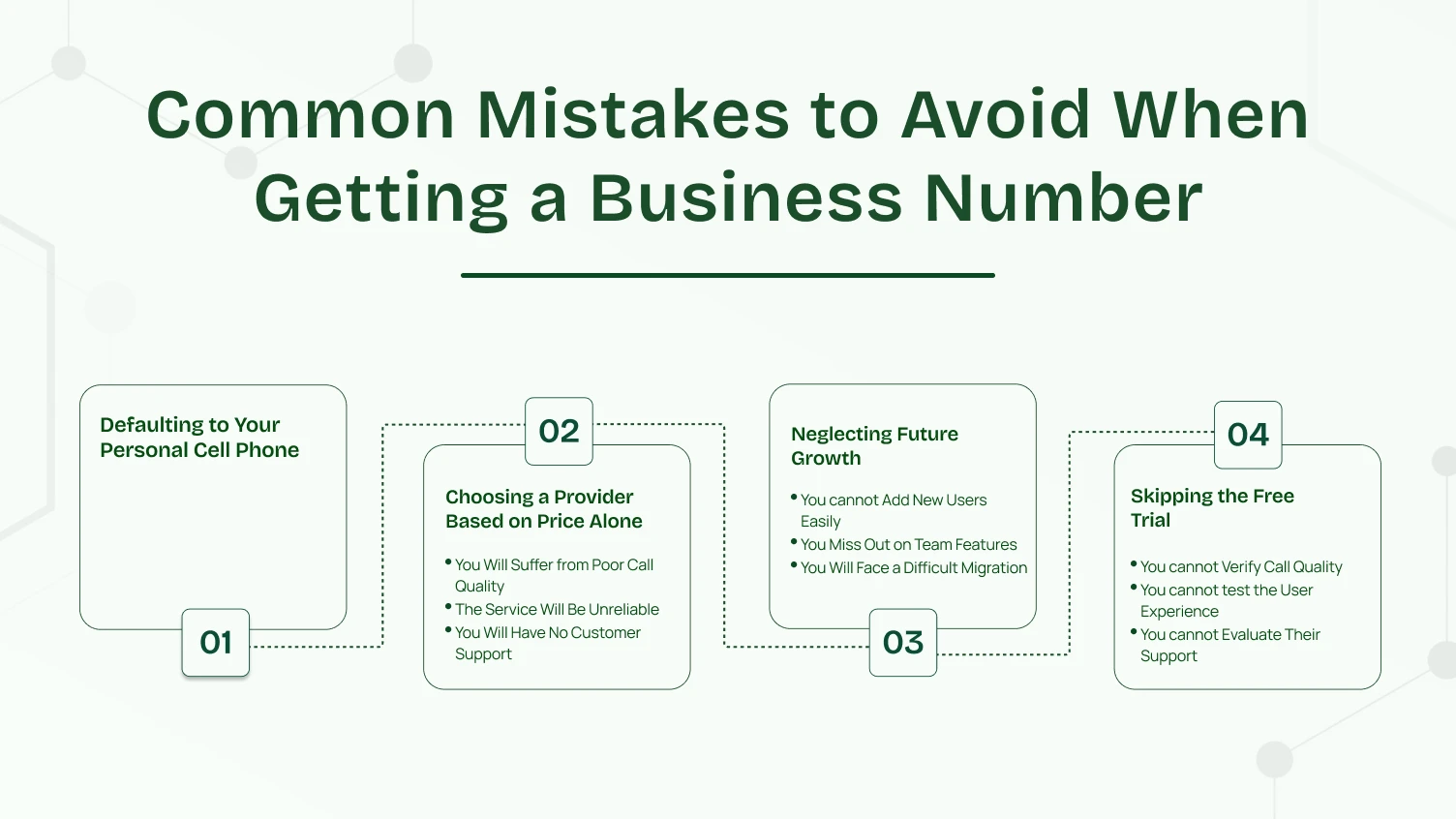
This is the most common and damaging mistake new business owners make. Using your personal number seems easy at first. However, it quickly leads to significant problems.
Example: Imagine a small bakery owner who started with her personal phone number. As the bakery grew, she began receiving customer calls late at night, even during family time.
Without a dedicated business line, she couldn’t separate work from personal life, leaving her exhausted and overwhelmed.
Everyone wants a good deal. Choosing the cheapest phone plan available is often a costly mistake. The lowest-priced providers have to cut corners somewhere, and these cuts directly impact your business.
Example: A small e-commerce store chose a budget VoIP plan to save $10 a month. During their busiest sales weekend, the provider’s service went down for five hours.
They could not receive any customer calls, lost thousands in potential sales, and damaged their reputation.
The phone system that is perfect for you as a solopreneur may be completely inadequate for a team of five. Many business owners choose a simple system without considering their future needs.
Example: A successful real estate agent started her own brokerage. Her basic phone plan worked fine when she was alone, but when she hired two new agents, she realized her system couldn’t transfer calls to them or have a main office line.
She had to migrate to a new service, a major hassle that involved updating her number on hundreds of signs and business cards.
Nearly every reputable provider offers a risk-free way to test their service. This is usually a 14-day free trial or a 30-day money-back guarantee. Skipping this crucial step is like buying a car without a test drive.
Example: A marketing agency signed a one-year contract for a new phone system without testing it. They soon discovered that the call quality was terrible in their specific office building due to network issues.
Because they skipped the trial, they were stuck paying for an entire year of a service that did not work properly for them.
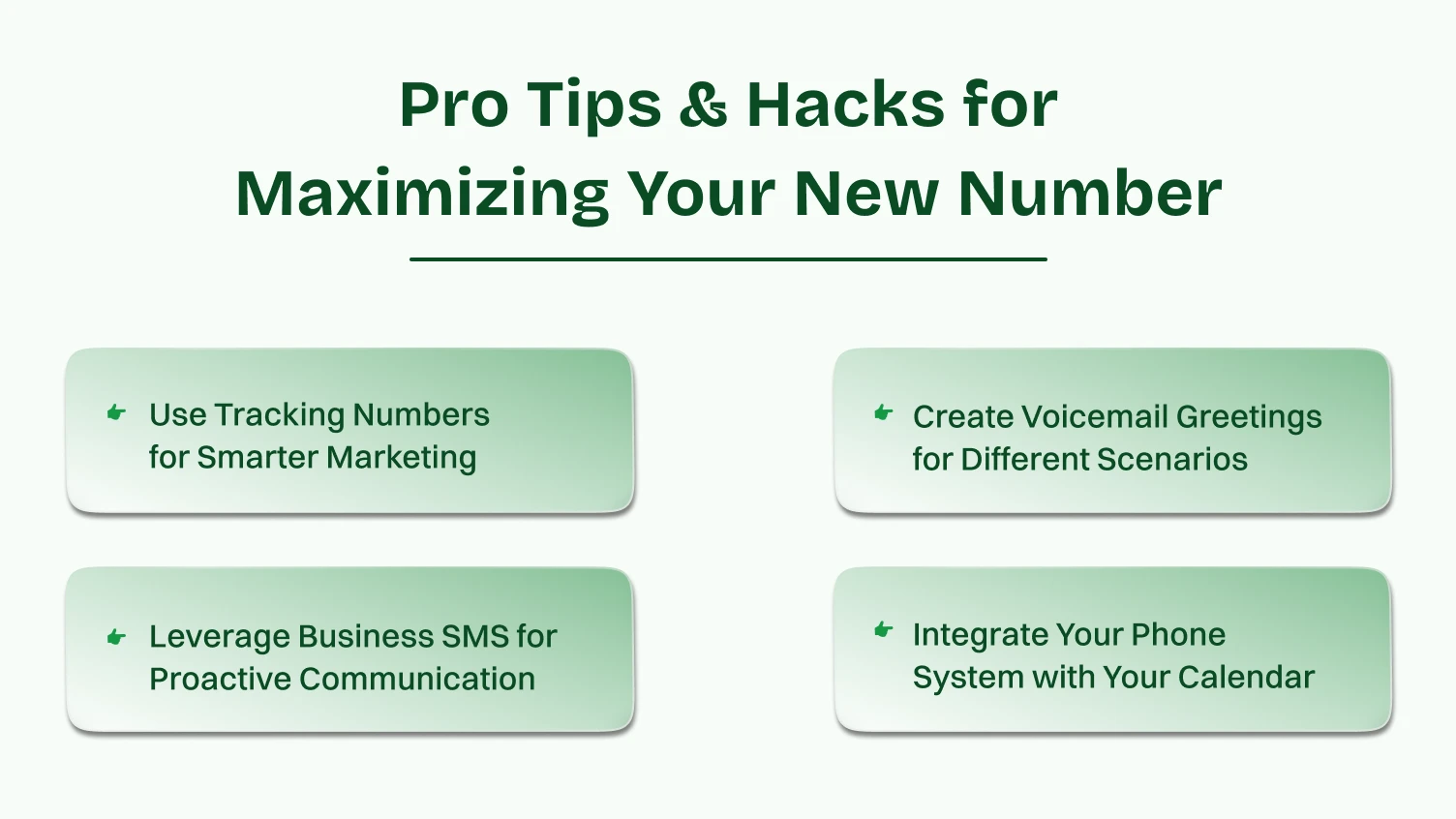
When you are switching providers, adding a line to your business, or just trying to get a fresh start, it’s important to plan how to get the most out of your new phone number. Here are smart tips and tricks to make the transition smooth and the management better.
Instead of using just one business number everywhere, assign a unique phone number to each of your marketing campaigns. Most VoIP providers allow you to add extra numbers to your account for a small monthly fee.
How It Works:
Place one number on your Google Ads, a different number on your Facebook page, and another number on your print flyers.
Why It’s a Hack:
Your phone system’s analytics dashboard will show you exactly how many calls each number received. This eliminates the guesswork of marketing. You will have concrete data showing that your Google Ads generated 50 calls while your print flyers only generated 5.
This allows you to calculate your return on investment (ROI) for each channel and shift your marketing budget to what actually works.
Real-Life Example:
A local plumbing company places a unique tracking number on their website, their Google Business Profile, and the magnetic signs on their vans.
After three months, their reports show that 70% of their new customer calls come from the number on their Google Business Profile. They now know that investing in local SEO is their most profitable marketing strategy.
A single, generic voicemail greeting is a missed opportunity to manage customer expectations. A professional phone system allows you to set up multiple, specific greetings that play based on different rules, showing a high level of detail and care.
How It Works:
In your phone system’s settings, you can record and assign different voicemail greetings to different situations. For example, you can have a specific greeting that plays only after 5 PM, another that plays only on weekends or holidays, and a default one for when you are simply busy on another call.
Why It’s a Hack:
This proactive communication prevents customer frustration. An after-hours greeting that clearly states your business hours tells a caller exactly when to expect a callback. A holiday message avoids the impression that your business is unresponsive, reinforcing your professionalism even when the office is empty.
Real-Life Example:
A financial advisor uses this feature to manage client expectations perfectly. When a client calls during the day while he’s in a meeting, they hear a greeting promising a callback within two business hours.
If they call at 8 PM, a different message informs them the office is closed and provides the next day’s hours. This simple setup ensures his clients always feel informed and respected, never ignored.
Do not wait for customers to text you. Use business SMS strategically to reduce manual work and improve the customer experience. Texts have a 98% open rate, making them far more effective than email for important updates.
How It Works:
Use texting for appointment reminders, order confirmations, payment follow-ups, and simple customer service questions. Many systems can even automate these messages.
Why It’s a Hack:
Sending an automated reminder text 24 hours before an appointment can dramatically reduce costly no-shows. Sending a quick follow-up text with a link to a review site after a service is complete is one of the most effective ways to generate positive online reviews.
Real-Life Example:
A car repair shop uses SMS to streamline its workflow. When a customer’s car is ready, they send a text: “Hi, Sarah. Your Toyota Camry is ready for pickup at your convenience before 6 PM today.”
This is faster for the staff than making a phone call and more convenient for the customer, who can see the message instantly.
Many modern VoIP systems can connect directly to your Google Calendar or Outlook Calendar. This simple integration creates a powerful bridge between your conversations and your schedule.
How It Works:
Connect your phone account to your calendar account in the system’s settings. This allows the phone app to see your availability.
Why It’s a Hack:
This integration saves you time and eliminates the back-and-forth of scheduling. While you are on a call with a client, you can see your open time slots directly in the phone app’s interface.
You can book a follow-up meeting instantly, and the system will automatically send a calendar invitation to both you and the client.
Real-Life Example:
A business coach is finishing a productive call with a new client. Instead of saying, “I’ll email you sometime later,” she says, “Let’s book our next session now. I see I have an opening next Tuesday at 10 AM. Does that work?”
The client agrees, and the coach books the meeting with a single click before the call even ends. This makes her appear incredibly efficient and organized.
Call & Contact Center
Sep 18, 2025
Read More
You have now learned what it takes to get a business phone number. The final step is choosing a provider that delivers on its promises. Many services offer powerful features but hide them behind a complicated interface. Others are simple but lack the tools you need to grow. Finding a provider that balances professional power with true simplicity is the key.
That is where Dialaxy is different.
We believe your business deserves crystal-clear HD call quality on every single call. Your professional image is too important to risk on a service with static, dropped calls, or delays. We built our network for reliability, ensuring that you and your customers can communicate with perfect clarity, every time. This is the foundation of professional communication.
Beyond quality, we focus on efficiency. Our platform is designed to be powerful yet incredibly easy to use. You can set up your entire system, from your auto-attendant to your business hours, in minutes from our clean, user-friendly dashboard. Our integrations connect directly to the tools you already use, like your CRM, turning your phone system into a central part of your workflow, not just another piece of software.
Finally, we believe in transparent partnership. With Dialaxy, you will find straightforward, scalable plans designed to grow with your business. There are no hidden fees or confusing contracts. The price you see is the price you pay. Whether you are a solopreneur or a growing team, our system can expand to meet your needs, ensuring you have a communication partner for the long term.
No, Google Voice for business is not free. It is a paid service that requires a Google Workspace subscription, which has its own per-user monthly fee.
The cost for a business phone line varies by service type. VoIP services are generally more affordable, ranging from $15 to $40 per user per month. Traditional landlines can be more expensive, typically costing $50 to $100 or more per line, plus additional installation and equipment fees.
You can find a business owner’s phone number through their official website, business directories, LinkedIn, or by checking domain registration details. If unavailable, try contacting them through email or a contact form.
While not a legal requirement to form an LLC, it is a critical best practice. A separate number enhances your professional image. It also helps maintain the legal separation between your personal and business assets.
Yes, you can absolutely keep your number through a process called “number porting.” By law, you have the right to take your number to a new provider. Your new provider will manage the entire transfer process for you.
You can get a business phone number on a cell phone by using a virtual phone system or VoIP services like Grasshopper, RingCentral, or Google Voice.
