

AI Phone Numbers: Benefits, Uses & Easy Setup Guide

Have you ever called a business and waited endlessly on hold? Or sent a message only to get a response hours later? Customers today want answers instantly, and businesses that fail to deliver risk losing them. This is where AI phone numbers come in as a modern solution that blends the familiarity of phone communication with the intelligence of AI.
An AI phone number is more than just a regular number. It’s a virtual number powered by conversational AI and voice AI, designed to answer calls, handle messages, and even route inquiries without human involvement. Imagine a phone number that works 24/7, never misses a call, and provides accurate, human-like responses every time. That’s exactly what an AI phone number does.
In this complete guide, we’ll explore what an AI phone number is, how it works, why it matters, and how you can set one up easily. If you’ve ever wondered, “Can AI have phone numbers? Or, how do AI phone numbers work? This article will give you clear answers.
Let’s dive in and see why AI phone numbers are becoming essential for businesses today.
An AI phone number is a virtual phone number connected to software that can understand speech and text. It can answer calls, reply to messages, and take action without a person on the line. It can book meetings, route inquiries, and pass context to your tools. It runs in the cloud and works from any location. This helps teams stay responsive at all hours. It keeps a clean record of every interaction for later review. That history improves service over time.
Think of it as your virtual receptionist. It welcomes callers, listens, and responds with clear steps. It will ask follow-up questions when needed. It will escalate to a person when the topic is complex. You choose the rules, and the system follows them on every call. That creates steady service for customers. It also frees your staff to focus on hard problems. Next, you will see why this matters now.
There is a change in the expectations of the customers. Citizens now want quick help and direct solutions, and they do not want to wait in long queues anymore. Not every call can be managed by the teams. The AI-enabled phone system is a solution to this gap at an affordable price. It does all the daily tasks, and your team can concentrate on more complicated problems. It gives you the same answer every time, and this answer is in line with your company’s policies.
Surveys conducted in the industry suggest a shift towards automation of the phone. AI will be incorporated into phone systems of most businesses within the next year. Faster response times and reduction of costs are already reported in many companies. Customers reward this efficiency through trust and repetitive business. It is likely that the trend will persist because voice technology will only get better. Knowing the way these AI systems work can thus be very rewarding.
An artificial intelligence phone number is powered by a mix of smart automation, cloud technology, and artificial intelligence. We can step through the process sequentially so you can see how that works.

Your number lives in the cloud, not on a SIM card. You manage it in a dashboard. You can add users, set hours, and assign roles. You can also pick a local area code or a toll-free option. This allows a local feel or a national reach as needed. That choice supports your brand plan.
The number connects to voice AI and conversational AI. The engine uses speech recognition and natural language tools. It turns sound into text and text into sound. It matches intent to the right action. It can check your knowledge base and your CRM. It can send a text message or an email when a task is done. This gives callers fast results.
Inbound calls reach the AI agent first. The agent greets the caller and asks how it can help. It provides answers, takes notes, and completes small tasks. If the caller needs a person, the agent does a warm transfer. Outbound calls work the same way. The system can place reminder calls or run surveys. That mix keeps calls clear and useful.
Most AI numbers support SMS. Some also support WhatsApp and other channels. The agent can confirm orders, send links, and gather feedback. You can review transcripts later. This creates a full picture of each account. That context leads to better service on the next call.
The system logs every call. It tracks calls handled, call transfers, response times, and outcomes. It writes notes back to your CRM. It tags issues by topic. It shows peak hours and common requests. You can use that data to improve scripts and training. Over time, the system gets smarter. That is the core loop.
These systems not only efficiently communicate but also provide the basis to achieve business growth in a measurable way by integrating cloud hosting, artificial intelligence-based call management, and real-time analytics. And now we will discuss the main advantages they can offer.
These benefits precondition further practical usage, demonstrating how AI phone numbers can enhance customer support, sales, scheduling, and day-to-day processes.
Your line is always open. A customer can reach you at night or on a holiday. The agent answers with the same care each time. You build trust when help is always there. This sets a clear standard.
AI handles repeat tasks without breaks. You spend less on overtime and overflow. You keep staff for expert work. The budget goes further, and the team feels the lift. Savings can fund growth plans.
Hold music drives people away. AI cuts wait time and gets to the point. The agent listens, confirms, and acts. That speed reduces churn. It also boosts conversion on sales calls.
You can add a new number in minutes. You can spin up a campaign line for ads. You can test a new market with a local area code. You can scale back when a season ends. This keeps you agile.
Every call creates a transcript and a summary. You can search and share notes with your team. You can coach using real examples. You can prove compliance. This helps every department work in sync.
These benefits go beyond simple convenience; they reshape how businesses interact with customers, optimize resources, and stay competitive. To understand where they make the biggest difference, let’s explore the top use cases for AI phone numbers.
AI phone numbers are not just a tech trend—they serve practical roles across multiple scenarios. From handling customer queries to managing schedules, their use cases span every part of communication.
Answer common questions and reset passwords. Share order status and explain policies. Collect details for a ticket. Route complex cases to the right team. Support stays steady during busy hours. This protects your brand.
Use unique numbers on ads and landing pages. Track which channel drives calls. Let the agent qualify leads and book demos. Pass warm prospects to a rep. This keeps the pipeline full. It also improves return on ad spend.
Let callers pick a time without waiting. Sync with calendars to avoid conflicts. Send reminders by text. Reschedule with a single reply. This reduces no-shows. It also saves staff time.
Blend AI phone agents with people. Have AI greet, gather details, and verify identity. Have AI finish simple tasks. Use call routing to send complex cases to a specialist. Add IVR menus for quick paths. This reduces handle time and increases first call resolution.
Individuals can use an AI number for research or reminders. Students, freelancers, and busy parents benefit. The agent can send notes to email. It can create a to-do list. It can call back with results. This keeps life organized.
These examples show that AI phone numbers adapt to business and personal needs alike. Next, let’s look at the leading providers that make these features possible.
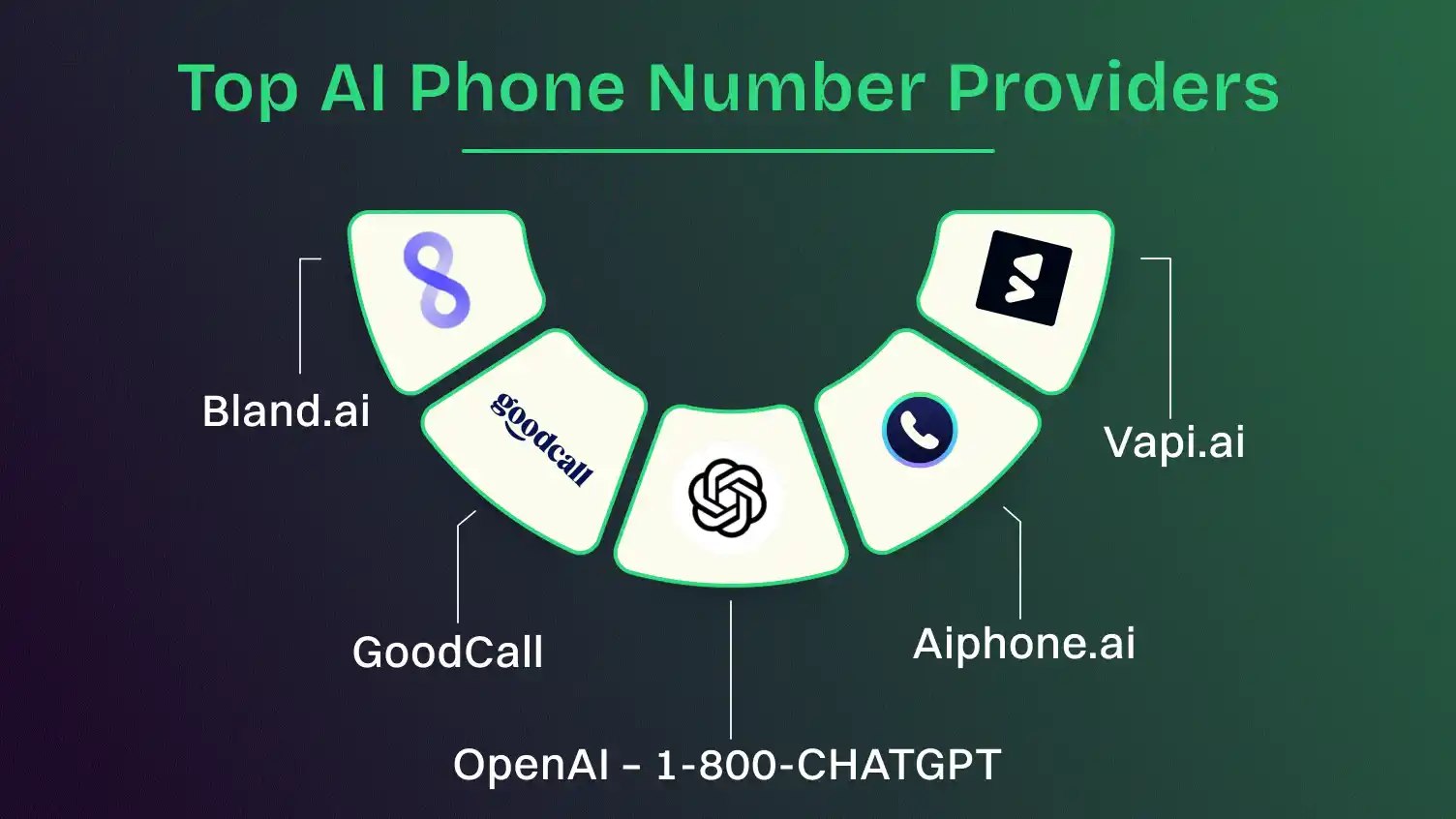
It is essential to find the correct AI phone number provider as every platform has special features depending on the need, both for small businesses and big companies, as well as individuals.
Focus on outbound calling at scale. Strong tools for sales follow-ups and event reminders. Clear controls for pacing and compliance. Useful dashboards for live results. Many teams start here for campaigns.
Built for small businesses that need an answering service. Handles inbound calls with friendly flows. Books appointments and answers FAQs. Simple pricing and fast setup. Owners like the ease of use.
Let’s people call and text a helpful assistant. Good for quick ideas and research. Handy for solo workers and students. It shows the power of voice AI for daily tasks. It is a helpful entry point.
Full AI phone system for growing teams. Supports voice agents, call routing, and deep analytics. Works well with CRMs. Good for support and sales together. Many mid-sized firms use it as a hub.
Popular with developers and product teams. Flexible API for custom voice agents. Good docs and quick start guides. Teams use it to embed voice into apps. This keeps the stack in one place.
These top providers established the standard, and the next thing to do after that is to know how to establish your own AI phone number in the shortest time possible.
An AI phone number is also not as difficult to set up as many people imagine. With a few guided steps, you can have a fully functioning system within a short time.
Step 1: Choose a Provider:
List your goals and compare features, support, and pricing. Pick a provider that fits your business size and stage.
Step 2: Select Your Number
Choose a local area code for regional trust or a toll-free number for a national presence. Map each number to a purpose.
Step 3: Connect the AI
Link the number to your AI engine, import FAQs, and connect your CRM or helpdesk. Test voice responses and intents.
Step 4: Configure Workflows
Set up greetings, IVR menus, call forwarding, and transfers. Keep workflows simple and clear.
Step 5: Go Live and Monitor
Launch softly, track calls, response times, and escalations. Review transcripts and refine workflows regularly
Now that you have completed these steps, your AI phone number is now functional and prepared to provide you with efficient and automated communication that can serve your business or personal requirements.
Some of the features of AI phone numbers are not limited to calls, but they are full of advanced features that take communication and business intelligence to the next level.
The agent understands intent, entities, and context. It handles follow-ups. It adapts to the caller’s pace. It keeps a calm tone. This builds confidence.
Recordings help with training and audits. Transcripts help with search and coaching. Summaries save time for managers. Teams use these tools to improve.
The system can verify identity with passphrases and patterns. This reduces fraud. It also speeds up secure tasks. People appreciate quick yet safe flows.
Dashboards show spikes and trends. You see which topics drive calls. You see which ads pull best. You learn which hours need more staff backup. Data turns into action.
Connect to CRM, help desk, email, and calendars. Push notes to tickets. Create tasks for follow-up. Trigger surveys after calls. These links keep work moving.
These new features turn an AI phone number into a growth, security, and customer satisfaction asset.
When comparing AI phone numbers against traditional phone lines, it becomes clear why more and more businesses are considering implementing AI-based solutions to achieve efficiency and expansion.
Comparison Table:
| Feature | AI Phone Number | Traditional Phone Number |
|---|---|---|
| 24/7 Availability | ✅ Yes | ❌ No |
| Automation | ✅ Yes | ❌ No |
| Cost Effective | ✅ Yes | ❌ No |
| Scalability | ✅ Yes | ⚠ Limited |
| Analytics | ✅ Yes | ❌ No |
| Multilingual Support | ✅ Yes | ⚠ Rare |
This comparison shows that the benefits of the AI phone numbers are much more flexible and efficient, besides providing features that cannot be matched with traditional phone lines, which makes the AI phone numbers perfect in the modern business environment.
Choose a local area code for trust in a region. Use a toll-free number for reach. Keep numbers simple and easy to say. Map each number to a clear use case. This makes routing simple.
Set up call forwarding for backup
Use call routing to send calls by topic or skill. Add IVR with short menus. Keep options under five. People value simple paths.
Write short scripts with a friendly tone
Avoid jargon and filler. Confirm next steps and give a reference number. Send a short summary by text when the call ends. This reduces repeat calls.
Review analytics weekly
Track calls handled, transfers, and missed calls. Listen to a few recordings. Update flows based on what you learn. Share wins with the team. Small tweaks help a lot.
AI Phone Numbers and Business Growth
Firms that adopt AI phone agents report fewer missed calls and faster fixes. Sales teams see more booked meetings. Support teams clear queues with less stress. Leaders get clean reports with trends. This makes planning easier.
Use case stories help show the path
A clinic reduced no-shows by half with text reminders. A repair shop booked more jobs by using local numbers in ads. A software firm routed billing questions away from engineers. Each team gained focus. You can do the same with a clear plan.
AI phone numbers are getting smarter, faster, and more integrated in the future. High-tech voice recognition will allow real-time translation, opening the borders of foreign countries and facilitating communication in different languages. Voice commerce will allow customers to order automatically without having to search long menus, and voice ID will make payments faster and safer. These inventions make the phone an effective means of communication.
Artificial intelligence phone numbers will become part of devices and applications as well. A call can be initiated on a site and be seamlessly handed to a telephone, and notes and transcripts will be synchronized across business applications. Call clips can be used to coach the managers, and the line between the phone system and other digital applications will disappear. Both of these technologies will give an advantage to companies that embrace them first.
An artificial intelligence phone number changes the nature of the conversation with customers. It maintains your line 24/7, minimizes delays, costs less, and scales easily with your team. All calls and messages are logged, giving one a good idea of how to better the service and processes. With or without stress, an AI phone number will provide a faster, smarter, and more consistent response regardless of how small, big, or independent you are.
Adopting this technology means not only automating calls but improving the customer experience, resource optimization, and putting your company ahead of the curve in 2026 and beyond.
Yes. AI phone numbers are virtual and tied to software, not a single device. They can make and receive calls like a normal line. This makes them flexible.
Some services offer a free tier. OpenAI’s 1-800 CHATGPT is one example in select regions. Check current terms before use.
No. Number recycling and new ranges keep growth steady. Virtual lines also reduce pressure on old pools. There is room to expand.
Yes. Many firms run sales and support on AI numbers. They blend AI with people for a balanced approach. Start small and scale as results grow.
Yes. Most AI numbers support SMS. Some support rich text through apps. Check what your provider offers. Test before launch.
Ethical use is key. Do not attempt to track people without consent. Use privacy first settings. Focus on service, not surveillance.
This changes often. Look for numbers from OpenAI, Aiphone.ai, and GoodCall. Avoid random AI phone numbers from unknown sites. Trust the brand first.
They live in your contacts app. Many people sync to iCloud or Google. Check settings to confirm backups. That way, you avoid loss.
Yes. Many teams run a 24/7 AI phone number to catch after-hours calls. You can set rules for on-call staff. You can alert a person for high-risk cases.
Publish your official numbers on your site. Use caller ID and allow block lists. Train staff to verify callers. Security is a daily habit.
