

How to Call the UK from Any Country With Dialing Codes

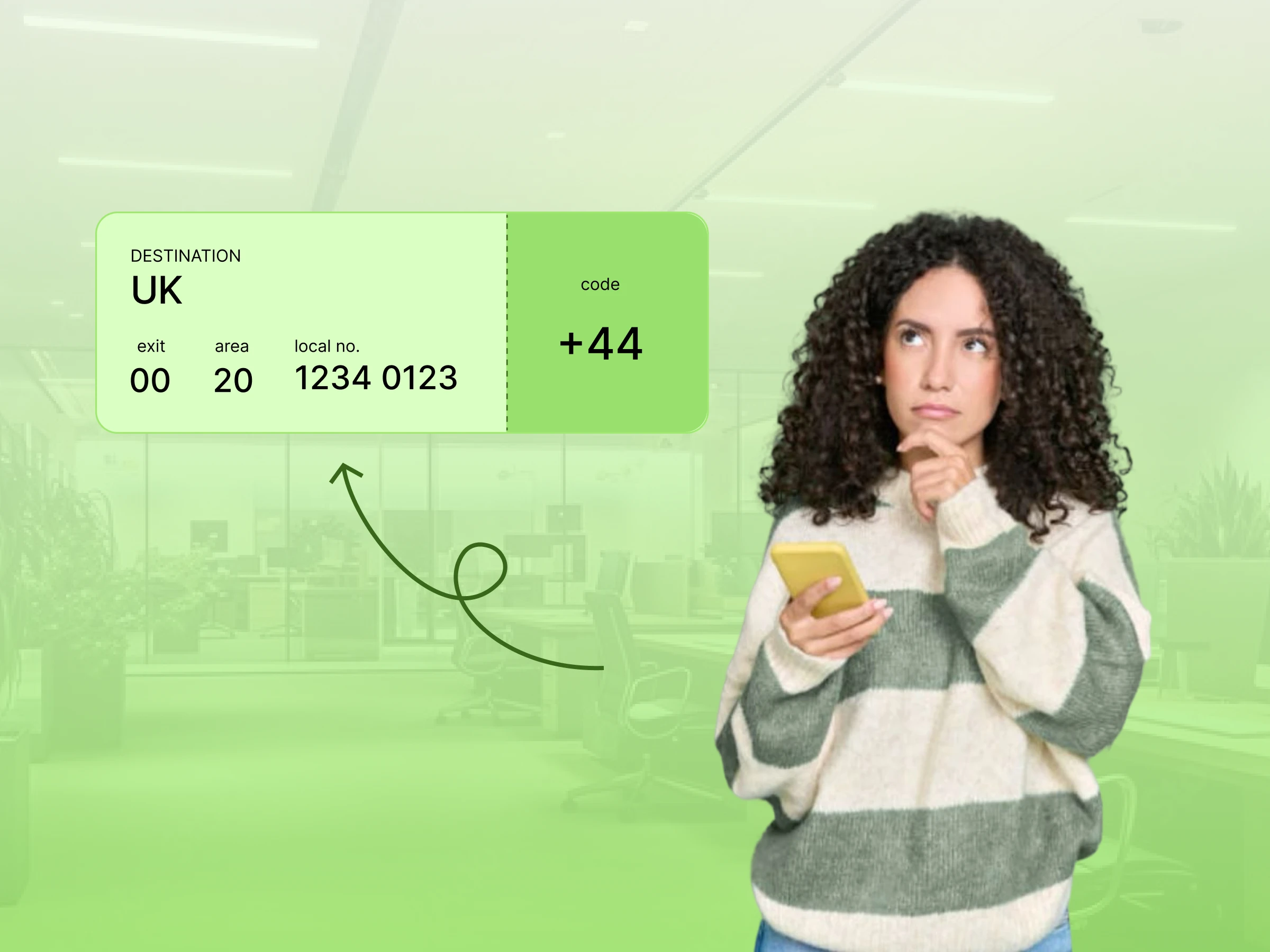
Trying to call the UK from abroad? It’s simple: dial your international exit code or use +, then enter the United Kingdom country code, +44, followed by the UK phone number without its leading 0.
For example, a London number written as 020 7946 0958 in the UK becomes +44 20 7946 0958 when calling from abroad.
This guide explains how to call the UK from the USA, India, Australia, and other countries. You’ll also learn about UK phone number formats, area codes, mobile numbers, and more.
Before you start dialing, take a few seconds to check the number and your phone plan. It can save you from failed calls or unexpected charges.
UK landlines generally use 01 or 02, while mobile numbers usually start with 07. Other UK numbers use different prefixes and charges.
Some traditional carriers require you to activate international calling before you can make an international call. Others include international minutes in selected plans.
For a personal call, your regular phone line or calling app may be enough. Businesses that make frequent calls may prefer internet-based services, VoIP, or a UK virtual number.
The UK’s international country code is +44. ITU lists +44 as the country code for the United Kingdom.
UK Country Code (United Kingdom Country Code): +44
Use +44 when you call a UK number from another country.
The basic format is: +44 + UK number without the initial 0
You can usually use the + symbol on a mobile instead of entering your country’s international dialing code.
When you call internationally from a traditional phone service, you may need an international access or exit code before +44.
| Origin Country | International Exit Code | Full UK Dialing Sequence |
|---|---|---|
| USA | 011 | 011 + 44 + UK number without 0 |
| Canada | 011 | 011 + 44 + UK number without 0 |
| Australia | 0011 | 0011 + 44 + UK number without 0 |
| India | 00 | 00 + 44 + UK number without 0 |
| Singapore | 001 | 001 + 44 + UK number without 0 |
| Most European countries | 00 | 00 + 44 + UK number without 0 |
Exit codes can vary by country and carrier. On a mobile, using +44 is usually simpler.
The UK does not use one simple number format for every service. Different number ranges serve different purposes.
Ofcom maintains the UK’s National Telephone Numbering Plan and publishes current numbering data.
The first 0 in a normal UK number is used for domestic dialing. When you use the international format, you replace that 0 with +44.
For example:
UK domestic: 020 7946 0958
From abroad: +44 20 7946 0958
The same rule applies to mobile numbers:
UK: 07123 456789
International: +44 7123 456789
Quick tip: Don’t dial +44 020 or +44 071. Remove the initial 0.
Sometimes, but not always. Numbers beginning with 01 or 02 are geographic numbers. Their area codes point to particular regions. For example, London uses 020, while Manchester uses 0161.
Mobile numbers are different. A 07 number does not identify a person’s current location. Number portability also matters. People can keep their phone number when they switch providers. So the number’s beginning may not tell you which provider the caller currently uses or where they are today.
Understanding the format makes international dialing much easier. UK numbers use different ranges depending on the service.
A London landline might look like: 020 7946 0958
When calling internationally: +44 20 7946 0958, the domestic 0 is removed.
A UK mobile number can look like: 07123 456789
From abroad: +44 7123 456789
Current ITU information lists UK mobile numbers in international formats beginning with +44 71, +44 72, +44 73, +44 74, +44 75, +44 77, +44 78, and +44 79.
Some UK services use numbers that aren’t tied to a particular location.
Examples include:
0300 123 4567
0800 123 4567
0870 123 4567
03 numbers are charged at geographic rates. 080 numbers are Freephone in the UK. Other 08 ranges can have additional charges.
A simple rule works for most standard UK numbers: +44 + UK number without the first 0
| UK Number | International Format |
|---|---|
| 020 7946 0958 | +44 20 7946 0958 |
| 0161 496 0123 | +44 161 496 0123 |
| 07123 456789 | +44 7123 456789 |
Once you know the country code and number format, calling the UK only takes a few steps.
Step 1: Dial your international exit code: 011.
Step 2: Dial the UK country code: 44.
Step 3: Enter the UK phone number without its first 0.
From a traditional carrier, dial: 011 + 44 + UK number without 0
Example: 011 44 20 7946 0958
On a mobile, you can normally use: +44 20 7946 0958
Step 1: Dial the Australian international access code: 0011.
Step 2: Dial the UK country code: 44.
Step 3: Enter the UK phone number without its first 0.
Use: 0011 + 44 + UK number without 0
Example: 0011 44 20 7946 0958
Or use the mobile format: +44 20 7946 0958
Step 1: Dial India’s international access code: 00.
Step 2: Dial the UK country code: 44.
Step 3: Enter the UK phone number without its leading 0.
Use: 00 + 44 + UK number without 0
Example: 00 44 20 7946 0958
On a smartphone, +44 is usually the easier option.
Many European countries use 00 as their international access code, but this can vary by country and carrier.
Step 1: Dial your country’s international access code, usually 00.
Step 2: Dial the UK country code: 44.
Step 3: Enter the UK phone number without its first 0.
The general format is: 00 + 44 + UK number without 0
Example: 00 44 20 7946 0958
Check with your carrier if you’re unsure about the exact dialing code.
Calling Guide
Aug 24, 2026
Read More
UK area codes help identify geographic landlines. They can be useful when you need to understand a UK phone number or reach a particular location.
| City | UK Area Code | International Format |
|---|---|---|
| London | 020 | +44 20 |
| Birmingham | 0121 | +44 121 |
| Manchester | 0161 | +44 161 |
| Liverpool | 0151 | +44 151 |
| Leeds | 0113 | +44 113 |
| Sheffield | 0114 | +44 114 |
| Nottingham | 0115 | +44 115 |
| Bristol | 0117 | +44 117 |
| Edinburgh | 0131 | +44 131 |
| Glasgow | 0141 | +44 141 |
| Cardiff | 029 | +44 29 |
| Belfast | 028 | +44 28 |
Ofcom’s area-code tool lists these and many other geographic codes across the UK.
The UK has different number ranges for emergency help, businesses, public services, and other organizations.
The main UK emergency numbers are:
These numbers connect callers to emergency services.
For non-emergency situations, different services may use other numbers, such as 101 for police non-emergency calls. Ofcom lists 101, 112, and 999 among UK service numbers. If you’re calling from outside the UK for urgent assistance, verify the correct local option first and be careful to avoid security or scam issues.
UK Freephone numbers normally begin with 0800 or 0808. Calls to 0800 and 0808 numbers are free for consumers calling from UK mobile phones and landlines.
Important note: Calling an 0800 number from outside the UK can work differently. The number may not accept international calls, and your carrier may charge you.
03 numbers are UK-wide non-geographic numbers. They are charged at the same rate as calls to 01 and 02 numbers. They also count toward inclusive minutes when those minutes cover 01 and 02 calls.
084 and 087 numbers are service numbers. They can cost more than ordinary geographic calls.
For consumer calls in the UK, the price can include an access charge from your phone company and a service charge set by the organization you call.
09 numbers are used for premium-rate services. The cost can be higher than a standard call.
Check the stated price before you call. Ofcom includes 09 numbers among ranges where premium-rate charges can apply.
The cost of an international call depends on how you make it. No single UK calling rate applies to every user.
| Calling Method | Cost | Best For |
|---|---|---|
| Mobile or landline carrier | Varies by provider and plan | Occasional calls |
| International calling plan | Depends on plan | Frequent international calls |
| VoIP service | Depends on provider and destination | Regular personal or business calls |
| Internet calling apps | Often free app-to-app | Personal calls |
| Virtual phone number | Depends on provider and plan | Businesses calling or receiving UK calls |
Several factors can affect what you pay:
A one-minute call and a one-hour call will obviously have a different cost. Some plans charge by the minute, while others include a set number of minutes each month.
Time differences can make or break a business call. You don’t want to ring a customer when they’re asleep or already finished for the day.
The UK uses Greenwich Mean Time (GMT) when clocks are on standard time. During daylight saving time, the UK moves to British Summer Time (BST), which is one hour ahead.
In 2026, UK clocks go forward on 29 March and back on 25 October.
For business calls, a good starting point is 9 AM to 5 PM UK time on working days.
| Your Location | UK Time Difference | Good Calling Window |
|---|---|---|
| New York | Usually 5 hours behind the UK | 9 AM–5 PM UK time |
| Los Angeles | Usually 8 hours behind the UK | 9 AM–5 PM UK time |
| Toronto | Usually 5 hours behind the UK | 9 AM–5 PM UK time |
| India | Usually 4.5–5.5 hours ahead | 9 AM–5 PM UK time |
| Sydney | Usually 9–11 hours ahead | 9 AM–5 PM UK time |
| Singapore | Usually 7–8 hours ahead | 9 AM–5 PM UK time |
The exact difference can change when either country changes its clocks.
Businesses often have different needs from personal callers. If your team makes many calls to UK customers, a simple mobile line may not be the best long-term option.
A UK virtual number lets a business use a UK phone number without relying on a traditional physical phone line.
Calls can be routed to your team wherever they work. This can help small businesses serve UK customers while their staff work from different countries or regions. A virtual number does not automatically mean your company has a physical UK location. It is simply a communication option.
A business can connect calling tools with its CRM or other internet-based services. Staff can click a customer’s number instead of typing all the digits manually. This can reduce dialing mistakes and help teams keep call information with the customer’s account.
Tools such as Microsoft Teams can also support business communication, depending on the setup and subscription you choose.
Sometimes a call reaches the customer, but the caller ID looks unfamiliar. In other cases, a call may be flagged as spam.
Possible reasons include:
If your calls are repeatedly declined, don’t simply keep calling. Check your caller ID setup and calling practices. Look at customer reactions and see whether a change improves answer rates.
A UK local number can make your business easier for UK customers to recognize. For example, a company serving London may choose a London number rather than displaying an overseas number.
Still, don’t assume a local number guarantees trust or higher call success. Customers may be more engaged when the call is relevant, expected, and clearly identified.
Most failed international calls come down to a small dialing issue or a restriction on the line.
Wrong: +44 020 7946 0958
Correct: +44 20 7946 0958
Remember: remove the first 0.
Your international dialing code depends on the country you’re calling from. If your call fails, check the exit code for your country or use +44 from a mobile.
Wrong: +44 07123 456789
Correct: +44 7123 456789
The first 0 is removed when you switch to the international format.
Your carrier may have international calling disabled. Some plans also require you to subscribe to an international calling option.
Check your account or contact your provider if the call is declined immediately.
Some UK service numbers may not accept calls from outside the UK. This can happen with certain Freephone or business numbers. If you’re calling from another country, check whether the organization provides an international alternative.
If you’re using an internet calling service, your connection matters. Slow bandwidth, network congestion, high latency, or packet loss can affect call quality. Try a stronger connection or switch networks if the call keeps dropping.
Dialaxy gives you a simpler way to manage business communication with a UK virtual number.
The United Kingdom country code is +44. Use +44 when calling a UK number from another country.
From a traditional phone service in the USA, dial 011 + 44 + the UK number without its first 0. From a mobile, you can usually use +44 instead.
Dial 00 + 44 + the UK number without its first 0. On a mobile, you can normally use +44 directly.
Remove the first 0 from the UK mobile number and add +44. For example: 07123 456789 → +44 7123 456789.
Yes. When you call a standard UK number internationally, remove the initial 0 and add +44.
London’s area code is 020. From abroad, remove the first 0 and use +44 20. For example: 020 7946 0958 → +44 20 7946 0958.
UK numbers vary by service. Geographic numbers generally begin with 01 or 02, while mobile services use 07. Other ranges include 03, 080, 084, 087, and 09.
Not necessarily. 0800 numbers are Freephone when called by consumers from UK mobiles and landlines, but calls from abroad can have different access and charging rules.
There is no single international rate. The cost depends on your carrier, plan, destination number, call length, and calling method. Check the current rate before you call.
The UK uses GMT during standard time and BST during daylight saving time. The exact current time changes with the season, so check the current UK time before an important call. In 2026, the clocks change on 29 March and 25 October.
Yes. You can use a traditional mobile or landline service. Internet-based services such as VoIP and calling apps use an internet connection instead.
The right option depends on your call volume, budget, customers, required features, and the countries or regions you need to reach. Occasional callers may use their existing phone plan. Businesses that make frequent calls may consider VoIP, a UK virtual number, or another business calling service.
