

Best Contact Center Software: In-Depth Review

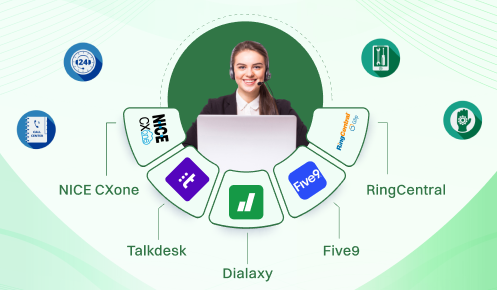
Modern businesses depend on communication. Every interaction shapes the brand. That is where contact center software becomes essential. It brings every communication channel together. It manages inquiries. It also helps teams deliver consistent customer experiences.
Companies today face growing call volumes. They also face rising expectations. Clients want quick responses and accurate answers. A center solution helps teams handle these requests with less effort. It also provides better accuracy. It improves efficiency. It keeps operations flexible. It supports long-term growth.
This guide explores the best contact center software. It explains its benefits. It reviews top platforms. It helps managers and decision-makers choose software. This software should fit their customer base and business goals.
Modern businesses rely on consistent communication to build trust. The right contact center software connects customers with brands at every step of their journey. It helps companies manage multiple interactions. It does this while maintaining accuracy, empathy, and speed.
Any successful company is oriented to engagement with its customers. The contact center is the point of contact for this engagement. It enables brands to develop a personalized relationship. It does this by offering personalized support.
Customers using digital channels desire precision and concern when connecting. Modern center software provides real-time data. It provides a chance to customize the responses of agents. The outcome is better satisfaction and increased loyalty.
Efficiency defines competitive advantage. Businesses using software solutions manage high call volumes. They do this without hiring large teams. Tools like automatic call routing and interactive voice response reduce waiting time. They are also free agents for complex issues.
Scalability matters as operations grow. Cloud platforms expand as demand increases. This ensures a steady experience during seasonal peaks or product launches.

A contact center platform is an integrated solution. It manages all customer interactions. Communications are handled through calls, emails, chats, or social media. This happens in the same way, through a single dashboard.
Through a single interface, businesses can easily track performance. They can record conversations. They can also examine third-party service quality. A contact center platform ties all teams together. It provides them with tools. There will be better communication and efficiency in daily operations.
| Type | Description | Ideal For |
|---|---|---|
| On-Premise Contact Center | Installed locally, managed by in-house IT teams. | Large enterprises need full control. |
| Cloud Contact Center | Hosted online, accessible anywhere. | Growing companies need flexibility. |
| Hybrid Contact Center | Combines local and cloud systems. | Organizations balancing data security with remote access. |
Each model offers distinct strengths of their own. Cloud options are the most favored by businesses. It is because of their quick setup and lower maintenance costs that facilities.
The effectiveness of the right platform is not limited to communication. Investing in contact center software will change the process of team-customer interaction.
It offers a structure, data visibility, and flexibility, and also enhances productivity. Businesses in the contemporary world depend on these benefits to compete efficiently in the dynamic markets.
Customer expectations keep rising. A cloud contact center improves consistency across every communication channel. Customers move from live chat to calls or social media without repeating details.
Customer journey orchestration tools guide agents through context. This creates personalized experiences and faster resolutions.
Agents are the heart of every operation. Good management tools reduce frustration and improve focus. Unified communications keep all data visible, and CRM integration ensures faster responses.
Agents spend less time switching between apps. Automation supports them with suggestions through agent assist and real-time prompts.
Strong reporting helps managers spot trends. Metrics like average handle time or quality assurance scores measure agent performance.
With reporting and analytics, leaders can identify training needs and service gaps. These insights transform data into actionable strategies.
Growth demands adaptable tools. A contact center software feature allows new users or digital channels without major system changes. Cloud-based solutions adjust automatically when new agents join.
Scalability keeps performance stable even during promotions or campaign spikes.
Automation cuts manual tasks. Workflow automation and self-service options lower dependence on large teams. Over time, these improvements create significant savings without affecting quality.
A robust contact center software solution includes capabilities across communication, management, and analytics.
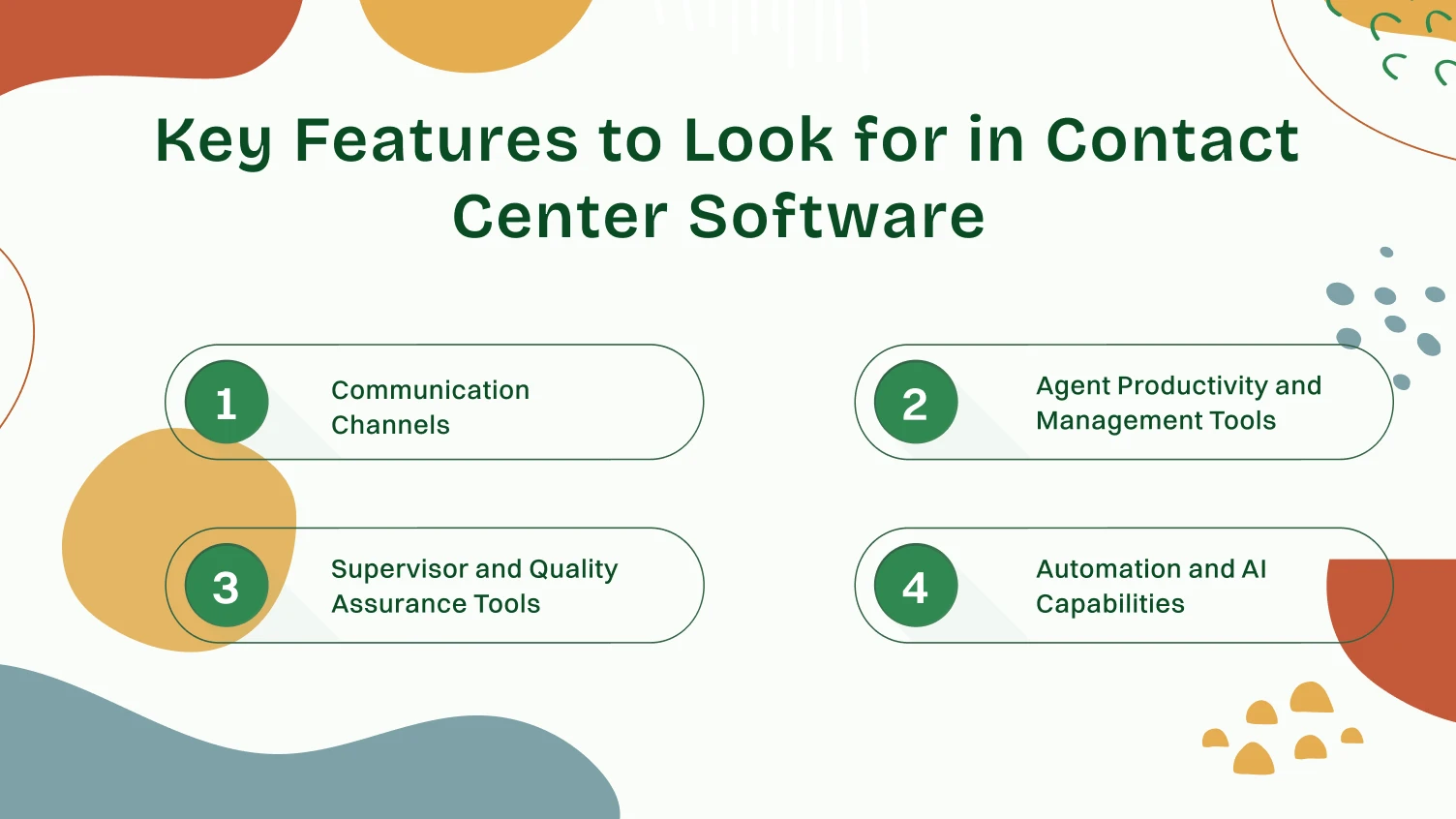
Modern customers prefer flexible communication options. A strong contact center platform brings all engagement channels into one space. This structure simplifies interactions, reduces response times, and ensures no customer inquiry gets lost. Omnichannel systems also improve team collaboration and data tracking.
| Channel | Purpose | Tools Included |
|---|---|---|
| Voice | Supports calling through IVR, ACD, and call routing. | Callback, voicemail, call recordings. |
| Manages tickets from one dashboard. | Templates, tagging, scheduling. | |
| Live Chat | Handles instant customer inquiries. | Canned replies, chat transfer. |
| SMS/Text Messaging | Keeps mobile users updated. | Two-way texting. |
| Social Media | Tracks posts and DMs. | Integration for quick replies. |
| Video Support | Adds video conferencing for technical issues. | Face-to-face guidance. |
Each engagement channel strengthens the overall communication flow. By connecting multiple touchpoints under a single interface, companies reduce delays. They also provide faster service. Agents gain full visibility into the customer journey. This makes interactions smoother and more meaningful.
Key features include CRM system connection, knowledge base, and workforce management. Agents use a unified agent desktop to view full customer data.
Other highlights:
All these systems maintain operational efficiencies and uplift morale in the workforce.
Supervisors rely on real-time dashboards. They monitor metrics and guide staff through call barging or whispering functions.
Recordings, scoring sheets, and quality management ensure consistent service. Leaders evaluate progress using speech and text analytics and performance trends.
Automation transforms routine tasks. AI-powered chatbots handle first-level questions. Sentiment analysis measures emotion during calls.
Modern systems even support predictive dialing for outbound teams. Generative AI and AI knowledge tools craft responses, cutting training time.
Choosing the best contact center software requires an overall understanding of the software. You have to know the strengths, features, and pricing of leading providers. The following overview highlights six top platforms. It discusses the suitability for different business needs.
| Provider | Key Strengths | Best Suited For | Pricing Model (General) |
|---|---|---|---|
| Dialaxy | Affordability, ease of setup, virtual business numbers, 24/7 support | Startups, small businesses, sales/support teams needing affordable, easy-to-use cloud telephony | Tiered, per-user/month (e.g., Basic $10/month) |
| Five9 | Robust omnichannel, advanced AI/automation, workforce optimization, scalability, and reliability | Mid-market to enterprise, businesses implementing advanced AI/automation and WFO | Tiered, per-user/month (custom quote) |
| NICE CXone | AI-first approach, unified CXone Mpower platform, enterprise-grade security/compliance, scalability | Large enterprises, organizations needing highly scalable, secure, AI-driven omnichannel solutions | Per-agent/month (tiered packages) |
| RingCentral | AI-powered, unified UCaaS/CCaaS, 99.99% uptime, comprehensive omnichannel | Businesses of all sizes seeking robust, scalable, reliable cloud CCaaS with UCaaS integration | Per-user/month (e.g., RingCX $65/user/month annually) |
| Talkdesk | AI-powered CXA, industry-specific Experience Clouds, extensive integrations, scalability | Enterprises needing advanced, AI-first omnichannel with industry-specific features | Custom quote (per-user/month) |
| Genesys Cloud CX | AI-powered experience orchestration, all-in-one solution, multi-channel, robust analytics | Organizations prioritizing multi-channel support, analytics, and workforce engagement | Tiered, per-user/month (e.g., CX 1 $75/user/month annually) |
Overview & Key Strengths
Dialaxy provides affordable cloud telephony services as virtual business numbers. The advantages of it are ease of installation, 24/7 support, and ease of use.
Notable Features
Best Suited For
Startups and small businesses need affordable, easy-to-use contact center software solutions. Ideal for small sales or support teams.
Pros & Cons
| Pros | Cons |
|---|---|
| Affordable pricing plans | Limited advanced AI features |
| Quick setup and user-friendly | CRM integrations are still in development |
| Unlimited call recording | Focus on U.S. and Canada numbers only |
Pricing Snapshot
Basic $10/month, Plus $20/month, Pro $30/month, and Enterprise custom pricing. Additional users and numbers at an extra cost.
Overview & Key Strengths
Five9 provides a scalable and reliable cloud contact center service platform. The strong points of the company are its strong omnichannel presence, AI-based automation, and workforce optimization.
Five9 is beneficial in businesses. It enhances the performance of agents. It simplifies work processes.
Notable Features
Best Suited For
Mid-market to enterprise organizations seeking a scalable cloud solution. Ideal for companies deploying AI automation and optimizing workforce productivity.
Pros & Cons
| Pros | Cons |
|---|---|
| Extensive omnichannel support | Complex implementation |
| Advanced AI and automation | Higher pricing than basic solutions |
| Robust WFO tools | May require training for smaller teams |
Pricing Snapshot
Tiered, per-user/month. Core, Premium, Optimum, and Ultimate plans. Add-ons like AI agents and workflow automation are available with custom quotes.
Overview & Key Strengths
NICE CXone is an AI-first omnichannel-oriented. Its CXone Mpower platform serves workflow orchestration, workforce augmentation, and service automation. Highly regulated businesses are made appropriate by enterprise-grade security and compliance.
Notable Features
Best Suited For
Large enterprises require secure, AI-driven contact centers. Especially useful for organizations needing in-depth analytics and compliance adherence.
Pros & Cons
| Pros | Cons |
|---|---|
| Leading AI and automation capabilities | An advanced feature set may overwhelm small teams |
| Enterprise-grade security and scalability | Higher cost for enterprise deployment |
| Extensive integration options | Complexity may require dedicated IT support |
Pricing Snapshot
The packages are tiered by per-agent/month. Examples: CXone Mpower Ultimate Suite $249/month, CXone Mpower Voice Agent $94/month, CXone Mpower Omnichannel Agent $110/month. Additional services of knowledge management and AI self-service are available, too.
Overview & Key Strengths
RingCentral offers an AI-powered cloud contact center and unified communications. With 99.99% uptime, it provides reliable, scalable operations. AI capabilities improve customer experiences and agent efficiency.
Notable Features
Best Suited For
Businesses of all sizes seeking a robust cloud contact center platform with integrated UCaaS.
Pros & Cons
| Pros | Cons |
|---|---|
| High reliability with 99.99% uptime | Pricing details are not always transparent |
| Comprehensive AI and omnichannel support | Extensive features may be complex for very small teams |
| Strong CRM integrations | Some features require premium plans |
Pricing Snapshot
RingCX AI Contact Center: $65/user/month annually. Higher-tier plans and add-ons may incur extra costs.
Overview & Key Strengths
Talkdesk is an AI-first cloud contact center platform with industry-specific experience clouds. It focuses on automation, omnichannel service, and AI-powered customer interactions.
Notable Features
Best Suited For
Large enterprises that need advanced, AI-first omnichannel software with industry-specific functionality.
Pros & Cons
| Pros | Cons |
|---|---|
| Strong AI automation and omnichannel support | Pricing requires a custom quote |
| Industry-specific Experience Clouds | Advanced features may be excessive for small teams |
| Extensive integrations and scalability | Deployment requires planning |
Pricing Snapshot
Custom per-user/month pricing based on features, industry clouds, and scale.
Overview & Key Strengths
Genesys Cloud CX is an inbound and outbound operations solution powered by AI and is all-in-one. It is good at orchestrating experience and engaging the workforce.
Notable Features
Best Suited For
Organizations of all sizes are prioritizing multi-channel support, analytics, and workforce management.
Pros & Cons
| Pros | Cons |
|---|---|
| All-in-one solution with AI orchestration | Occasional performance slowdowns |
| Strong analytics and reporting | Higher cost compared to some competitors |
| Scalable for large or growing teams | Advanced features may require training |
Pricing Snapshot
Tiered per-user/month, billed annually. Prices range $75–$155, depending on features and deployment scale.
The decision on the best contact center software is important. It influences the customer experience, the performance of the agents, and daily activities. The needs of every business are different. Problem evaluation allows long-term value and efficiency.
Begin with the analysis of essential requirements. Determine anticipated volumes of calls. Identify the most desired communication channels. Specify the number of agents needed. Exemplar mapping of the customer journey includes frequent questions. Define IT budget constraints and resources. Consider the integration of your helpdesk tools or CRM.
Take into account future scalability. The software capabilities of cloud-based solutions enable easy expansion. This is an advantage for high-volume contact centers. Smaller businesses could focus on simplicity and low cost. However, they should not forego fundamental operations such as call routing and reporting.
There are differences in compliance and regulations in industries. The selection of software with such standards will secure sensitive data and prevent fines.
| Industry | Compliance Focus | Example |
|---|---|---|
| Healthcare | HIPAA | Protecting patient records |
| Finance | PCI DSS | Securing payment information |
| Retail | Data Privacy | Handling seasonal spikes safely |
Platforms designed for regulated industries often feature advanced quality management, secure storage, and audit trails. These features maintain operational efficiency while ensuring customer trust.
The process of choosing appropriate contact center software should be carefully evaluated. All features affect agent performance. They also affect operational efficiency and customer experiences.
The capabilities should focus on features relevant to the day-to-day running of the business. They should also consider the long-term development of the business.
1. Scalability and Flexibility
The software should be based on a platform that can promote business growth. This should happen without needing to change to a new infrastructure. Adding agents, channels, or locations can be easily done using cloud-based solutions.
Systems with flexible architecture avoid bottlenecks as the number of calls rises. Scalable platforms can also help a business reach new markets. This is possible without losing the ability to communicate with customers. They can still provide the same quality of experience.
2. Ease of Use and Onboarding
Easy user interfaces help save on training and adoption costs. Agents are able to navigate dashboards, customer inquiries, and live chat easily. Streamlined processes boost operational efficiency. They also minimize mistakes.
An easy-to-use interface enables supervisors to track performance. This is done through reporting and analytics. It also assists new employees during peak hours. User-friendly onboarding and contact center software platforms guarantee quick implementation. They also reduce payback time.
3. Integration Capabilities
Workflows are optimized through seamless integration. This includes integration with CRM systems, analytics platforms, and workforce management platforms. With integrated systems, customer data can be accessed in real-time.
This enhances customer journey orchestration. Agents have a single perspective of channel interaction.
Workflow automation and AI-powered agent assist also do not require much implementation. This is facilitated by integration. It saves time on manual work. It also improves response time to customer inquiries.
4. Reporting and Analytics
High-tech dashboards and call recordings enable one to see performance measures. Supervisors track agent performance, call resolution time, and customer satisfaction. Historical reporting reveals trends, bottlenecks, and resource allocation. Analytics insights aid in making strategic decisions.
These relate to staff, schedule, and future technology investment. Real-time monitoring platforms with predictive analytics reinforce business performance. They also help improve customer experiences.
5. Security and Transparency
To protect sensitive customer information, genuine VoIP encryption, access policies, and vulnerability disclosure policies are implemented. Platforms must meet industry requirements. They must also have audit capabilities.
Customers are not afraid of safety concerns. Controlled industries are not disobedient. Companies will be able to concentrate on providing outstanding service. They can do this without compromising their information system or interrupting operations.
6. Support and Training of Providers.
The quality of support helps to solve problems in time. Documentation providers, live support, and partner portals minimize downtimes. Agent and supervisor training modules enhance platform knowledge.
This includes contact center software solutions, AI, and reporting options. High support also improves agent performance. It reduces mistakes. Customer satisfaction across all communication channels is high.
Testing platforms in real time reveals true performance. Hands-on trials show how systems handle daily operations. During evaluation, check handle time, call routing, and agent performance across communication channels. Notice how easily the interface adapts to your workflow and team size. Smooth navigation and clear dashboards reduce confusion during busy periods.
Requesting demos from multiple vendors gives valuable context. Each platform delivers unique contact center software features, so testing helps compare usability. Monitor reporting dashboards, agent dashboards, and integrations with CRMs. Observe how workflow automation supports daily activities like ticket management or escalation handling.
Reading customer stories and success stories provides a deeper understanding. These reviews show how companies manage high call volumes. They also reveal how they handle remote teams and complex routing needs.
Real-world experiences reveal long-term reliability. They also show provider responsiveness and integration effectiveness. They highlight how providers support scaling as customer bases grow.
Businesses gain insights from verified users before investing. Reviews often reveal trends in quality assurance. They also show support, consistency, and downtime frequency. With trial experiences available, contact center leaders can make confident decisions based on this information.
The deployment of a cloud call center needs to be coordinated and planned. Proper onboarding brings people, systems, and workflows in line with each other to operate smoothly.
Proper organization prevents distractions. Service delivery remains constant across all communication channels.
Deployment time can take days, depending on the system’s size. However, it is usually completed within a few days. Installation includes user setup, SIP trunking, and network security setup. When this is done, skills-based routing and automatic call distribution are tested.
These guarantee effective communication with customers. This communication occurs either through voice, email, or chat. Premature testing assists in identifying possible bottlenecks. This happens prior to complete implementation.
Performance tests validate call routing, queue handling, call center analytic, and CRM synchronization. Consolidating social media communications allows administrators to monitor real-time activity across all channels more effectively.
Training is essential to utilize all the software capabilities of each center. Training programs equip agents to handle live chat, call recordings, and case tracking with confidence. Such learning materials include simulations and practical scenarios.
Supervisors are further coached on workforce engagement management, real-time monitoring, and quality assurance. These applications keep productivity on track. They also monitor agent performance. Agents and supervisors can provide a better customer experience. They achieve high customer satisfaction when they know the system functions.
Teams receive new AI modules or automation tools. These are updated by regular training sessions. Regular refreshers guarantee consistent performance. They also ensure high retention of best practices.
Migration will start after reviewing and mapping data structures. Historical data from older tools is transferred into new contact center software solutions. This is done through safe transfer protocols.
Supervisors thereafter certify automatic call systems and routing rules. This ensures proper flow. Certain initial live sessions will enable a trial under actual conditions. Customers are dealt with by small pilot groups. Managers then identify potential problems.
After being tested, the complete rollout commences. An appropriately implemented go-live plan will ensure a stable process. It also ensures customers are assisted through a steady transition.
Constant support is provided after launch to make the system efficient. Providers also offer documentation, community forums, and a partner portal for troubleshooting. Specialized support teams address technical issues fast. They also reduce downtimes.
Good vendors also help in updating and adding features. They track the use of workflow automation. They lead businesses in the optimization process. Availability of comprehensive directions assists teams. It exploits AI-powered tools, chatbots, and knowledge base systems.
A high level of support guarantees operational stability and continuous enhancement. Companies experience fewer disruptions. They also retain customers throughout all touchpoints.
Customer service is evolving rapidly. Companies are now using adaptive tools that combine AI, analytics, and human expertise. These modern systems improve teamwork and agility. It provides personalized experiences across both digital and voice platforms.
Artificial intelligence improves customer response and foresight decision-making. AI discusses conversations in real-time. It also detects the mood and motive. This understanding helps contact center leaders personalize their responses and enhance satisfaction.
Generative AI has now been enhanced. It includes summarization, suggestions, and drafting of responses. Such models save agents’ time. They also enhance uniformity in contacting customers. The use of AI routing is also able to send queries to the most competent agents. This enhances handle time and lowers frustrations.
Predictive analytics involves speech and text analytics. It helps in predicting needs and measuring performance. This intelligence assists in making plans for staffing. It also helps with workforce management.
Omnichannel systems integrate all engagement channels into a single platform. Voice, social media, live chat, and video conferencing are now in liaison with each other. This allows customers to move across channels without repeating information. Customers have a better experience.
Companies embracing omnichannel reinforce loyalty and retention. Combined applications enable managers to monitor complete customer journeys. This is done through integrated dashboards. This visibility allows prompt reactions. It also improves quality control for every type of interaction.
Contact center success continues to focus on agent well-being. Workforce engagement tools improve motivation. These include gamification, balanced scheduling, and performance tracking. They also foster accountability and development. Real-time dashboards demonstrate goal progress. This motivates further progress.
Better customer satisfaction directly depends on better agent support. Employees will provide better service when empowered and made to feel valued. Engagement is a culture. It is fostered through platforms that promote recognition, skill development, and feedback.
Workforce management software balances workloads. It does this by allocating tasks fairly. Decreased burnout leads to more stable performance. It also results in less escalation.
Self-service tools are smarter and more intelligent. AI-powered chatbots and virtual assistants address common problems. They do this without human assistance. These systems respond to queries. They provide troubleshooting guidance. They also solicit feedback automatically.
By integrating knowledge base systems, customers can easily get answers. Organized documentation, frequently asked questions, and interactive material reduce resolution time. Self-service saves agents’ workload. It still offers quality support.
Lower costs and quick response times are realized in companies using self-service options. Easy accessibility means customers will never be dissatisfied. This is true even when the business is not operational.
Remote work will be a permanent component of the contemporary call center model. Distributed teams are flexible with cloud contact center solutions. Agents can access tools through authenticated portals wherever they are.
Data in cloud-based systems is synchronized across departments in real-time. Supervisors also track real-time activity. They use dashboards for calls, messages, and video conference meetings. The availability of accurate measurements maintains performance across all locations.
Hyper-resilient cloud infrastructure guarantees business continuity in the event of disruption. It helps in continuous service even when things go wrong. The next generation of contact center platforms is defined by their flexibility, accessibility, and scalability.
Modern customer operations need more than traditional voice tools. The right contact center software connects people, data, and systems under one platform. It strengthens teamwork and ensures consistent customer engagement across every channel.
Those companies that embrace AI, analytics, and omnichannel interaction provide improved customer experience. They also see improved performance. Whether you manage a small support team or a large multinational company, selecting the right solution can enhance growth and productivity.
Periodic review aids in keeping track of business objectives. Further updates and smart integrations will keep enhancing customer service departments. They will also improve overall output.
Use Dialaxy’s powerful contact center platform to simplify workflows, improve team efficiency, and deliver better customer experiences.
A call center handles voice interactions only. A contact center manages multiple channels like email, chat, and social media.
Prices vary by model and agent count. Cloud plans start per user per month with tiered features.
Yes, most solutions include CRM integration. Or, they offer native plugins for systems like Salesforce or Microsoft Dynamics.
Cloud systems offer flexibility and quicker deployment. On-premise tools provide full control over data.
Basic setups are complete within a few days. Complex enterprise migrations may take several weeks.
