

Call Center vs Contact Center: Which One Does Your Business Need?

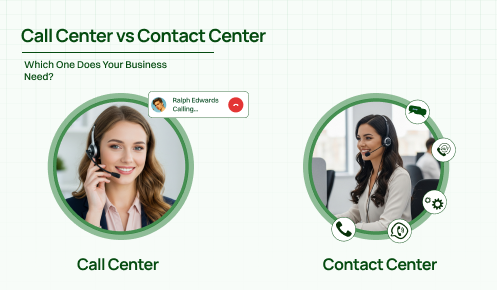
Customer communication is not only desirable but also crucial in today’s fast-paced business world. Businesses are always seeking a solution to reach out to customers, assist them, and establish a long-term relationship.
This usually results in a huge decision: should you invest in a call center or in a contact center? Although these terms are used interchangeably in some cases, they are quite different in the way they approach customers. These differences are important in understanding the proper solution to your business.
This guide will explain the main ideas, key differences, and benefits of both call centers and contact centers. We will also examine the best ways to operate them, common mistakes, and what is next in this area. This will help you make a good decision that makes your customers happier.
Customer communication is the backbone of any business. It doesn’t matter if you sell coffee or complex SaaS software; if your customers can’t reach you easily, they’ll find someone else who’s ready to talk.
For example, imagine a small bakery using only a traditional phone line. When calls come in for orders, the line is often busy. Customers get frustrated. On the other hand, instead of relying on several platforms to place orders, answer calls, and even WhatsApp messages, a bakery with a modern contact center is able to process them on the same platform and reduce missed orders, customer satisfaction levels, and revenue.
Good communication also builds trust. When a company reacts promptly to its customer complaints over the phone, via mail, or on social media, it gains loyalty. Customers are appreciated and remain longer.
Before comparing the two, let’s break down what each one really means.
A call center is all about voice calls. Customers dial in. Agents answer. That’s the core job. But call centers can take a few different forms:
Call centers are typically voice-focused, often operating on outdated systems with limited communication capabilities.
A contact center takes things further. Instead of only voice calls, it handles multiple ways in which customers reach out. These centers support:
For example, a modern e-commerce brand might use a contact center so a customer can:
All from the same software. No switching platforms.
A call center is primarily built to support voice work with customers. Take it as a point where customers make calls, request, or complain. The more common traditional call centers use phone systems that have simple tools such as IVR menus and call routing to control call flow. E.g., a call center may be used by a retail business to respond to product inquiries or complaints via the telephone. It is simple and only restricted to voice communication.
Customer service is then brought to a higher level by a contact center. It facilitates the use of various communication mediums, including voice calls, live chat, text messaging, email, and social media. Agents do not have to pick up the phone and can reply to a query on Facebook, a chat on a website, or a query on WhatsApp, all within the same platform.
A good example is an eCommerce business, where customers may want to make orders via chat, get refunds via email, or call in requesting urgent assistance. The call center provides an integrated and simplified multichannel experience.
Let’s break it down in tabular form:
| Feature | Call Center | Contact Center |
|---|---|---|
| Primary Channels | Voice calls only | Voice calls + text, email, live chat, social media |
| Technology Used | Traditional phone systems, basic IVR | Cloud computing, chatbots, CRM. |
| Customer Inquiries | Handled one call at a time | Managed across multiple channels simultaneously |
| Call Volumes | Limited to available agents | Scalable with digital queues & automation |
| Wait Times | Longer hold times if call volumes spike | Lower with self-service tools & instant chat |
| Call Distribution | Manual or basic call routing | Intelligent routing using AI & analytics |
| Workforce Engagement | Focused on call handling | Focused on customer experience & omnichannel support |
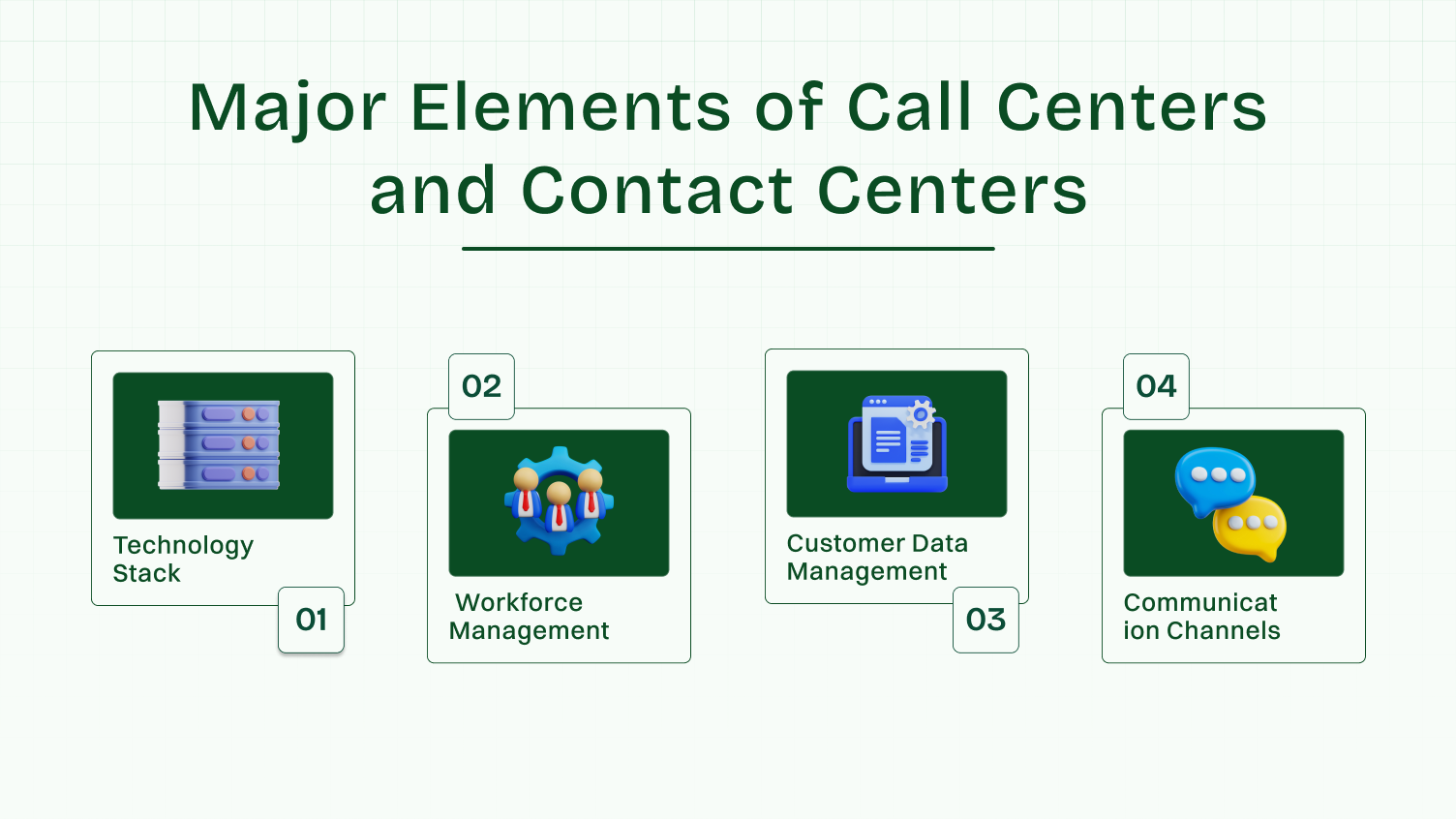
In order to see which system is appropriate to your business, it is worthwhile to separate the larger components that contribute to the success of call centers and contact centers. These factors determine how agents work, how consumers can be served, and how businesses quantify performance.
The technology stack is the backbone of any center. The traditional type of call center uses mainly IVR systems, call center software, and simple phone systems. These devices are used to direct incoming calls, call history, and call centers to make or place outbound calls.
Contact centers take the technology further. They combine CRM, knowledge bases, and agent assist tools powered by AI. This enables agents to manage various channels, such as voice calls, live chat, email, SMS, and social media, without losing context. Tools of analytics also monitor cross-channel communications to assist managers in enhancing customer experiences and call allocation.
Example:
A small retail business might use a call center with phones and IVR menus to handle basic customer inquiries. Meanwhile, a modern eCommerce company might use contact center software that combines live chat, social media integration, and AI agents, giving customers several ways to reach support efficiently.
People are as difficult to manage as technology. At a call center, it is the center manager who arranges shifts, checks the number of calls received, and makes sure that the agents pick up the phone in good time. Agents usually have to work with simple tools, and they do not receive much assistance during rush times.
Scheduling is not all that workforce management entails in a contact center. Skills-based routing means that each customer inquiry is directed to the appropriate agent, and wait time is minimized. AI-powered contact center and agent assist tools can offer real-time recommendations and work processes to enhance efficiency. Managers are also tracking agent performance across channels other than phone calls to maximize workforce engagement.
Example:
A call center agent can transfer a call manually when it is too complicated, which can be a cause of delays. Instant AI-driven suggestions can be provided to a contact center agent, who can then direct the customer to the appropriate expert and keep the discussion flowing on the relevant channels.
Data is where contact centers outshine traditional call centers. Basic call logs and customer information are what call centers usually follow. This is enough when dealing with basic interactions, but it does not give information on customer behavior or preferences.
Contact centers monitor the complete customer experience. They hold customer information, track multi-channel engagements, and leverage conversational analytics to interpret sentiment, identify patterns, and predict demand. This data is safeguarded by security and is key to compliance and creating customer trust.
Example:
When a customer calls a call center, he or she gets a general response as the agent only sees the previous call history. Within a contact center, the agent is able to see the history of the customer in terms of email, chat, and social media, resulting in quicker resolution and better customer experiences.
Communication is the core of both systems. Call centers focus on inbound and outbound calls. This is fine for basic customer support, but it limits reach to only one communication channel.
Contact centers manage multiple channels simultaneously:
With this multichannel strategy, customers can access your business in the way they want, enhancing customer engagement and satisfaction.
Example:
If a customer has an urgent order question, they could call a retail call center and wait on hold. With the right center technology, the same customer in a contact center would be able to message through WhatsApp, chat on the site, and even make a call, all handled under the same system.
It is essential to measure the effectiveness of customer service to optimize the service performance and make it effective and aligned with business objectives. There are many ways of measuring the performance of both call centers and contact centers, but contact centers tend to have more because they deal with a broader scope of communications.
Call Center Performance Metrics:
These measurements give good information about how well phone-based support is working. They help call center managers find areas to improve.
Contact Center Performance Metrics:
Contact centers track all the measurements a call center does, plus extra ones made for handling many different communication types:
By examining these various measurements, businesses can gain a comprehensive understanding of their customer service performance and identify opportunities to enhance the overall customer experience. This complete approach is crucial for getting the best from staff and making customers happy.
Picking between a call center and a contact center has big effects on your business. The right choice can bring many good things.
Benefits of a Call Center:
For businesses that mainly communicate in one way, a call center offers a simple and effective way to manage phone calls.
Benefits of a Contact Center:
In the end, a contact center offers a stronger and more future-ready solution for businesses aiming to give great customer experiences everywhere they connect. This leads to customers staying longer and being more loyal.
Even with good intentions, businesses can make errors that hurt how well their customer service works. Being aware of these most common mistakes can prevent them.
Common Call Center Mistakes:
Such errors have the potential to significantly decrease customer trust and loyalty.
Common Contact Center Mistakes:
The prevention of these mistakes is essential to achieving a high ROI on a contact center and providing genuinely outstanding customer experiences. This ensures that each and every customer interaction, regardless of how it occurred, is a positive one.
Call centers and contact centers can only perform their best when they take the time to be well-managed. Adhere to good practices, provide quality service, and satisfy customers.
Call Center Best Practices:
These practices help make sure call center staff are well-prepared to handle customer questions effectively.
Contact Center Best Practices:
These positive habits can help make the contact centers of businesses formidable engines of customer happiness and loyalty. This interactive nature of customer communication is highly beneficial to the customer experience.
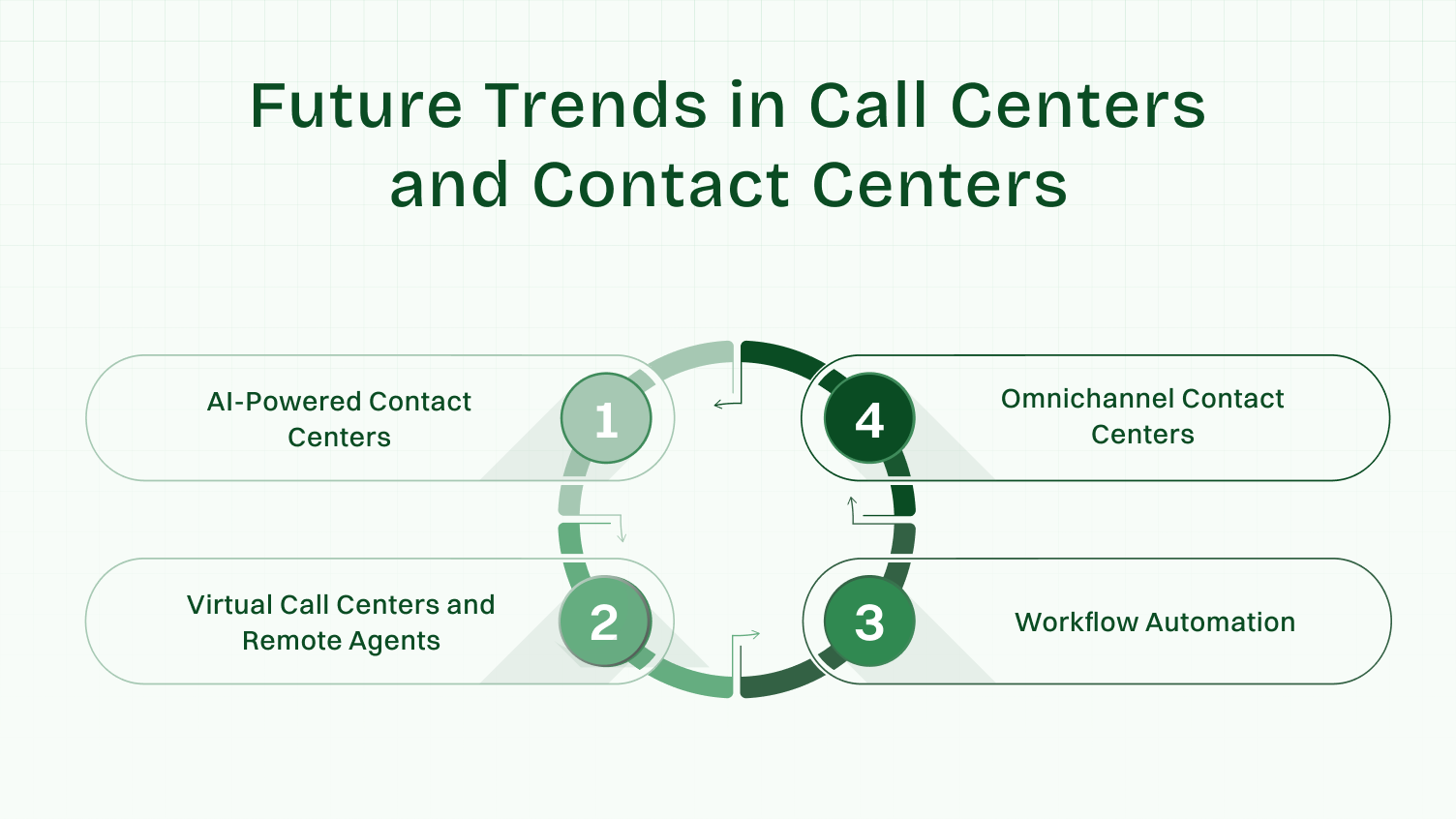
Customer communication is a rapidly evolving world. Companies that continue to use call centers in a traditional manner will be left behind very soon. Contact centers are changing with technology, and these changes are influencing the way companies do business with their customers.
AI is not a luxury anymore; it is an important element of the current contact centers. Generative artificial intelligence and chatbot analytics assist agents in knowing how a customer feels, anticipating customer needs, and proposing solutions in real time. This improves the customer interaction and speeds up the problem resolution.
Example:
Ecommerce contact center is an AI tool that processes customer messages on chat, email, and social media. Real-time recommendations are provided to agents and help to decrease response times and increase customer satisfaction scores.
Companies around the globe are using virtual call centers and remote agents more and more. This arrangement enables businesses to recruit talented employees anywhere in the globe, scale fast, and place time zone calls without the costly physical setup.
Example:
A software firm serves clients in the United Kingdom, in the US, and in Asia with remote agents who are linked through a contact center software that is based on cloud computing. Messages and calls are handled without any hassles at various places.
Manual processes such as call distribution, following up, and reporting are being minimized through automation. Artificial intelligence (AI agent) and workflow automation enable the agent to work on complex customer problems rather than on repetitive tasks.
Example:
Rather than manually directing the outgoing calls, an automated system directs the calls to the most appropriate agent, considering the matching skills, previous interaction, and availability. This reduces the waiting time and enhances efficiency.
Customers demand a one-piece experience in the channels. In modern contact centers, omnichannel communication is used, combining phone, chat, email, SMS, and social media channels. Information does not need to be repeated, and customers can easily change channels during the journey, resulting in a more seamless customer experience.
Example:
A retail customer receives an initial text message on a delayed order, then proceeds with the discussion on live chat, and then calls into the center to clarify. The agent can observe all the interactions and provide a uniform service experience.
As these trends inform the future, we can conclude by summing up the differences and guide you on what solution best fits your business.
These trends are beginning to take shape, and now is the time to choose which of these solutions best suits you, your customers, and your overall goals. Whether your business is more phone calls and basic questions, a basic call center is an efficient, economical solution.
When your customers require an approach that is multichannel (e.g., email, live chat, text, and social media), a modern contact center is the better choice. It provides integrated communication, customer experiences, and better customer relationships.
Consider these things in making your decision:
The alternative to investing in improved customer experiences, efficiency, and loyalty is to choose a contact center. The appropriate solution will assist your company to surpass all expectations in every channel and establish more enduring relationships.
Take the Customer Communication Next Leap today by choosing the solution that best fits your business and begin providing customer experiences that will matter to them.
The best practices include using modern software, training agents regularly, tracking KPIs, and adopting omnichannel tools.
A manager can improve communication by using call routing, IVR systems, CRM integration, and reducing wait times.
Multichannel communication is important because it lets customers connect by phone, chat, email, or social media, creating better engagement and satisfaction.
KPIs track satisfaction, resolution rates, and handling times, helping managers improve performance and customer service.
AI supports automation, smart call routing, conversational analytics, and improves overall customer experience.
